


I THOUGHT “CONFIDENTIAL” WAS THE MOST IMPORTANT WORD ON THIS PAGE.
IT WASN’T.
It was “VERIFY.”
A screenshot can tell Claude Code what an app looks like. It can’t tell Claude what happens when the input changes, which function gets called, or what values control the result.
That’s why the diagram doesn’t jump from ORIGINAL APP straight to BUILD.
REA inspects the behavior first.
Claude Code turns what it finds into a spec and builds an independent version. Then both versions get the same inputs.
If they disagree, you have a specific rule to investigate instead of another vague “make it closer” prompt.
I broke down every box on this page in the free 12-step guide I’m quoting below, including the prompts and verification process.
Read that before trying to rebuild your next app. ↓


I HAD ONE CHANCE TO PHOTOGRAPH THIS DOCUMENT.
I saw “CONFIDENTIAL” at the top and took the shot.
Only later did I notice what was actually on the page.
At the bottom are two ways to rebuild an app:
Screenshot → Guess → Retry
Inspect → Specify → Build → Compare
The second path connects Claude Code to REA.
Instead of guessing from the interface, it traces the original function, its callers, constants and state.
Claude builds from that evidence, then checks the result against the original.
The numbers printed on the page stopped me: 3,205 matching tests. 63 matching compiled bytes.
I couldn’t fit the full process into one photo, so I broke it down step by step in the free article below, including the workflow and prompts.
Read it if you want to understand what this page is showing. ↓

THE CRAZIEST THING I TOOK FROM AN AI CONFERENCE FITS ON THIS ONE PAGE.
Look at the two paths at the bottom of the photo.
Most app rebuilds follow the first one: screenshot → guess → retry. Claude Code can make the result look convincing, but nobody has checked whether it behaves like the original.
The second path starts before the code.
REA traces the function, callers, constants and state. Claude Code uses that evidence to write a spec, build independently and compare both versions on the same inputs.
In the public DX-Ball reconstruction, that meant 3,205 matching tests and 63 matching compiled bytes.
I drew this page to make the difference impossible to miss.
The full 12-step workflow and prompts are in the free article I’m quoting below. ↓

YOUR APP CLONE LOOKS IDENTICAL.
WHY DOES IT BREAK THE SECOND SOMEONE USES IT?
Old reverse engineering was mostly guessing: take screenshots, ask Claude Code to recreate what you see, then hope the hidden logic works the same way.
REA changes the starting point.
Claude Code can inspect the original function, trace what calls it, recover the values it depends on, and turn that evidence into a spec.
Then it builds the feature independently and tests its behavior against the original.
The difference is simple:
Screenshot → plausible clone
Evidence → testable reconstruction
In the public DX-Ball example, the reconstructed function matched 3,205 test cases. It also matched all 63 compiled bytes.
I put the full Claude Code + REA workflow in the article below,
from the first inspection to the final comparison. Read it before your next “recreate this app” prompt. ↓
CLAUDE CODE + REA CAN FIND OUT IF IT ACTUALLY WORKS THE SAME.
Claude runs the investigation. REA traces the function, its callers and the values inside the original app. The findings become a spec, then an independent build gets tested against the original.
In the public DX-Ball reconstruction, that process produced a function matching 3,205 original test cases and all 63 compiled bytes.
A screenshot clone is a demo. A tested reconstruction is a blueprint.
I put the full 12-step workflow, setup and prompts in the free article below. Save it and give Claude one feature to investigate first ↓
HOW DID 1,000 FREELANCE JOB POSTS TURN INTO $24,500 WITHOUT ME WRITING A SINGLE PROPOSAL?
I wasn’t looking for any freelance job I could win. I gave Grok one offer to look for: businesses losing leads between their landing page, booking form, and follow-up.
It rejected 969 listings. For the remaining 31, it checked the company’s site and drafted a short message about the specific gap it found.
I reviewed the messages and approved the ones worth sending.
Seven companies bought a $1,500 audit. Two of them then paid $7,000 each to implement the fixes.
$24,500 collected.
Finding the leads was only the first half.
Each reply had to become an approved scope, each scope had to reach Sol with the right context, and each finished build had to pass QA before delivery.
That handoff is where most “AI freelance automation” setups fall apart.
So how did I connect the whole thing without juggling 31 chats, lost briefs, and half-finished projects?
The full Grok + GPT-6.1 Sol workflow is in the article I’m quoting below.
Read it for the setup, prompts, handoff, and delivery system.

PromptSmiley 🟡 retweeted

A 20 YEAR OLD ENGINEER SENT HIS ANDROID OUT INTO A STORM TO TRIM THE FRONT LAWN AND THE WHOLE BLOCK STOPPED TO WATCH
an undergrad at an elite technical university reportedly built a humanoid in his spare time with a roommate’s help, for roughly $19,000
his goal was to learn whether hardware could handle household chores once the weather turns miserable
so he waited for the gloomiest morning of the month
drizzle thickened into a downpour, mist swallowed the street, soggy turf squished underfoot, leaves drifted down like confetti
then he rolled an ordinary red mower out of the garage
the android gripped the handle, yanked the cord and marched across the grass in perfectly parallel stripes, pivoting neatly at every edge
curtains twitched up and down the lane
by friday, three households had slipped notes under his door asking for a similar service
here’s the twist nobody expected
a person facing sleet, scorching heat or bitter frost slows down, gets cranky or risks an injury
a capable contraption treats every forecast as a normal workday
it never tires, never grumbles, skips coffee breaks and keeps its focus through endless repetition
the student is already sketching a second unit and dreaming of a landscaping business
so which chores will people still insist on doing themselves when skies darken?


FORGET MANUAL FREELANCING.
I BUILT A MACHINE WHERE GROK FINDS THE CLIENT AND GPT-6.1 SOL BUILDS THE FIX.
I still approve the price, scope, and final delivery. Everything between those decisions runs through one workflow.
It starts with a specific offer: find where a business loses leads between its landing page, booking form, and follow-up.
Grok reads public job requests, checks the company’s site, rejects poor fits, and drafts a proposal around the exact leak it found.
Not another “I’d love to work with you” message.
When a client replies, the conversation becomes a scoped brief in a shared ledger. Once I approve it, Sol builds the audit or implementation, tests the customer journey, fixes failures, and prepares the handoff.
The machine doesn’t need to invent a new service for every client. It gets better at delivering the same one.
The monthly target is 13 audits at $1,500 and 7 builds at $7,000. That’s a $68,500/month model built around one repeatable offer.
I put the complete setup in the article I’m quoting below: portfolio, client radar, prompts, agent handoff, QA, approvals, and payments.
Read the full guide if you want to build your own version.
COMPANIES ARE WRITING MY SALES PITCHES FOR ME.
THEY JUST DON’T KNOW IT YET.
They leave the clues everywhere: one-star reviews, job posts, help pages, and complaints about work their software still makes them do by hand.
My crawler collects those signals. Dots connect the complaints to real companies and keep the source links.
Astra finds the repeated problem and drafts a teardown around the smallest fix.
By the time I reach out, I’m not asking, “Do you need AI automation?”
I’m showing them the problem they described publicly, where it costs them money, and what I’d fix first.
The full crawler + Dots + Astra workflow is in the free article I’m quoting below.
Read it if you want to build your own version.
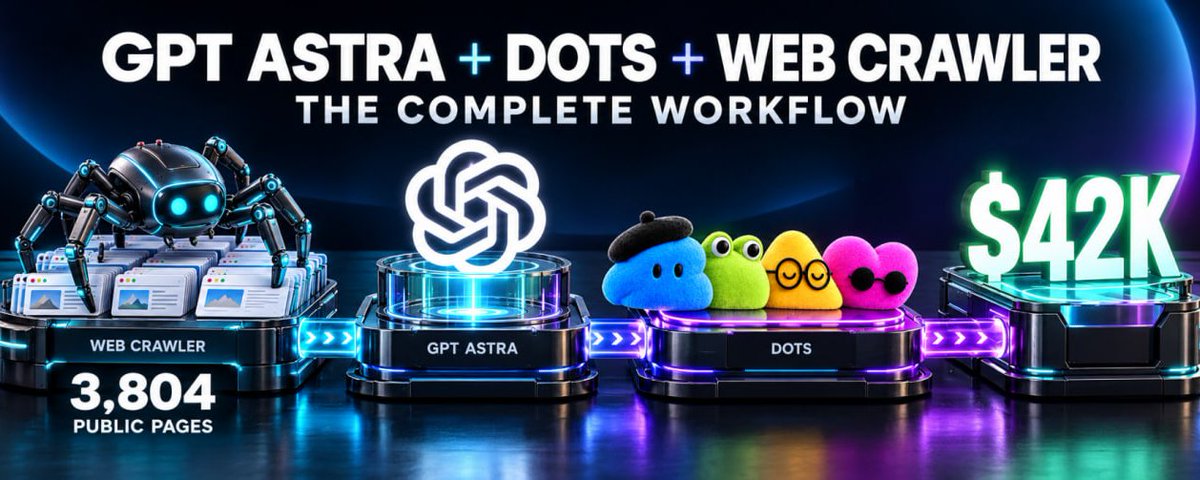
3 nights. 3,804 public pages. $42K collected over the next 2 weeks.
FULL FREE GUIDE ⬇⬇⬇
ULTRAFAST GPT-6.1 SOL + JEV SHOULD BE ILLEGAL.
THIS WORKFLOW MADE ME $47,000 OVERNIGHT.
TOMORROW I’M GIVING YOU THE WHOLE THING FOR FREE.
I used to make my best model read every page, sort every lead, and decide whether a problem was worth pursuing. Most of those decisions were just “skip.”
So I changed the order.
The crawler brings in public signals: complaints, job posts, help pages, and the manual work companies are already paying people to do.
Jev handles the fast decisions: skip, group, match, verify, escalate.
GPT-6.1 Sol only sees the cases where the evidence lines up. It finds the revenue leak and turns it into a specific offer. Before bed, I checked the sources and approved the teardowns.
Not every company said yes. Some ignored the offer. Others asked questions or pushed back on price.
By morning, paid audits and implementation deposits added up to $47,000 collected.
The difference wasn’t one genius prompt. It was giving each part of the system one job and making the handoffs fast.
The full GPT-6.1 Sol + Jev workflow drops tomorrow. Every agent, prompt, decision rule, and step.
Free.
You don’t have to wait to start. The guide I’m quoting below lets you rebuild the previous version of my workflow right now.
Build it today. Tomorrow I’ll show you what I changed to make it ultrafast.
Bookmark this post and follow so you don’t miss the upgrade.
3 nights. 3,804 public pages. $42K collected over the next 2 weeks.
FULL FREE GUIDE ⬇⬇⬇
MY CRAWLER READ 8,400 PAGES WHILE I SLEPT.
GPT-6.1 SOL SAW ONLY 37.
FOUR COMPANIES PAID $2K EACH.
I used to send every job post, one-star review, and help page straight to my best model. Most of its work was deciding that a page was irrelevant.
I had turned Sol into an expensive SKIP button.
So I put Dots in front of it. They handle the small decisions:
→ repeated complaint or one-off rant?
→ real company match or unrelated page?
→ does another public source confirm the problem?
→ send it to Sol or drop it?
8,400 pages became 37 evidence bundles.
Only then did Sol do the hard work: identify the revenue leak, compare the sources, and draft a teardown around the smallest fix.
I checked every URL before sending anything. Nine tailored teardowns went out. Four companies bought a $2K audit.
$8K collected.
Dots aren't smarter than Sol. Sol just shouldn't spend its time saying “no” 8,363 times.
Dots sort. Sol reasons. Code saves the evidence and moves the work.
I approve what leaves the system.
Watch the handoff at 0:18.
The full crawler + Dots workflow is in the article I'm quoting below. Bookmark this post and read the guide if you want to build the pipeline.
3 nights. 3,804 public pages. $42K collected over the next 2 weeks.
FULL FREE GUIDE ⬇⬇⬇
PromptSmiley 🟡 retweeted

This is a fictional mission-control dashboard for "Aurora Cell Lab", an imaginary research facility where a swarm of AI agents autonomously hunts for new battery chemistries. None of the data is real. Every number, log line and metric is synthetic telemetry generated by the animation itself.
The centerpiece is a hollow torus made of 6,000 bezier strands. It slowly rotates in 3D while a wave of light sweeps around the rim, and a tracking callout locks onto individual "candidates" as the agents evaluate them. Around it sit the panels you'd expect from a control room: a live discovery-load pulse, query and blocked-result streams, a compute split between two fictional agent engines, 32 sandbox pods flickering between states, a rolling commit queue, and before/after benchmark charts for things like dendrite rate and charge time.
Technically, it's a single HTML file with canvas and vanilla JS, no libraries. The animation is fully deterministic with a seeded RNG, so I could step through time exactly. I captured it frame by frame with Playwright and encoded it with ffmpeg: 25 seconds, 60 fps, 1080x1350.
I wanted to see how far a sci-fi terminal aesthetic could go while staying readable. Happy to share more details about the strand rendering or the layout if anyone's interested. Feedback welcome!
I THOUGHT FINDING CLIENTS WAS ABOUT WRITING BETTER COLD DMs
THEN I CONNECTED A WEB CRAWLER, DOTS AND GPT ASTRA.
→ the crawler reads job posts, reviews and help pages
→ Dots connects repeated complaints to specific companies
→ Astra finds the gap and drafts a tailored $2K audit offer
→ I check the sources before anything gets sent
The crawler alone just collects pages. Astra alone can write a convincing pitch.
The useful part is the handoff between them: a customer describes the problem, a company reveals it still exists, and the offer addresses that exact gap.
No random lead list. No “we can automate your business” message.
I broke down the full crawler + Dots + Astra workflow in the article below. Read it if you want to build the pipeline yourself.
3 nights. 3,804 public pages. $42K collected over the next 2 weeks.
FULL FREE GUIDE ⬇⬇⬇
WHAT IF YOUR NEXT CLIENT HAS ALREADY WRITTEN THE PROBLEM INTO A JOB POST?
I used to read hiring posts as a list of roles.
Now I read them as evidence of work a company is already paying to do.
A one-star review tells me what customers keep complaining about. A job post tells me the company needs people to handle something. A help page tells me what it promised customers would happen.
One of those pages means very little on its own.
But when all three describe the same broken step, I have something worth investigating.
In one run, my crawler scanned 3,804 pages and pulled out 47 recurring complaints. Dots connected the strongest patterns to 13 companies.
Astra drafted a teardown for each promising match, using the original pages rather than guessing what the business needed.
I still check the sources before anything goes out. If the review, job post and company don’t actually line up, I kill the lead.
If they do, the outreach is simple: here’s what customers are experiencing, here’s the manual work you’re hiring for, and here’s the smallest fix I’d start with.
That’s a very different conversation from “I can build you an AI agent.”
The company has already described the problem in public. My system connects the pieces before I write the offer.
I broke down the full crawler + Dots + Astra workflow in the article I’m quoting below, including how to build the agents and turn a verified signal into a teardown.
Read it if you want to run the process yourself.
3 nights. 3,804 public pages. $42K collected over the next 2 weeks.
FULL FREE GUIDE ⬇⬇⬇
THE BEST LEAD MY CRAWLER FOUND WASN’T A LEAD.
IT WAS A COMPANY DESCRIBING THE SAME BROKEN WORKFLOW IN THREE DIFFERENT PLACES.
Customers complained about it in one-star reviews.
The company was hiring someone to handle it manually.
Its help page promised a result its process couldn’t deliver.
Separately, those are just web pages. Together, they’re almost a sales brief.
The crawler saved the sources. Dots connected them to the same company. Astra drafted a teardown and the smallest fix worth offering.
I checked the evidence and sent that.
No “we can transform your business with AI” pitch. Just the problem they’d already admitted, what it was costing them, and a way to close the gap.
The full crawler + Dots + Astra setup is in the article below, including how the agents find, filter and turn these signals into an offer.
Read it before building another crawler that only scrapes headlines.
3 nights. 3,804 public pages. $42K collected over the next 2 weeks.
FULL FREE GUIDE ⬇⬇⬇
OKAY, MY CRAWLER FOUND A REFUND COMPLAINT IN ONE-STAR REVIEWS.
10 DAYS LATER, I’D COLLECTED $8K FROM THE COMPANY BEHIND IT.
Most crawlers just collect pages. Mine looks for problems a company is already paying people to handle manually.
The setup is simple:
Crawler reads. Dots connect the evidence. Astra drafts the teardown. I check the sources and send the offer.
Here’s what happened:
→ The crawler kept finding versions of the same complaint: “My return was approved. Where is my refund?”
→ Dots linked those reviews to a returns-coordinator job post and a help page promising updates, with no way for customers to track what happened after approval.
→ Astra turned the gap into a short, source-backed teardown. I verified it and sent it to the company.
They paid $2K for an audit.
Inside, agents were copying order IDs between the returns tool and support inbox. Approving a return didn’t trigger a customer update.
So we built the smallest fix: status updates automatically, the customer gets a message, and overdue cases land in a follow-up queue.
They paid another $6K for the build.
One repeated complaint. One company. $8K collected.
At 0:42 in the visual, you can see the build payment hit the counter.
The full crawler + Dots + Astra workflow is in the article I’m quoting below. Bookmark this, then read the guide if you want to build the pipeline yourself.
3 nights. 3,804 public pages. $42K collected over the next 2 weeks.
FULL FREE GUIDE ⬇⬇⬇
I MADE GPT ASTRA REJECT COMPANIES BEFORE IT WROTE A SINGLE OFFER.
That filter helped turn 3 nights of research into $42K collected.
A crawler read 3,804 public reviews, job posts, and company pages. Dots found 47 recurring complaints and matched them to 13 companies.
One company stood out. A customer had waited until the next day after requesting a quote. The company was hiring someone to coordinate inbound estimates. Its website still said, “We’ll get back to you.”
That was a signal, not proof of lost revenue. Astra built the teardown around what the sources actually showed.
I approved 9 personal teardowns. 7 companies paid $2K for an audit. 4 later paid $7K to build the first fix.
$14K in audits. $28K in builds. $42K collected over the following 2 weeks.
The crawler didn’t sell anything. The evidence trail made the offer worth reading.
I’ve laid out the full crawler + Dots + Astra workflow, including the instructions and how the audits became builds, in the article below.
3 nights. 3,804 public pages. $42K collected over the next 2 weeks.
FULL FREE GUIDE ⬇⬇⬇