

I went to bed with an outdated CV and woke up to 7 interviews on my calendar for next week. Grok Bot did the job hunt overnight.
If you've ever looked for a job, you know the worst part isn't the interviews. It's the grind before them. Scrolling hundreds of listings, rewriting the same CV for the tenth time, sending applications into the void and refreshing your inbox for days.
So I handed that whole grind to Grok Bot from 23:00 to almost 07:00. Here's what you're seeing in the video.
The pipeline at the top is a conveyor belt of real-looking job cards. Every role passes through three gates:
FIT ≥ 80%: does this job actually match me?
TAILOR CV: rewrite the CV for this exact role
SEND: only then does the application go out
Most cards never make it past the first gate. They fall off the belt with the reason in red: on-site only, under $90k, needs 10 years of experience, unpaid test task. That's the filter I never have the discipline to apply myself. At 1am I'd apply to anything.
The middle panel is my favorite. Grok Bot reads the job post, highlights what they actually care about (design system, experiments, analytics), then crosses out my lazy CV lines and rewrites them. "Designed screens for various projects" becomes "Shipped a design system used by 40+ engineers". The match score climbs from 57% to 92%.
By morning:
1,486 roles scanned
63 applications sent
19 replies
7 interviews booked
And the inbox panel shows it triaging replies on its own. Interview invites get booked straight into the calendar, rejections get archived, a salary question gets a drafted reply waiting for me to approve.
My honest opinion:
One thing matters more than anything here: the rewrites only make my real experience clearer. They don't invent it. If an AI starts adding skills you don't have, you'll get caught in the first interview. The value is in translating what you actually did into the language each company uses, and that's exactly where most CVs fail.
The second thing is that saying no is the real superpower. 63 applications out of almost 1,500 roles. It's not spamming, it's choosing. 7 interviews from 63 targeted applications is a way better ratio than 300 random ones.
And honestly, the emotional part is underrated. Job hunting is exhausting because of the rejection loop. Letting an agent take the boring, painful middle part means I show up to interviews with energy instead of burnout.
Comment "HIRED" and I'll DM you how I set up Grok Bot for a job hunt: the fit rules, how it tailors the CV without making stuff up, and how it handles the inbox
And tell me honestly: how many applications have you sent that you never heard back from? I stopped counting at 80


Grok Bot vs The Market. One round, 99 seconds, and I've watched this fight more times than I'd like to admit.
The whole run is built like an old arcade fighting game. On the left is a little white robot with a G on its chest. On the right is The Market, a giant red bear, level 99. Every trade is a move. When a trade hits, the robot lands a punch and The Market loses HP. When a trade goes wrong, the bear counters and the robot takes damage.
The move list at the bottom is honestly hilarious:
$FURY +$928
$HOOKR +$2,347
$SLAMR +$1,102, 2 hit combo
$KNOX +$3,218
$TITNZ +$4,085, the finisher
And the counters:
$JABZ -$684
$SMASH -$411
$UPCUT -$903
The super meter fills with every clean hit, and at the end it fires "SUPER: TO THE MOON", the bear goes flying off screen, and it's K.O. Market defeated.
$3,690 at the start, $16,713 at the end on paper. 4.53×. 7 hits, 3 taken, and 267 rugs blocked before they could even throw a punch.
My honest opinion:
The genius of this format is the HP bar. Most trading screens just show you money. Here you see your health. The robot finished with 67% HP. It took real hits, three of them, and still won because none of them were knockouts. That's exactly how it should feel. You're allowed to get punched. You're not allowed to get knocked out.
The 267 blocked rugs are the defense nobody shows in the replay. Before every fight there's a list of moves the robot simply refused to make. That's where most of the HP was saved.
But I'll be straight: look at the numbers next to the moves. 50x, 75x, 100x, 125x. The arena literally says high leverage, 18+. That's why the counters hurt so much. $UPCUT took almost a thousand dollars in one hit. In a real market, one counter at 125x can take the whole HP bar. I'd keep the blocking and play a much lower difficulty.
Comment "KO" and I'll DM you how the bot decides which moves to block and when it goes for the combo
And tell me honestly: in your own trading, how many rounds have you lost to The Market by K.O.? I've lost more than I've won, and the bear wasn't even level 99
Grok Bot turned a whole night of trading into a beehive, and I can't decide if it's the cutest or the most degen thing I've ever watched.
The screen is a giant honeycomb. Every cell is a coin. Little bees fly around the hive: Scout, Analyst, Sniper, Guard, Filter, and Grok in the middle as the queen making the calls. When a coin is good, the cell turns gold and fills with honey. When it's a scam, it turns into a red wasp cell and gets crossed out.
By the end of the night:
2,113 cells scanned
337 wasps blocked
9 sweet, 3 stung
$2,965 → $13,724 in the honey jar, 4.63× on paper
The colony log reads like a nature documentary with a crypto problem:
filter: wasp $WASP · mint live
filter: wasp $HORNT · LP 0%
filter: wasp $STING · honeypot
filter: wasp $GRIME · vol $1k
grok: ape $HIVEX
sniper: $HIVEX +$3,416
The best cells were $HIVEX +$3,417, $GOLDN +$2,689 and $ROYAL +$2,214. The stings were $QUEEN -$231, $jelly -$357 and $WAXX -$298.
My honest opinion:
The honey jar is a genius idea. It fills slowly, drop by drop, and when you get stung you watch the level dip a bit. It makes you feel how small the losses are compared to the wins. 9 sweet cells did all the work, and the 3 stings barely made a dent.
The red cells around the gold ones are the real story though. Look how much of the hive is red by morning. Most of the colony is wasps. The bot's real job wasn't finding honey, it was not getting stung by 337 wasps in a row.
Now the part I can't ignore. This is labeled "degen colony 18+" for a reason. Some of those cells say 75x and 125x. That's not trading, that's sticking your hand in the hive and hoping. The filter logic is legit and worth stealing. The leverage is pure chaos, and I'd never run it like that with real money.
Comment "HIVE" and I'll DM you how the bees split the work and the exact wasp rules the filter uses
And tell me which wasp name you'd fall for first. I'd be lying if I said $ROYAL wouldn't have gotten me


Somebody built a trading bot as an actual circuit board, and every trade turns into a Tetris block. I've watched it about ten times now.
Here's what's on screen. In the middle sits the Opus 5.5 chip. Six smaller chips are wired around it: Scout, Filter, Analyst, Claude, Sniper, Guard. When one of them is working, its trace lights up and you can see the signal travel through the board. Data comes in from the Solana RPC at the top, and money goes out to the wallet port at the bottom.
My favorite detail is the chip temperature. It sits at 40°C when the bot is idle and climbs to 60°C with the clock speed going up while it's thinking. It means nothing for the trading, and it's still exactly the kind of detail that makes you feel the machine is working.
Under the board there are three slot machine reels: token, score, verdict. Every coin gets a spin. $RUGZ, score 0.39, KILL. $APEX, score 0.93, PASS. Most spins land on KILL, and that's how it should be. By the end of the run that was over 1,850 spins and only a handful of passes.
Then comes the balance panel, which is literally Tetris. One block is worth $60. Every win drops new blocks onto the stack: $ZAP +$264, $KOVA +$412, $MAKO +$846. A loss like $ONYX -$121 knocks blocks off. By the end the stack is almost full.
$1,500 → $5,618 on paper, and every fill in the hexdump says the same thing: risk 2%.
My honest opinion:
The Tetris idea is smarter than it looks. A number like $5,618 means nothing to your brain. A tall stack of blocks does. And when a loss eats a couple of rows, you feel it, but you also see that the stack is still standing. That's how drawdowns should feel: visible, but not the end of the world.
What I respect about Opus 5.5 in this setup is the hexdump on the right. KILL, PASS, FILL, EXIT, one line per decision, each with a reason: top10 41%, honeypot, mint live, score 0.85. No vibes. If I want to know why it bought something, the answer is one line away.
And the 2% risk on every single fill is what keeps the stack from collapsing. It didn't size up after $MAKO, and it didn't get scared after $ONYX. Same block size every time. That's boring, and boring is what makes it work.
Comment "BOARD" and I'll DM you how the six chips are wired to the core and the exact kill rules behind the reels
And tell me honestly: if your trading history were a Tetris stack, would you be at the top of the screen or already game over? Mine would have lost to the first $ONYX


I plugged my phone into my laptop, gave Opus 5.5 control of it overnight, and the funniest part of the log isn't the trading. It's "water plants 08:00".
Let me explain what you're watching, because it's a bit wild.
Opus 5.5 is running the actual phone. Not an app, not an API. It looks at the screen, decides what to do, and taps it. Five agents split the work:
Opus plans every step
Reader takes a screenshot and figures out what's on screen
Tapper presses buttons through adb
Typer writes text
Checker verifies every single action before moving on
Look at the log on the left. Within a couple of minutes it:
replied to 3 unread threads, including "landing at 9:40, see you there"
moved my dentist appointment to Thursday 10:00
tagged 3 receipts in my notes
set a reminder to water the plants
cleaned my inbox, archived promos and flagged an invoice
booked a table for 2 on Friday, window seat
synced a grocery list: milk, eggs, coffee, rice, bread
And in between all of that, it kept switching back to a perp chart and scalping OPS/USDT. 7 trades in the session, a couple of small losses, Today's PnL showing just under $3,000 by the end. The last line of the log says "38/38 tasks · 7 trades · 0 errors · all tasks green · going quiet".
My honest opinion: the trading is the flashy part, but the part that impressed me is the Checker. After every single tap there's a line confirming it actually worked. "ok · reply · Anna". "ok · event saved". "ok · reminder set". It never assumes. That's the difference between an agent you can leave alone and one you have to babysit.
And the context switching is crazy. Dentist, chart, receipts, chart, groceries, chart. A human doing this would lose track after the third switch. It just carries the state and keeps going.
Now the honest warning, because I mean it. That trading panel uses leverage up to 50x, and that's dangerous in anyone's hands, AI or human. Even with a 2% size and a stop on every trade, one bad gap can hurt. If you ever try something like this, test it on paper first and keep leverage way lower than what you see here. The life admin side, though? I'd let it run every night.
Comment "PHONE" and I'll DM you how the five agents are set up, how Reader understands the screen and how Checker confirms every action
And tell me in the replies: what's the first boring phone task you'd hand off? Mine is the inbox, forever
The number at the end of this video is stupid, and that's exactly why I want to talk about everything except the number.
$80 at 23:30. $5,432 by 07:30. 67× on paper overnight.
If you saw that on your timeline without context you'd scroll past and assume it's fake. Honestly, fair. So let me show you what actually made this run interesting, because it wasn't the green line.
Opus 5.5 ran this night as a crew of 6 agents, and every one of them had a job that's mostly about saying no:
Scout found 13,906 new pairs
Filter killed 97% of them before anyone even looked twice
Analyst scored the survivors and threw out anything under 0.6
Sniper never put more than 8% of the stack into a single trade
Guard set a hard -6% stop and only trailed winners after +12%
Scribe wrote a reason for every single decision, nearly 14,000 notes by morning
My favorite panel isn't the balance. It's the Graveyard at the bottom.
Mint not revoked: 3,904
LP not locked: 3,511
Top 10 holders over 20%: 2,786
Dev wallet linked to past rugs: 991
That's thousands of coins that would have looked tempting at 3am to a tired human with a phone in bed. Every one of them is a mistake the crew didn't make. 13,512 killed, 44 traded. That ratio is the actual strategy.
And look at the losses. Worst trade of the whole night: -$19. The biggest win was over $1,000. When your losers are capped at 6% and you never size above 8%, a few big runners do all the heavy lifting and the bad trades barely show up on the chart.
My honest take on Opus 5.5 here:
What impresses me isn't speed. Bots have been fast for years. It's that the rules held for 8 hours straight. The filter at 07:27 is killing $JINX for the exact same reason it killed coins at midnight. No drift, no "this one looks different", no getting greedy after a 10× milestone. That consistency is the hardest thing to get from a human and, until recently, from an AI too.
The other thing I like is the Scribe. Every buy, every sell, every kill has a line with a reason. If something goes wrong you don't have to guess. You read the log.
Now the part I'll always say. This is paper trading, simulated results, not a promise of anything. Memecoins are the most brutal market there is, and one simulated night tells you about the rules, not about tomorrow. If you play with something like this, keep it on paper for a long time, and treat the graveyard as the real lesson.
Comment "CREW" and I'll DM you how the 6 agents hand off to each other, the exact filter rules from the graveyard, and the sizing logic
And tell me honestly: which graveyard reason has burned you the most in real life? Mine was "LP not locked", and I learned it the expensive way
paper trading, simulated results, not financial advice


I gave Grok Bot my lunch break. Two hours, $1,000, and one rule I refused to bend: 2% risk per trade, nothing more.
I expected a boring sprint. That was kind of the point.
Six agents ran the whole thing:
→ Scout flagged setups across Hyperliquid perps
→ Filter killed almost everything that didn't fit the rules
→ Analyst scored what survived
→ Executor sized every trade at exactly 2% risk
→ Risk kept stops fixed at -1R and trailed only winners
→ Logger wrote down the reason for every move
By 14:00 the sprint was done:
$1,000 → $2,384
29 trades, 21 wins, 8 losses
best trade +$212.60
worst trade -$39.60
profit factor 7.58
max drawdown -1.8%
stops moved: 0
human input: 0
The stat I care about most isn't the balance, it's the drawdown. -1.8% over the whole sprint. That's what a strict risk rule actually buys you: you can lose 8 trades and barely feel it.
My take: the bot isn't smarter than me. It's just more boring than me, and in trading boring wins. It doesn't chase PENGU because it's pumping, it doesn't hold a loser hoping it comes back, it doesn't get excited at +50%. It just follows the same rules on trade 29 that it followed on trade 1.
Simulated sprint, illustrative numbers. If you build anything like this, paper first, start tiny, and treat the risk rule like law.
Comment "SPRINT" and I'll DM you the full setup: the six agents, the 2% sizing logic and how the trailing works
Would you trust a bot with your lunch break, or would you be checking the chart every five minutes?


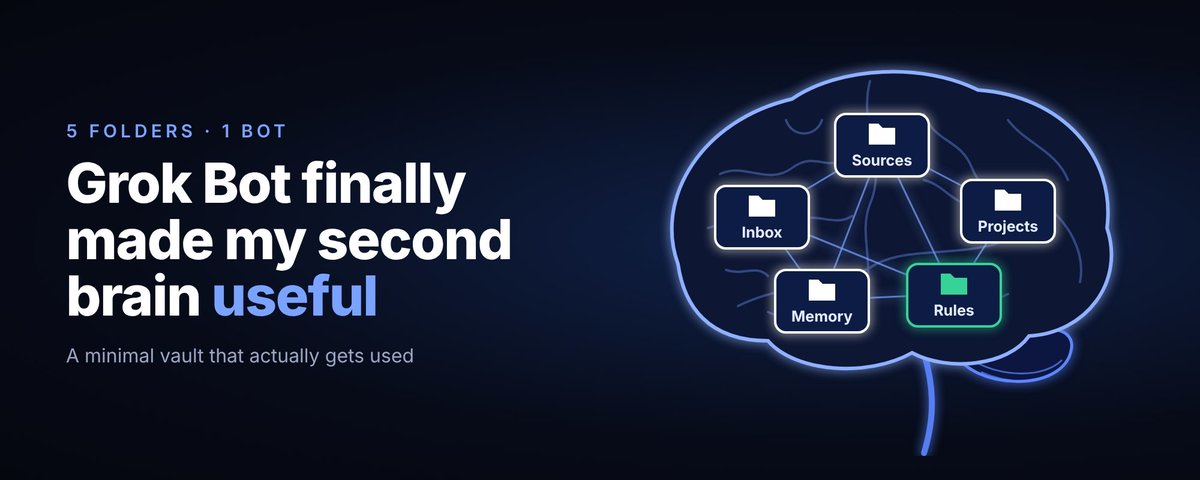
I've tried every second brain setup on the internet and honestly most of them died in my notes app within a week.
This article is the first one that made me rethink the whole idea
The problem was never collecting stuff. I'm amazing at collecting stuff. Bookmarks, voice notes, screenshots, half ideas typed on the go, links I swear I'll read later. My vault had over 3,000 notes and I used maybe 20 of them
A second brain that only stores things is just a very organized graveyard
What changed for me with Grok Bot is that the notes finally started doing something. It doesn't just sit on top of the vault and answer questions. It reads what's in there, connects things I wrote months apart, and turns them into actual output
The video is a good example. That's one of my old ideas sitting in my notes for almost a year: a small tool for tracking side project costs. I had the problem described, a couple of screenshots, a rough list of features, some angry notes about existing apps. Classic note graveyard material
I pointed Grok Bot at it and let it run. What you're watching is the build board: dependencies, design tokens, API routes, state, type check, bundle, container, deploy. Every tile is one piece of the job, the little robot jumps to whatever is being worked on right now, and the bars at the bottom show how far along it is. No magic, just a clear view of every step
A few things I genuinely liked:
it pulled context from notes I forgot existed, including a pricing idea from March that ended up being the best part
it asked me 2 questions instead of 20, and both were actually important
it showed every step on the board, so I always knew where it was and what broke
when the type check failed it fixed it and reran instead of pretending everything was fine
the result went back into my vault as a clean note, so the second brain got smarter instead of messier
My honest opinion: the second brain movement had it backwards. Everyone was optimizing how to save information. Tags, folders, links, templates. Nobody was asking what the notes are actually for. Notes are only worth something when they turn into decisions, drafts, products or plans. That's the missing piece, and AI agents are finally good enough to fill it
And I don't think this replaces thinking. It's the opposite. I still have the ideas, I still make the calls. Grok Bot just removes the part where good ideas die because I never had a free weekend to build them
If you have a vault full of things you never touched again, read this article. It's the first time the second brain thing felt practical to me and not just a productivity aesthetic
Comment "BRAIN" and I'll DM you how I connected Grok Bot to my notes, how I pick which ideas to build, and the build board setup from the video
And I'm curious: how many notes are sitting in your vault right now that you've never opened twice? Be honest, mine was 3,000+

I honestly didn't expect a 15 minute check to make me feel this stupid about my own phone.
Your camera roll is probably the least protected place on your iPhone, and you don't even think about it
I let Opus 5.5 go through mine last night and it found years of stuff I forgot I ever saved
Here's how it happened. I plugged my iPhone into my MacBook to make a regular backup, and while it ran I asked Opus 5.5 to do a quiet privacy sweep. No fancy setup, just the backup folder and the permissions list. What you see on the screen in the video is it going through photo after photo and sorting them into what's fine and what absolutely should not be sitting there
I expected maybe a couple of awkward selfies. That's not what came back
Here is what it actually flagged:
screenshots of banking apps with full balances and card details
photos of my passport and ID that I took once for some form and never deleted
screenshots of a recovery phrase I "temporarily" saved back in 2022
a photo of a whiteboard with a WiFi password and a door code on it
screenshots of private chats I thought I deleted months ago
receipts with my home address, full name and phone number
QR codes for things I don't even remember signing up for
All of that was just sitting in my main library, synced to the cloud, available to any app I ever gave full photo access to
And that's the second part that got me. Opus 5.5 pulled the list of apps that have Photos permission. I expected 5 or 6. It was way more than that. Editors I used once. A scanner app from years ago. Two random games. A food delivery app. Every single one of them had full access to my entire library, not just the photos I picked
Then there's Recently Deleted. When you delete a photo on iPhone it doesn't disappear, it sits there for 30 days. Half of what I "cleaned up" last month was still there, just one tap away from coming back
What I liked about doing this with Opus 5.5 is that it didn't just dump a giant list on me. It grouped everything by risk, explained why each thing mattered, and gave me a short order of what to fix first. It also didn't touch anything on its own. It showed me, I decided
Here's what I ended up doing in about 15 minutes:
moved every ID and document photo into a locked folder and deleted the rest
deleted the recovery phrase screenshot and moved the funds to a fresh wallet just in case
switched almost every app from full access to limited or none
emptied Recently Deleted for real
turned off the old apps that still had access to Photos, Contacts and Local Network
My honest take: we spend so much time worrying about hackers and passwords, and then we keep a photo of our passport next to 4,000 memes. The risk isn't some movie-style breach. It's the boring stuff we saved once and
The best moment in last night's run wasn't a green check. It was the build that stopped itself at step 4 of 8 and waited for me.
Six Opus 5.5 agents. One core. One night. And honestly, that pause is the reason I could sleep through it at all.
What you're watching is the whole team, drawn around the brain they share. The glowing sphere in the middle is Opus 5.5. The six icons around it are the roles it plays. Every time one of them lights up, a pulse flies into the core and the ring flashes its color. That's a handoff. Nothing moves without one.
Six agents, one job each:
→ scout reads the repo. 3,800 files scanned, 3 race conditions flagged before a single branch moved
→ reader reads the docs. 14 notes mapped, 2 breaking changes caught early
→ lead is Opus 5.5 itself. it turns all of that into a 9-step plan and asks zero questions back, because the scope was already written down
→ builder writes the code. plan, scaffold, write, refactor, then it reaches tests and holds for review instead of pushing through
→ gate checks everything. 40 checks, all green, but only after 3 fixes
→ ledger logs every run. 1,240 runs recorded, 0 lost
Most overnight setups are built to finish.
This one was built to stop at a line I gave it before bed.
What I love about watching it this way:
→ you can see who's working right now, not just what happened afterwards
→ every agent has its own lane of light into the core, so nothing sneaks around the plan
→ the cards at the bottom aren't decoration. each one is that agent's actual progress: the scan grid filling in, the checklist ticking, the 40 dots of the gate going green one by one
The mistake I made for months was thinking "zero prompts" was the flex. That I wanted an agent that never needs me.
It's not.
The agent you can leave alone isn't the one that never hits a wall. It's the one that brakes at the wall without waking you up, writes down why, and leaves the decision for the morning.
What I'd steal for your own setup:
1. write the scope on paper before you start. the lead plans better when it doesn't have to guess
2. give the gate the power to say no, and make it re-run after every fix
3. let the builder hold at a checkpoint instead of finishing at any cost
4. log every run. if the "lost" counter isn't zero, you don't have a system yet
My honest take: the smartest thing about this setup isn't the model. It's that the model is surrounded by roles that are allowed to stop it.
One core. Six roles. And a brake you can trust.
Save this before your next overnight run.