

Project FIND-EM is advancing the identification & repatriation of American POW/MIAs using dental chemistry. We are seeking donations of extracted wisdom teeth.
- Tweets43
- Following55
- Followers68
- Likes64


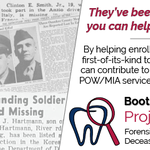





ALT Word cloud and journal cover


ALT In 1950, Wynn was reported missing in action while fighting with the Chinese People’s Volunteer Forces in North Korea. Despite being awarded the Silver Star, his remains could not be recovered and he was declared nonrecoverable in 1956. In 2018, North Korea turned over 55 boxes of remains, including Wynn's. Using various scientific methods, DPAA identified his remains, and he will be buried in Centralia, Illinois. Contact the Army Casualty Office for more information.

ALT The Ellis R. Kerley Research Award plaque is displayed at the Defense POW/MIA Accounting Agency's (DPAA) lab on Joint Base Pearl Harbor-Hickam, Hawaii, Mar. 9, 2020. The award annually recognizes one forensic anthropologist who best demonstrates excellence in pursuing developments in the field of forensic anthropology. (U.S. Air Force photo by Staff Sgt. James Thompson)

ALT Dr. Gregory E. Berg, lab case manager for the Defense POW/MIA Accounting Agency’s (DPAA) scientific analysis directorate, weighs a portion of a test specimen, in DPAA’s isotope lab, on Joint Base Pearl Harbor-Hickam, Hawaii, Mar. 9, 2020. Berg earned this year’s Ellis R. Kerley Research Award for his research in intraperson variation in isotopic values, which is directly linked with the establishment of the first Department of Defense ANAB-accredited isotope laboratory, housed in DPAA's facility. (U.S. Air Force photo by Staff Sgt. James Thompson)

ALT Dr. Gregory E. Berg, lab case manager for the Defense POW/MIA Accounting Agency’s (DPAA) scientific analysis directorate, weighs a portion of a test specimen in DPAA’s isotope lab on Joint Base Pearl Harbor-Hickam, Hawaii, Mar. 9, 2020. Berg earned this year’s Ellis R. Kerley Research Award for his research in intraperson variation in isotopic values, which is directly linked with the establishment of the first Department of Defense ANAB-accredited isotope laboratory housed in DPAA's facility. (U.S. Air Force photo by Staff Sgt. James Thompson)

ALT Defense POW/MIA Accounting Agency (DPAA) members participate in a disinterment ceremony at the National Memorial Cemetery of the Pacific, Honolulu, Hawaii, Jan. 9, 2023. The ceremony was part of DPAA’s efforts to disinter the remains of service members lost on the Enoura Maru, a Japanese cargo ship used by the Imperial Japanese Navy during World War II as a troop and prisoner of war transport ship. DPAA’s mission is to achieve the fullest possible accounting for missing and unaccounted-for U.S. personnel to their families and the nation. (U.S. Army photo by Staff Sgt. John Miller)

ALT The Enoura Maru was a cargo ship used by the Imperial Japanese Navy during #WWII for the transportation of troops and prisoners of war. These ships, known as "hell ships," were notorious for their overcrowded and unsanitary conditions, leading to numerous deaths on board. On January 9th, 1945, while docked at the port of Takao in #Taiwan and carrying Allied prisoners of war who had survived the sinking of another ship, the Ōryoku Maru, the #EnouraMaru, was attacked by Allied aircraft. The attack resulted in the deaths of approximately 400 prisoners of war on board. The raid severely damaged the ship, and it was later declared sunk after another attack on March 26th, 1945. However, it actually remained afloat at the #Takao dockside until the end of the war. DPAA’s mission is to achieve the fullest possible accounting for missing and unaccounted-for U.S. personnel to their families and the nation. | #NeverForget | #NeverForgotten | #OurPromise | #HellShips |

ALT U.S. Marine Sergeant Jack Rigsby, Defense POW/MIA Accounting Agency (DPAA) forensic photographer, renders a salute at a disinterment ceremony at the National Memorial Cemetery of the Pacific, Honolulu, Hawaii, Jan. 9, 2023. The ceremony was part of DPAA’s efforts to disinter the remains of service members lost on the Enoura Maru, a Japanese cargo ship used by the Imperial Japanese Navy during World War II as a troop and prisoner of war transport ship. DPAA’s mission is to achieve the fullest possible accounting for missing and unaccounted-for U.S. personnel to their families and the nation. (U.S. Army photo by Staff Sgt. John Miller)

ALT The Enoura Maru was a cargo ship used by the Imperial Japanese Navy during #WWII for the transportation of troops and prisoners of war. These ships, known as "hell ships," were notorious for their overcrowded and unsanitary conditions, leading to numerous deaths on board. On January 9th, 1945, while docked at the port of Takao in #Taiwan and carrying Allied prisoners of war who had survived the sinking of another ship, the Ōryoku Maru, the #EnouraMaru, was attacked by Allied aircraft. The attack resulted in the deaths of approximately 400 prisoners of war on board. The raid severely damaged the ship, and it was later declared sunk after another attack on March 26th, 1945. However, it actually remained afloat at the #Takao dockside until the end of the war. DPAA’s mission is to achieve the fullest possible accounting for missing and unaccounted-for U.S. personnel to their families and the nation.

ALT Why did you choose to pursue forensic stable isotope analysis? I first fell in love with applied science when I got my undergraduate degree (at Elon University), and stable isotope analysis lets scientists like me apply one technique to help answer many forensic questions: Did that elite athlete dope themself with testosterone? Is this jar of honey actually corn syrup? Currently, I’m focusing on applications for human identification: Where was that individual from? I enjoy developing uses of the technique, and I never get tired of talking about isotopes. Caption: Collagen extraction progress is checked for a sample of animal bone.

ALT What would you say is the most important part of your job? It sounds cliché, but teamwork is the most important part of my job. I'm lucky to work day-to-day with a talented group of preparation scientists and isotope analysts. My background is in biochemistry, and I've been grateful to learn from some of the world's best archaeologists, anthropologists, and odontologists how the chemical evidence provided by isotope testing can help them make an identification. The work wouldn't be possible without other folks in laboratory administration, evidence coordination, sample collection, and quality assurance. Caption: Collagen extracted from animal bone is weighed for quality control.

ALT What does this job mean to you? This is a "unicorn" job for me, meaning I'll likely never have another opportunity to apply forensic stable isotope analysis at this scale and make such an impact. My family has a military history; my paternal grandfather was a Marine, and my maternal grandmother served as a cryptographer for the Army Signal Corps. My great uncle Augustus (Gus) Hamilton's aircraft was shot down over France in 1944, and his dog tags weren't recovered until 1993. I'm proud to be a part of their legacy and serve the DPAA's mission using my (science) skills.