

Tweeting all things agriculture and climate change from the HQ of @Profitpk. Account usually managed by @babarenthusiast
Lahore
Joined June 2022
- Tweets484
- Following26
- Followers4.1K
- Likes374




Profit Agri Journo🚜 retweeted

How Rich is Abu Bakr from Dar e Nijat? We did be math
(Since I can't seem to shut up about the implications this character has on the changing nature of inequality in Pakistan)
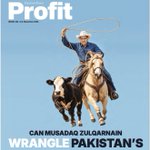
It is hard to imagine Musadaq Zulqarnain in the mould of a cowboy. But what he is attempting in Pakistan’s dairy sector is undeniably cowboy-esque:
A farm to table dairy business that sells and exports Interloop's own consumer retail brand of milk, cheese, and butter {THREAD}

“Our long-term ambition is to establish the Interloop Group as a significant player in Pakistan’s dairy industry, particularly in the value-added dairy products segment," says Musadaq Zulqarnain. Of course, there are already a number of established players on the retail market.
1
4
280
The Interloop Group's play is international. They want to introduce high end products to the Pakistani market, yes, but also products they can export.
For all the details, read on in this week's cover story at:
profit.pakistantoday.com.pk/…

Profit Agri Journo🚜 retweeted
If you want diverse reporting in a single publication, I suggest you pick up this week's edition of Profit.
You'll find matters of national importance like Abu Bakr's bank balance and more casual reporting on issues like agriculture, corporate Pakistan, and the economy.


Profit Agri Journo🚜 retweeted

Nearly one in four Pakistani households faces moderate or severe food insecurity, while consumption of staples and protein has fallen despite rising meat, milk and egg production. Pakistan is among the ten countries bearing the largest burden of the global food crisis, according to the international humanitarian organisation Action Against Hunger.
Read: profit.pakistantoday.com.pk/…

Profit Agri Journo🚜 retweeted
Sir Anwer Pervez is 91 years old. He is a billionaire. He is Chairman Emeritus of the Bestway Group, which owns the second-largest food wholesaler in the United Kingdom. And while the UK is where Sir Anwar Pervez lives and made his fortune, his legacy is seeping into every corner of corporate Pakistan.
Since the 1990s, the Bestway Group has been a big investor in Pakistan. They own the country’s largest commercial bank, United Bank Limited, and Bestway Cement has the largest production capacity in the cement industry. In February this year, the conglomerate acquired an automotive assembly plant at Port Qasim in Karachi, and announced last month they would be launching three new vehicles in partnership with Chinese car giant Geely.
The auto sector is perhaps the hottest new avenue for Pakistan’s domestic conglomerates. The Manshas (Hyundai, Jaecoo, Oomoda, and iCaur) and the Tabbas (KIA, Peugeot and GAC) have already entered the space and taken their place at the top of the leaderboard. Bestway’s entry means another one of Pakistan’s heftiest business groups has entered the space.
It also means he is leaving a legacy that has blossomed in Pakistan, and is far from done with the country. But as Sir Anwar Pervez enjoys his role as a senior statesman in his twilight years, where does his legacy stand?
profit.pakistantoday.com.pk/…

Profit Agri Journo🚜 retweeted
The federal government has, in principle, agreed to the cultivation of genetically modified corn in Pakistan. It is an approval that foreign seed companies have been lobbying to get for decades. But will Pakistan’s agriculture supply chain and society accept these seeds of doubt?
#GMO #GMOCorn #PakistanAgriculture #AgriCrisis #FoodPolicy #ProfitMagazine
Profit Agri Journo🚜 retweeted
Last week, the federal government agreed “in-principle” to allow the cultivation of Genetically Modified (GMO) Corn in Pakistan. It is the most direct acceptance of GMO foods in Pakistan to date, but it is far from without its detractors.
Perhaps the most concerned stakeholder will be Rafhan Maize. The company grinds more than 400,000 tonnes of corn a year, providing corn-based industrial products to industries ranging from textiles to pharmaceuticals. They also export maize products to a number of countries, which could be harmed if Pakistan is categorised as a GM corn country.
But the larger challenge will be public perception. GMO foods are often seen with suspicion, with many concerned about their potential health risks. While there is little scientific scholarship to back this, perceptions can be enough to cause an uproar. Caught in the centre of this are the multinational seed companies that have been lobbying for GM corn to be grown in Pakistan for decades. For the full story, read this week’s cover story at: profit.pakistantoday.com.pk/…

Profit Agri Journo🚜 retweeted
For at least two decades, a loose association of multinational seed companies has been lobbying the federal government to allow the cultivation of Genetically Modified (GM) corn in Pakistan. Last week, they achieved their clearest victory yet.
The government decided “in-principle” to adopt the cultivation of Genetically Modified Corn in Pakistan. But the GMO issue has always been a contentious one in Pakistan.
On the one hand, there is the issue of public perception: many people think GMO foods have negative health effects. While there is little scientific data to back this, the perception has been enough for GM foods to be banned or restricted in many parts of the world. And that is what brings us to the other problem. Pakistan produces nearly 10 million tons of corn, and a lot of that corn is taken by Rafhan Maize and turned into industrial and consumer products. Some of those products are exported, and if Pakistan becomes a producer of GM corn, it could end up affecting exports to countries that do not allow GM-produced corn.
The choice is delicate. On the one hand, GM corn can improve yields and make farmers more money. On the other, GM corn can cross-pollinate with the regular or hybrid varieties Pakistan already grows and exports. Any cross-contamination could be harmful to what is already a thriving industry. The question is, can this government find the right balance?
profit.pakistantoday.com.pk/…

Profit Agri Journo🚜 retweeted
The average Pakistani only eats 2.83 eggs a month. That is less than one egg every 10 days. In rural areas, it is even lower.
For an agricultural country, this is a monumental failure all of us should be ashamed of.

Pakistanis are eating less and they are eating worse because they can no longer afford as much food. Data from the Pakistan Bureau of Statistics (PBS) shows that over the past six years people across the urban and rural divide are consuming less food across all categories.
That means families are cutting back on the size of their rotis, the number of times meat is cooked in a month, how much milk is being given to their children, and even how many cups of tea they are drinking in a day.
The social indicators are staggering. The percentage of households categorised as “moderate to severely food insecure” in Pakistan has gone from 15.92 percent in 2019 to 24.35 percent in 2025. Severe food insecurity has also gone from 2.37% of households to 5.04% of households in the past six years. That means more than a quarter of Pakistani households face some form of hunger and malnutrition.
None of this is because we don’t have enough food. Pakistan grows its own wheat and rice. We are some of the largest producers of poultry, eggs, and milk and we even have a modest but growing meat export sector. The problem is affordability.
profit.pakistantoday.com.pk/…

Profit Agri Journo🚜 retweeted
Pakistanis are eating less and they are eating worse because they can no longer afford as much food. Data from the Pakistan Bureau of Statistics (PBS) shows that over the past six years people across the urban and rural divide are consuming less food across all categories.
That means families are cutting back on the size of their rotis, the number of times meat is cooked in a month, how much milk is being given to their children, and even how many cups of tea they are drinking in a day.
The social indicators are staggering. The percentage of households categorised as “moderate to severely food insecure” in Pakistan has gone from 15.92 percent in 2019 to 24.35 percent in 2025. Severe food insecurity has also gone from 2.37% of households to 5.04% of households in the past six years. That means more than a quarter of Pakistani households face some form of hunger and malnutrition.
None of this is because we don’t have enough food. Pakistan grows its own wheat and rice. We are some of the largest producers of poultry, eggs, and milk and we even have a modest but growing meat export sector. The problem is affordability.
profit.pakistantoday.com.pk/…