

economist and professor geeking out on biomedical technologies, FDA, conflicts of interest, med ethics, and government ethics
Univ of Southern California
Joined December 2018
- Tweets2.9K
- Following816
- Followers920
- Likes7.7K





Pinned Tweet
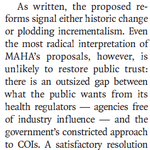
Patient and consumer reps on FDA advisory committees are supposed to represent the public, but do they?
In our new paper in @Health_Affairs Scholar (link in comments), we IDed the orgs that patient and consumer reps were actively involved with and tracked down pharma donors:

Genevieve Kanter, PhD retweeted

Kanter study finds 38% of FDA advisory committees 2013-22 had a patient or consumer representative tied to a pharma-funded advocacy organization
academic.oup.com/healthaffai…

Link to open-access article here:
academic.oup.com/healthaffai…
Genevieve Kanter, PhD retweeted

I think this is a hugely important point about the clinical trial prediction market concept.
However, my personal 2c: rather than depress trial enrollment, I think this could be misused to falsely drive trial enrollment (by driving up price to imply insiders believe drug works)

Prediction Markets in Clinical Trials and @FDA Drug Approval via @ProfGenKanter
jamanetwork.com/journals/jam…

Genevieve Kanter, PhD retweeted

Prediction Markets in Clinical Trials and @FDA Drug Approval via @ProfGenKanter
jamanetwork.com/journals/jam…
Betting markets for drug approvals and clinical trials are here. But what exactly are these markets and how do they work? Why would we want them? What can go wrong?
In my commentary in JAMA Health Forum, I answer these questions and provide an explainer
jamanetwork.com/journals/jam…

Genevieve Kanter, PhD retweeted

@Health_Affairs Scholar provides a high-quality outlet for your research: speed, reach, and relevance!

In which Big Brained economist and cancer patient Chalres Manski identifies* the distorting incentives in cancer care and drug development... I love stories that combine economics, economists, and health policy
*yeah, a bit of inside-baseball there
kffhealthnews.org/health-ind…

Genevieve Kanter, PhD retweeted

Every college syllabus should include these graphs.
Use AI for homework, you will get it done faster and get a higher grade, and then get crushed on the exam.

Genevieve Kanter, PhD retweeted

A prolonged vacancy atop the FDA could mean delayed work on new treatments until there's greater policy clarity, USC Schaeffer's @ProfGenKanter tells @PharmaVoice.
pharmavoice.com/news/why-the…

Genevieve Kanter, PhD retweeted

Long Post: What’s going on with these so-called Complete Response Letters (CRLs)?
There’s long been strong public and investor interest in CRLs, the letters the FDA issues to companies explaining exactly why a drug application (deficiencies in safety, efficacy, manufacturing, ...).
FDA launched a major “radical transparency” push in 2025 under then-Commissioner Marty Makary. In July 2025 the agency released more than 200 CRLs, mostly for previously approved applications. In September 2025 it announced real-time or prompt public release of newly issued CRLs (including for pending or withdrawn or unapproved applications) and released another batch of 89. Some real-time style releases followed before the later pause.
Industry pushback followed, including a citizen petition filed on April 20, 2026 (by Covington & Burling on behalf of an unnamed pharmaceutical company). The petition raised concerns about process, redactions, and legal authority for disclosing CRLs tied to unapproved applications.
FDA reportedly paused new real-time releases around April 2026. An HHS spokesperson later confirmed the temporary pause while the agency evaluates next steps.
The agency is now moving to formalize and expand the policy through rulemaking under RIN 0910-AJ16 (“Proactive Disclosure of Complete Response Letters”).
On the roughly 9–18 month timeframe: This is a realistic ballpark based on how federal rulemaking usually works. From an NPRM (expected October 2026) you typically get a public comment period (often 30–60 days), agency review of comments, internal clearances (including OIRA review for significant rules), and final publication. Many rules take 6–12+ months from proposal to final rule, and complex or contested ones can stretch longer, sometimes well over a year. That’s standard across agencies and described in guides such as the Federal Register’s overview of the rulemaking process.
Key links:
Proposed rule (Unified Agenda): reginfo.gov/public/do/eAgend…
Citizen petition (April 20, 2026): regulations.gov/document/FDA…
openFDA CRL database: open.fda.gov/apis/transparen…
This is what I have gathered so far from public sources and reporting. It is not an exhaustive deep dive. Things can move or change once the NPRM is published in October.
Genevieve Kanter, PhD retweeted

RIP Ned Phelps
Ned Phelps followed his own intellectual journey.
When Keynesians relied on a long-run tradeoff between unemployment and inflation, he showed why this was a weak reed to stand on. Thus was born the natural rate hypothesis (although the coining of the word goes to Friedman, a year after Ned’s paper).
When, later, New Keynesians were focusing on nominal rigidities, he built models of fluctuations where nominal rigidities played no role. When New Classicals were exploring the cyclical implications of competitive markets, he focused on the role of distortions in goods and labor markets, be it efficiency wages, or variable markups.
It would be fair to say that, today, the frontier macro models embody the natural rate hypothesis, and many of the distortions Ned focus on---and, what he did not like, i.e. nominal rigidities.
His style was highly idiosyncratic. He was often a poor expositor of his fundamental insights. He did not listen much to others, pursuing his agenda with focus and passion. But, to use an overused but appropriate expression, he was certainly one of the giants in the field. We often met and sometimes fought, be it on hysteresis or nominal rigidities, but I had infinite respect for him.
Genevieve Kanter, PhD retweeted

SCOOP: FDA Commissioner Marty Makary is resigning from the agency.
Kyle Diamantas, who previously worked as the top food official at the agency, will lead the FDA in an acting capacity.
w/ @Gardner_LM: subscriber.politicopro.com/a…

Genevieve Kanter, PhD retweeted

📰 𝗔 𝘄𝗼𝗿𝘁𝗵𝘄𝗵𝗶𝗹𝗲 𝗿𝗲𝗮𝗱 𝘁𝗵𝗶𝘀 𝘄𝗲𝗲𝗸𝗲𝗻𝗱.
A worthwhile read this weekend, and one I wanted to share with my network.
Medscape — "The Unprecedented Rise of Scientists Fact-Checking the Feds."
A few points from the article worth pausing on:
— Public trust in the CDC, FDA and NIH has fallen in double digits since 2024
— Yet 𝘁𝗵𝗿𝗲𝗲 𝗶𝗻 𝗳𝗼𝘂𝗿 𝗨𝗦 𝗮𝗱𝘂𝗹𝘁𝘀 𝘀𝘁𝗶𝗹𝗹 𝘁𝗿𝘂𝘀𝘁 𝘀𝗰𝗶𝗲𝗻𝘁𝗶𝘀𝘁𝘀 𝘁𝗼 𝗮𝗰𝘁 𝗶𝗻 𝘁𝗵𝗲 𝗽𝘂𝗯𝗹𝗶𝗰 𝗶𝗻𝘁𝗲𝗿𝗲𝘀𝘁 (Pew, January 2026)
— In February, the American Academy of Pediatrics issued its own immunisation schedule, departing from recent CDC changes
— Independent research committees are being formed to protect the integrity of scientific work
Read the Article: medscape.com/viewarticle/unp…
🎙 The article covers a topic I was widely quoted on earlier in the year and discussed in 𝗧𝗵𝗲 𝗟𝗮𝗻𝗰𝗲𝘁 𝗢𝗯𝘀𝘁𝗲𝘁𝗿𝗶𝗰𝘀, 𝗚𝘆𝗻𝗮𝗲𝗰𝗼𝗹𝗼𝗴𝘆 & 𝗪𝗼𝗺𝗲𝗻'𝘀 𝗛𝗲𝗮𝗹𝘁𝗵 podcast: "𝗽𝗮𝗿𝗮𝗰𝗲𝘁𝗮𝗺𝗼𝗹 𝘂𝘀𝗲 𝗱𝘂𝗿𝗶𝗻𝗴 𝗽𝗿𝗲𝗴𝗻𝗮𝗻𝗰𝘆".
🎧 Listen on Apple: apple.co/4sY7WTh
🎧 Listen on Spotify: bit.ly/4brIwru
#EvidenceBasedMedicine #ClinicalResearch #ScienceCommunication #Healthcare #WomensHealth #Pregnancy #PublicHealth #PerinatalHealth @TheLancet @MedscapeObGyn @Medscape
The Lancet Obstetrics, Gynaecology, & Women’s Health Medscape
🤖 Made with AI

Genevieve Kanter, PhD retweeted

A widely used knee surgery may not just be ineffective — it may cause harm.
10-year results from the FIDELITY trial, now in @NEJM.
🧵 – at Helsinki, Finland
Genevieve Kanter, PhD retweeted

The Trump administration has downsized US science by historic margins — but it's not just via grant or workforce cuts.
Our new @nature analysis reveals the government has cut more than 100 scientific advisory panels across all major science agencies.


Genevieve Kanter, PhD retweeted
If Trump's proposed $6B cut to NIH were enacted in FY27, the NIH estimates that the number of new research grants would drop **47%**
officeofbudget.od.nih.gov/pd…

Genevieve Kanter, PhD retweeted

Interesting to take part in today’s panel debate with @NIH Director, Dr Jay Bhattacharya @DrJBhattacharya , at a USC event hosted by Dean Carolyn Meltzer and Dr Neeraj Sood (USC School of Public Policy). Some takeaways:
💡The NIH budget will likely remain flat next year, but an increase in “forward funding” (now 37% of grants, up from 20%) will likely mean fewer grants awarded. Forward funding is intended to allow projects to spend much more in their first year than if the budget was constant in all years, and some investigators, e.g. a junior researcher, may need initially larger funding to set up their lab.
💡If a clinical trial is fully funded at the start, it avoids having nothing to show if each continuation year depends on annual funding appropriations (which are unstable). Forward-funding leads to a temporary very large drop in numbers of grants awarded but “at equilibrium” the same number of grants will be awarded.
💡Calls to increase the 500k/year budget for R01s (the standard type of NIH grant) have to be carefully balanced with the recognition that raising this would lead to fewer grants overall.
💡There is very high priority on reproducibility of research, as not prioritizing this has led to loss of public trust in science. Consortia can address this. Some audience members (incl Rob McConnell) noted it might make sense to expand reproducibility to include experimental work where multiple lines of converging evidence point to a conclusion, from multiple different approaches, rather than just repeating the experiment. But this can be expensive.
💡Paylines (where the top x% of grants are funded, and x is known) are being replaced by a system where NIH institute directors and POs have more discretion. This is because the top-N by score may not be necessarily more impactful than the best selection of grants that collectively as a portfolio could make the greatest impact. If there is redundancy, this can be traded off by funding a lower-scoring grant with higher risk/higher impact.
💡Foreign components on grants are welcome, but must use the new PF5 format with higher expectations of auditing and reporting for the foreign site, including making primary research records available to the funder via the prime site. Foreign subawards are no longer being used as they involve less oversight which can lead to loss of public trust.
💡Panelists noted the need to speed up reviews and the time-to-funding, which has greatly increased. Dr Bhattacharya noted that some ideas take time to incubate in the community before they can be reliably funded, whereas others (perhaps AI, clinical trials) can lose impact if delayed or review is too slow.
💡There is a proposal being entertained that K awards (for junior faculty) be given as an allocation to the institution to give out to people they vet, rather than directly awarded.
💡NIH wants to “spread out” funding to more institutions, across more of the country, to reduce the concentration of funding at some institutions.
💡Innovation is sometimes killed by reviewers who put too much emphasis on the certainty of the approach working. Often Aims 2 and 3 of a project depend on a high-risk, high-payoff Aim 1 working. Forward funding of 2-3 years can allow a checkpoint to be included on a high-risk Aim, before more funding.
💡Thank you to @KECKSchool_USC for hosting the event, and to Neeraj Sood for his "Open Dialogues" project.
