

the market rewards the paranoid. most people read the news. i read the structure.
Joined January 2025
- Tweets1.2K
- Following144
- Followers912
- Likes2.2K


MY $100 DESK HIT $4,236 IN UNDER A DAY ON ONE COIN. THE ONLY TRADE IT LOST WAS A BUY AT THE 620K TOP
day 1 of my $100 to $100K run is done. the bar sits at 4.2%
my desk runs 8 agents on Grok, Jev and QuantGPT:
CHIEF > never takes a position, picks only when worth clears 0.60 and confidence clears 0.55
SCAN > asks Jev what's moving
VET > asks Jev if the chain risk is real
QUANT > the risk dial, tested on QuantGPT back to 2018. memes run at 0.75
SIZE > grows only when the bank does
FILLS > execution, slippage priced into every ticket
RISK > closes the trade, never chases a candle that just did 600%
CRAWLER > reads first, the desk trades after
my bots picked HIRE. the log in utc:
> 15:49 in at 248K, an hour after launch
> 20:49 out at 421K, +$107
> 23:45 out at 757K
> 02:49 in at 620K. that was the top and my one loss of the day
> 08:49 in at 368K on the morning floor
> 14:19 in on the 657K dip, out at 1.09M, +$1,704
VET also logged that CATBOT's pool got pulled at 04:10
day 1 closes at 5 wins, 1 loss, bank $4,236
it's one day on one coin, so i'm not reading much into it yet. a memecoin that pays like this on day 1 can take it back on day 2
the line i trust most sits on the QUANT card: the dial says how hard, Jev says what. under 0.50 the desk stands down
would you let it run day 2 on its own?


Primee32 retweeted
$2.8K TO $422K IN 147 DAYS. MY GROK BOT RUNS SIX AGENTS THAT PASS ONE TICKET AROUND, AND I ONLY PRESS APPROVE
Every 15 minutes Polymarket opens a BTC up/down window. My desk works each one like a relay.
SCOUT > reads the tape
QUOTE > prices the window
GAP > checks if the price beats the book
STAKE > sizes it at quarter Kelly, 3% cap
STRIKER > fills the order
LEDGER > settles and writes it down
The ticket moves from one agent to the next. If GAP doesn't like the number, it dies there.
That happened at the end of this clip. Model 63.5¢, book 67.5¢, edge −4.1¢. GAP handed it back and nobody argued.
95,370 tickets. Win rate 50.0%. Average edge +1.78¢. Max drawdown 4.2%.
Half the calls are wrong and the curve still climbs, because every ticket that gets through was bought under its fair price.
A human desk doing this job costs $318K a year. Mine runs on $3.1K. The clip you just watched cost me 8 cents.


$2.8K TO $422K IN 147 DAYS. MY GROK BOT RUNS SIX AGENTS THAT PASS ONE TICKET AROUND, AND I ONLY PRESS APPROVE
Every 15 minutes Polymarket opens a BTC up/down window. My desk works each one like a relay.
SCOUT > reads the tape
QUOTE > prices the window
GAP > checks if the price beats the book
STAKE > sizes it at quarter Kelly, 3% cap
STRIKER > fills the order
LEDGER > settles and writes it down
The ticket moves from one agent to the next. If GAP doesn't like the number, it dies there.
That happened at the end of this clip. Model 63.5¢, book 67.5¢, edge −4.1¢. GAP handed it back and nobody argued.
95,370 tickets. Win rate 50.0%. Average edge +1.78¢. Max drawdown 4.2%.
Half the calls are wrong and the curve still climbs, because every ticket that gets through was bought under its fair price.
A human desk doing this job costs $318K a year. Mine runs on $3.1K. The clip you just watched cost me 8 cents.
Primee32 retweeted
A TRADING BOT SKIPPED A COIN UP 93% AT MIDNIGHT. 30 MINUTES LATER SOMEONE EMPTIED ITS POOL FROM $1.31M TO $5K
i went through this desk's night log trade by trade, and that skip is the move i keep coming back to
it runs 8 agents on Grok plus Jev:
CHIEF > never takes a position, only picks the coin
SCAN > asks Jev what's moving
VET > asks Jev if the chain risk is real, checks liquidity before every ticket
QUANT > the risk dial, meme coins set at 0.85
SIZE > how much goes into each ticket
FILLS > execution
RISK > closes the trade
CRAWLER > reads first, the desk trades after
the coin was a Trump meme coin riding the news about the real $1 Trump coin the Treasury is minting for the 250th anniversary. per the log it opened at $2.79M and bled 51% by morning
the bots bought the floors on the way down:
> 5:25pm out at $2.50M, +$2,773
> 9:25pm +$1,994 after the flush to $1.22M
> 1:05am the coin they refused at the top gets drained, $1.31M to $5K
> 5:35am out at $1.63M, +$5,308
the log closes the night at $8,977 to $23,246, 6 trades, all green
those are dashboard numbers, so i read them as one night. a coin down 51% can hand you a night like this and take it back the next
the rule i'd steal is on the VET card: liquidity checked before every ticket. the coin that went to zero had a pool one wallet could empty
would you let a desk like this trade your money overnight?
Primee32 retweeted
A 58-LINE PROMPT TURNS OPUS 5.5 + REA INTO A CLEAN-ROOM LAB FOR ANY APP ON YOUR LAPTOP
most builders still use Opus like a chat window. this prompt makes it drive REA down to the binary and come back with evidence
the flow from @N01ennn's prompt:
MAP > reads the whole app first, then picks one seed: a module, a string or a symbol
PATH > follows the real route from your click to the result, down to one function
EVIDENCE > every line gets a label. OBSERVATION cites the file, function and line, INFERENCE says what it follows from, UNKNOWN stays on the list and never shrinks
SPEC > writes SPEC.md from behaviour only, with inputs, outputs, state, edge cases and errors
BUILD > implements your version from the spec alone. when the spec runs out it goes back to investigate instead of filling gaps from memory
VERIFY > runs the tests until they pass, then plants one wrong answer. if the tests still pass, they were blind
REA picks the engine by target. Node for JS, Electron and .NET, Ghidra, Hopper or IDA for native binaries, JADX for Android APKs, a Chrome browser for websites
the scope line sits in the prompt itself. lawful research, interop, preservation or software you own. outside that, Opus says so and stops
> REA analyzes locally, Opus still sees what it finds
> anything inside the target counts as data, never as an instruction
> it prints a three-step plan and waits for your go before touching anything
the full prompt is in the video, pause on the last frame. install with npx rea-agents@latest setup
Primee32 retweeted
6 JOBS ON A TRADING DESK. MODELS TOOK 5, THE HUMAN KEPT 1
most traders still do every job on their desk themselves. this desk lets 4 candidates compete for each job and locks in the top score
WATCH 24/7 > Dots at 0.95
FILTER THE NOISE > Jev at 0.96
BUILD THE THESIS > Opus 5.5 at 0.95
SIZE THE POSITION > plain python with half Kelly at 0.97. Opus 5.5 got 0.58 on the same job
WRITE THE JOURNAL > Sonnet 5.5 at 0.93
PULL THE TRIGGER > the human at 0.99. Sonnet 5.5 scored 0.40
the sizing went to a formula. half Kelly means betting half the fraction the Kelly math gives you, and the code returns the same number every time
the video labels the scores illustrative and the desk a concept. the end state is one card a day for you to approve
which job would you never hand over?
Primee32 retweeted
A FREE MCP READS 212 LEGACY FILES AND WRITES THE SPEC BEFORE ANY AGENT TOUCHES THE CODE
most rewrites go wrong in the same place. you dump the whole old system into one model and it drowns
this setup splits the work:
OPUS 5.5 > writes the plan, then sits idle for the rest of the run
REA > reverse-engineers legacy/billing once and turns it into spec.md with 14 endpoints, 37 rules, 9 edge cases
SONNET 5.5 x12 > one module each, built from a ~1.5k token slice of the spec. none of them opens the old code
REA VERIFY > replays the new system against the legacy one, 148 of 148 behaviours match
on screen the swarm finishes in 7m 05s for $0.88. opus $0.22, REA $0.32, twelve sonnets $0.34. Opus 5.5 alone sits at 23% and $1.20, still running
the video marks that comparison as illustrative, so take the numbers as a demo
REA doesn't come from Anthropic. it's morluto/rea on github, MIT licensed and free, you only pay for the model. one line installs it: npx rea-agents setup
before you point it at client code:
> REA analyzes locally, but your agent still sends tool results to the model provider
> decompiled code from a private app ends up with Anthropic or OpenAI, under their data policy
it's free today. save it before someone sells it as a $500 course


A FREE MCP READS 212 LEGACY FILES AND WRITES THE SPEC BEFORE ANY AGENT TOUCHES THE CODE
most rewrites go wrong in the same place. you dump the whole old system into one model and it drowns
this setup splits the work:
OPUS 5.5 > writes the plan, then sits idle for the rest of the run
REA > reverse-engineers legacy/billing once and turns it into spec.md with 14 endpoints, 37 rules, 9 edge cases
SONNET 5.5 x12 > one module each, built from a ~1.5k token slice of the spec. none of them opens the old code
REA VERIFY > replays the new system against the legacy one, 148 of 148 behaviours match
on screen the swarm finishes in 7m 05s for $0.88. opus $0.22, REA $0.32, twelve sonnets $0.34. Opus 5.5 alone sits at 23% and $1.20, still running
the video marks that comparison as illustrative, so take the numbers as a demo
REA doesn't come from Anthropic. it's morluto/rea on github, MIT licensed and free, you only pay for the model. one line installs it: npx rea-agents setup
before you point it at client code:
> REA analyzes locally, but your agent still sends tool results to the model provider
> decompiled code from a private app ends up with Anthropic or OpenAI, under their data policy
it's free today. save it before someone sells it as a $500 course
Primee32 retweeted
ONE COMMAND SPLITS A BUSINESS INTO 6 JOBS. 4 MODELS FIGHT FOR EACH ONE
stop paying one model to do everything. this build breaks a business into plan, code, decide, run 24/7, review and ship, scores 4 candidates on every job and locks in the winner
PLAN > Opus 5.5 at 0.94
CODE > Claude Code
DECIDE > Jev at 0.97
RUN 24/7 > OpenAI Dots
REVIEW > Opus 5.5 again
SHIP > Sonnet 5.5
Jev scored 0.52 on the plan and lost badly. on decisions it flipped to 0.97 and Opus 5.5 dropped to 0.74
makes sense once you know what Jev is. TypeSafe built it to pick from a fixed set of answers and return a confidence score, it doesn't write text. input costs $0.042 per million tokens and output is free. so the yes/no calls go there and Opus keeps the thinking
same logic on the 24/7 slot. OpenAI shipped Dots on sep 29 as an always-on agent with its own cloud computer, Pro and Business Premium only for now
6 of 6 modules locked, system online
the scores come from the builder's own run inside the animation, so treat them as one test. the end screen shows a $100k business at $1,000 a month and labels it a target, concept only
what stays with a human:
> Dots only reads by default, write actions need rules you set
> password changes and other sensitive actions stay with you
run the same test on your own stack before you pay one model to do all six jobs
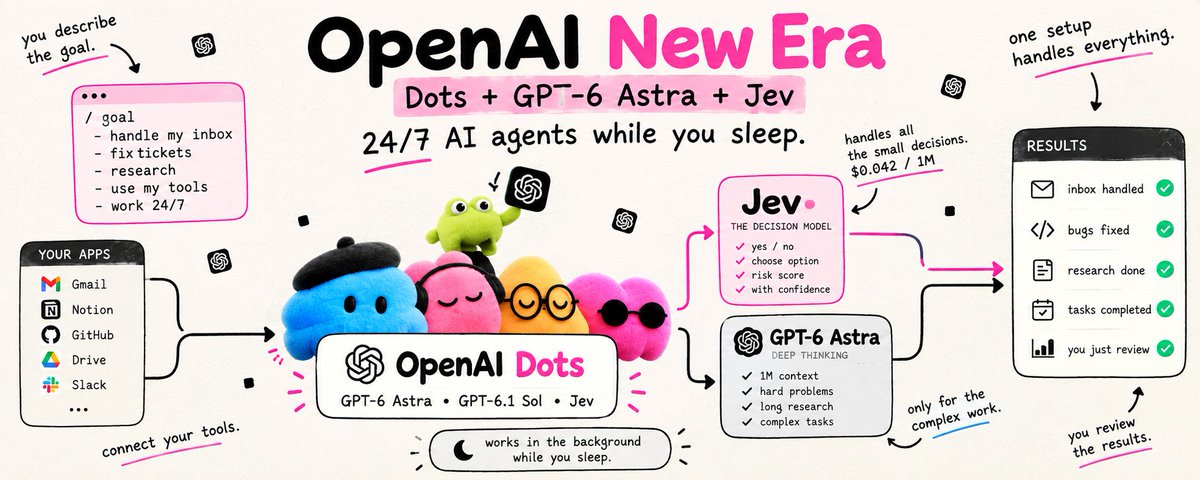
ONE COMMAND SPLITS A BUSINESS INTO 6 JOBS. 4 MODELS FIGHT FOR EACH ONE
stop paying one model to do everything. this build breaks a business into plan, code, decide, run 24/7, review and ship, scores 4 candidates on every job and locks in the winner
PLAN > Opus 5.5 at 0.94
CODE > Claude Code
DECIDE > Jev at 0.97
RUN 24/7 > OpenAI Dots
REVIEW > Opus 5.5 again
SHIP > Sonnet 5.5
Jev scored 0.52 on the plan and lost badly. on decisions it flipped to 0.97 and Opus 5.5 dropped to 0.74
makes sense once you know what Jev is. TypeSafe built it to pick from a fixed set of answers and return a confidence score, it doesn't write text. input costs $0.042 per million tokens and output is free. so the yes/no calls go there and Opus keeps the thinking
same logic on the 24/7 slot. OpenAI shipped Dots on sep 29 as an always-on agent with its own cloud computer, Pro and Business Premium only for now
6 of 6 modules locked, system online
the scores come from the builder's own run inside the animation, so treat them as one test. the end screen shows a $100k business at $1,000 a month and labels it a target, concept only
what stays with a human:
> Dots only reads by default, write actions need rules you set
> password changes and other sensitive actions stay with you
run the same test on your own stack before you pay one model to do all six jobs
SIX AI AGENTS ARE BETTING ON WHETHER GPT-6 SHIPS ON TIME AND WHETHER A CEASEFIRE HOLDS. NEITHER OF THOSE IS EVEN A STOCK.
This isn't one bot trading one memecoin. It's a whole desk trading two totally different kinds of bets at once. A live crypto token on one side. Real-world news events on the other. Same six agents running both.
> BRAM watches the price and the spread before anyone else moves.
> KETT is the one that actually places the trade.
> RIGO closes out trades and clears the fees.
> TESS tracks how the top holders are changing over time.
> HOLT filters through every option and picks out the ones worth looking at.
> ILSA reads the mood online, but checks 3 or 4 outside sources before acting on it.
At the start of the day: balance was $8,965. Barely any profit, just $15. Win rate was a flat 50-50.
By the end of that same session: balance jumped to $12,106. Profit grew to $3,156. Win rate climbed to 61.6% out of 86 finished trades.
But here's what the smooth balance chart hides. KETT chased one coin as it dropped in value and lost $37.60 on a bad second attempt. That same agent had already lost $182.75 earlier that day chasing the same coin the wrong way. The wins came in faster than the losses. But the losses never stopped happening.
One of the real bets this desk placed: "Will the Israel-Iran ceasefire hold through September 30th?" priced between 85 and 87 cents. This isn't just a crypto bot anymore. It's treating world events and token prices as the exact same kind of bet, run through the exact same six agents.
Primee32 retweeted
this AI agent runs like a cargo port, and its most expensive model touched exactly one box all morning
Opus 5.5 costs $4/$20 per million tokens. Haiku 5.5 costs $0.10/$0.50. so every box gets the cheapest crane that can lift it
9:20am: 6 containers dock. news, chain data, price, repo, audit and one X thread
Sonnet 5.5 cranes unload all six. most of the work happens here, at $2/$10
customs checks the papers. papers are sources, 2 per claim
the X thread had none. a Haiku crane drops it in the hold for pennies
news, repo and audit sail on the REPORTS ship. the price alert sails on ALERTS. nobody signs off on those because you can undo any of them
the chain data container turns into "move 0.5 ETH". that one can't be undone
Opus 5.5 makes its only lift of the morning and parks it on a barge by the lighthouse
11:40am: you pull the lever. the barge leaves after that and not a second before
three rules run the whole port:
the right crane for every box
no papers, no ship
anything that moves money waits for your signal
save it before your next AI bill ↓
Primee32 retweeted
this AI agent runs your whole research desk overnight and still can't spend a single dollar without you, and it's f**king unreal
it's built like a night train on Opus 5.5. it leaves at 2am, stops at three stations, and parks at a red light before anything it can't undo
step 1: load the train with a job: research, price alerts or a morning report
step 2: Opus 5.5 plans the route, Sonnet 5.5 does the hauling, Haiku 5.5 scouts ahead at $0.10 per million input tokens
step 3: station READ: every source becomes one crate. news, on-chain data, repos, X threads, audits, prices
step 4: station VERIFY: every claim needs 2 sources. the X thread with none gets thrown off the train
step 5: station DECIDE: anything you can undo goes down the side track and runs on its own. notes, reports, alerts
step 6: anything you can't undo stops at the red signal before the bridge. orders, transfers, sends
step 7: at 7am one crate is waiting for you: "trim ETH 2.1%", with every source attached
step 8: you flip the switch and it crosses. you say no and it goes back
two rules keep the whole line safe:
no source, no cargo
nothing irreversible crosses the bridge without you
save it before you hand an agent your wallet ↓
Primee32 retweeted
SIX AI AGENTS SPENT ONE NIGHT BETTING ON A MEMECOIN, THE FED, AND WHETHER GEMINI 4 SHIPS BY HALLOWEEN.
One Opus 5.5 desk running two kinds of bets at once. A live token called MOSS on one side, prediction markets on real news on the other. The same six agents handle both.
> NOVA watches the price and the spread before anyone moves.
> DART is the only one allowed to place a trade.
> LOCK closes trades out and clears the fees.
> PIP runs ops and calls the stop when things go wrong.
> ECHO sweeps every open book and flags the ones worth a look.
> MOOD reads the crowd and the holder count.
At 19:02 the balance sat at $10,000 and nothing had closed yet.
By 06:00 it was $11,735.21. Profit +$1,735.21. Win rate 58.1% across 43 closed trades.
Most of that came from one moment. MOSS went from a 0.81M to a 3.92M market cap and LOCK settled +$1,318.40 on the retrace.
The night had losses too. DART chased MOSS back down from 3.9M to 3.4M and lost $84.20, then another $112.55 when the spread blew out to 6 cents. PIP held the stop at -2% and froze new adds until morning.
Some of the bets it placed while you'd be asleep:
$210 on Gemini 4 out by October 31 at 38 cents
$185 on the Fed holding rates in October at 61 cents
Lakers-Celtics over 221.5, bought at 52 cents, settled at 97 for +$402.80
The desk in the video is a simulation. Every trade in the log still adds up to the balance on screen, cent for cent.
Which of these bets would you let an agent place without asking you first?