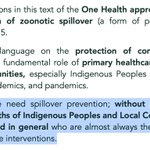
75% of emerging infectious disease originate in animals and spill-over into humans. Want to learn more about how we can prevent such spillover events from happening?
Check out this article by our coalition members in
@EIDjournal 👇
wwwnc.cdc.gov/eid/article/29…
Each year, the wildlife trade industry brings tens of millions of live animals straight from the wild into the US, creating the exact conditions needed for pathogens to spill over from animals to humans.
We need new policy to fix this. Read more here: lnkd.in/eXGmWjDM.
Preventing Pandemics at the Source retweeted
TOMORROW! The next PREZODE webinar is June 18, 8:00 a.m. EDT.
Nature-based solutions (NbS) are gaining recognition as an important component of One Health strategies. This webinar will explore how NbS can help prevent the emergence of zoonotic diseases: prezode-initiative.org/en/we…
In September, the UN General Assembly will hold its second High-Level Meeting on pandemics and deliver a new Political Declaration.
👉Authors of a new Lancet Comment urge the Declaration to elevate spillover prevention & include 5 key items: lnkd.in/ehRQijQq.
We are excited to share our 2025 impact report!
Together with our partners, we are building a strong scientific foundation to guide spillover prevention, shaping the global health architecture, and raising global awareness for spillover prevention.
72d37324-5089-459c-8f70-271d…
Preventing Pandemics at the Source retweeted
WHO Member States advanced their negotiations in support of WHO Pandemic Agreement
Countries progress their negotiations on the Pathogen Access and Benefit Sharing (PABS) system. A part of the WHO Pandemic Agreement, the PABS system is intended to enable safe, transparent and accountable sharing of pathogens with pandemic potential and their genetic sequence information, alongside the fair and equitable sharing of benefits arising from their use, including vaccines, therapeutics and diagnostics.
Read more: bit.ly/3YYAdfB
New podcast!
This week, Neil Vora joined #HealthStuffPodcast to talk about how the environment impacts our health, what horror movies and TV shows get right when they portray outbreaks, and the importance of imperfect activists.
Listen here: iheart.com/podcast/1119-heal…
Preventing Pandemics at the Source retweeted
One Health: Prevention begins with compassion 🛡️
For decades, our world has treated the health and wellbeing of animals, humans, and the environment as separate. But history has made it clear - they are inseparable. 🌍
#PandemicPrevention #OneHealthDay
💡New OpEd!
Yesterday, PPATS Executive Director Neil Vora and coalition member Christian Walzer published an OpEd calling for biodiversity to be integrated into both climate and health strategies.
Read the full piece: lnkd.in/etNc2Cvg
Congratulations to Neil Vora, Executive Director of Preventing Pandemics at the Source, for being named to this year’s #TIME100Next list! 👏
lnkd.in/e5j_Q9zV @conservationdoc
Preventing Pandemics at the Source retweeted
PREZODE is looking for new members to join the Initiative’s governing body.
These include 5 seats to be filled on the Science College, 5 seats to be filled on the Regional College, and 3 seats to be filled on the Civil Society College.
More info: prezode-initiative.org/en/op…
Some say it’s impossible to prevent spillovers.
But that’s not true.
Watch this video of Latiffah Hassan, Raina Plowright & Neil Vora on how to reduce spillover risk and improve health of people, animals & environment: tinyurl.com/2s4krbvu
Video by Climate Acceptance Studios
After 3 years of negotiation, the world's first #PandemicAgreement was adopted today in Geneva at #WHA78 👏.
"The Agreement is a victory for public health, science and multilateral action” says WHO Director-General, Dr. Tedros Adhanom Ghebreyesus.
Critically, the text recognizes the importance of #OneHealth, #spillover #prevention, and addressing the drivers of infectious disease.
Preventing Pandemics at the Source retweeted
#PandemicAgreement: History made in Geneva! #WHA78🌍✍️
@WHO Member States have just adopted a binding global agreement that includes #OneHealth - acknowledging the interconnectedness of human, animal & environmental health and wellbeing.🐾🌿
This is prevention at source🛑
On March 13, an outbreak of H7N9 #birdflu was confirmed on a Mississippi poultry farm with 47,000 chickens, marking the first time the deadly strain was confirmed in the US since 2017.
Read more here: reuters.com/business/healthc…
A new variant of #birdflu - with a mutation that may help it spread in mammals - has been found in dairy cows.
“We have never been closer to a pandemic [..] and we still are not doing everything possible to prevent it or reduce the impact if it hits.”
fortune.com/well/2025/02/08/…
Preventing Pandemics at the Source retweeted
PREZODE interviewed Priya Basu, Executive Head of the @Pandemic_Fund at the World Bank, on how the Fund helps operationalize the One Health approach, from a theoretical concept to practical action at the country or regional level: prezode.org/news/interview-w…
We must shift the way pandemics are perceived and addressed: not as inevitable events to be contained, but as a product of our own doing, of our broken relationship with nature -- that can be prevented.
#OneHealthAwarenessMonth
🧵Let’s talk about #OneHealthAwarenessMonth!
Did you know that the health of humans, animals, and the environment is deeply connected? #OneHealth is about working together to protect them all. Let’s dive into why this matters. 👇
PPATS Executive Director, Neil Vora, shares how art and philosophy can #preventpandemics: news.mongabay.com/podcast/20…
“If we want to see societal transformation, we’re going to need people feeling inspired, and that’s where art and philosophy come in,” Vora says.
In this Mongabay podcast, Mike DiGirolamo chats with Neil Vora (@conservationdoc) about how art and philosophy are necessary, and perhaps underutilized, tools to drive the global change needed to prevent further outbreaks: news.mongabay.com/podcast/20…
Preventing Pandemics at the Source retweeted
In this @PLOSGPH article, Anish et al. review the relevance of surveillance & health system preparedness, infection control, early diagnosis and treatment with broad-spectrum antivirals, environmental conservation, and community engagement in mitigating Nipah outbreaks in India.