

Markets, data, maths & crypto
onchain
Joined January 2022
- Tweets10.1K
- Following259
- Followers451
- Likes15.4K




Praize_Jr(♟,♟) retweeted

Always made my best money by being early: $YFI farming, $LIT referrals etc.
Only 9 days in, and I'm not early to Papertrade anymore.
Early farmers got 100 PAPER per $1 of eligible losses. Now just ~11.
Just feels like I'm an exit liquidity. No?
A $1000 losing trade now gets me ~10.7k PAPER.
Stake it and I'd get ~$2.60 to $4.90 per day if recent payouts continued.
200 to 385 days just to recover my loss. And that excludes new issuance diluting my share.
So once PAPER becomes transferable, some traders might prefer selling to recover losses instead of waiting for yield.
Soooo... The BIG BET on PAPER is whether traders keep gambling after farming stops making sense.
At the end, the product needs to be worth using even when the incentives aren't enough.
For losers, yeah, they get the token.
But winners pay an 'asymmetric-impact haircut' BEFORE the additional 2% fee.
(There are no funding or notional trading fees, so the cost comparison isn't so simple)
How many are here for the product vs deliberately losing because they expect PAPER to pay them back?
That is what one needs to answer.
As Galaxy Research posted:
'Once PAPER becomes transferable, the market price will determine how much farming happens, and that, in turn, will determine long-term revenue.'
So PAPER dumping could mean less farming -> lower payouts -> less reason to hold.
Got rekt from this kind of down spiral a few times.
My next opportunity might be buying from farmers selling to recover losses.
But only if the price makes sense on payouts AFTER farming slows.
So I will treat PAPER as a "revenue token" if it sustains it after a while.
Trading PAPER once it's transferable seems easier to me than trading on Papertrade itself.


Praize_Jr(♟,♟) retweeted

In crypto, competition matters even more than in most other industries.
Pumpfun vs fomo is good for users, since both compete on the best programs and the lowest fees. Opensea vs Blur was good too, because Blur's launch pushed OpenSea to lower its fees and ship new products, monopolies are bad
you can literally use your @papertrade_xyz liquidation logs as a tax write-off and a dividend-generating portfolio asset at the exact same time
losing trades mint $PAPER ➔ $PAPER stakers capture 50% of fees + 100% of LP surplus past $5M.
exchange.papertrade.xyz/port…

POV: you’re not getting liquidated; you’re executing an automated seed-round LP acquisition.
Act accordingly @izebel_eth 🤝


Praize_Jr(♟,♟) retweeted

long degeneracy
noun | /lôŋ də-ˈje-nə-rə-sē/
1. "a belief that the world will only get more degenerate, financialized, speculative, lonely, tribal and weird"
2. as real returns compress, risk increases to compensate
oldcoinbad.com/p/long-degene…

mcap tells you where capital is parked, but volume tells where the action is
seeing tokenized $NVDA churn through more than half its mcap in a day means constant price discovery and arbitrage against static DEX pools

i’ve checked @coingecko’s RWA tools today
here’s the snapshot:
→ Gold: $6.03B tokenized mcap, $271M traded in 24H
→ Nvidia: $163M tokenized mcap, $103M traded in 24H
tokenized gold is ~37x larger than tokenized Nvidia
but its daily trading volume is only ~2.6x higher
gold alone accounts for ~64% of the $9.43B tokenized mcap tracked on the page
meanwhile, Nvidia’s daily volume is equivalent to ~63% of its tokenized mcap, compared with 4.5% for gold
capital concentration and trading activity tell different stories
CoinGecko’s RWA Charts show mcap and volume by asset type and issuer
the Assets List lets me compare individual assets, their tokenized prices, size and trading activity
let see whether equities can sustain that turnover as their tokenized supply grows
explore the data and compare the assets you follow:
coingecko.com/en/rwa

if you’re managing LP positions or building RWA market-making infrastructure, how are you pricing the calendar gap right now?
DMs open

tokenized asset market cap is climbing, but here is the question no one has answered yet:
are AMM LPs taking on unpriced overnight jump risk for a few basis points in swap fees, or are arbs just picking off stale quotes the second sunday night futures open?
NFA - dyor

short singapore / indonesia / malaysia tourism stocks
short massive gaming companies - ai gaming indie companies will take off
short tv long phones - ai vid gen will just accelerate reel movies
long ai vids somehow
long high end luxury stocks short consumer middle class brands - k shaped world
long financial trading interfaces short financial "experiments"
long energy, commods - dont really like this one its not very novel nor is it early
"bro wat is a boundary?"
An attempt to explain what @Bound_Exchange is cooking
🧵

Boundaries are a new derivative on Hyperliquid.
Set a target and a loss, and know your payout before you open.
⬇️ Check our docs to learn more.
docs.bound.exchange/bound-do…
Another key distinction from options is time decay
Options have theta, meaning their time value can erode as expiration approaches
With boundaries, the time-related cost is priced upfront
Your position doesn’t decay simply because another hour or day passes.
Boundaries offer a different way to think about breakouts, ranges and market events
Instead of asking only where price will end, you can ask which level it will reach first
That’s the primitive @Bound_Exchange is building around.
I hope you do understand wtf a boundary is now


Praize_Jr(♟,♟) retweeted

The tokenized stock story may look US-centric at first glance.
But Asia is already playing a much bigger role than it seems.
1. The demand is already here in Asia
Asia already has a massive base of crypto-native investors.
Binance bStocks is currently the second-largest tokenized stock platform by market cap, and both Binance and BNB Chain have particularly strong user bases across Asia.
The trading data makes this even clearer. 72% of bStocks trading volume happens onchain, and 92% of that onchain volume takes place outside US market hours.
Activity also picks up around the start of the Asian trading day.
Asia is not just a potential market for tokenized stocks. The demand is already there.
2. Asia itself is home to some of the most attractive assets for tokenization
The opportunity is not just about Asian investors buying US equities. Asia itself has some of the most globally relevant stocks.
Korea, China, Taiwan, and Japan sit at the center of semiconductors, memory, batteries, robotics, EVs, and advanced manufacturing.
As AI becomes more dependent on physical infrastructure, these industries are becoming even more important.
We are already seeing this demand move onchain.
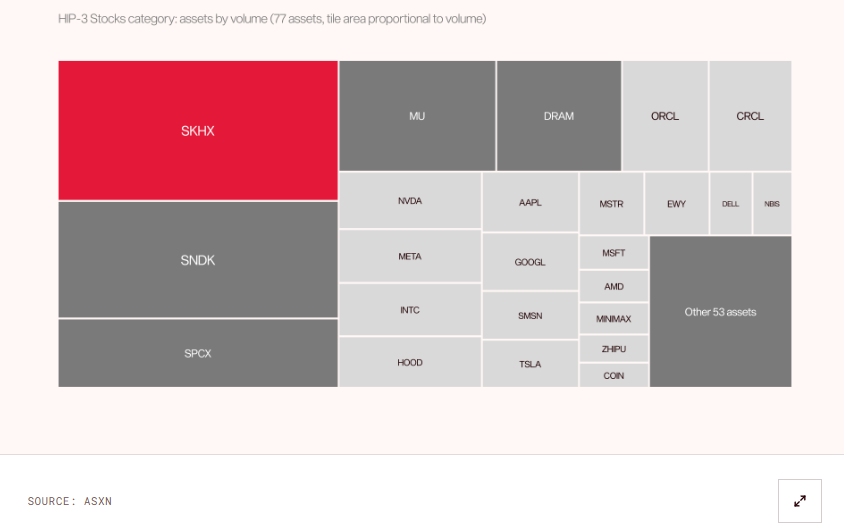
SK Hynix has consistently been one of the most actively traded equities in perp markets, alongside names like Samsung Electronics and other Asian tech companies.
Tokenization can eventually bring much broader global access to these assets.
3. Asia has the regulatory infrastructure to make this real
One of the biggest challenges in tokenized equities is legal structure.
Many existing products rely on multiple jurisdictions for SPVs, issuance, custody, prospectus approval, and distribution.
ADGM offers a very different setup.
Within a single jurisdiction, companies can establish an SPV, structure a tokenized security, receive prospectus approval, offer it publicly, and potentially trade it on a regulated exchange.
That makes ADGM particularly attractive for equity tokenization. And this is not theoretical.
Binance bStocks and Coinbase Tokenized Stocks are already using ADGM's regulatory framework.
4. Regulation is moving across Asia, but each market will take a different path
There will probably never be one unified "Asian tokenized stock market."
Each jurisdiction is developing around its own capital market structure.
Korea is building a legal framework for security tokenization, with the new regime taking effect in 2027.
Hong Kong is opening regulated secondary markets for tokenized investment products.
Japan already has an established security token framework, although tokenized equity activity remains limited.
The UAE, through ADGM, is taking a more infrastructure-driven approach and is already attracting global platforms.
Different paths, but the direction is becoming increasingly clear.
5. Asia has almost all the ingredients needed for the next phase of tokenized stocks
- A large investor base.
- Crypto-native users.
- Globally important equities.
- Deep capital markets.
- Regulatory frameworks that are gradually becoming workable.
Asia is still easy to overlook when people talk about tokenized stocks.
But from trading activity and investor demand to underlying assets and regulatory infrastructure, the region is already having a much bigger impact than most people realize.
Honored to work with @redstone_defi and @AleaResearch, with featured insights from @Securitize, @DinariGlobal, @SuperstateInc, @extendedapp, @lista_dao, @JupiterExchange, @CredoraNetwork.


Tokenized stocks total $3.17B+ in onchain value.
Only 2.6% of that is used in DeFi.
Read our latest report with @FourPillarsFP and @AleaResearch, revealed at @TokenizeThisNYC Singapore edition, to learn why.
Features insights from: @Securitize, @DinariGlobal, @SuperstateInc, @extendedapp, @lista_dao, @JupiterExchange, @CredoraNetwork.
Ascend is more than a token launchpad.
It is trying to build a full lifecycle for @Enter_Elysium projects:
Launch → Ascended → HyperCore Spot → HIP-3 Perps
The interesting part is the economic loop behind that progression.
Here’s the simple version 🧵

The Ascend Litepaper is live.
Stake Hype on Ascend through kHYPE, earn two streams: ecosystem tokens funded by yield, and HYPE funded by protocol revenue.
No protocol token. A 1% trading fee with up to half to creators. Every dollar of protocol revenue buys $HYPE and kinetiq:native.
Supporting token lifecycle from launch to Ascended listings, HyperCore spot listings, and HIP-3 Perps listings through Kinetiq.
We're also giving away 10 WL spots on this tweet to people who like, RT, and tag a friend with one unique mechanism they really like about Ascend.
ascendlaunch.gitbook.io/docs

The staking side creates another loop:
HYPE → kHYPE → staking yield → ecosystem-token purchases → stakers
Separately:
Protocol-owned HYPE → staking yield → ecosystem-token purchases → burn
Ascend is using different revenue sources for different parts of the ecosystem.
The intended lifecycle is:
Launch
↓
Ascended
↓
HyperCore Spot
↓
HIP-3 Perps
Each step has different requirements around performance, liquidity, technical readiness and market infrastructure.
@AscendLaunch's core idea is to make support continue beyond launch day.