

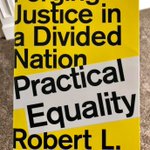
By @robertltsai. How do we do the hard work of equality in a divided nation? @wwnorton Now in paperback: https://xitter.cf/t.co/dnFABglY8u
New York, NY
Joined June 2017
- Tweets1.3K
- Following409
- Followers163
- Likes2.2K




Pinned Tweet
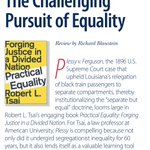
@joshuarothman writes in @NewYorker: “The gap between intuition and argument—between outrage and the best response to outrage—is the subject of @robertltsai’s #PracticalEquality.” @wwnorton

Most of us agree that too much inequality is bad—but what kind of equality is good? In this week’s @NewYorker, I write about the philosophy of egalitarianism, which is full of puzzles, contradictions, and insights: newyorker.com/magazine/2020/…

Practical Equality retweeted

“When injustice is left in place and perceived to be irremediable, citizens begin to doubt the power of the law. They start to lose their sense of civic responsibility and faith in a shared future.” bit.ly/4aGgvKY

Practical Equality retweeted

For our special print issue on the country’s 250th anniversary, we asked about 100 historians and other public intellectuals to make some lists for us that summarize the nation’s high and low points: our best and worst presidents; the images that most sharply define American history; the greatest works of art; and more. The results are fun, fascinating, and give a real and true sense of the sweep of our history.
Now it’s your turn! Take this reader survey and tell us what you think the right answers are—and see where yours stack up compared to our experts and to other readers. 👇


Practical Equality retweeted
Best and worst presidents, important works of art, and more! #America250 #NewRepublic


For our special print issue on the country’s 250th anniversary, we asked about 100 historians and other public intellectuals to make some lists for us that summarize the nation’s high and low points: our best and worst presidents; the images that most sharply define American history; the greatest works of art; and more. The results are fun, fascinating, and give a real and true sense of the sweep of our history.
Now it’s your turn! Take this reader survey and tell us what you think the right answers are—and see where yours stack up compared to our experts and to other readers. 👇
Practical Equality retweeted
“In establishing the American republic, the Framers unleashed a pair of seductive ideas: popular sovereignty and written constitutionalism. One is treated as a God-given right; the other, a cherished means of ordering society.” @Harvard_Press #America250

Practical Equality retweeted
The Most Influential Founding Fathers trib.al/eViceum

Practical Equality retweeted
Honored to join this distinguished group of scholars asked to help @newrepublic commemorate #USA250. Have a look!

Practical Equality retweeted
To learn more, check out America's Forgotten Constitutions or “John Brown’s Constitution”: bit.ly/4acdToI
Practical Equality retweeted
Did you know that before John Brown attacked Harper’s Ferry he wrote a Declaration of Independence? Or that he led a convention that approved a provisional constitution? Please join us for a conversation about Brown’s legacy on June 29, 7 pm EST zoom: bit.ly/49XMRRJ
Practical Equality retweeted
What a gorgeous venue in which to discuss presidential power. @Roosevelt_House @Hunter_College


Practical Equality retweeted
On this day in 1800 John Brown was born

What’s in John Brown’s Constitution and how did it differ from the 1787 US Constitution? @USArchives
Practical Equality retweeted
“As another season of last-minute U.S. Supreme Court opinions are handed down, Americans are faced with a perennial question: how much compliance is obligatory and how much room is there to disagree?” time.com/6981058/supreme-cou…
Practical Equality retweeted
It should be clear by now that SCOTUS’s power is no longer merely interpretation but national policymaking in nature, with all of the hopes, dreams, and demands for accountability that that entails.

The Supreme Court, which ordered Alabama to create a second Black opportunity district just three years ago, has lifted that order one week before the primary. The Purcell principle says courts shouldn't permit chaos too close to an election—it's now an open question as to whether there will even be a primary on schedule.

Practical Equality retweeted
To what should you be paying attention if you worry about the future of free and fair elections in the United States? @huntercollege @Roosevelt_House
Practical Equality retweeted
Where can you play offense if you have a more robust vision of equality? #PracticalEquality
Practical Equality retweeted
I look forward to addressing fellow teachers on the principle of equality at @ConstitutionCtr

