

Building RWArmor — parametric risk buffers for tokenized real-world assets. The trust layer institutional capital needs to go on-chain. @Protofire_io
Prague
Joined March 2012
- Tweets905
- Following428
- Followers131
- Likes223







Time to replace the 5+ y old one, I guess :D – at Frankfurt on the Main, Germany

🎁 24H TREZOR GIVEAWAY 🇨🇿
Free Trezor for the @solana CZE fam! Just pay shipping.
How to enter:
- Follow @Trezor & @SolanaCZE
- Like + RT
- Comment why you want it & why it's the best
⭐ Bonus: Creative QRTs!
Huge thanks to Trezor & @XJustmichael for making this happen! 💜

Someone printed 4,000 fake bitcoin and cashed them out. The whole point of bitcoin is that nobody can print more.
Liquid is a network that runs alongside bitcoin. On 6 September a bug there let someone mint 4,000 bitcoin tokens backed by nothing.
They swapped them for about $320 million of real bitcoin in about 36 minutes.
About 600 bitcoin never came back.
If you issue a coin, your code has to refuse to mint what your reserve can't cover.
We build that check for issuers. Here's how the check works: protofire.io/blueprints/mint… – at Prague, Czech Republic

Rado (Potven) retweeted

Protofire turns 10 this year. 10 years, built together.
A look back at some of the partners, protocols, and ecosystems we’ve helped build with since 2016.
Grateful to everyone who has trusted us to build meaningful infrastructure.
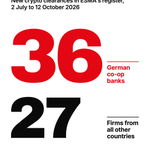
Europe's crypto race is being won by small local banks you have never heard of.
ESMA's own register: of the firms cleared for crypto with start dates from 2 July to 12 October, 36 are German co-op banks. Every other country together adds 27.
Each of them is cleared only to buy and sell crypto for clients, none for custody. Under the setup DZ BANK runs for its more than 700 co-op banks, the coins sit with one custodian, Boerse Stuttgart Digital Custody.
My blueprint for networks like this builds the trading once and switches it on for each bank, and it says where the delivery risk sits: protofire.io/blueprints/netw…
If your network makes each member bank build its own crypto setup, you are paying for the same project over and over. – at Prague, Czech Republic

One hundred dollars. That is Yield.xyz's liability cap for all direct damages, under clause 16.3 of its published terms.
I found it while researching the stablecoin earn blueprint. I read every vendor contract behind it, line by line.
Yield.xyz is one of the API vendors European banks plug into for these earn products. Those rails move client money in the millions.
A hundred dollars does not cover that gap.
When did you last read the liability clause in your own vendor contracts?
P.S. The blueprint, with the full vendor list, is here: protofire.io/blueprints/stab… – at Prague, Czech Republic

Rado (Potven) retweeted
What turns an onchain finance pilot into dependable market infrastructure?
Episode 5 of The Protocol Roundtable brings together:
- Emma Laundriault, Global Head of Kinexys Labs and JPM Coin, J.P. Morgan Payments
- Martin Quensel, Co-Founder of @centrifuge and Founder of @anemoycapital
- Ryan Zega, Head of Structured Finance at @AptosLabs
- Rado Patus, Lead Product Manager at @protofire
Hosted by Andrei Yurkevich, Co-Founder of Protofire.
📅 1 Oct
⏰ 1 PM UTC
📍 Live on X, LinkedIn and YouTube

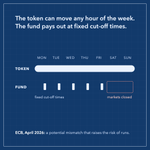
Your money market fund's tokens can change hands at 2 a.m. on a Sunday. The fund behind them still pays out only at fixed cut-off times.
The ECB flagged this gap in April, in its Macroprudential Bulletin. It calls it a potential mismatch that raises the risk of runs. A disruption while markets are closed could force fire sales once they reopen.
The blueprint I wrote for these funds ties redemption to the fund's own dealing cycle: protofire.io/blueprints/toke…

At the DEA Summer Forum in Frankfurt today.
The DLT Pilot Regime did what a sandbox is meant to do: it made experimentation legal and gave the market somewhere to test. The harder question is what comes after the pilot, and how Europe gets from isolated use cases to tokenized capital markets that institutions can allocate to.
That shift is less about technology than about the pieces around it. A settlement asset. Secondary market liquidity. Infrastructure that connects rather than duplicates.
Looking forward to the discussion.
Thanks to Digital Euro Association and Mayer Brown for hosting. – at Frankfurt, Hesse

The emergency stop you are counting on might already be dead.
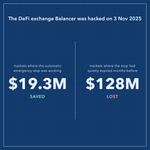
On 3 November 2025 one attack hit the DeFi exchange Balancer. The older markets lost more than $128 million. The newer ones lost almost nothing.
The newer markets had an automatic emergency stop. It fired within minutes, across nine networks. About $19.3 million stayed safe.
The older markets had the same kind of stop. Its permission had quietly expired months earlier. Nobody had checked.
Go test your own emergency stop today.
protofire.io/blueprints/risk…

Rado (Potven) retweeted
TradFi is moving onchain. But who’s actually building the systems it will run on?
Protocol Roundtable, Episode 4: TradFi Goes Onchain
With leaders from @Circle, @0xPolygon, @ADI_Foundation, and @Protofire.
Friday, Sept 18 · 1 PM UTC

Rado (Potven) retweeted

gm!
Solana DeFi takes over Decada 🇨🇿
Join us in Prague with Vik (@DeusNero) from Kamino, joining remotely to talk @solana DeFi and what’s next.
📅 Sept 9 · 18:00–20:00
📍 Café Decada
🍺 Free drinks + open Q&A
Bring your questions 👇
luma.com/8gba26rp?tk=3RduOB

Rado (Potven) retweeted

I spent about 6 months on creating an implementation of @ISDA's SIMM for DeFi.
I hope this represents a step forwards in providing an open-source guide to removing the risks around arbitrary leverage in DeFi.
As a lender, you can use an AI model to audit collateral LTV limits for safety.
This gives you minimum safety bounds, derived from cross-industry quants and experts to rely on.
For risk managers, structurers and lending protocols this gives you a benchmark on how to set parameters with a full methodology.
Now caveats, I'm really not happy with putting this out there today as I feel like it's not finished and I keep finding errors here and there. But it's at the point, where my errors seem to just be grammatical or bad phrasing, or some random slop that snuck in. Whilst, I remain unable to say this is a final version I think it's well past the 80/20 principle and needs to just get out there.
Contributors ...
1) As mentioned, this isn't finished (arg). There are a number of sloppy parts in the back components in particular.
2) We need to extend this to a new crypto risk class
- btc, eth, sol, avax etc.
- bridges (wBTC, BTC.b etc)
- wrappers / staking (wstETH, weETH, wETH etc.)
3) I'll be working on some edits over the next few weeks into FX, Equities, Comm etc as they're a LOT easier than tokenised funds.
Link in comments ...

Rado (Potven) retweeted
3,000+ firms sold crypto in Europe before MiCA. About 325 hold a licence today. The ones left are shipping.
We documented 21 live architectures, end to end: the exact article, who runs it, which vendors held up, and the one layer no vendor sells.
protofire.io/blueprints


Rado (Potven) retweeted
Call for contributors for a paper on DeFi liquidations...
Liquidator roles have changed drastically since the addition of tokenised assets as DeFi collateral.
Originally coordinators of infrastructure, they are now expected to provide balance sheet to absorb market and credit risk.
The problem is that DeFi protocols have been built assuming assets can be sold instantly to a willing buyer. Whilst risk managers have taken this into account somewhat with LTVs, the protocol design has neglected the liquidator's need for a haircut to warehouse these risky assets.
Our calls with leading liquidators this week confirmed what we suspected: most are unaware that protocols have hard constraints on the discounts that can be applied to collateral.
This means that a slightly unhealthy position in a tokenised fund is unlikely to find any bidders, and will instead sit idle in the market.
It is also possible that under certain conditions an asset can never be liquidated, as the maximum discount available is simply not enough for any rational actor.
Different lending protocols have different constraints, but we found that in general none were well suited to clearing tokenised assets and funds in their default configuration.
Some DeFi lending protocol teams, as well as some risk managers, have been aware of this issue and have been working on fixes.
In talking to industry practitioners, one recurring theme was that levered credit positions rarely (if at all) got liquidated. The liquidation business for tokenised assets was therefore a low priority for most would-be liquidators, despite a surge in interest earlier this year.
What this means is that for these assets, liquidators are relied upon to provide a service that is objectively negative expected value for them.
We expect that some of the largest market operators, Aave for example, can justify this position as a service. But it gives reason to believe that the majority cannot, or would not, in a big market sell-off.
The incentives are skewed against them, as being a liquidator in such conditions is effectively being a charity.
We consider any third-party agreements (SLAs) with liquidators under such conditions to be largely spurious unless there are significant protocol changes: they are effectively deep out-of-the-money uncleared put options.
This concerns us as retail exposure to DeFi increases through exchanges, PSPs and neobanks. It represents a critical fragility vector.
Link to the GitHub repo below. It's still a draft, but we've spent about a week tidying it up so that it's ready for outside reviewers and contributions.

Rado (Potven) retweeted
Day 1 of @blockchain_rio from the floor in Rio, where our Venture Studio Co-Founder and @arenas_credit CEO Luis Medeiros spent the day.
The headline from ExpoRio: this market has grown up. The opening framed it plainly. Prove how the technology improves the financial system, not whether it should exist. The floor backed that up, with a more institutional crowd than most expected. Mercado Bitcoin, Kraken, Ripio and Gate around the room, and compliance as the loudest topic of the day.
A few things worth carrying into Day 2:
Tokenization has left the slides. ANBIMA showed a sandbox running 20 use cases on DLT, from debentures to investment funds, with no real money in it yet, purely to see where the efficiency lands. Custody kept coming up as the real unlock. Adoption stays capped until it is obvious who holds the asset and how it gets redeemed.
Stablecoins in Brazil point outward. Pix already owns domestic payments, so the opportunity sits in cross-border settlement and FX, and in the unglamorous plumbing a corporate treasury can run on.
Staking is heading into its next regulatory chapter. Brazil's Central Bank signaled more rules ahead for staking-as-a-service, weighted toward security and clear accountability, applied in proportion to risk. That is the bar anyone building yield infrastructure should design against now.
The tone all day was operational, and that is the part that matters. The systems being argued over on stage, from staking to tokenized credit, are the ones we build and run for the teams shipping them.
More once Day 2 wraps.


Rado (Potven) retweeted
@blockchain_rio starts tomorrow 🇧🇷
Luis Medeiros, our Venture Studio Co-Founder and @arenas_credit CEO, will be in Rio for both days.
If your team is building something on-chain, from tokenization to onchain credit, this is the moment to grab time with him. A few meeting slots are still open.
DM us or drop a reply below, and we'll set a time to meet in Rio.

Rado (Potven) retweeted
Rio is the place to be this August. 🇧🇷
Luis Medeiros, our Venture Studio Co-Founder and @arenas_credit CEO, will be in Rio de Janeiro for @blockchain_rio on Aug 12 and 13.
If you're building something on-chain, from a new protocol to the infrastructure behind it, come find him.
Reply or DM us and we'll set up a time to meet.

Rado (Potven) retweeted

Major announcement!!!
The most popular zk-KYC solution in DeFi is now free.
Join over 200M and industry leaders and try it today.
Onboarding shouldn't be taxing.
Privacy Leaders Roundtable tomorrow ;)

Privacy is quietly turning into the thing every serious protocol has to answer for. We're putting three of the teams actually building it around one table.
Privacy Leaders Roundtable: The Future of Web3 Privacy
▸ Beldex - @BeldexCoin
▸ Midnight - @midnightfdn
▸ Telos - @HelloTelos
Private transactions, confidential computation, compliant privacy. One conversation.
📅 Thursday, 16 July, 2PM UTC
🎙 Live on X Spaces
