

Finance background | Founder & Investor | X is my public journal: raw thoughts and market reads | @TrendAnalytics_ | NFA, DYOR $CRDO $SPCX $NAUT $VST
Switzerland
Joined December 2016
- Tweets3.4K
- Following266
- Followers2.6K
- Likes3.2K




Pinned Tweet
Two days ago I wrote about why I bought $SPCX and why I think it could be a $3–4 TRILLION company by 2030–2031.
Then two filings dropped in 48 hours and I had to redo my math. Now try to follow along and I’ll explain what changes (I think my SUPER INTELLIGENCE target might be too LOW).
Most people think SpaceX's AI business is Grok and a lot of hype. But the real business right now is renting computing power to the biggest AI labs in the world.
But let’s look at the numbers;
> $ANT IPO filing: up to $120.5B of SpaceX compute through 2029
> That's $3.1B PER MONTH once all capacity is delivered, expected by year-end
> SpaceX's original disclosure was $1.25B per month. That's roughly 2.5x bigger
> $GOOG: $920M per month through June 2029, for ~110,000 $NVDA GPUs
> Apollo: a $40B GPU lease, the largest committed GPU financing ever
What's interesting to me is the size. Why? At full speed, Anthropic alone would pay SpaceX $9.3B per quarter. The ENTIRE Super Intelligence segment did $7.56B in Q3.
That's ONE customer bigger than the whole segment was three months ago.
And it adds up. Anthropic + Google alone annualize to $48B. That's roughly 27%–32% of my 2030–2031 target, from just TWO contracts.
Here's the catch: those contracts are NOT locked in forever. Anthropic can walk away on 90 days' notice once the initial periods end in early 2027. Google can do the same after December 31st. And one unnamed customer was already 34.5% of SpaceX's Q3 revenue.
Okay so let's talk about my SUPER INTELLIGENCE target again.
My target was $150B–$180B ANNUAL REVENUE by 2030–2031. From a Q3 run rate of $30B (Q3 × 4), that's roughly 38%–43% growth a year over five years.
But SpaceX guided Q1 2027 revenue at $33B–$37B. Starlink and launch did $7B in Q3. Even if they grow to $8B, my rough math says the AI side would be doing $25B–$30B per quarter. That's approximately $100B–$120B annualized, ONE quarter from now.
So you're telling me AI could be at a $100B+ run rate by early 2027 and I need four more years to get to $150B? I'm starting to think I was too conservative.
Now you might be asking: HOW do you even pay for something this BIG!?
Here’s how;
@elonmusk said the 200+ neoclouds are going to see "guppy-level death and consolidation". Harsh, but look at the contrast. SpaceX just got $40B led by Apollo and $GS, with BlackRock and KKR-advised accounts anchoring it, to lease Nvidia's next-gen Vera Rubin chips. Fitch said its BBB+ rating doesn't change. And the CFO says they're seeing less than one-year payback on this infrastructure.
This is the moat: STARLINK PAYS FOR THE BUILD AND WALL STREET LENDS AGAINST IT.
But I want you guys reading this to be clear about one thing, my thesis here is ASSUMING:
> Anthropic actually reaches the full $3.1B per month by year-end
> Neither Anthropic nor Google walks away when the exit windows open in 2027
> SpaceX keeps building on time: 1.7 GW at the end of September, 2.5–3 GW expected by December
And here's what could completely destroy my thesis;
> CONCENTRATION: At full speed, Anthropic alone could be 25%–28% of the Q1 2027 revenue guide. If they leave, roughly $37B of annual revenue walks out the door. Even Evercore is asking how dependent SpaceX is on a single tenant.
> DURATION MISMATCH: The Apollo lease runs 5 years. The customer contracts can be cancelled on 90 days' notice from 2027.
Fixed costs, flexible revenue.
> CASH BURN: In nine months SpaceX generated $13.1B of operating cash and spent $48.1B on capex. Q4 capex alone is guided at $35B–$40B. If AI demand cools, that's a very expensive building with nobody inside.
At $145, $SPCX trades 8% above its $135 IPO price and 35% below its high. I personally don't think the market is pricing this yet.
My investment horizon doesn't change: 3–5 years MINIMUM. What I'm watching next is simple: does Anthropic hit the full run rate in December, and does SpaceX deliver its $33B–$37B Q1 guide?
I'm going to end it off with this
A BIG CUSTOMER IS A GIFT AND A RISK AT THE SAME TIME.


My $SPCX position is down 9%. Average $154, stock at $140.
I'm buying more.
Last week I published my thesis: $SPCX can be a $3–4 TRILLION company by 2030–2031.
A 9% drop doesn't change that and this is where most people get it wrong. The market moves on fear, headlines and flows. If you let it make your decisions, you'll buy the tops and sell the bottoms. Every time.
That's why conviction matters. You build it BEFORE the stock drops, by going deep on the thesis. Then when it drops, you don't react. You check.
So when $SPCX fell, I went back to my thesis and asked myself three questions;
1. DID THE BUSINESS CHANGE?
In all of 2025 SpaceX did $18.7B in revenue. In Q3 2026 alone, $14.6B. For Q1 2027 management guided $33–37B, almost 2x the entire 2025 in ONE quarter.
2. WHY IS THE PRICE FALLING?
Supply. Since August the IPO lock-up has released up to 3.8B shares. The biggest tranche, up to 1.3B shares, unlocked on October 22, two days after earnings. That day the stock fell 9%. That's employees and early investors cashing out.
3. WHAT WOULD PROVE ME WRONG?
Most of the AI revenue comes from renting compute to a handful of AI labs, and some of those contracts can be cancelled on short notice starting in early 2027. At the same time SpaceX is spending $35–40B on capex this quarter alone. If those customers walk away or demand slows down, the math breaks. And another 798M shares unlock on December 8, so the price could get worse before it gets better.
If you can't answer all three for a stock you own, you don't have conviction. You have hope.
I can answer them. So I keep accumulating, in steps, with a 3–5 year horizon.
What's the one stock you'd keep buying if it dropped 30% tomorrow? And why?

2
702
Everyone is sharing the Morgan Stanley's chart tech momentum factor is 62% below its 12-month high. Deeper than the dot-com bust.
The conclusion on my timeline: the AI bubble just popped
In 2000–2002 the Nasdaq lost 78% over 2.5 YEARS. The whole market went down with it.
This time the momentum unwind happened in about 4 months. And the Nasdaq-100? It's 11% below its October high and still up 10% this year.
So what actually happened? The most crowded AI trades got liquidated. NOT the whole market.
Meanwhile CNN's Fear & Greed Index sits at 23: EXTREME FEAR.
And today the US votes. Prediction markets give Democrats 90%+ odds for the House and 70–75% for the Senate, and the market is positioned the same way.
When everyone sits on the same side of the boat, the expected outcome is already priced in. The surprise is what nobody is ready for. Just over a week ago in Brazil, prediction markets had the losing candidate at 80% on the morning of the vote.
I'm not here to call the result. But here's a stat I do care about: the S&P 500 has been higher 12 months after EVERY midterm since 1950. 19 out of 19.
So where do I want to be? In the sector leaders whose multiples already reset;
> $NVDA: 17% off the highs, 22x forward earnings
> $GOOG: 31% off the highs, 14x forward earnings
> $CRDO: 55% off the highs, 22x forward earnings while guiding 85%+ growth
> $MU: 34% off the highs, 5x forward earnings (cyclical, so smaller size)
(I own $NVDA, $GOOG and $CRDO).
Where's the bottom? Nobody knows. That's why I scale in instead of going all in.
THE BEST ENTRIES NEVER FEEL GOOD WHEN YOU TAKE THEM.
What are you buying in this fear, if anything?
2
358
If you’ve survived the last few months, congratulations
we’ve done better than many did in 2008


6
661
SpaceX is worth almost 4x AT&T, Verizon and T-Mobile COMBINED. Now it wants their customers.
The Washington Post reports $SPCX is in talks with EchoStar to buy Boost Mobile, or at least use its network. Nothing is signed yet.
Why Boost? Because it gives Musk what Starlink doesn't have yet in mobile; 7.4M wireless subscribers, a brand people know and a ready-made sales channel.
Add Starlink's 13.6M subscribers (+90% in a year) and the $8B of 800MHz spectrum SpaceX agreed to buy in October, and you start to see the plan: a phone network that works from space AND from the ground.
BUT Boost doesn't run its own network anymore. It rents capacity from AT&T and T-Mobile. According to the Post, Musk already asked Verizon, AT&T and T-Mobile for access and all three said no. And those rental contracts may not even transfer to a new owner without their approval.
So what SpaceX would really be buying today is customers and a brand, NOT coverage. The coverage problem is still there.
Funny detail: the last company that tried to become America's 4th carrier was EchoStar itself. It ended up selling most of its spectrum in 2025, part of it to SpaceX.
Why I still think this matters: the US wireless market is $235B a year and three companies control most of it. Nobody has broken in because building a network costs too much. SpaceX is the first challenger that already has one in the sky.
I'm long $SPCX at $154. This doesn't change my thesis today, but I'm watching two things: whether AT&T and T-Mobile let those contracts move, and whether this ends up as a full acquisition or just a network deal.
Would you switch your phone plan to Starlink?
$SPCX
$ECHO
$TMUS
$T
$VZ

I sold $ENPH this morning at $26. Down 43% on the position. And as I'm writing this, it's up 11%.
Would I do it again? Every single time.
This is the rule I follow on every swing trade; I don't sell on an intraday break. I wait for the WEEKLY close. If the week closes below my stop loss level or below the last swing low, I'm out. No second chances, no "let's see what happens Monday".
Why weekly? Because intraday and even daily moves are full of noise: earnings gaps, headlines, stop hunts. One ugly day can be just a wick. A full week closing below your level is the market making a decision.
On ENPH my line was the last weekly swing low at $28.59. Earnings came out and the stock opened under $24. I didn't panic sell on Wednesday. I waited for Friday. The week closed at $25.65, roughly 10% below my level. That's confirmation.
And waiting didn't even cost me: I got out at $26, above Wednesday's close.
Now here's the part that tests you. Today it bounced right back to $28.59, the exact level it broke. Old support often turns into resistance. Could it keep going higher? Sure. But a bounce back to a broken level is not a reason to get back in. If it reclaims $28.59 on a weekly close, I'll look at it again. Until then I'm not chasing it.
To be honest with you guys, the real mistake on ENPH wasn't the exit. It was holding it after I had already banked two winning rounds on it, one of them a 1,000% trade on calls. The stock had paid me TWICE and I stayed in waiting for a third. When a trade has already paid you, that's exactly when you should get MORE strict with it, not less.
One thing the weekly close can't do is protect you from an earnings gap. That's what position size is for.
A STOP LOSS ONLY WORKS IF YOU RESPECT IT WHEN IT HURTS.
Do you guys use daily or weekly closes for your stops?

3
616

$SKHY (SK hynix) is now trading at 5.5x forward P/E and under 4x forward sales
That's a business running 70% net margins. The market is clearly pricing this as PEAK earnings.
Either the memory cycle is about to break, or this is one of the cheapest AI names out there.
Which one is it?

1
4
643


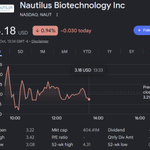
I've started building a position in $NAUT, accumulating under $3. It's 2% of my portfolio for now and I plan to keep adding. This is a 3–5 year bet for me.
Let me be upfront: this is the riskiest name I've ever written about. It's a biotech tools company with basically no revenue yet, and it will need to raise money.
But if it works, I think this is an $8–$13 stock. And right now the market is pricing roughly a one in three chance that it does.
And full transparency: I'm NOT a biotech guy.
Most of what I cover is tech, semis and AI infrastructure, so this one is a completely new challenge for me. I approached it the only way I know: filings, earnings call, the science, and then the numbers.
Some context on how I got in: the stock ran from $0.80 cents in August to over $3 in October, then dropped 25% in one session right before earnings. The next morning Nautilus reported, kept its launch timeline, and the stock bounced 18%.
So here's what this company actually does, how I think about what it's worth, and everything that could go wrong;
"Proteomics" sounds like something you'd skip in a biology class. Stick with me for a minute, because this is simpler than it sounds.
Your DNA is the instruction manual. Proteins are the workers that actually run your body: they're what breaks when you get sick and what most drugs are designed to hit. And one gene doesn't produce one protein. It produces many slightly different versions, called proteoforms. Those tiny differences can be what separates a healthy brain from one with Alzheimer's.
The problem is that today's tools have a hard time telling those versions apart. Nautilus built Voyager, a benchtop machine that reads proteins ONE MOLECULE AT A TIME, up to 10 billion molecules in a single run, and uses machine learning to identify every one of them.
And it's not just a pitch deck. Their work on tau, the protein linked to Alzheimer's, was published in Nature Methods: the assay can resolve up to 768 groups of tau proteoforms, and in a small early cohort it separated cognitively normal people from people with Alzheimer's.
Small sample, early data, but that's the kind of result that gets drug developers interested.
The guy running it has done this before. CEO Sujal Patel founded Isilon and sold it to EMC for over $2 billion. And he's not just collecting a paycheck: he bought another 200,000 shares at $0.68 in 2025 and held 17M shares after that.
Okay, now the numbers.
Latest quarter (Q3 2026);
> Revenue: $234K
> Operating Expenses: $16.9M
> Net Loss: $15.6M
> Cash & Investments: $114.3M
> Runway: into Q1 2028
Revenue is basically zero, and that's expected at this stage. What I care about is the roadmap: first beta unit placed by the end of 2026, commercial launch and pre-orders in early 2027, instrument shipments plus the tau and AKT1 kits in mid-2027, and 20 proteoform assays by mid-2028. The new oncology assays are already hitting the same precision as tau (median variability between 4% and 9%, vs a 10% target). And they just joined an ARPA-H funded consortium worth up to $6M to them over four years.
The CEO put it simply on the call: "2027 is a year where we set the foundation, and 2028 is a year where we really go and scale the business."
The flip side, and I want everyone to read this part: they burn $15M a quarter and management is already exploring a raise before mid-2027. They have a $125M at-the-market program in place (not used yet) and a $300M shelf. DILUTION IS COMING.
So how do you value something with almost no revenue? Not like a normal stock. Putting a multiple on sales that don't exist yet would just be fiction. So I treat it as a bet with two outcomes.
IF IT WORKS: Voyager ships in 2027, the assay menu keeps growing and Nautilus becomes a real proteomics platform. For reference, Thermo Fisher paid $3.1B for Olink, another proteomics company. A $2B–$3.2B valuation with 250M shares (I'm assuming the share count almost DOUBLES from 127M today because of future raises) works out to $8–$13 per share.
IF IT FAILS: the launch disappoints and they keep burning cash. Today there's $0.90 of cash per share, but without new money that's closer to $0.50 by mid 2027. That's roughly where I think it goes if this doesn't work.
Here's what got me interested. At $3.20, the market is pricing roughly a 22%–36% chance of success. Basically one in three, maybe one in four.
I think the real odds are better than that. The science is peer-reviewed, the precision is holding as they add new assays, the CEO has built and sold a hardware company before and owns a big chunk of this one, and the timeline was just reaffirmed.
What the business looks like if it works;
> PROTEOFORM ASSAYS: the engine. Every machine runs on kits and consumables, so that's recurring revenue. Tau first, AKT1 next, 20 assays by mid-2028.
> INSTRUMENTS: the way in. Pharma, biotech and academic labs that want to measure what nobody else can.
> BROADSCALE PROTEOMICS: the big long-term vision, measuring the whole proteome. That timeline already slipped, so I'm giving it ZERO credit today. Pure bonus if it happens.
And the bigger picture: BCC Research expects the proteomics market to reach $57B by 2030. Nautilus doesn't need much of it to justify a few billion.
All of this depends on a few things going right:
> Voyager actually ships in mid-2027 and labs buy it.
> The assay menu keeps growing on schedule.
> They raise the money they need without crushing the share price.
And here's what could break it;
> DELAYS: the launch has already slipped more than once. It was supposed to be late 2025, then late 2026, now mid-2027. Every delay means more cash burned and more dilution.
> DILUTION: raising money at low prices hurts existing shareholders. This is the most certain risk on the list.
> ADOPTION: today's demand is mostly tau-related, the sales team is only three people, and academic customers are nervous about NIH funding. Mass spectrometry is the established standard, and Quantum-Si and Seer are chasing the same labs. Great science doesn't automatically mean sales.
I'm looking at 3 to 5 years here, minimum. As long as it trades under $3, I'll keep accumulating. The next checkpoints are the first beta placement by year-end and the launch and pre-orders in early 2027. If those land, I'll size up from there.
One more thing: I only came across Nautilus recently. I did the work, but I'm sure there are pieces I haven't seen yet. If you know this space better than me, or you think I missed something, bull or bear, drop it in the comments. I'd much rather hear it now than learn it the hard way.
Final thought: THE RISK IS REAL. SO IS THE UPSIDE. THAT'S WHY IT'S A STARTER, NOT A FULL POSITION.
Let's see what the proteins have to say.

Polvans retweeted

I am excited to be an investor in trade(xyz) as they partner with ICE to bring 24/7 perpetual futures on Hyperliquid to the United States. As a market participant, I am looking forward to to using their innovative product to enhance my investment process.
Don’t get me wrong, I don’t know where the bottom is. Nobody does.
But I know what I own. 60 more shares of $SPCX @ $141.70
I’m NOT trying to time it, I’m building a position for the next 3-5 years.


Two days ago I wrote about why I bought $SPCX and why I think it could be a $3–4 TRILLION company by 2030–2031.
Then two filings dropped in 48 hours and I had to redo my math. Now try to follow along and I’ll explain what changes (I think my SUPER INTELLIGENCE target might be too LOW).
Most people think SpaceX's AI business is Grok and a lot of hype. But the real business right now is renting computing power to the biggest AI labs in the world.
But let’s look at the numbers;
> $ANT IPO filing: up to $120.5B of SpaceX compute through 2029
> That's $3.1B PER MONTH once all capacity is delivered, expected by year-end
> SpaceX's original disclosure was $1.25B per month. That's roughly 2.5x bigger
> $GOOG: $920M per month through June 2029, for ~110,000 $NVDA GPUs
> Apollo: a $40B GPU lease, the largest committed GPU financing ever
What's interesting to me is the size. Why? At full speed, Anthropic alone would pay SpaceX $9.3B per quarter. The ENTIRE Super Intelligence segment did $7.56B in Q3.
That's ONE customer bigger than the whole segment was three months ago.
And it adds up. Anthropic + Google alone annualize to $48B. That's roughly 27%–32% of my 2030–2031 target, from just TWO contracts.
Here's the catch: those contracts are NOT locked in forever. Anthropic can walk away on 90 days' notice once the initial periods end in early 2027. Google can do the same after December 31st. And one unnamed customer was already 34.5% of SpaceX's Q3 revenue.
Okay so let's talk about my SUPER INTELLIGENCE target again.
My target was $150B–$180B ANNUAL REVENUE by 2030–2031. From a Q3 run rate of $30B (Q3 × 4), that's roughly 38%–43% growth a year over five years.
But SpaceX guided Q1 2027 revenue at $33B–$37B. Starlink and launch did $7B in Q3. Even if they grow to $8B, my rough math says the AI side would be doing $25B–$30B per quarter. That's approximately $100B–$120B annualized, ONE quarter from now.
So you're telling me AI could be at a $100B+ run rate by early 2027 and I need four more years to get to $150B? I'm starting to think I was too conservative.
Now you might be asking: HOW do you even pay for something this BIG!?
Here’s how;
@elonmusk said the 200+ neoclouds are going to see "guppy-level death and consolidation". Harsh, but look at the contrast. SpaceX just got $40B led by Apollo and $GS, with BlackRock and KKR-advised accounts anchoring it, to lease Nvidia's next-gen Vera Rubin chips. Fitch said its BBB+ rating doesn't change. And the CFO says they're seeing less than one-year payback on this infrastructure.
This is the moat: STARLINK PAYS FOR THE BUILD AND WALL STREET LENDS AGAINST IT.
But I want you guys reading this to be clear about one thing, my thesis here is ASSUMING:
> Anthropic actually reaches the full $3.1B per month by year-end
> Neither Anthropic nor Google walks away when the exit windows open in 2027
> SpaceX keeps building on time: 1.7 GW at the end of September, 2.5–3 GW expected by December
And here's what could completely destroy my thesis;
> CONCENTRATION: At full speed, Anthropic alone could be 25%–28% of the Q1 2027 revenue guide. If they leave, roughly $37B of annual revenue walks out the door. Even Evercore is asking how dependent SpaceX is on a single tenant.
> DURATION MISMATCH: The Apollo lease runs 5 years. The customer contracts can be cancelled on 90 days' notice from 2027.
Fixed costs, flexible revenue.
> CASH BURN: In nine months SpaceX generated $13.1B of operating cash and spent $48.1B on capex. Q4 capex alone is guided at $35B–$40B. If AI demand cools, that's a very expensive building with nobody inside.
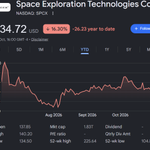
At $145, $SPCX trades 8% above its $135 IPO price and 35% below its high. I personally don't think the market is pricing this yet.
My investment horizon doesn't change: 3–5 years MINIMUM. What I'm watching next is simple: does Anthropic hit the full run rate in December, and does SpaceX deliver its $33B–$37B Q1 guide?
I'm going to end it off with this
A BIG CUSTOMER IS A GIFT AND A RISK AT THE SAME TIME.
1
466


Culper has been short $NVDA since May and now they're short $CBRS too.
Wild.
Their whole case on Cerebras: the wafers wear out after 2 years
Now hear me out; the same "chips die too fast" debate already exists for GPUs.
$CBRS is already 70% off its highs.
Below $100, I'm scooping some shares.

NEW: We are short Cerebras Systems $CBRS. Cerebras claims to have solved wafer-scale chips. We believe otherwise: $CBRS wafers break down after just ~2 years in use - a lifespan that undermines the entire business. See full report and disclosures on our website, link in bio.

1
962

