

A transdisciplinary group of students and scientists studying pollinators @UnivOfKansas
Joined February 2020
- Tweets39
- Following191
- Followers383
- Likes6






Pollinator group at KU retweeted

Another job opportunity! Genomics Specialist | @UnivOfKansas sjobs.brassring.com/tgwebhos…
Pollinator group at KU retweeted
Hello insect people, a collection manager position at the University of Kansas #Entomology #bees #biodiversity
👇
employment.ku.edu/staff/2222…

Pollinator group at KU retweeted

First report of a gynandromorph in #squashbees. Paper in the #JournalOfMelittology @PollinatorsKU by @LauraJonesEco @SKK_Anthophila
Learn more about it in this blog: "A diamond in the pumpkin patch" lopezuribelab.com/2021/02/25… via @lopezuribelab
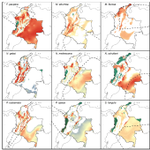
Climate change could affect stingless beekeeping in Colombia #pollinators #bees @conservation
sciencedirect.com/science/ar…

Bees in Kansas: A recent publication in The Kansas School Naturalist lists 432 species in 64 genera. #bees #pollinators #Kansas @emporiastate

A male polyester bee (genus Colletes) visiting flowers of Erythroxylum coca, the coca plant. Indigenous peoples have utilized the leaves of this plant for thousands of years for their alkaloid content. @vhgonzab @wallacetrigona @Mlucia_Xylo
Credits: instagram.com/najilcab/
Stingless bees get sugars from sap-sucking bugs' secretions (honeydew), especially in periods of scarce floral resources. Here is a species of Trigona feeding on honeydew produced by membracid bugs. #pollinators #Colombia @vhgonzab @mmlopezu
Credits: instagram.com/najilcab/
Stingless bees are major tropical pollinators. Here is species of Nannotrigona from Colombia's coffee region. #stinglessbees #Colombia #Coffee @najilcab @Mlucia_Xylo @wallacetrigona
Credits: facebook.com/najilkab/
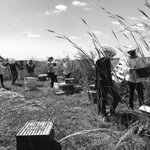
Charles Michener, R. S. Bailey, and George Bohart (left to right), at a nesting site of the alkali bee Nomia melanderi near Fillmore, Utah, Aug 1950.
Photograph by W. Murdock


Towards a U.S. national program for monitoring native bees! @bees @pollinators

Hot off the press: Towards a U.S. national program for monitoring native bees sciencedirect.com/science/ar…
Work led by @WoodardLab in collaboration with many others @DanforthLab @melittologist @rufocinctus @msuberrybugs @WilliamsBeeLab @jha_ut @CariveauLab
A solitary bee of the genus Diadasia from Colombia's dry forests, an endangered tropical ecosystem. Most species of Diadasia are restricted to Xeric environments. #Colombia #bees #pollinators
Credits: @MottaBees
Bees that walk on water! A rare behavior observed in solitary bees of the tribe Emphorini in Colombia's dry forests. Credits: @MottaBees
#Colombia #pollinators
Pollinator group at KU retweeted
Acute exposure to sublethal doses of neonicotinoid insecticides increases heat tolerance in #honeybees disq.us/t/3s4rtgx #pollinators #bees

New bee chapter in the Encyclopedia of Social Insects
link.springer.com/referencew…

Stingless bees are important for the Tharu people of Nepal
journals.ku.edu/melittology/…

Brood development and nest parasitism of Xylocopa (Neoxylocopa) augusti Lepeletier (Hymenoptera: Apidae), a promising crop pollinator in Argentina onlinelibrary.wiley.com/doi/… @vhgonzab
A primer of host-plant specialization in bees @wallacetrigona @vhgonzab
portlandpress.com/emergtopli…

Pollinator group at KU retweeted
Another species of #squashbees that is widespread in North America and Mexico @lopezuribelab
Happy Friday!

Taxon-specific associations of tallgrass prairie flower visitors with site-scale forb communities and landscape composition and configuration #pollinators
sciencedirect.com/science/ar…
