

The company behind #TiDB, a #MySQL compatible, #OpenSource #DistributedSQL database for building scalable modern apps.
Sunnyvale, CA
Joined August 2015
- Tweets3.7K
- Following130
- Followers7.5K
- Likes1.9K




TiDB, powered by PingCAP retweeted

Daytona now officially documents how to mount TiDB Cloud Filesystem directly into a sandbox.
This is exactly the architecture we’ve been betting on:
Sandbox is disposable.
Workspace is durable.
AI infrastructure shouldn’t mean giving every sandbox a permanent disk. Give compute a durable workspace instead.
Huge thanks to the @daytonaio team for making this integration happen. Looking forward to doing much more together! 🚀
daytona.io/docs/en/mount-ext…

TiDB, powered by PingCAP retweeted
前几天有人问我:
TiDB 现在内部用了什么 Multi-Agent System?
我回答得很直接:
其实我们在刻意避免 Multi-Agent。
能一个 Agent 干完的,就一个 Agent 干。
实在需要拆,最多上面放一个 Coordinator,下面几个边界非常清楚的 Agent。
原因也很朴素。
分布式系统做久了,对“多组件协作”多少有点 PTSD。😂
Agent 一多:
通信来了
状态来了
retry 来了
context 丢了
最后还不知道到底谁背锅。
刚好最近看到 Anthropic 讲 Multi-Agent 的经验,也挺有共鸣。anthropic.com/research/multi…
他们提到,很多团队花几个月搭复杂的 Multi-Agent,最后发现把 single agent 的 prompt 和 tools 做好,效果差不多;Multi-Agent 真正比较适合的是 context isolation、parallel execution 和 specialization,而且通常要付出大约成倍 token 的代价。
所以我现在对选择 Multi-Agent 还是挺慎重的。
毕竟我们花了几十年才学会怎么把分布式系统搞稳定。
现在没必要因为 Agent 出来了,再主动把自己分布式一遍。😂

TiDB, powered by PingCAP retweeted

AI agents already write the code.
The missing piece is taking AI-generated apps to production.
With Novita Artifact Hosting + @PingCAP TiDB:
• one SDK call
• managed database provisioning
• automatic migrations
• zero DevOps
From sandbox → production, seamlessly.
Read more 👇
novita.ai/blog/novita-tidb-f…

TiDB, powered by PingCAP retweeted
Drive9 is not just file storage.
We built a small demo: PhotoVault
drive9-photo-vault.netlify.a…
Upload a photo, and Drive9 can automatically generate its summary and tags.
That means your app does not just “store files” anymore.
It can understand them.
With this, you can easily build your own photo service, personal knowledge vault, AI album, content management app, or any AI application that needs file + metadata + retrieval.
This is the power of Drive9:
Files become searchable.
Files become understandable.
Files become part of the AI runtime.
Try Drive9: drive9.ai/


TiDB, powered by PingCAP retweeted
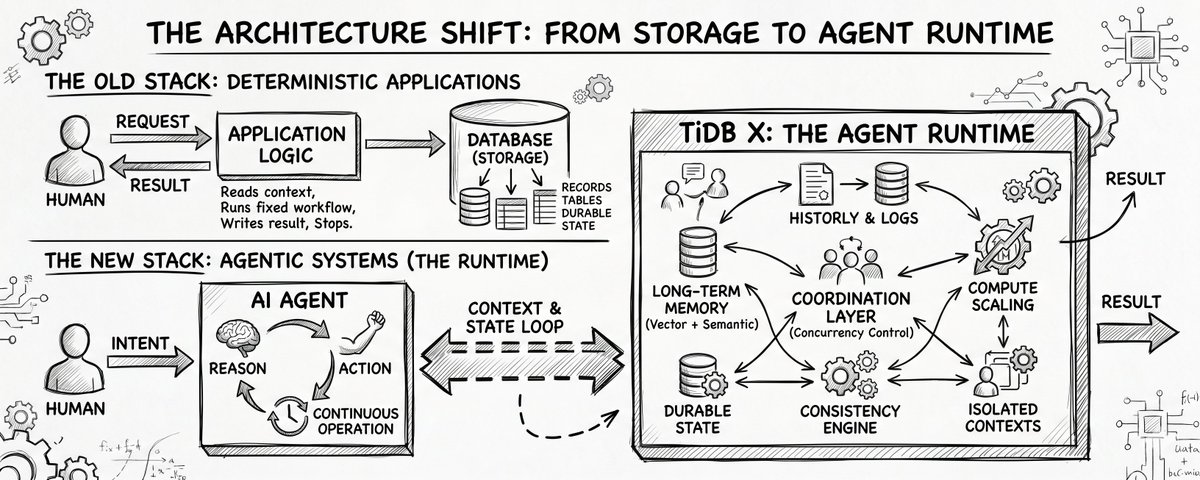
The workload is also completely different.
The 2008 paper was thinking about Web 2.0 applications: small objects, interactive services, scale-out availability.
TiDB X is designed for AI-agent workloads:
sessions, memory, checkpoints, artifacts, logs, replayable state, bursty compute, and many short-lived tenants.
Different animal.
TiDB, powered by PingCAP retweeted
The old question was:
Can we build a database on S3?
The new question is:
What kind of database do AI agents need when object storage becomes the ground truth?
That is a much more important question.
TiDB, powered by PingCAP retweeted
An agent-native database needs different properties.
It must be cheap enough for millions of agents, sessions, or small tenants.
It must be elastic, because agent workloads are bursty.
It must be queryable, because memory should not become a pile of opaque files.
And it still needs transactions, because agents can absolutely corrupt state too.
TiDB, powered by PingCAP retweeted
I would not frame this as “we solved what 2008 could not.”
The better framing is:
2008 asked the right systems question early. AI agents finally make that question urgent.
Object-storage-native databases are becoming the natural default for AI agent workloads.
TiDB, powered by PingCAP retweeted
We built drive9 — a network drive with semantic search for AI agents.
→ ls, cat, cp, mv — commands your agent already knows
→ Auto-embedding + vector search on every file
→ FUSE mount — zero code changes
→ Zero-copy operations, instant branching
→ Smart summaries so agents scan before loading full content
One install. Zero config.
drive9.ai
TiDB, powered by PingCAP retweeted

wiki9: github.com/disksing/db9-wiki
Agent-native LLM Wiki powered by DB9. Based on @karpathy LLM Wiki pattern.
Instead of traditional RAG, the LLM incrementally builds and maintains a persistent wiki — a structured, interlinked collection of markdown files. Instead of embedding LLM calls in the tool itself, db9-wiki generates AGENTS.md + skill files so any AI agent (Claude Code, Cursor, Windsurf, etc.) can operate the wiki directly.

TiDB, powered by PingCAP retweeted
Drive9: github.com/mem9-ai/drive9 the dropbox for Agents

TiDB, powered by PingCAP retweeted

teaming up with @PingCAP as our Data & Storage Partner.
To help our cohort to build, TiDB is generously providing $3,000 in database credits per team!
Welcome to the SCALE family 🤝

TiDB, powered by PingCAP retweeted

TiDB Cloud Zero Public Preview: Get a Database in 1 Second, Claim It in 3 Clicks
from @PingCAP
pingcap.com/blog/tidb-cloud-…

TiDB, powered by PingCAP retweeted

40+ AI startup founders. One curated dinner. 🚀
We hosted the Singapore AI Founders VIP Dinner.
Big takeaway: AI founders are thinking about database infra, not just models. TiDB from @PingCAP lets you run transactions + real-time analytics in one MySQL-compatible distributed SQL database, scale to petabytes with automatic sharding, and use vector search + full-text search for RAG and agent memory -- no separate systems, no ETL.
If you're an AI founder or technical leader in Singapore -- the next one is worth clearing your calendar for. 😊
#AIBuilders #PingCAP #TiDB #AWS #AIFounders


TiDB, powered by PingCAP retweeted
Hot take: What if your agent's filesystem understood meaning?
$ search "deployment config for prod"
/config/prod.env
/scripts/deploy.sh
/docs/deployment.md
Multi-agent sharing built in from day one.
Just storage that feels native to agents.
TiDB, powered by PingCAP retweeted
Hot take: Every agent framework nearly goes through the same arc:
- Store state in memory → session dies, state gone
- Dump to local files → can't search, can't share
- Add a database → great for structured data, overkill (or actively harmful) for storing artifacts like files, images, or blobs
- Build a custom file layer → congratulations, you just reinvented a filesystem
Step 4 always happens. The question is whether you build it well or badly.
TiDB, powered by PingCAP retweeted

Token stagflation, as context windows grow, the value of each additional token decreases, while the cost (compute, latency, and reliability degradation) increases.
TiDB, powered by PingCAP retweeted
30 days ago I set out to answer one question: what does a database for AI agents actually need?
Here's what I learned building it:
Agents don't read docs. Your onboarding flow is an API call or it doesn't exist. We had to make TiDB Cloud provisionable in a single HTTP request — no dashboard, no email verification, no "choose your region." zero.tidbcloud.com/
Memory is messier than state. Agent memory isn't rows and columns. It's half-structured thoughts, conversation fragments, and tool outputs all shoved into the same namespace. Schema flexibility isn't optional. mem9.ai
The cost model is backwards. Traditional databases charge for uptime. Agents are bursty — intense for 30 seconds, idle for hours. If you can't scale to zero, you're charging agents rent for an empty apartment.
Multi-agent is the real test. One agent, one database is easy. Five agents sharing context without corrupting each other's state? That's where every shortcut breaks.
Developers will surprise you. Someone used clawmem.ai to build a shared knowledge base across 3 different AI assistants. I never designed for that. They made it work anyway.
The biggest surprise? The hard problems aren't database problems. They're ownership, permissions, and lifecycle problems — wearing database clothes.
Month 1 done. Month 2 starts tomorrow.
