

Pi News at Your Fingertips
Joined December 2024
- Tweets4.5K
- Following78
- Followers5.4K
- Likes10.9K





Pi Coin Magazine retweeted

Congratulations 🎊 to you if you are still holding your mined Pi coin.
Something great is happening behind the scene.
Pi ecosystem is giving great vibes and the value of the products in the ecosystem made me to cry because it will bless many lives.
Hold your mined #Pi
Great message

Every time there's a slight delay in upgrades, some members of the community create a stir because of the delay. They start insulting the team and attacking influencers. Now, the upgrade has been completed on time. We didn't see any of those disruptive and unethical elements when the team met its deadline.
So, regarding the October 20th issue I mentioned last month,
it could be an update, like a team report on the protocol upgrade and node update, even if it's delayed by a day or happens a day early after the upgrade is complete. This will happen.
We have many applications that won in hackathons and are probably being prepared for launch now. There are many details, actually.
But I see that as the Pi team progresses and the matter becomes imminent, the negative attacks increase, attempting to demoralize the community. Haven't the pioneers noticed this? The team has appeared at conferences and announced partnerships.
They are preparing 300 applications. Is it possible you don't see these achievements? I know there are delays, but failure is impossible. Stay united and don't let a few naysayers discourage you. Be strong.
#PiNetwork #PiDEX #PiRC #Protocol27 #Mainnet #Web3 #PiNetwork
#PiPioneers
#PiMainnet
#PiCoreTeam
#PiCrypto
#PiCommunity
#PiDEX
#PiLaunchpad
#PiNode
#PiAI
#Protocol27
#Protocol28
#DeFi
#Web3
#Decentralization
#CryptoNews
#DigitalEconomy
#FinancialFreedom#DeFi
#Web3
#Decentralization
#CryptoNews
#DigitalEconomy
#FinancialFreedom#PiDEX
#PiLaunchpad
#PiNode
#PiAI
#Protocol27
#Protocol28

Thank God, We’re moving forward. Protocol 28 has been fully upgraded on the Mainnet API


Pi Network Protocol 28: Node Upgrade Deadline and Mainnet Timeline
Today, October 13, is the stated deadline for Pi Network node operators to complete the Protocol 28 upgrade. Meanwhile, Protocol 28 has reportedly been deployed to Testnet 2, where it can be tested before the Mainnet rollout.
The Mainnet upgrade is expected to be completed by October 16. Node operators should follow official Pi Network instructions and check their node status to confirm they have upgraded successfully.
#PiNetwork #Protocol28 #PiNode #PiMainnet #Testnet2 #Pioneers #Blockchain #Web3


I don’t think, The PiCoreTeam is monitoring everything, maybe The full decentralised Mainnet will be lunched in November. Every good thing can happen at moment from Now by Divine Grace. Let’s be in prayer, I recommend all pioneers to exercise patience, not to rush into anything, when we rush doing things, we don’t have a good result. May God bless Pi Community

This is a great and Fabulous news!
Pi Network is introducing Pi Ecosystem Summit, a three-day online event taking place November 17–19, 2026, focused on Pi’s developer platform, ecosystem building, and utility creation. The Summit will feature new platform and feature announcements, developer tool demos, partner and community app showcases, conversations with developers, and details on an upcoming all-new hackathon.
minepi.com/blog/introducing-…


Pi Coin Magazine retweeted

OFFICIAL WARNING TO ALL PI PIONEERS
Stop Spreading the False “Pi Purity Account” "Duel-Value " Claims!
I want to make my position absolutely clear regarding the misleading claim that buying Pi from an exchange and transferring it to your own Pi wallet will cause your account to be labeled “impure” and may even result in your account being banned.
This claim is creating unnecessary fear among pioneers and discouraging people from purchasing Pi through exchanges.
Many pioneers who are unfamiliar with blockchain technology have believed this claim to be true. As a result, they are afraid to buy Pi from exchanges because they worry that their accounts will be flagged or banned.
Let me share my own experience. I have personally purchased Pi several times through exchanges and transferred it to my own wallet, where I subsequently locked up my Pi. I am certainly not the only one. Many other pioneers have done the same.
So, where is the evidence that purchasing Pi from an exchange automatically makes your wallet “impure” or puts your account at risk of being banned?
Do not confuse self-written code with official Pi Network rules!
Anyone can write or modify a piece of code. With today's AI tools, including ChatGPT, generating sample code is easier than ever. Someone can create a field called “isPurePiHolder” or write code that appears to track a so-called “Pi purity badge.” But simply writing such code does not mean that Pi Network has adopted it, implemented it on the blockchain, or authorized anyone to use it to classify pioneers' accounts.
Technical rules concerning Pi Network must come from official Pi Network sources—not from unverified code, screenshots, or claims made by individuals.
I strongly urge all pioneers to study carefully, think independently, and verify information before accepting it as fact. Do not blindly follow what others say. Do not allow fear and misinformation to dictate your decisions.
Ask yourself: Does this claim have an official source? Is there verifiable technical evidence? Has Pi Network officially announced such a rule?
If not, do not treat it as an established fact!
Finally, let me clarify two important points:
- For Pi Network technical matters: Follow official Pi Network announcements and verified technical documentation.
- For GCV Movement matters: Follow official information released by the Global GCV Movement through its authorized channels.
No individual should invent rules, misrepresent technical concepts, or spread unverified claims in the name of Pi Network or GCV.
Pioneers, please wake up to the importance of independent thinking. Learn to distinguish official rules from self-written code, verified facts from rumors, and genuine education from fear-based misinformation.
Do not let anyone mislead you into believing something simply because it looks technical.
Verify first. Think independently. Follow official sources. Never blindly believe rumors!
🌍🪷 DORIS YIN 🪷🌍
FOUNDER & CHAIRPERSON
GLOBAL GCV MOVEMENT
Education · Unity · Responsibility · Value
One Goal · One Vision · One GCV


I couldn’t even remember what I put as answers. If I knew I would’ve screenshot the answers to review them later. I think I answered them well
🌏🌏🫡🫡🫡💯💯💯♥️♥️
His blessings.
I hope all pioneers understand a very, very, very important point.
Regarding the survey, it is a **personal survey** for you. You have the complete freedom to choose what suits you and what you are able to do.
You have all the options and decisions. This is something that concerns **you** — how you want something. Do **not** restrict yourself to anyone. It is **not** an exam where we cheat by copying answers from each other.
These are **your** decisions alone. Do not limit yourself to what any influencer does or their choices. You have your own opinion and your own decision.
**For example:**
When I was asked how much I could deposit in dollars and stake, I put **$50 to $100**. I might be able to do that, or I might put less. You must assess **your own** situation.
When they asked me how I prefer to receive my rewards, I chose **in Pi only**.
When they asked me if I could lock my rewards and for how long, I said **yes** — so that the Pi economy can revive and its value can grow.
As for how many people I can invite, I put **1 to 5**.
Even though I am an influencer, and maybe I could do more than that to invite people so they can benefit from this feature, I cannot give you a confirmation because of the tight financial situation the whole world is living in. There may be people with capital (and I am sure there are) who can put more than $1,000, but that does not make me assert anything. These questions express **you** and **your** opinion. You might be able to do much more than me as an influencer in the project.
**Your decisions are yours. Your life is yours.**
Honesty gives greater strength, and this will reflect on the value of the project, which will benefit everyone.
All love and respect to you. ❤️❤️
#PiNetwork #PiDEX #PiRC #Protocol27 #Mainnet #Web3 #PiNetwork
#PiPioneers
#PiMainnet
#PiCoreTeam
#PiCrypto
#PiCommunity
#PiDEX
#PiLaunchpad
#PiNode
#PiAI
#Protocol27
#Protocol28
#DeFi
#Web3
#Decentralization
#CryptoNews
#DigitalEconomy
#FinancialFreedom#DeFi
#Web3
#Decentralization
#CryptoNews
#DigitalEconomy
#FinancialFreedom#PiDEX
#PiLaunchpad
#PiNode
#PiAI
#Protocol27
#Protocol28

The survey is back on our home screen. Take your time to read it and understand it very well before answering.

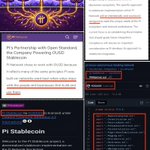
Pi is the native cryptocurrency of the Pi Network ecosystem, supporting ecosystem participation and utility across the network. Stablecoins are cryptocurrencies designed to maintain a relatively stable value, typically by being pegged to an asset such as the U.S. dollar, and they may serve an important but narrower purpose where stable prices are particularly useful.
Learn more about how stablecoins can expand the types of utility and economic activity the Pi ecosystem can support while maintaining a distinct role from Pi itself.
Learn more
Pi Network’s Approach to
minepi.com/blog/pi-stablecoi…

Pi Coin Magazine retweeted
Pi is the native cryptocurrency of the Pi Network ecosystem, supporting ecosystem participation and utility across the network. Stablecoins are cryptocurrencies designed to maintain a relatively stable value, typically by being pegged to an asset such as the U.S. dollar, and they may serve an important but narrower purpose where stable prices are particularly useful.
Learn more about how stablecoins can expand the types of utility and economic activity the Pi ecosystem can support while maintaining a distinct role from Pi itself. minepi.com/blog/pi-stablecoi…
Great one

A few thoughts after TOKEN2049 Singapore, following a long journey and finally making my way back home.
Quite unexpectedly, I met a Product Owner from Pi Network during the event. I should make one thing clear from the beginning: I am not someone who understands Pi Network deeply. I am writing this simply from the perspective of someone relatively new to it, and I would genuinely welcome corrections or different perspectives from those who have followed the project for longer.
I only began looking seriously into Pi Network about a month ago. Nicolas Kokkalis, however, was not a completely unfamiliar name to me.
I first came across Nicolas roughly eight years ago, when I happened to attend a panel where he was presenting StarX, the incubator he was working on at the time. To be quite frank, StarX itself did not leave a particularly strong impression on me. What I did remember was Nicolas. He struck me as someone with an unusually deep understanding of distributed systems — arguably among the stronger people in that field at Stanford.
Later, I briefly had the opportunity to speak with him during a gathering with mutual acquaintances. It was nothing particularly significant, but I remember people describing him as a rather calm and reserved person: someone who rarely made public statements and was far more comfortable with research than publicity.
And that was more or less where the story ended for me. I continued researching AI systems, while he continued on his own path.
Until recently.
As I began exploring the concepts of free mining, decentralised finance and community-owned digital infrastructure, a surprising number of people told me: “You should study what Nicolas built.”
I have never been uncomfortable learning from someone else, regardless of age, background or industry. So I spent about a week studying his project, particularly from the perspective of what lessons might be applicable to the decentralised AI infrastructure we are building.
What I discovered was that the problem was considerably more complicated than I had imagined.
Building technology is difficult. Building technology for millions of people is considerably more difficult. And building something where millions of people attach financial expectations, emotions and personal hopes to that technology is an entirely different matter.
Social media makes this even more complicated.
Perhaps this is also why I understand, to some extent, why Nicolas appears to prefer research to constant public communication. And I respect that.
Recently, he has found himself at the centre of considerable criticism, particularly around the decline in the price of PI. Some people believe that he is deliberately suppressing the token price, or that he should personally be held responsible for its market performance.
I see it somewhat differently.
Before Amazon became what it is today, it went through periods when its survival was genuinely questioned. Tesla went through similarly difficult periods. Had every difficult chapter been reduced entirely to the share price — and had every founder been judged solely by short-term market performance — some of the companies we now consider transformative might never have survived long enough to fulfil their ambitions.
That does not mean founders should be immune from criticism. Nor does it mean price, tokenomics, transparency or execution do not matter. They absolutely do.
But price and vision are not always the same thing.
What I find interesting about Nicolas’s original idea is its ambition: to make digital currency accessible without requiring people to begin with significant capital or pass through the traditional barriers associated with acquiring digital assets, while ultimately pursuing a monetary network that is less dependent on conventional financial intermediaries.

I never and will never move my pi from my wallet to CEX.
So I recommend to all pioneers to do the same. May God bless Pi Community
Pi Ecosystem Participation Survey: What the Questions May Tell Us
I didn’t see it but some Pioneers say they received a Pi Ecosystem Participation Survey before it was removed. Based on questions shared by respondents, the survey explored how people might prefer to receive rewards for activities beyond mining, such as using Pi apps, contributing to projects, or participating in the ecosystem.
One question asked respondents to choose a preferred reward mix:
•All Pi
•Mostly Pi, with some USD stablecoin
•An equal mix of Pi and USD stablecoin
•Mostly USD stablecoin, with some Pi
•All USD stablecoin
Another asked how much they might convert into a USD stablecoin on Pi if rewards were paid entirely in Pi. The listed choices ranged from $0 or less than $5 to more than $1,000.
Why the survey is worth noting
If accurately reported, these questions suggest Pi Network is gathering feedback on possible participation-based rewards and how users might use stablecoins within the ecosystem. They also raise practical questions any future program would need to address: how rewards are funded, which activities qualify, how stablecoins would be supported, and what rules would apply.
For now, the reported questions offer a glimpse into topics that may matter to Pioneers as the Pi ecosystem develops.
#PiNetwork #PiEcosystem #Pioneers #PiApps #DigitalRewards #Stablecoins #Blockchain #Web3 #CommunityFeedback #CryptoEcosystem


The Pi Network Ecosystem will never fail or die by God’s Grace . I don’t know exactly which project you’re talking about but if you referred to Pi Network. Then! Let me tell you this: I have been monitoring this project for 6 years now and since that time I haven’t stopped praying and supporting it with all what I have in my possession . So I believe, It won’t die.
You’re unable to view this Post because this account owner limits who can view their Posts. Learn more