

Assistant Professor at APCTP. Working in the borderlands between quantum information, many-body physics, high-energy theory, and gravity.
Pohang, South Korea
Joined July 2019
- Tweets466
- Following424
- Followers1.1K
- Likes2.7K





I'm very happy about our new paper on the (im-)possibility of relating QFTs to stabilizer codes, using the rigorous tools of von Neumann algebras.
arxiv.org/abs/2610.20790
Big thanks to my collaborators, especially my PhD student Leo Shaposhnik who made this paper possible!


What does it take for relativistic quantum field theory to emerge from a lattice system? Our new work connects this question to a resource from quantum information theory: nonstabilizerness, also referred as as “magic”.
scirate.com/arxiv/2610.20790
The bridge is the structure of local observable algebras. Type III von Neumann factors are characteristic of relativistic quantum field theory. We prove that lattice stabilizer systems—states without magic—exclude type III factors from the central decomposition of their local algebras. For the hyperfinite factors of Araki, Woods and Powers, we establish a quantitative equivalence: the limiting factor is of type III precisely when the locally optimized min-relative entropy of magic diverges.
In this setting, the required resource is therefore an infinite amount of magic. This gives a rigorous connection between a quantum information resource and the algebraic structure of quantum field theory, supporting the proposal that infinite magic is a necessary ingredient for a relativistic continuum to emerge.
Warm thanks to Leo Shaposhnik, @lorenzo_leone_, @bittel_l, Dimitris Saraidaris, and @PhysicistAlex for the wonderful collaboration.

Furthermore, it has been shown that gravitational back-reaction also requires magic (arxiv.org/abs/2403.07056). This means that a code model of holography that describes the interaction of gravity with quantum fields cannot be described with stabilizer codes, either.

The impacts are getting closer... It seems that every field relying on formal proofs will soon be consumed by AI.
Good thing most hep-th papers are written in nigh-indecipherable prose building upon layers of vibe instead.
Lenny Susskind was ahead of the curve once again.

This contains a shocking list of problems in quantum information, many-body physics and quantum computing, the field that are dear to my heart. There are too many, but let me pick the following.
1. Proof of area law in 2D.
2. Spin-one Haldane gap
3. Parity is not in QAC^0
4. Constant-error Aaronson-Kuperberg conjecture
5. Unitary VOAs generating conformal nets.
Things are changing fast. I cannot even imagine what will happen over the next few months, let alone a year.
I suspect many of those "empowered" scientists will be quite upset about being semi-scooped by an unreleased AI version that they couldn't possibly compete with.


We’re releasing a broad range of new mathematical results produced by an internal frontier model.
We’ve been consulting with the independent Advisory Group on Mathematics and Artificial Intelligence at the Institute for Advanced Study, and we have drawn on their advice and public recommendations to inform how we release these results.
github.com/openai/math

With a beautiful view and a full box of hagoromo in my new office, I'm off to a perfect start at APCTP in Pohang, South Korea!


Per popular request, I've extended the application deadline for both postdoc positions to *Aug 19*.

As promised, I'll be hiring two postdocs for my new group at APCTP later this year!
We'll work on a range of topics from high-energy to quantum information theory, collaborating across the Asia-Pacific region and beyond.
Deadline Aug 12. More: apctp.org/bbs/board.php?bo_t…

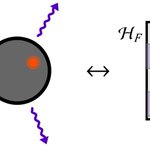
Three years ago, we proposed "overlapping qubits" as a description of information encoding in quantum gravity.
In our new paper with Charles Cao's group at @VTPhysics, we finally apply overlapping qubits to evaporating black holes!
arxiv.org/abs/2608.10085

But if we wait longer, our overlapping exterior basis becomes more and more overcomplete, allowing us to recover the interior with a simpler circuit! That is, the complexity barrier between interior and exterior modes is gradually, and very slowly, broken down.