

Ed tech consultant, blogger, family man
Cave Creek, AZ
Joined December 2008
- Tweets26.4K
- Following1.1K
- Followers8.3K
- Likes9.4K





We need to stop calling every course chatbot an “AI tutor.” That fallacy is already leading to "research" (square quotes intended) that is impacting institutional decision-making.
A new University of Maryland study reports lower average course grades and lower LMS participation in sections offered an AI study assistant. @morganmundum and I looked at what was actually tested (mostly based on Morgan's analysis, augmented by Stephen J. Aguilar):
• Only about 15% of students offered access ever used the tool.
• The default mode provided answers. Only two instructors ended the term with tutoring mode enabled.
• Nearly 74% of student requests sought information, explanations, or solutions. Less than 1% sought feedback on students’ own attempts.
Putting course documents behind a chatbot does not automatically create tutoring. Tutoring should identify what a student understands, diagnose misunderstandings, and adapt guidance accordingly.
Likewise, putting a tool inside the LMS does not establish that instructors integrated it into their teaching.
The lower grades and participation deserve attention. But the study does not establish that using an AI tutor caused students to learn less. At best, the study measures the effects of *offering this particular intervention with no scaffolding*, with limited adoption and an unresolved explanation for the declines.
There is useful evidence here about a poorly-designed chatbot rollout. Presenting it as evidence about “AI tutoring” stretches that contribution into something the study barely tested.
Availability is not adoption. Answer delivery is not automatically tutoring. Course grades and LMS activity do not tell the whole learning story.
onedtech.philhillaa.com/p/an…

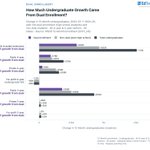
High school students account for 9.3% of undergraduate enrollment at public four-year institutions—but 47% of their enrollment growth from 2022–23 to 2024–25. The composition of enrollment is important to understand.
Building on CCRC’s new dual enrollment analysis, my latest On EdTech post looks at where the growth is coming from, by sector and institution. Across the institutions included in our analysis, high school dual enrollment students accounted for 38% of undergraduate growth.
Some colleges are adding both high school students and other undergraduates. Others are growing overall because dual enrollment gains offset declines elsewhere. And this pattern extends well beyond community colleges.
Rising headcounts alone don’t establish financial recovery or stability.
onedtech.philhillaa.com/p/du…
#HigherEducation #DualEnrollment

I’ve held back on attributing the difficult job market for recent college graduates to AI. The tech hiring correction started before ChatGPT, and too many explanations skipped over that fact.
We now know more.
A new Census Bureau working paper offers some of the strongest evidence yet connecting college majors’ AI exposure to graduates’ actual employment and earnings. Its particular value: it follows graduates across industries, capturing setbacks that studies focused on particular occupations can miss.
Graduates from the most AI-exposed majors experienced the largest deterioration. But these fields were also heavily exposed to the reversal of the pandemic tech hiring boom. The study cannot fully separate those effects.
My interpretation: it is increasingly likely that AI is adding to the deterioration in early-career opportunities. How much remains unresolved.
In my latest On EdTech post, I explain the findings and limitations in plain language, with recreated, interactive charts that let readers explore individual majors.
Read “A Clearer Picture of AI and the College Job Market”: onedtech.philhillaa.com/p/a-…

Phil Hill retweeted

When Schools Ban AI, What Exactly Are They Banning?
- @PhilOnEdTech
onedtech.philhillaa.com/p/wh…

There’s a growing movement to ban or restrict AI in education. But once you get past the announcement, a basic question becomes surprisingly difficult:
What exactly are you banning?
AI is increasingly embedded throughout EdTech products. It can generate course materials, coach students, translate captions, remediate documents, summarize discussions, provide formative feedback, or evaluate student work. Those are very different activities, even when they sit inside the same product.
In my latest On EdTech post, I look at the new restrictions in NYC, LA, Chicago, Berkeley, and Rutgers, then work through what they could actually mean for LMS and other EdTech products.
I also look at the approaches emerging from MIT and the University of Sydney, which I find much more useful. They start with the educational activity and who gets to make the decision, rather than treating the mere presence of AI as the deciding factor.
Because “we banned AI” is the easy part. Figuring out what that means in an LMS, courseware platform, Zoom meeting, or accessibility tool is where things get interesting.
onedtech.philhillaa.com/p/wh…

I think we can stop asking whether online education has “staying power.” The more interesting question is what the post-pandemic market actually looks like.
The latest 12-month IPEDS data make the first part surprisingly clear. After years of steady growth, followed by the obvious Covid disruption, online participation appears to have found a new equilibrium. We now have four consecutive releases showing essentially the same pattern. This is starting to look less like the lingering effects of Covid and more like the emergent structure of US higher education.
But the top line numbers hide quite a bit. Undergraduate and graduate students use online education very differently, despite apparently similar participation rates. And institutional online growth can mean actual enrollment growth—or merely offset losses elsewhere.
I dug into all three, including why the newer 12-month data provide a better lens for this question than the Fall enrollment data getting attention this week.
onedtech.philhillaa.com/p/on…

IPEDS Fall Enrollment data gets most of the attention, but it has an important limitation for understanding online education: it is a snapshot taken in the fall. That increasingly misses how online education actually works, particularly with multiple starts, shorter terms, and working-adult students.
The newly released 2024-25 IPEDS 12-month enrollment data gives us a different view. And there are some interesting results.
Two-thirds of students took at least one online course during the year, considerably higher than the Fall Enrollment measure. The post-pandemic modality mix also looks remarkably stable at this point—not a continued return toward pre-pandemic patterns.
And at the institutional level, WGU and Southern New Hampshire continue to operate at a scale that is hard to appreciate from the usual fall enrollment numbers.
I pulled together the latest data, including trends by modality and sector and the largest institutions by online enrollment.
onedtech.philhillaa.com/p/20…

Risepoint announced this morning that it has acquired Keypath Education’s North American business.
The headline is straightforward. The more interesting story is what Risepoint thinks it bought, and what the deal says about where the OPM market is going.
I spoke with Risepoint CEO Fernando Bleichmar about the acquisition. His argument is that the old OPM model—built heavily around marketing, enrollment, and the bottom of the funnel—is stale. In this deal, Risepoint is making a specific bet on healthcare and particularly on clinical placements, a constraint that marketing can’t solve.
There are also some interesting questions about what exactly Risepoint acquired, why Keypath sold now, and how much further this concentrates the OPM-supported nursing market.
I cover the story in today's On EdTech post: onedtech.philhillaa.com/p/ri…

I don’t often cross-post articles from other newsletters, but occasionally @morganmundum 's On Student Success covers a topic that deserves a broader audience. This is one of those cases.
The post tackles a subtle but important shift in higher education. For years, growth mostly meant attracting more students into the system. Increasingly, however, growth means taking students from someone else. Particularly in the US and the UK.
That may sound like semantics, but it changes how institutions should think about strategy. It also changes how we interpret stories about enrollment gains, partnerships, and “winning” in the market.
It’s a useful framework for understanding why some colleges and universities are doing well despite a flat—or shrinking—overall market.
Worth a read if you’re trying to make sense of where higher ed is headed.
Original OSS post: onstudentsuccess.morganedtec…
Cross-posted at OET: onedtech.philhillaa.com/p/wh…

I left InstructureCon with three overriding impressions.
First, Instructure passed the transparency test. Given the seriousness of the cybersecurity incident this spring, I was watching closely to see whether the company would avoid the topic or address it directly. To its credit, leadership discussed what happened, what they learned, and where they’re investing going forward. Not every company would have handled that as openly.
Second, the company has a strategy. That’s worth saying because the LMS market has been flooded with AI announcements over the past year. At InstructureCon, I came away with a much clearer picture of how Instructure sees AI fitting into its platform and business over the next several years. Whether you agree with the strategy or not, it felt far more coherent than a year ago.
The third impression is more mixed. Having a strategy is one thing. Delivering on it is another. There are still execution challenges, and I think that’s the biggest question facing Instructure over the next few years.
My conference notes cover all three topics, along with product announcements and what I think they mean for the LMS market.
onedtech.philhillaa.com/p/in…

I spent last week at D2L Fusion, and my biggest takeaway isn’t about AI. It’s about strategy.
I came away thinking that D2L seems to have the most advanced LMS strategy in the market right now. Not always the best product, and certainly not the biggest company, but the clearest strategic view of where the market is heading and how to position itself over the next several years.
At the same time, the company still seems to have a bit of a chip on its shoulder. That’s understandable. Despite making a series of smart moves over the past few years, D2L isn’t dominating the market or financial results. The strategy is paying off, but not nearly as dramatically as the company would like.
That combination was fascinating to watch. A company that seems increasingly confident in its direction, yet still has something to prove.
My conference notes cover why I think D2L has quietly strengthened its position, what I learned from the conference, and what it all says about where the LMS market is heading.
onedtech.philhillaa.com/p/d2…

A typical Department of Education higher-ed rule takes about 17 months to travel from the first negotiated rulemaking session to a published Final Rule. Before this year, the fastest anyone had ever managed was roughly nine months.
The Trump II Administration just produced the three fastest rules in the entire 2009–2026 record. RISE (student loan limits) at seven months. Workforce Pell at five. Institutional Accountability at six. All three clear the old floor by a comfortable margin.
I mapped every major ED postsecondary rule going back to 2009 to see whether this speed was genuinely new or just felt that way. It is new. And the more interesting finding is how they did it: not by rushing one stage of the pipeline, but by running the whole thing fast, from negotiation through comment response.
Some of that was forced by an OBBB statutory deadline. But I'd argue what we're watching is a deliberate strategy, and it comes with real costs, including litigation risk on choices ED made that Congress never required.
New on On EdTech, free to read and share: onedtech.philhillaa.com/p/un…

AI resistance in higher ed has mostly been treated as a B2C issue: students, faculty, cheating, learning, jobs, and institutional policy.
I think the B2B version is becoming a much bigger issue.
The Anthropic Fable 5 saga is a warning shot. The specific debate is about Anthropic, US government restrictions, and advanced model access. But the broader EdTech question is simpler:
What happens when universities and vendors start depending on AI capabilities they do not control?
This is not just about campus-wide ChatGPT or Claude contracts. It is about AI embedded into LMSs, advising platforms, assessment tools, accessibility workflows, student support, analytics, and administrative systems.
In the cloud era, Europe’s adoption of cloud-based EdTech was slowed by privacy, surveillance, and data-residency concerns until infrastructure changed the procurement conversation. AWS Frankfurt was one of those moments.
AI may need its own version of AWS Frankfurt.
Not because the analogy is perfect. Cloud sovereignty was mostly about where data lived. AI sovereignty is about something harder: who controls the capability, who can change it, and what happens if it is restricted, repriced, downgraded, or withdrawn.
My latest On EdTech post: put AI sovereignty on your radar.
onedtech.philhillaa.com/p/pu…

CalMatters found a genuinely indefensible online course in the California Community Colleges: decade-old recorded lectures, multiple-choice quizzes, and the professor handing students the answers before the test. They're right to be appalled. So am I.
But then the article does something the evidence doesn't support — it extrapolates that one bad course across a system where 40% of courses are now online, as if the modality were the diagnosis.
It isn't. Bad course design is bad in any modality. The variable that actually predicts course quality is not online vs. in-person — it's whether a campus chose to invest in quality. And the system's own 2024 POCR Landscape Report already documents both halves of that story: where peer course review is applied, success rates rise (12% at Chaffey, with the same faculty pre/post) — but the process is optional and unevenly funded, which is exactly how a course like the one CalMatters found still slips through.
None of that infrastructure — the course-design rubric, POCR, the data showing the online/face-to-face performance gap nearly closed — made it into the article. It wasn't hard to find. It just didn't fit the story.
My full breakdown, including what the current and former CVC executive directors told me on the record:
onedtech.philhillaa.com/p/wh…

I've spent a lot of words on what's wrong with the federal earnings-premium accountability rules. Stale data, blunt instruments, measurement that doesn't measure what it claims to. I haven't changed my mind about any of it.
But this morning Patrick Methvin of the Gates Foundation made the case for why we need accountability anyway — and he's right. So I wrote the half I've covered too little.
My daughter Betsy finished an associate degree in diagnostic medical sonography a year ago. In-demand field, hard program, real work. Nearly 200 applications later, she still doesn't have the job she trained for. Neither do most of the people she graduated with.
The reason isn't her. Phoenix has three sonography programs feeding more graduates into the metro than it can hire. And almost no one is accountable for matching how many students a program enrolls to what a real, local labor market can actually absorb.
That's the dimension the national earnings debate keeps missing. Accountability isn't a formula — it's a school owning what happens to the people it enrolled.
A flawed instrument is an argument for a better one, not for no instrument. Worth doing, and worth doing right.
Betsy isn't the point. She's just the window.
👉 onedtech.philhillaa.com/p/th…

Most of the opposition to the Do No Harm earnings accountability rule is arguing about something Congress already settled.
Of the 8,719 public comments in the AHEAD docket (as of today), 83% reject the rule outright—defending cosmetology, massage, allied health, or another sector. But the framework itself is now statutory, codified through OBBB. ED can't withdraw a statutory requirement in response to public pressure, and litigation against the underlying law faces a much higher bar than litigation against regulatory choices.
The comments that will actually matter—the ones ED's lawyers are reading carefully and that will surface in the inevitable court challenge—include a small cluster of filings (McGuireWoods, AACS, Aveda Institutes Cooperative, Association of Chiropractic Colleges) arguing that ED lacks statutory authority to extend earnings-premium accountability to undergraduate certificate programs. One of them is meaningfully cleaner than the others, because it uses OBBB itself as the limiting statute rather than relitigating older HEA text.
Other findings from the AI-enabled classification of all 8,719 comments:
→ Career-school operators filed 35% of comments directly; roughly half the docket came from the regulated industry or its direct representatives
→ Only 1.5% of comments are purely pro-rule
→ The citizen voice is mostly genuine—1.8% of citizen comments use coordinated industry talking points, vs. 6.7% on the operator side
→ Total cost of the analysis: $9.68 in API spend plus about seven hours of work, on tools that didn't exist six months ago
Full post—who filed, what they said, which arguments will shape the final rule, plus methodology and four charts: onedtech.philhillaa.com/p/in…

I suggest that all newsletter writers take the rest of the day or week off in honor of @neilmosley5 's gem of a paragraph today.
"Those looking for a singular, simple reason to explain the growing number of partnerships coming to an end will be disappointed. There are a range of factors at play. Some OPM critics, including small pseudo-religious sects that seem to live out their days in a simplistic, angsty, Manichean la la land, will point to company performance and how the “evil” private sector is leeching off higher education whilst simultaneously not delivering, and the sector is getting wise to it. However, while they build their plastic populist personas on whatever slightly naff Twitter substitute is currently popular, the complex, nuanced, real world spins around them."
We cannot top that.
neilmosley.com/blog/why-are-…

Instructure took a meaningful step forward this weekend in its response to the Canvas cybersecurity incident.
CEO Steve Daly issued a direct, named apology. The company added more substance to its Incident Update page. It disclosed the Free-For-Teacher root cause and named CrowdStrike as part of the response.
Those are real improvements.
But the response still has a deeper problem: Instructure is describing this as a platform security incident, while its customers are experiencing it as an academic continuity event.
Canvas is not just another enterprise system. It is where students get assignments, submit work, access grades, prepare for finals, and communicate with instructors. When Canvas is unavailable, defaced, or tied to exposed messages and identifying information—especially during finals week—the impact is not merely “inconvenience and concern.”
It hits the core academic operations of institutions.
That distinction matters. Academic leaders from universities including Illinois, Chicago, and ASU have been announcing canceled or delayed finals. Higher ed trade press is still being deflected to static statements. Direct questions about ransom payment are going unanswered. The scale of the breach and end-of-term disruption has not been fully acknowledged by the company at the center of it.
There is also a transparency issue. Instructure’s Incident Update page carries a noindex directive, meaning the company has published a public page while signaling search engines not to include it in search results. That may be technically defensible for a live operational page, but it is much harder to defend for the central public source during an active incident, when customers, students, parents, reporters, and institutional stakeholders are searching for authoritative information.
The point is not that Instructure has done nothing right. It has. The point is that the form of the response is improving faster than the substance.
Canvas built its market position in the 2010s on openness, customer alignment, and trust. That posture is not yet visible enough in Instructure’s response to this incident.
One step forward. One step back.
I wrote more in today’s On EdTech post: onedtech.philhillaa.com/p/on…

New podcast episode:
"In this bonus episode recorded live at the @CollegisEdu DisruptED summit in Phoenix, Dustin Ramsdell spoke with me and Charlie Rose about the rapidly shifting higher education policy landscape and its implications for institutions. They unpack how recent federal actions—particularly new legislation and accelerated rulemaking—are creating both urgency and uncertainty, while also signaling a longer-term shift toward accountability, affordability, and measurable student outcomes."
enrollify.org/episodes/live-…

New post at On EdTech:
The new graduate loan caps are being discussed as a federal finance policy issue. That is true, but it is also incomplete.
Using data from PEER Center’s new report, I created a set of visualizations to show a point that is hard to grasp from tables alone: the impact will not hit evenly. At California, Oregon, New York, Nevada, and Vermont institutions, more than 40% of graduate borrowers already borrow above the new OBBBA loan caps. In Arizona, Delaware, New Hampshire, and Utah, the share is 15% or lower.
The geography matters, but it is not the whole story. What the data really suggest is a geography-plus-program-portfolio problem. Professional programs such as medicine, law, and dentistry face one kind of pressure, while MBA, nursing, social work, PT, and physician assistant programs face another. Same federal law, very different local consequences.
I also included a downloadable PDF with all 52 images (50 states + DC + US view) for anyone who wants to explore the state-level patterns more directly.
The post is here: onedtech.philhillaa.com/p/th…
