

The drop-in Postgres cache. Check your workload: https://xitter.cf/t.co/WkdtkZP5G8 Quick start: https://xitter.cf/t.co/zEEzsoPPoR Discord: https://xitter.cf/t.co/2KP69gQ4ys
Los Angeles, CA
Joined April 2026
- Tweets80
- Following61
- Followers17
- Likes26




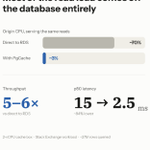


Oracle has a built-in read cache .. why doesn't PostgreSQL?
Teams migrating from Oracle end up rebuilding it in the app.
At PgCache we think there's a better way to serve reads for Postgres: a drop-in proxy that automatically caches hot reads.
pgcache.com/try

Reliability is indeed one of the big reasons that James is building @PgCache on PostgreSQL!

What keeps you coming back to PostgreSQL?
For James Nelson of @PgCache, it’s reliability, even with the trade-offs.
Watch: youtu.be/iBtHtSzsZBw


PgCache retweeted

Postgres logical replication and schema changes: James Nelson, Founder and CTO of @PgCache, shares his Postgres Wish on T3D.
youtu.be/YC5B1zjFaZ0

Here's the free WASM tool we built to speed up some of the analysis for you:
pgcache.com/fit

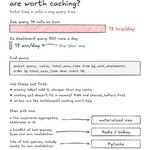
Which Postgres queries are worth caching?
We shared a free online Postgres tool on Reddit yesterday. 26k views and 180 shares so far!
The idea behind it is pretty simple: rank your queries by total time vs what "feels slow."

PgCache retweeted

CYBERTEC CEO Hans-Jürgen Schönig (@postgresql_007) breaks down why the massive, unstoppable PostgreSQL ecosystem is what actually makes the difference for enterprise stability and long-term dominance.
Watch the full #ConvoWithCEO interview here 👇
youtu.be/g6PL2uUL4lY?si=hOTa…
Want to know if your workload fits before you build anything? Paste your pg_stat_statements into the Fit Analyzer. It shows which queries PgCache would cache, which pass through, and why. Runs in your browser: no signup, nothing uploaded.
pgcache.com/fit
Under the hood it's a Smart Read Replica: it holds only the data your traffic touches and keeps it current from the logical replication stream. Writes and anything it can't cache go straight to Postgres. (Not a fit yet if your reads rely on RLS.)
Several teams have come to us lately at this exact point: cache decided, not built yet.
What they wanted to skip: cache logic around every hot query, key deletes on every write path, TTLs to second-guess in production.
That's what we built PgCache for.

We built PgCache but we've never met (yet!)
That'll change when we head to NYC in a couple weeks for Postgres Summit US/ @pgconfnyc
And, if you're in SoHo 9/30 to 10/2, and want to grab a coffee, send us DM --we'd love to connect!

You probably don't need another read replica.
What you probably need is the answer to this question:
"how much of our read traffic can be cached?"
Check yours for free in 2 minutes, locally in your browser, at pgcache [dot] com/fit.

We see a third path for scaling reads on PostgreSQL
Path 1 - Read replicas & server upgrades.
Path 2 - External caches.
Path 3 - CDC-driven smart read replicas.
We saw what's possible with PostgreSQL Logical Replication, and thought "it doesn't have to be this complicated."
@HuluWZ built an independent PgCache benchmark with a custom ecomm workload and some slick design choices.
No diff on point lookup speed (not our focus)...
But he saw 2.9 seconds -> 0.6 ms on a 10M-row join 🔥
dev.to/huluwz/how-i-put-pgca…

Independent benchmark of PgCache.
16M rows, published in full.
No difference for point lookups, because that's not what we're solving for (0.3ms → 0.3ms).
But the 10M-row join?
2.9s → 0.6ms
Unpaid, unaffiliated, MIT repo:
dev.to/huluwz/how-i-put-pgca…
In the age of Logical Replication there's simply no reason a human or agent should have to manually configure invalidation, TTLs ... much less decide which queries get cached.
PgCache does it all for you. Check out our benchmark harness.
github.com/PgCache/pgcache-b…
