

𝚌𝚛𝚢-𝚙𝚝𝚘 || 𝚜𝚑𝚒𝚝𝚙𝚘𝚜𝚝𝚒𝚗𝚐 || 𝚖𝚎𝚖𝚎𝚜 || 𝚖𝚊𝚛𝚔𝚎𝚝𝚒𝚗𝚐 || AMB @𝚜𝚗𝚍𝚌𝚊𝚙𝚙, @𝙳𝙸𝙰𝚍𝚊𝚝𝚊_𝚘𝚛𝚐 ×͜×
The Metaverse
Joined July 2023
- Tweets7.6K
- Following904
- Followers2.5K
- Likes8.3K









Pinned Tweet
what if the biggest assumption behind blockchain security is starting to become outdated?
for years, we've relied on billions of dollars in staked tokens to keep networks honest.
but cryptography is beginning to challenge that model, and i think the implications are bigger than most people realize.
I dug up one of DIA old blog post on "How Cryptography is Eating Cryptoeconomics"
🧵and here is my opinion in this mini thread🧵

but i don't think cryptography makes staking unnecessary.
a mathematical proof can confirm that a computation was correct, but it cannot guarantee that someone will process transactions on time.
networks still need incentives for availability, participation and accountability.
both approaches solve different problems.

this is particularly interesting when you look at what @DIAdata_org is building with Lasernet.
DeFi protocols depend on oracles for asset prices, collateral valuations and liquidations.
Lasernet makes oracle data processing and aggregation verifiable onchain.
it shows why transparency matters beyond simply delivering a price.
my takeaway from DIA article is that blockchain security doesn't have to depend entirely on how much capital participants are willing to stake.
cryptography can help prove correctness, while economic incentives help keep networks operational.
i think the future will involve more of both, rather than one completely replacing the other.
full article: [diadata.org/blog/post/crypto…]

Proof of Stake relies on economic incentives.
validators lock up tokens, and if they cheat, they risk losing them.
cryptography takes a different approach. instead of relying on financial penalties, mathematical proofs can verify whether a computation was done correctly.

take @DIAdata_org zkVMs, for example.
they allow computations to happen outside a blockchain while generating proofs that can be verified onchain.
MPC and FHE also make it possible to work with private or encrypted data.
the interesting part is how these technologies reduce the need to trust whoever performs the computation.

PETREX ☯︎ retweeted

Wasn't eligible for the free CONSO BOT by @conso_xyz , so I did what I do best and made a motion graphic about it 🎬
Install the extension, connect your AI, keep your streak going.
Farm → conso.xyz/extension
Bots → conso.xyz/bots
most people only see the final price an oracle delivers, not how that price was calculated.
@DIAdata_org is changing that with Lasernet, bringing data aggregation and price computation onchain.
for DeFi protocols, being able to verify how a price was calculated is just as important as receiving it.
transparency should extend beyond the final number.

Most DeFi protocols assume oracles only bring off-chain market prices on-chain.
They completely overlook the bigger bottleneck: private off-chain reserves.
When protocols deal with tokenized treasuries, institutional bank reserves, or private credit, APIs either:
1. Expose private credentials/sensitive data, or
2. Rely on a centralized auditor’s sign-off.
ethereum:0x84ca8bc7997272c7cfb4d0cd3d55cd942b3c9419 ZK solves this with zkTLS and selective disclosure.
Instead of trusting an off-chain API response, DIA cryptographically binds the web session to the source. The smart contract verifies the TLS handshake and the reserve balance without ever seeing the private API keys or underlying institutional credentials.
No auditor trust assumption. Pure cryptographic proof.
Is zkTLS the missing primitive for institutional RWA on-chain? @DIAdata_org

a single bad price feed can put millions in DeFi collateral at risk.
lending positions, liquidations, and collateral valuations all depend on accurate data.
even audited smart contracts can fail users when the information they rely on is wrong.
@DIAdata_org provides transparent, verifiable oracle feeds that help protocols price assets and manage risk across multiple blockchains.
because secure code means little if the data driving it can't be trusted.

there's a lot you can learn about crypto without having to lose money figuring things out yourself.
i've been spending some time exploring @exolix_com Academy, and what i appreciate is how it breaks down topics that people often overlook until they encounter a problem.
from understanding crypto swaps and what to do when funds don't arrive, to learning about DePIN, RWAs, tokenomics and how different parts of DeFi work.
even as someone who's been around crypto for a while, i still find it useful to revisit these topics. sometimes it's the small details you think you already understand that turn out to matter most.
what i also like is that the articles aren't limited to beginners. there's enough variety for someone who's just getting started and someone who wants to understand the industry beyond trading tokens.
if you're using crypto regularly, i'd recommend spending some time with Exolix Academy.
understanding how things work can save you from mistakes that are much more expensive than the time spent learning

I hope it's not too late to GM 😌
If you need to chase airdrops, think @sndcapp
Looking for that trusted exchange to swap with, think @exolix_com
You want a reliable data feed oracle for your DeFi protocol, think @DIAdata_org
Best coin to hold now? Think DIA token (NAFA)
Keep grinding 🥂
DeFi has a collateral pricing problem, and it's becoming a concern beyond crypto.
the IMF recently highlighted something important about tokenized finance: as more real-world assets move onchain, the way these assets are priced could become a risk to the wider financial system.
here's why.
most DeFi lending protocols rely on market prices to determine how much collateral is worth, how much users can borrow, and when liquidations should happen.
this works reasonably well for assets with deep liquidity and active trading markets.
but what happens when the collateral is a tokenized treasury fund, a yield-bearing token, or an asset that barely trades?
using the last traded price might not reflect what that asset is actually worth.
and when a lending protocol relies on an inaccurate or outdated price, it can trigger unnecessary liquidations or create bad debt.
this is particularly important because smart contracts execute automatically. they don't stop to question whether the price they're receiving makes sense.
the IMF's concern is that faulty pricing could amplify financial stress as tokenized assets become more connected to the broader financial system.
this is where @DIAdata_org's DIA Value becomes relevant.
instead of depending entirely on secondary market trading, DIA Value calculates an asset's fundamental value using inputs such as redemption rates, reserve balances, and other verifiable data.
for example, a yield-bearing token can be valued using its redemption rate from the issuing smart contract, while a reserve-backed stablecoin can be assessed using the relationship between its reserves and circulating supply.
the computation is also verifiable onchain, making it easier for lending protocols and risk managers to understand where a valuation comes from.
this doesn't mean market-based oracles are becoming irrelevant. they're still useful for liquid assets.
but as DeFi expands into tokenized RWAs and institutional lending, different assets will require different pricing methods.
and institutions won't just need accurate collateral valuations. they'll need pricing methodologies they can inspect, verify, and defend during audits.
that's why oracle infrastructure is becoming part of the conversation around financial stability and regulation.
bringing assets onchain is only part of the work. making sure DeFi can value them reliably is just as important.


onchain lending vaults are becoming a much bigger part of DeFi.
deposits have grown from $1.5B to $10B in just two years, and S&P Global Ratings is now introducing a framework to assess their risks.
this signals a growing need for transparency and standardized risk assessment across DeFi lending.
but evaluating vaults also means being able to compare them across different protocols and blockchains.
that's where @DIAdata_org's vaults map becomes useful.
by bringing vault data together across 70+ chains, DIA makes it easier to explore and compare lending opportunities across the ecosystem.
as institutional interest in DeFi grows, accessible data and independent risk assessments will become increasingly important.
the next phase of onchain lending isn't just about attracting more deposits. it's about making the risks behind those deposits easier to understand.

This is some wonderful read 📚
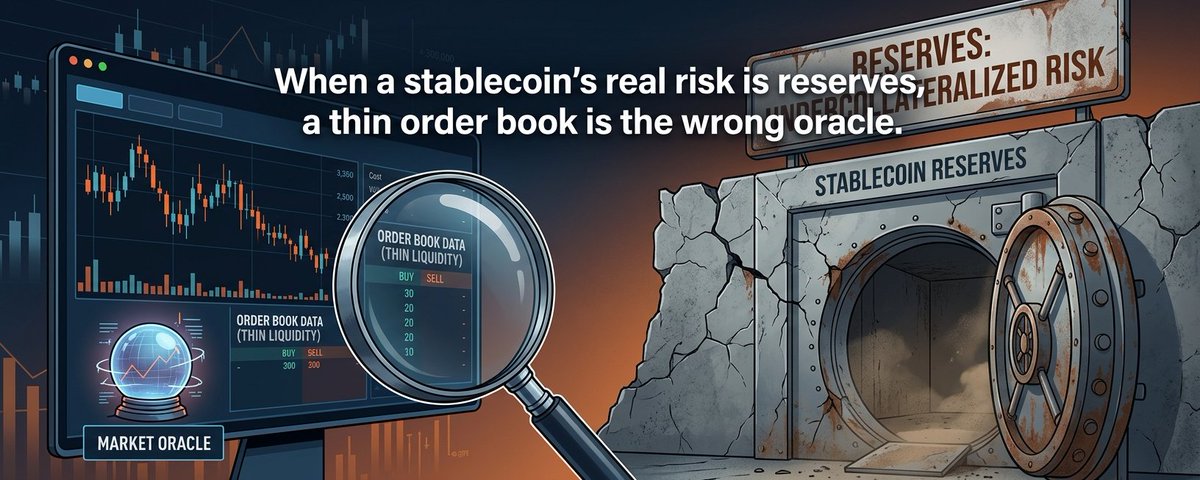
market prices don't always reflect what backs a stablecoin.
this is where @DIAdata_org's DIA Value oracle helps.
it uses verifiable reserve data, backing ratios and onchain supply to calculate fair value, giving DeFi lending protocols more transparent collateral pricing.
tGBP is a practical example of why proof of reserves matters beyond market prices.

the @exolix_com × @kotova_io Zealy sprint is still live, and there's 500 $USDC up for grabs.
if you haven't joined yet, there's still an opportunity to get involved.
explore both projects, complete project-focused quests, earn points, and climb the leaderboard for a chance to share in the prize pool.
don't miss out on the sprint: [zealy.io/cw/exolix/questboar…]

crypto has spent years trying to eliminate trust from financial transactions, yet many DeFi protocols still rely on price data they can't independently verify.
think about that. a lending protocol can have perfectly audited smart contracts, but if its oracle reports an inaccurate collateral price, users can still face unfair liquidations or the protocol could accumulate bad debt.
that's why i find @DIAdata_org's approach to oracle infrastructure interesting.
through DIA Lumina, market data is collected by independent Feeders, processed onchain through Lasernet, and delivered to applications through Spectra.
the goal is to make the entire data pipeline transparent and verifiable, rather than asking protocols to blindly trust a reported price.
and as DeFi expands into RWAs, stablecoins and tokenized financial assets, this becomes even more important.
because a smart contract can only be as reliable as the data it depends on.
that's a fundamental problem DIA is working to solve.

Lionel Messi retires from international football ⚽️
Thanks for making football this interesting all these years ✨️🥂
mass adoption usually means more users, institutions, and regulators.
That pressure tends to favor transparent chains and identity checks (KYC/AML) because exchanges, banks, and governments want traceable flows.
in my opinion, projects that treat privacy as a baseline (rather than an optional add-on) face delistings, restricted access, or design choices that trade usability for compliance.
but, I would like to know more where privacy sits in this exploration, and i will like my DeFi frens to join the space. you will learn a lot
Be there today by 14:00 UTC 🫵🏾

🔓 As crypto moves toward mass adoption, where does privacy fit in, and what comes next?
🎙️ Join Exolix Roundtable to discuss the future of privacy with @zelcore_io, @PirateCash_NET, @monerujowallet & @PirateChain on Oct 7 at 14:00 UTC.
Set a reminder: xitter.cf/i/spaces/1vJpPNOgEbkJE…
