
Husband, Father, Director @centre4fe , Research Associate @famstudies . Substack: https://xitter.cf/t.co/GiVdv0CRkg. Views my own
Joined February 2025
- Tweets617
- Following116
- Followers161
- Likes596


Pinned Tweet
Two working papers in the past month ascribed fertility decline to the smartphone, but they couldn't tell us which aspect of smartphones do it. In this paper, I find that interest in mobile dating apps, unlike social media, leads to an immediate fall in fertility outcomes.

Peter Foreshaw Brookes retweeted

I was delighted to get to write this piece. Usually I have to keep my demography takes "demography, with a veiled hint of faith." Was nice to be able to lay out what I think the stakes really are for churches.


Happy to have @lymanstoneky debut @AmReformer discussing an important study he and his colleagues @FamStudies recently published on cultural factors influencing fertility and ways Christians can think about creating a culture that supports and encourages having children.
Peter Foreshaw Brookes retweeted

We know fertility is contagious, but we do not know what exactly is being “caught.”
@lymanstoneky @PeterRFB begin to open the "black box" of fertility culture in indispensable new research @FamStudies. Link below
Peter Foreshaw Brookes retweeted

Happy to have @lymanstoneky debut @AmReformer discussing an important study he and his colleagues @FamStudies recently published on cultural factors influencing fertility and ways Christians can think about creating a culture that supports and encourages having children.
Peter Foreshaw Brookes retweeted

Fighting back against safety-ism is essential for rebuilding social bonds.
My @famstudies colleagues @lymanstoneky @DrJasonCarroll @PeterRFB find a connection between a willingness to take risks and intending on having kids.

Peter Foreshaw Brookes retweeted

Important @lymanstoneky @DrJasonCarroll @PeterRFB @BYUWheatley on fertility and culture: ifstudies.org/report-brief/b…
Dan Snow, the pop historian, performed a citizen's arrest during the 2011 London riots

In a low fertility world, willingness to take a chance & willingness to act under uncertainty is what it takes to form a family today, as @lymanstoneky, @DrJasonCarroll and I find in @FamStudies today

Report here: ifstudies.org/report-brief/b…. Piece on the relationship between risk and fertility today: persistentruminator.substack…
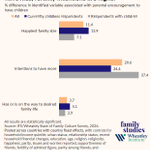
Families that value having kids on a family-wide level... have more kids. New with @FamStudies

Report: ifstudies.org/report-brief/b…

Life is all about priorities. If you prioritise thing A and don't do anything about achieving thing B, you implicitly say no thing B. So it is with family life today, as @lymanstoneky, @DrJasonCarroll and I find in @FamStudies today

Report: ifstudies.org/report-brief/b…


Having children today is a matter of seizing the day! As I detail here following our report @FamStudies: persistentruminator.substack…
Source: ifstudies.org/report-brief/b…
Peter Foreshaw Brookes retweeted

We know that culture drives fertility more than money these days, but what specifically is it about culture?
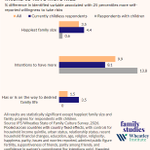
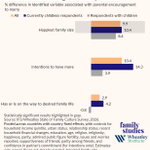
In wonderful report published today, @FamStudies surveyed 10,000 people around the world to learn what it is about culture that leads people to have kids or not. 🧵.


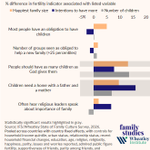
In this new report, @lymanstoneky @PeterRFB and @DrJasonCarroll begin the work of opening the black box of fertility culture. We explore the specific factors across and within societies that lead some people to have many more children than others.
We used a survey of nearly 10,000 people spanning over a dozen countries.
Most of our survey covered questions that have rarely, if ever, been
surveyed cross-nationally, or have not been surveyed in a research program that also. As a result, we can present first-of-a-kind evidence on what specific. cultural norms typify successful pronatal cultures.
Here are our main findings:
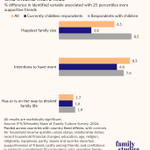
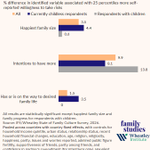
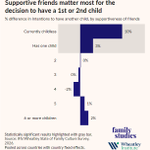
1. Friends and family matter to fertility intentions.
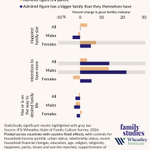
2. The family lives of celebrities (and the visibility of celebrity family lives)
influence the family lives of fans.
3. Effective pronatal beliefs entail positive attitudes towards family life, but not necessarily any particular sense of obligation.
4. Division of household labor does not have a big impact on fertility.
5. Active faith matters to fertility desire and outcomes.
6. A willingness to take risks and an optimism about the future both predict intentions to have children and the number of children a respondent already has.

Peter Foreshaw Brookes retweeted

Institute for Family Studies: Baby Nudges: How Social Influences Shape Fertility Choices ifstudies.org/report-brief/b…