

Retired Harpsichord Polisher.
Joined July 2011
- Tweets48.8K
- Following2.6K
- Followers2K
- Likes12.6K




Painting at Bedtime.
Miss Elsie Palmer.
John Singer Sargent.
I think this is one of Sargent's best portraits. The sitter is about 17 here, and she is looking boldly at us. The part of her dress at the back is called an accordian pleat. Never let it be said I don't do my research

Painting at Bedtime.
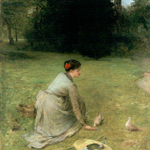
Feeding the Pigeons.
Sir William Quiller Orchardson.
Orchardson was a Scottish artist, mainly of genre pieces and portraits. His paintings are always interesting, even unusual, and were well received in his own time. He was knighted 3 years before he died.

Painting at Bedtime.
Yachting on the Mediterranean.
Julius LeBlanc Stewart.
Stewart was an American artist from Philadelphia. He spent almost all of his time painting in Belle Epoque Paris. He was wealthy and painted anything he liked. This is his most expensive painting.

Painting at Bedtime.
Autumn.
Mary Cassatt.
This is a painting of Mary Cassatt's sister Lydia. The colours of the clothes she is wearing match the autumnal setting in which she is sitting. Lydia was the older sister and suffered from a serious kidney complaint.

Painting at Bedtime.
The Feather Fan.
William Strang.
Strang was a well known Scottish artist, possibly best known as a book illustrator during his lifetime, but he also painted portraits and everyday scenes in a very colourful realist style. The sitter here is unknown.

Painting at Bedtime.
Ana Bolena Arquer.
Jules Adolphe Goupil.
Goupil was a French artist who died quite suddenly when only 43. Not much is known of the sitter. I have always been intrigued about where the light source is. I think it must be a studio light in front of her.

Painting at Bedtime.
The Cottage.
James Charles.
Charles was at one time a very well known artist, (he died in 1906). Like many other artists he became less well known over the years, but there are 63 of his paintings in public galleries in the UK.


Painting at Bedtime.
Firle Beacon, Sussex.
Eric Ravilious.
Ravilious was a painter, whose best known works are, like this one, watercolours, although he did paint in oils too. His works are very distinctive, he had his own style, captured in pencil and watercolour.

Painting at Bedtime.
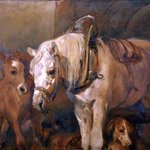
Mare and Foal.
Sir Edwin Landseer.
Landseer was very well known for his paintings of animals, which was not particularly high in the hierarchy of painting. However, he was well regarded and got the task of sculpting the lions at the foot of Nelson's Column.

Painting at Bedtime.
Shepherdess with Sheep.
Franz Marc.
Marc was a German artist, usually described as an 'Expressionist'. He was noted for his paintings of animals, often brightly coloured and playful. Hitler did not like his paintings, but most survived WW2. Marc died in WWI.

Painting at Bedtime.
Mrs Lowff.
Valentin Serov.
This is Marie Yakovlevna Simonivich. The artist who painted this, Valentin Serov, was probably the greatest portrait painter of his generation. He painted other things too, but it's for his portraits he is best known.

Painting at Bedtime.
Bouquet and a Cat.
Suzanne Valadon.
Valadon was a model for Puvis de Chavannes, Renoir and Toulouse Lautrec, and at least half a dozen others. She then became an artist herself, receiving help from Degas. She was a beauty from a poor background who became...

Painting at Bedtime.
Firelight Reflections.
Sir James Guthrie.
A leading member of the 'Glasgow Boys' school of painters, this is a pastel on brown paper work during Guthrie's experimental phase of social realism and atmospheric interior studies for which he was noted.

Painting at Bedtime.
Lady at the Window Feeding Birds.
Alfred Stevens.
Stevens was a Belgian artist who eventually became famous for his paintings of elegant women, although his earlier career featured the urban poor. Many of his sitters were known to the Paris vice squad.

Painting at Bedtime.
The Babylonian Marriage Market.
Edwin Long.
This painting has it's origins in a story told to the Greek traveller Herodotus. The story was that women were auctioned off in Babylon. The more desirable the woman, the more was paid. The money was then...

Painting at Bedtime.
Dawn.
Harold Knight.
Knight was the artist husband of Laura Knight, who is probably more famous now than he is, though part of that is his being a conscientious objector in WW1. He was a very good painter, and the RA made him a full member in 1937.

