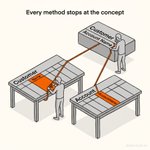
Silver layer modeling methods tell you which business thing a table is about. Only the canonical model says what each column means, and it rewrites every source to do it. Your AI assistant needs that meaning to stop guessing.
deltavault.ai/blog/every-met…
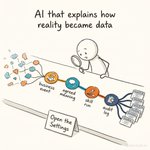
If nobody wrote down what a code means, your AI agent will guess it for you. Who on your team approves that meaning?
Written as an ontology over the same tables, business meaning lifted large language model accuracy from 16% to 54%. Meaning used to cost a table per concept. Now it costs a sentence mapped to a column. Where does your team keep it today?
We recorded our own AI losing to a data engineer. Not on a hard problem: one view over two staging tables. It inner-joined across staging layers and flattened the history the view exists to keep. Catching that in a second is data engineering, not prompt engineering.
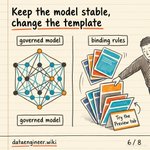
Your data model lives in a load notebook, so every migration sends someone back to reinterpret it. Keep the model in the catalog as governed metadata and render native Databricks code from it. A new target changes the template, not the meaning.
deltavault.com/blog/keep-the…
Data Vault wrote business meaning into table structure because a table was all a machine could read. An AI agent reads sentences now, so that meaning belongs in your catalog. How many of your tables exist for something other than meaning?
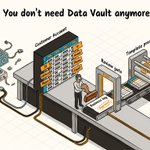
You don't need Data Vault in your lakehouse silver layer. Hubs, links and satellites encoded meaning as tables because tables were all a machine could read. Now a model reads the sentences, so a wrong definition gets read at scale.
Top-down vs bottom-up was never a sequencing question, it's a mapping one. Neither side tells you which source table is which business entity. You find out the day Customer turns out to be a billing account. Map & Match proposes the link.
deltavault.ai/blog/top-down-…
Your steward is half of somebody's job. Your business expert gives you an hour a fortnight. That's the diagnosis, not the excuse: those hours belong on rulings only they can make, not on plumbing. Start with one subject area.
/ebooks/the-data-lakehouse-for-everyone/
Classify Email Address once, then find it unclassified in three staging tables and a vault satellite. That is a correspondence problem, not a coverage one. Record the mapping and the meaning travels.
/ebooks/the-data-lakehouse-for-everyone/the-mapping-is-the-deliverable/
You don't have 500 design problems in your integration layer. You have a dozen patterns, copied 500 times. Hand-written, your real design ends up in the diffs between files. Rendered from your catalog, it lives in one template you can read.
deltavault.ai/blog/integrati…
Databricks foreign keys are informational only, so an imported schema lands with no joins recorded. DeltaVault's discovery skill drafts them, each with a score and a reason. You approve every one.
/blog/ai-drafts-the-tedious-part-you-keep-the-decision/
A coding assistant reading your Jinja template guesses field names, because nobody gave it the contract. We documented that contract field by field. Drafts start from real names, then meet a live preview and validation on save.
deltavault.com/blog/own-the-…
Lineage harvested from query logs tells you what ran, not what anything was meant to be, and it lands mid-incident when you have no time to check it. Write the edge when the mapping is made instead: click any column, and the whole path lights up, ancestors and descendants.
DeltaVault never pushes to your Databricks workspace. Build renders an immutable snapshot you read file by file, and a build with a failed artifact can't be committed at all. Deployment isn't the interesting moment. Review is.
deltavault.com/blog/portabil…
Re-run an AI recommendation two weeks later and most tools hand back suggestions that know nothing about the first, so review becomes deduplication. Accept context with the proposal and every later run inherits it, and so does every descendant.
/blog/tags/how-we-use-ai/
The modeling was the fast part. The next quarter goes to staging objects, hash keys and load order. Most of it is derivable: business keys become hubs, reference columns links, descriptive columns satellites, and the run order falls out of the lineage your catalog already holds.
We built AI into every corner of DeltaVault, then watched it lose to a data engineer on one view over two staging tables. The panel flattened the history that view exists to keep. Right-click, Create View, correct the first time.
youtu.be/UvPJF7Q6Pcc
Your prompt is not the bottleneck. The glossary, the workshop notes, the dictionary nobody opened since go-live are. Upload them and DeltaVault pulls out the business entities and attributes, quoted verbatim, ready for the modeling workshop.
deltavault.ai/blog/give-ai-c…
Your catalog drifts because nothing ties it to the code your team maintains by hand. Declare a table once, let the platform write the create-table, staging, merge and workflow code. Lineage is captured when you declare it, not mid-incident.
deltavault.ai/blog/manage-da…