
Climate scientist at University of Bristol, most interested in present/future extreme climatic event risk and improving our prediction models, including with AI
Joined December 2013
- Tweets429
- Following379
- Followers429
- Likes232





Pinned Tweet
Machine learning applications for weather and climate need greater focus on extremes - topic of perspective just accepted in ERL: iopscience.iop.org/article/1… @IOPPublishing (with nicer formatting at arxiv.org/abs/2207.07390) 1/

2026 PhD opportunity: "Machine learning for understanding extreme weather in a changing climate", to develop methods to apply new ML/AI tools in trustworthy ways. At Bristol Uni in the GW4+ PhD program. With interdisciplinary team inc. @RuiZhuRich, @dougmcneall. Links below.

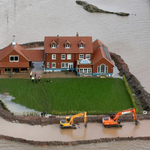
ALT Flood defenses protecting home surrounded by floodwater in Somerset Levels in 2014, by Matt Cardy/Getty Images, from the Atlantic

Happy to share Bobby Antonio's paper on applying generative machine learning to improve skill at forecasting rainfall in East Africa: doi.org/10.1029/2024MS004796
Particularly interesting aspects are improvements in the diurnal cycle and getting good performance in an extreme season.

PhD opportunity at Bristol: "Machine Learning for Understanding Extreme Weather in a Changing Climate". Please share with potential applicants. With @RuiZhuRich, @milankloewer

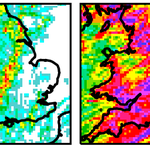
ALT Realistic rainfall simulations generated by a machine learning model over England and Wales (Addison et al., 2024)
Very exciting work on probabilistic weather forecasting by DeepMind's GenCast: nature.com/articles/s41586-0….
But I think most of the points from this thread still apply.


I’ve been getting questions about DeepMind's AI weather forecasts, so thought I'd jot a few quick takes. In all it's very impressive of course, but still has some limitations (which I think the researchers acknowledge, but articles often missed) 1/🧵 xitter.cf/GoogleDeepMind/status/…
Some positive development (beyond having probabilistic forecasts) is evaluation at greater extreme thresholds - up to 99.99th percentile of 12 hourly data, or ~1 in 14 year events. So getting into the extreme tail, but there's still more to look into there.
PhD opportunity to study climate drivers of future extreme flood risk, using recently developed large-ensemble simulation datasets, machine learning methods and state-of-the-art flood risk modelling: noc.ac.uk/gsnocs/project/cli…. In Flood-CDT (flood-cdt.ac.uk/).

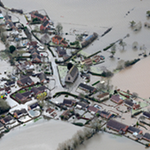
ALT Aerial photo of flooding of a village in the Somerset Levels in 2014
With a great team including @paul_d_bates, @oejwing, @climatehat and Sean Longfield at the Environment Agency. Thanks if you can share.
Only just learned there's a way to turn off allowing xAI to train their Grok model on your tweets, which was enabled by default. Under Settings -> Privacy... -> Grok

Very happy to share Henry's excellent work applying machine learning to achieve km-scale downscaling of rainfall in climate simulations! It's far cheaper than running km-scale regional models, opening up applications to e.g. studying extreme events in large simulation ensembles.

Excited to announce a pre-print of my first paper as part of my PhD at @BristolUni! We’ve created a generative ML emulator of a UK convection-permitting climate model (CPM). It’s able to produce simulations of high-res precipitation at far lower computational cost.

With the new academic year soon to start, it seems like a good point to crowdsource resources with advice for starting PhD students - is there anything out there that you think would be particularly useful to share? Anything you'd have liked to know?
Very interesting series from Vox. The first article on how environmental organisations currently greenwash meat production is certainly instructive about how big corporations corral others to control media narratives.

Factory farming is bad for our planet, for animals, and for us. There's a better way.
This week, we're launching a package of stories that we hope will challenge policy leaders and the public to imagine a kinder, saner, and truly sustainable food system: trib.al/pQ97Mwe

ALT A graphic features a collage along with the following text: "HOW FACTORY FARMING ENDS"
Peter Watson retweeted

20yrs ago Valdes moved to Bristol and our climate/biochemistry group (BRIDGE) was born. We celebrated our anniversary by bringing back many of our alumni. I love co-leading the group with @OceanFMonteiro - life is a lot of fun when you have such friendly and exciting colleagues❤️

Peter Watson retweeted
Our climate group has a new website so you know exactly what we are going 😀 - very proud to have so many amazing and fun people working together. Check it out: climatebristol.org/ Co-led by @_RachelJames @EuniceLoClimate @PeterAGWatson
PhD opportunity to study climate drivers of extreme UK flood risk and understand their role in future changes. Includes potential to apply newly developed machine learning-based rainfall prediction methods: noc.ac.uk/gsnocs/project/cli…. In #FloodCDT, deadline March 20.

ALT Flood defenses protecting home surrounded by floodwater in Somerset Levels in 2014, by Matt Cardy/Getty Images, from the Atlantic