

Founded by two educators in 1926, Perfection Learning provides high-quality, innovative curriculum solutions.
Logan and Clive, Iowa.
Joined October 2012
- Tweets2K
- Following356
- Followers366
- Likes333








What better way to celebrate Halloween with your #ELA students than a some spooky writing prompts? 👻 🎃
Choose from one of our prompts (or create your own) and let students' creativity flow!


Great literature gives students something worth thinking and writing about! Join Connections: Literature consultant Laura Kebart for “From Passage to Performance,” a free webinar on using rich literary texts to build critical reading and writing skills.
hubs.la/Q04Bz8ss0

Michael Guevara offers suggestions for Halloween-themed books for the month of October and provides five accompanying lessons.
hubs.la/Q04zW-090

Federalist No. 39 is now part of the AP® U.S. Government and Politics curriculum, and it may be the clearest answer students will get to a basic question: what kind of government did the Framers actually build?
hubs.la/Q04zWX2-0
Great literature gives students something worth thinking and writing about! Join Connections: Literature consultant Laura Kebart for “From Passage to Performance,” a free webinar on using rich literary texts to build critical reading and writing skills.
hubs.la/Q04zWSPb0

Dr. John P. Irish realized the CED isn't just a planning document for teachers.
In his latest Next Step post, he shares the simple annotation routine that turned the CED into the most well-worn resource his students have.
hubs.la/Q04zbfl60

Join @DrBrandonAbdon and emeritus professor David Jolliffe, former AP® English Language Chief Reader, for a guided exploration of Jolliffe's Rhetorical Framework and how it shows up in the AP English Language classroom.
Register: hubs.la/Q04zb8j70

Dr. John P. Irish walks through how he built a course that merges APUSh and AP® Lang.
hubs.la/Q04ytjl80

Join @DrBrandonAbdon and emeritus professor David Jolliffe, former AP® English Language Chief Reader, for a guided exploration of Jolliffe's Rhetorical Framework and how it shows up in the AP English Language classroom.
Register: hubs.la/Q04ys_760

Lauren Peterson has students analyze contemporary epistolary writing (texts, emails, chat logs, surveillance records) to explore perspective, reliability, and information control, then write their own digital epistolary narrative.
Full lesson plan ⤵️
hubs.la/Q04yt9St0

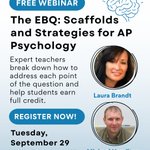
Join us for a FREE webinar with AP Psych teachers—The EBQ: Scaffolds and Strategies for AP Psychology.
Register! ➡️ hubs.la/Q04ytcxR0

This three-step lesson helps students understand their digital footprint clearly and do something about it! ⤵️
hubs.la/Q04ylXFK0

Join @DrBrandonAbdon
and emeritus professor David Jolliffe, former AP® English Language Chief Reader, for a guided exploration of Jolliffe's Rhetorical Framework and how it shows up in the AP English Language classroom. Register: hubs.la/Q04yhq8F0

Don't wait until 2nd semester to introduce the DBQ—by then, students are cramming skill development into a shrinking timeline. Our latest blog post from Colin Baker lays out a classroom-tested, three-stage scaffold for building DBQ skills from week one.
hubs.la/Q04ygRRx0

Every August, students download the AP® History Course and Exam Description. Then it disappears into their Google Drive, never opened again.
Dr. John P. Irish argues that's a missed opportunity ⤵️
hubs.la/Q04xZTcT0
Strong academic writing asks for something harder: an original claim, with sources used strategically to support it. This AP® Lang lesson plan gives students a clear framework for the five jobs a source can do.
hubs.la/Q04xZMzM0

"I'm a big believer in handwritten notes."
AP® World History teacher Dave Drzonek explains why: better retention when students write it out themselves, and far less of the copy-paste sharing that happens when notes live in a shared doc.
hubs.la/Q04y305_0
Free webinar for AP® History teachers in partnership with OpenStax ✅📚
The Argument is the Lesson: Scaffolding Skills from the New SAQs
🗓️Tuesday, September 22
⏰ 4 p.m. ET
Register: hubs.la/Q04xZCfc0
Four structures for getting students to actually talk to each other, from sentence-frame bookmarks to a Socratic Seminar where the teacher says nothing.
14-year ELA teacher Jennifer Epping shares what works 👇
hubs.la/Q04xspXK0

Michael Neal, Chief AP Language Reader, talks about teaching students to use AI conscientiously so they're better prepared for their future workplace.
For more insights, watch the full recording of our "Evening with the Chief Readers" webinar on our blog.
hubs.la/Q04xsdzN0