

🤖🕹💻🎮Articles/tutorials on AVR,#MSP430,#DIY,#Electronics,#Arduino,#RaspberryPi,#Robotics,#IoT,#Python3,#Java Website: https://xitter.cf/t.co/029T4a8vd4
Bengaluru (Bangalore) India
Joined July 2021
- Tweets5K
- Following4.6K
- Followers3.2K
- Likes5.8K








Pinned Tweet
Check out this #Python #Tkinter Serial Communication Program designed to talk to an #Arduino or Microcontroller like #RP2040,ATmega8535
👇👇Links to Tutorials Below,👇👇
youtube.com/watch?v=iKMPLOqG…


PerenialDeveloper retweeted

It's happening !!!!


PerenialDeveloper retweeted
There was a time when lots of US companies were launching on India’s low cost rockets. Then SpaceX’s transporter and bandwagon services stopped that.
Is this a sign it’s swinging back?

Welcome aboard, @reflectorbital. 🚀 Two dedicated launches on our Vikram rockets will take their future spacecraft to orbit.
Reflect Orbital builds mirrors that orbit Earth and reflect sunlight to chosen spots on the ground. Solar farms can generate power for longer, and rescue teams can find people in the dark.
This is a milestone for India’s private space sector. Just months after Vikram-1 reached orbit on its maiden flight, a US-based company is taking its spacecraft to orbit on rockets built in India. The agreement extends Skyroot’s launch manifest across the Vikram family and gives Reflect Orbital an assured schedule and capacity, alongside its planned launches from the United States.
Building for the world from India. 🇮🇳
#Vikram1 #SkyrootAerospace #OpeningSpaceForAll

PerenialDeveloper retweeted

Most of the world's axial flux motors come from China.
Chennai-based Torus Motion (@Torus_Motion) wants to change that. After five years in R&D, their patented axial flux motors outperform global alternatives in cost and capability.
Here's how they're building them in India.
PerenialDeveloper retweeted

Decades later I still find Joel on Software as relevant as when I first read it.
If you haven't read it, check out The Law of Leaky Abstractions.
Keep it in mind when someone tells you coding agents are another level of abstraction. As Joel and Thariq say sooner or later you'll end up needing to understand the lower level.


PerenialDeveloper retweeted

How do you build a telescope for particles that can pass straight through Earth? You turn a billion tonnes of Antarctic ice into the detector.
IceCube, the observatory behind Francis Halzen’s Nobel-winning work, has 5,160 light sensors frozen deep beneath the South Pole. Spread through a cubic kilometre of ice, they wait for an encounter that almost never happens.
Most neutrinos pass through unnoticed. Occasionally, one interacts with an atom, producing charged particles that race through the ice faster than light travels through ice. This does not break Einstein’s speed limit. Light slows down in ice.
Those particles emit a faint glow called Cherenkov light. By measuring which sensors light up, when they do, and how much light they receive, researchers estimate the neutrino’s energy and arrival direction.
The enormous detector gives these elusive particles more matter to interact with. The clear, deep ice lets their light reach the sensors.
Because neutrinos have no electric charge, cosmic magnetic fields cannot bend their paths. Their arrival directions can help trace the distant environments that produced them.
So, buried kilometres underground, IceCube watches the universe through tiny flashes in the dark. A marvel of modern science.

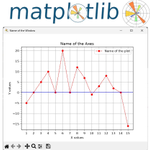
How to Activate and Customize Gridlines in a Matplotlib plot using Python
reddit.com/r/xanthium_in/com…
@ThePSF @PythonPr @MATLAB @matplotlib @Reddit
#python #matplotlib

PerenialDeveloper retweeted

In programming, you always need to understand at least one level of abstraction below the one that you’re working at to become really good at your craft. AI is no different.
In the age of low-level programming languages (e.g., C/C++), if you knew computer architecture, memory management, OS modules, etc.), you would be much better than the average programmer.
In the age of AI coding agents, knowing software architecture, design patterns, etc., makes you much better at agentic engineering than the average vibe coder who speaks in vague prompts.
PerenialDeveloper retweeted

In 1900, David Hilbert stood up in Paris and listed 23 problems he believed would define the next century of mathematics.
The twelfth is still open.
This week, a professor at IISc Bengaluru won the Ramanujan Prize for work that moved it forward.
His name is Mahesh Kakde. He was born in 1983, took his Bachelor of Mathematics at the Indian Statistical Institute in Bangalore, then went to Cambridge for his master's and his PhD in pure mathematics, which he finished in 2008.
After that he was an instructor at Princeton, a research associate at University College London, and then at King's College London.
In 2019 he came back to Bangalore, as a professor at IISc.
His field is algebraic number theory, which uses the machinery of abstract algebra to answer questions about ordinary whole numbers.
Hilbert's twelfth problem asks for something that sounds modest and is not. Given a number system, write down an explicit recipe for building a particular family of larger ones. For the simplest cases mathematicians had known how to do this for a long time. In general, nobody did.
Working with Samit Dasgupta, Kakde produced results on the Gross-Stark and Brumer-Stark conjectures that supplied exactly that kind of explicit construction where none had existed. The ICTP citation also singles out his fundamental results in noncommutative Iwasawa theory.
He received the Infosys Prize in Mathematical Sciences in 2022, and was an invited speaker at the International Congress of Mathematicians alongside Dasgupta.
The Ramanujan Prize is awarded jointly by the ICTP and the International Mathematical Union to young mathematicians from developing countries who do outstanding work in difficult conditions. It carries $10,000.
Ramanujan sailed to Cambridge in 1914 because there was nowhere in India that could hold a mind like his. He returned in 1919 and died the following year, aged 32.
A century later, Kakde made the same journey to Cambridge.
Then he came back to Bangalore, and the prize named after Ramanujan came to him here.

PerenialDeveloper retweeted

This little open-source crab robot called Jumper is seriously cool 🦀🤖
Check the replies for the GitHub link.
PerenialDeveloper retweeted

The new #LPSC director, N. Jayan, says #G1, the first uncrewed mission, will launch within a month after the GSLV-F18 / NVS-03 mission. The rocket is getting ready, Crew Module integration is complete, and last-mile testing is underway. #gaganyaan
Since NVS-03 has an internal window of 15 to 20 October, that puts G1 somewhere around November 2026, which lines up with the "end of this year" line ISRO keeps repeating.
One detail worth noting: G1 will fly with a prototype ECLSS, the life-support system, and the full version only arrives with G2. So G1 is a technology demonstrator, not the finished article.


Learn how to enable, configure, and customize grid lines in Matplotlib chart (plot) using Python in this step-by-step tutorial for beginners.
#matplotlib #python @matplotlib @clcoding @ThePSF
youtube.com/watch?v=-D-TF2MN…
PerenialDeveloper retweeted

A few months back, I published this guide on how to remember everything you read.
Re-sharing it here for anyone who finds these protocols useful.
(1/11)

PerenialDeveloper retweeted
A short manual on how to systematically increase your exposure to opportunity.
(1/2)


PerenialDeveloper retweeted

Samuel Euzedice de Lucena designed a PIC18F4550-based development and education board complete with full schematics and MPLAB® X / XC8 firmware examples: github.com/sdelucena/PIC18F4…

PerenialDeveloper retweeted

When the air is cold enough, the melody of a bird becomes visible.
📸 Kathrin Swoboda


PerenialDeveloper retweeted

neutrino observatories must be one of the most eerily beautiful structures humans have ever built

ALT Super-Kamiokande

ALT IceCube Neutrino Observatory

ALT Sudbury Neutrino Observatory

ALT The Deep Underground Neutrino Experiment (DUNE)
PerenialDeveloper retweeted
🚨 Chennai-based Agnikul Cosmos (@AgnikulCosmos) has completed a new firing test of their Agnite semi-cryogenic booster engine, including thrust sweeps and an extended-duration burn.
This 1 metre engine is 3D-printed as a single piece and uses electric motor-driven pumps.
PerenialDeveloper retweeted

Our avionics box with the outer cover removed. What you’re seeing inside are the heat sinks, which are made from a different aluminum alloy. In space, there’s no air to carry heat away through convection, so we conduct the heat away from the electronics through the structure and ultimately reject it by radiating it out into space.
