

Type any topic, answer three quick questions, and read a guide written for you, in short parts that adapt as you go. 3 days free.
- Tweets7
- Following3
- Followers525
- Likes1


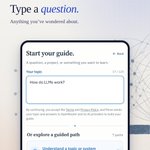


ALT Peras on a phone: the ‘Start your guide’ screen with ‘How do LLMs work?’ typed into the topic box. Behind the phone, the start of a watercolour panorama: a sparse network of nodes and fine lines. Headline: Type a question.

ALT Question 1 of 3 for the LLM guide, ‘What would show you understand LLMs?’, with ‘Explain core mechanics’ selected, tagged Tokenization, Attention and Next-token prediction. Behind the phone, the panorama continues: the network grows denser and its lines run down into a row of token tiles. Headline: Answer three quick questions.

ALT The guide ‘How LLMs work’, lesson 1, ‘From text to the next token’: an editorial illustration in muted blue and coral: a row of token tiles under a faint network diagram, five candidate tiles above an empty slot and the largest, coral one being lowered into it, then part 1, ‘Text becomes tokens’. Behind the phone, the panorama continues: a row of token tiles with fine arcs leaping between them. Headline: Read a guide written for you.

ALT A Peras guide on a phone after tapping Example: a worked example, ‘One step, then the next’, has been added. For the prompt ‘The capital of France is’, a compact table shows the model’s top next tokens: Paris 92%, a 3%, located 2%. Below it is the Reader help row. The Example button is shown pressed and outlined, and a dark label beside the phone, ‘Tap Example’, points to it. To the left of the phone, the panorama ends: candidate tiles fan out above an empty slot, and the largest, coral one is lowered into it. Headline: Want an example? Tap one.

ALT Headline: 3 days free. A smaller line under it: Then $4.99/month founding price. Cancel anytime. Below, three Peras guide cards fanned out: How CRISPR edits a gene, How LLMs work and How GPS knows where you are, each with an editorial illustration and its progress.

ALT Headline: Want an example? Tap one. Two phones show the same Peras guide. On the left, labelled 1, ‘Tap Example’: the end of the part ‘One job: predict the next token’, with its diagram and the Reader help row of Continue, Example, Slow down, Stuck and Ask. The Example button is shown pressed and outlined, and a dark label under the phone, ‘Tap Example’, points to it. On the right, labelled 2, ‘It appears where you’re reading’: the worked example that was added, outlined in blue. It’s called ‘One step, then the next’. For the prompt ‘The capital of France is’, a table lists the model’s top next tokens: Paris 92%, a 3%, located 2%, and the text explains that the model picks Paris, adds it, and runs the same step again.

ALT Headline: How does GPS know where I am? Supporting line: One question, followed all the way down. On the left, a phone showing the Peras guide it became, ‘How GPS knows where you are’, with an illustration of four satellites above Europe whose range circles cross at one point. On the right, under ‘The path’, the guide’s six lessons: 1 Every satellite is a clock; 2 Distance from time; 3 Why it takes four satellites; 4 Einstein in your pocket; 5 Where the errors come from; 6 How your phone gets a fix fast.

ALT Headline: Where does fat go when you lose it? Below, a page of a Peras guide in a phone: lesson 1, ‘Where the atoms go’, under a fine-line anatomical drawing of the lungs breathing out a drift of carbon dioxide molecules and water droplets. Part 1, ‘You breathe most of it out’, opens with a figure: lose 10 kg of fat, and a bar split 84% to 16% shows where it goes. 8.4 kg you breathe out as carbon dioxide; 1.6 kg leaves as water, in urine, sweat and tears. Source line: Meerman & Brown, BMJ 2014.
