

Improving patient outcomes with AI-powered pathology.
Boston, MA
Joined March 2016
- Tweets517
- Following55
- Followers2.5K
- Likes136





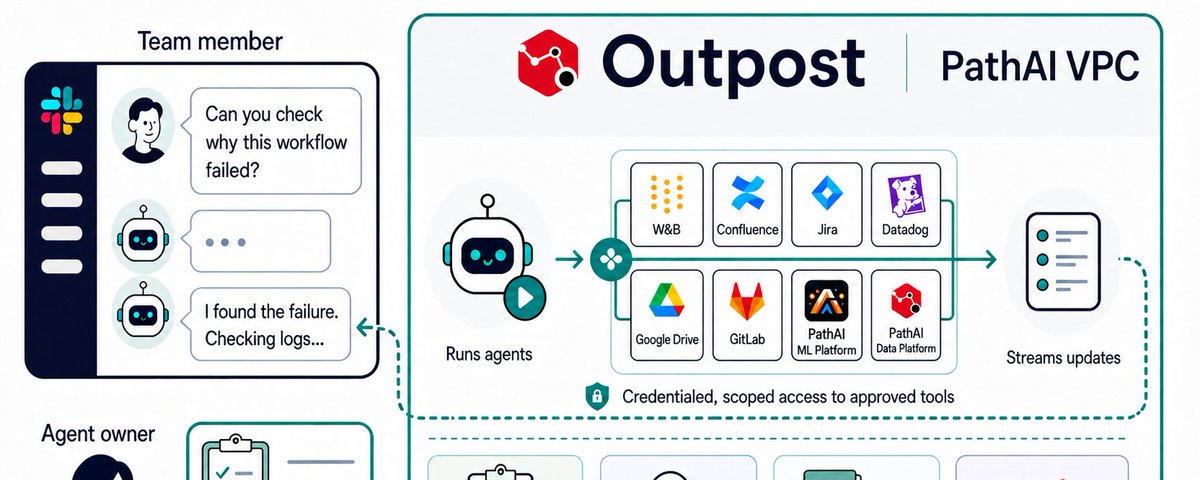
Outpost is a platform for PathAI teams to build and deploy custom AI model development and deployment agents within our cloud infrastructure with governed access to approved internal systems and tools. Read more in the article.
What’s next? Language unlocks potential capabilities beyond accuracy:
🔓 Open-vocabulary prediction: extend to new diagnoses with minimal tuning.
🔍 Natural language slide search: e.g. "slides showing interface dermatitis with basal vacuolization"
🩺 Further enrichment with case-specific clinical context
Full blog post: pathai.com/blog/advancing-mu…
#DigitalPathology #ComputationalPathology #HealthcareAI #PLUTO4 #MultimodalAI
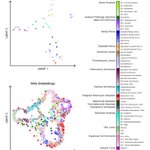
Looking deeper into the the shared embedding space, it has clinically meaningful structure:
🟢 Subtypes cluster together
🟤 Inflammatory dermatoses separate cleanly from melanocytic lesions
Slide embeddings mirror text embedding organization, showing alignment across modalities, not just within them.

Quantitative gains over image-only aMIL classifiers:
📊 Dermatopathology (52 subclasses, 3,388 eval slides): ~4–6% relative improvement
📊 GI pathology (102 subclasses, 7,857 eval slides): ~8–10% relative improvement

This reframes the task from: ❌ "Which label is this slide?" to: ✅ "Which description best matches this slide?"
Predictions are grounded in explicit disease descriptions. And since text embeddings are precomputed and cached, inference complexity stays comparable to standard MIL.
Here's how it works:
🖼️ Slide embeddings: PLUTO-4 tile embeddings aggregated via learnt attention pooling
📝 Text embeddings: pathologist diagnostic reports + LLM-generated morphological descriptions, projected into the same space
🔗 Aligned via contrastive learning, matching pairs pulled together, non-matching pushed apart
Pathologists interpret tissue using rich morphological descriptions: "Irregular nests of atypical melanocytes with pagetoid scatter and dermal invasion..."
These capture nuanced patterns that discrete class labels can't encode. So we brought language directly into the model.
🔬 Moving Beyond Pixels: Advancing Multimodal Pathology
Pathology AI has long relied on images alone. What happens when you add language?
We combined PLUTO-4 vision embeddings with rich histological descriptions to build a joint vision-language space for disease classification, and the results are promising.
🧵 #AI #MachineLearning #Pathology #MultimodalAI #FoundationModels

These results highlight how our PLUTO-4 foundation models enhance PathAI’s AI-pathology products across digital diagnostics and translational research.
We’re excited for the new capabilities PLUTO-4 will unlock for our partners and the community!
📄 Learn more in our technical report:
👉 arxiv.org/abs/2511.02826
#AI #Pathology #HealthcareAI #FoundationModels #PLUTO4

Beyond public benchmarks, PLUTO-4 shows real-world impact —
🩺 ~10 % improvement across multiple PathAI products, with strong gains in dermatopathology specimen classification.
These advances bring us closer to robust, generalizable FMs for pathology applications.
#Dermatology #HealthcareAI

Large-scale multi-node training is often communication-bound.
We optimized ViT-G training with DDP + GPUDirect RDMA, tuning parameters (bucket_cap_mb, gradient_as_bucket_view) to saturate InfiniBand bandwidth.
Result: 3× throughput improvement and near-linear scaling across 4 H200 nodes.

Self-supervised ViT training with DINOv2 is unstable at scale.
Key changes that stabilized PLUTO-4 training:
🔹 Use bfloat16 → prevents overflow and NaNs in projection heads
🔹 Add register tokens → capture high-norm activations
🔹 Use large batches (≥1024) → smoother gradients
#SelfSupervisedLearning #AI
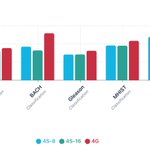
Comparison of Patch-Sizes
🧩 4S (FlexiViT) lets us tune patch size per task
ps-8 excels at tasks needing fine-grained features (ex: nuclear segmentation)
ps-16 suits coarse pattern tasks (Gleason patterns)
#FlexiViT #FoundationModels

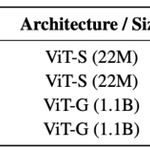
PLUTO-4 introduces two models:
🧩 4S — a compact, high-throughput model adaptable to different tasks. Trained with FlexiViT and RoPE for configurable patch sizes and multiscale feature extraction.
💪 4G — a frontier-scale model for complex tasks and peak performance
#VisionTransformers #ComputationalPathology #AI
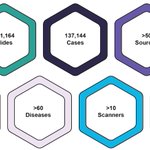
PLUTO-4 is trained on a diverse dataset of 551,164 WSIs from 137,144 cases across 50 institutions.
The dataset spans 40+ organs, 60+ diseases, and 100+ stain variants, capturing real-world variation in tissue, staining, and scanning systems.

🚀 Excited to share PLUTO-4, our new state-of-the-art foundation models for pathology! 🔬
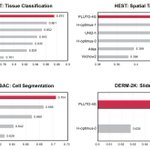
We’re seeing SoTA performance across multiple public benchmarks (EVA and HEST) — surpassing other leading pathology foundation models. (1/6)
#AI #MachineLearning #Pathology #FoundationModels #HealthcareAI

PathAI retweeted

The opportunity to standardize the way we construct data sets is important...If we try to build a data set for every use case, we can set ourselves up to fail. We don't want to build a large reference data set that doesn't get used - @balasubramaniac from @Path_AI #FriendDx

🔬 Impact
This study shows the promise & potantial of SAEs in explaining foundation model behavior for medical imaging. Interpretable features unlock:
- Potential for clinical AI 🏥
- New biological insights 🧪
🔗 Read the full work: bit.ly/4gl20xZ
#AI #Pathology
