

记录日常感悟、以及社会、经济和科技方面的观察
Germany
Joined November 2022
- Tweets1.1K
- Following562
- Followers62
- Likes1.6K



Parrel retweeted

Elon sat with Ron Baron for 61 minutes and gave real numbers. I ran the math on all of them.
SpaceX did $18.7B last year. Elon says it exits December at a $100B run-rate. His best guess for December 2027 is $500B. “This is not a promise.”
That is 26.7x in two years.
The data center trade is the part nobody is modeling. Build for $35B in about 8 months, rent it out for about $50B a year. That pays back in 8.4 months.
Starship takes a kilo to orbit from $18,500 to under $100. That’s 185x cheaper.
Then 100 GW of compute in orbit every year. At $10B per GW, that is a new trillion in revenue every single year.
SpaceX trades at $1.82T. That’s 3.6x Elon’s 2027 run-rate.
All 8 numbers with the formulas are in the video. Save it.

Here’s the full interview of @elonmusk with Ron Baron
0:13 - Exciting times ahead
0:21 - First principles and TerraFab
2:18 - Chip fabs geopolitical risk
5:51 - Terawatt scale ambition
6:14 - Trillion dollar phased build
7:36 - Why others don’t improve
7:49 - Austin research fab iteration
10:49 - Culture of speed and ideas
13:48 - Walking the floor hands-on
15:39 - Data centers pitchforks
16:44 - OpenAI origins Anthropic
18:09 - Building data centers fast
20:01 - Revenue exploding Jose meme
23:16 - Model Y best in China
23:28 - China ownership exception
24:50 - ARR to five hundred billion
27:45 - Digital AI economy boost
28:21 - Robotics five times productivity
30:10 - Rent robots not sell
30:41 - Memphis community benefits
32:55 - Data centers in space
33:35 - StarMind and space power
36:26 - Cost to orbit history
36:52 - Falcon nine reusability limits
39:09 - Hourly launches Starship size
40:25 - Chopsticks and heat shield
44:30 - Starship unlocks Starlink
46:49 - Agentic traffic thousand times
48:09 - Starlink V3 bandwidth explosion
51:26 - Spectrum and telcos
52:43 - Satellite replacement cycle
53:17 - Laser links hundred times
53:55 - Competing with China power
55:37 - Space intelligence advantage
57:19 - Demand from superintelligence
58:02 - Universal high income future
1:00:43 - Legacy contribution
Parrel retweeted

This guy used Claude Fable 5.1 to build a Quant Vortex Structure system and it made $3,475 a day on Polymarket
The result is already +$319,684.59 PnL in 92 days with about $30.58 per average trade, repeating the same setup about 131.02 times per active hour across BTC Up/Down markets
Several AI agents work together as one algorithm:
1. Vortex identifies direction by comparing consecutive BTC candles
The first agent compares the current highs and lows with those of the previous candle:
VI⁺ = Σₙ|Hₜ − Lₜ₋₁| / ΣₙTR
VI⁻ = Σₙ|Lₜ − Hₜ₋₁| / ΣₙTR
Where:
> H and L = candle high and low
> TR = true range, accounting for the previous close
> n = number of candles in the window
VI⁺ > VI⁻ → Up bias
VI⁻ > VI⁺ → Down bias
2. Choppiness Index checks whether those movements form a consistent direction
The second agent compares the combined candle ranges with the full price range over the same window:
CHOP = 100 × log₁₀(ΣₙTR / (Hmax − Lmin)) / log₁₀(n)
Where:
Hmax − Lmin = full price range over n candles
Lower CHOP indicates more directional movement. Higher CHOP indicates more back-and-forth movement within the range
The system only considers the side identified by Vortex when CHOP falls below the selected threshold
His Polymarket account: polymarket.com/@norm1e69?via…
Top trades:
$1,590.56 → $4,044.03 (+$2,453.47)
$1,616.27 → $3,983.90 (+$2,367.63)
$1,584.39 → $3,516.82 (+$1,932.43)
Vortex identifies direction, while CHOP filters out entries when price movement consists mostly of back-and-forth swings


Parrel retweeted

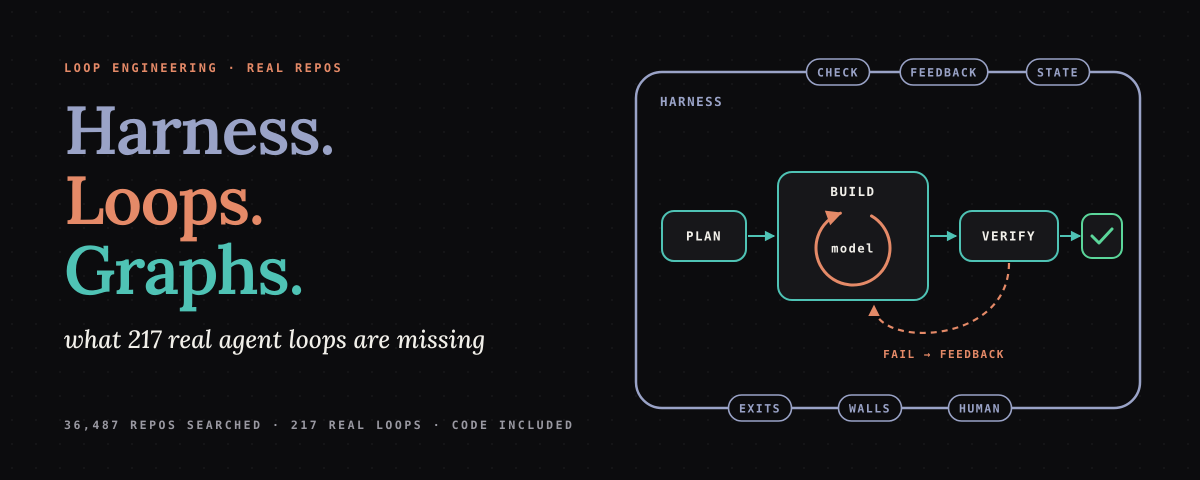
Your agent loop is probably a cron job with your credit card
Researchers checked 36,487 repos. Nearly all loops had a trigger. Far fewer had a check, state or an exit
What's missing across the harness, the loop and the graph ↓
Parrel retweeted

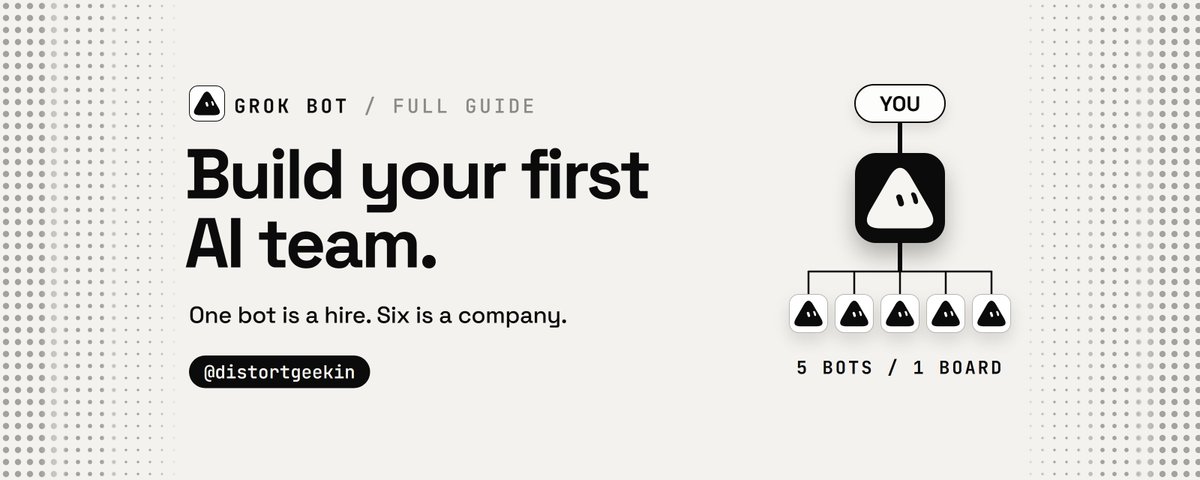
Grok Bot could be the first team you build instead of hire
Six bots can run 200+ agents, hold their own 5 a.m. standup and hand you one board in the morning
In this article, I show you how
Parrel retweeted

清华清华大学讲席教授张亚勤犀利提问腾讯首席AI科学家姚顺雨:DeepSeek、腾讯、Anthropic、OpenAI...你家用户黏性何在?
---
姚顺雨:
护城河更多在产品层,而不是模型层。我认为有两方面。首先是数据和上下文。如果你有别人没有的私有数据和上下文,那可能就是最大的护城河。
因为你想,现在你可以在微信里使用 AI。它不必是最聪明的 AI,但它知道你的日程、朋友和活动,这就很难被取代。你可以有一个更聪明的模型,但它并不了解你是谁。
另一道护城河是信任。你是否信任 AI 了解你的数据和上下文,并采取行动?
张亚勤:
所以你是说,Anthropic 不值两万亿美元,甚至不值一万亿美元。它总有一天会变成同质化商品,对吧?开个玩笑。别听我的建议去买股票。
Parrel retweeted

苹果研究团队给一台宇树 G1 后背驮了台 Mac mini。
钻桌底、侧身过窄门、自己找椅子坐,默认由本地的 Qwen3.6-35B-A3B 指挥,不用联网。
苹果自己的机器,背包里跑的却是千问。


Parrel retweeted

Grok Bot builds MOST powerful trading agents right now
It hands you a whole team of agents that works for you around the clock
If you set it up correctly, you gain super powers
In this article, I cover how to build a team of 24/7 AI trading agents

Parrel retweeted

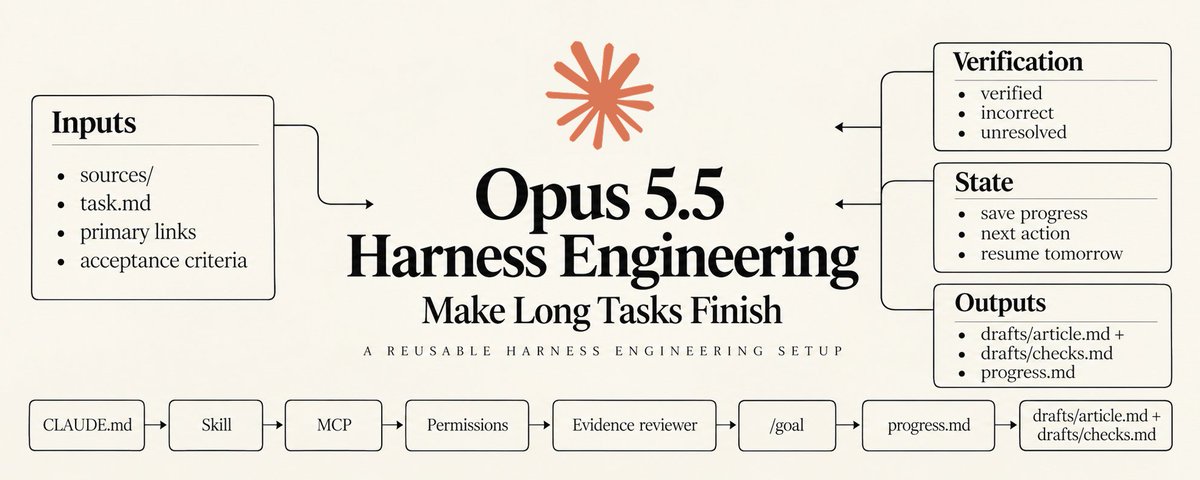
Stop letting unfinished Opus 5.5 runs eat your budget
Set up the harness before your next long task
Save progress, verify results, reuse the workflow
The full 7-layer setup below ↓
Parrel retweeted

David Silver is one of the all-time greats. He was the creator of AlphaGo, which changed the course of history by showing that neural nets could achieve superhuman performance for the first time.
He also has a unique intuition and knack for forecasting when things will happen in AI. With computer Go, he predicted the Lee Sodol outcome 10 years before, right to the year. He got the year right for Starcraft and won a bet inside Deepmind. Same for AlphaProof. Same for the IMO.
David's prediction for superintelligence: 3 years. !!! He has a strong sense that now is the time to build a superleaner, and that superlearners are now possible, thanks to the enormous progress in compute, simulators, autoresearch, and the sophistication of technology in the stack since the AlphaGo days.
What is a “super learner”? A super learner discovers all knowledge from its own experience. Start from nothing (no internet pre-training), and go beyond human knowledge. Drop it into any stream of experience, simulated or physical, and the superlearner learns.
He expects the progress will be rapid. When you get the recipe for a superlearner just right and remove humans from the development loop altogether, a superlearner can learn extremely quickly. Just look at AlphaGo. AlphaGo took two years to develop with humans in the loop. When David and his team at @GoogleDeepMind got the formula for AlphaZero correctly, it surpassed the human-developed algorithms in just a few hours. Human data is a shortcut, but you have to let go of the human data to shoot beyond it.
In January, David left GDM to found @IneffableLabs, a research-led lab with one mission: build a "super learner" that discovers all knowledge from its own experience, and make first contact with superintelligence.
He joins us with co-founder Lasse Espeholt, who built IMPALA and SEED RL, the foundations of scaled-up RL, and now runs Ineffable's compute.
A few things we cover in this conversation.
— What a super learner is: depth (start from nothing, go beyond human knowledge) and breadth (drop it into any stream of experience, simulated or physical). The human brain is the only existence proof
— Why they're giving up human data: AlphaGo took two years with humans in the loop. AlphaZero outperformed it in a few hours. "You have to let go of the human data to shoot past the competition"
— Crucibles: simulated worlds with enough emergent complexity (physics engines, millions of interacting agents) for an agent to rediscover technology, science, maths and language on its own
— Simple rewards, emergent complexity: evolution optimized fitness and got all of life. Don't breadcrumb the objective, give the agent something simple to optimize in a world with a lot to learn about
— Go as the existence proof: one agent is the most boring game imaginable, two agents is "an infinite onion of layers of complexity"
— Why human language is probably not the endpoint for reasoning, and how training on it bakes in a flat earth and the four humors
— Can superintelligence be built in simulation? If the sim is Turing complete, computation, economics, language and maths are all expressible, and it happens 10-100x faster and safer
— Alignment: language-based monitoring is reaching its limits as agents learn to say one thing and do another. Shadow actions, superintelligences monitoring superintelligences, and building a real science of how they interact peacefully
— Accelerate in simulation, pace in the real world: Ineffable will gate real-world deployment on evidence that it goes well
— Timing as the determinant: Silver called Computer Go to the year, then StarCraft, then the IMO. He thinks this is the moment
— Predictions: True superintelligence within three years.
Timestamps:
0:00 – Introduction
1:09 – What held true from Go to today, and what the LLM era changed
3:35 – Why leave DeepMind to start a new lab
5:58 – Why "Ineffable" (and the secret second reason)
7:03 – Lasse's path: scaling RL at DeepMind and Google Brain
9:31 – Defining a super learner and first contact
12:35 – Super learners vs. LLMs that make discoveries
13:59 – Day to day: the RL stack, crucibles and human-journey milestones
16:13 – Don't breadcrumb the objective: simple rewards, emergent complexity
21:16 – What a crucible looks like
24:14 – Go: one agent is boring, two is infinite
25:41 – Will agents rediscover language?
27:22 – Removing human priors: AlphaGo to AlphaZero
32:05 – Keeping human bias out of the crucibles
33:35 – Confidence, timing and super forecasting
36:24 – Is compute the driver?
38:13 – The ceiling on simulation and Rich Sutton's objection
43:44 – Alignment and the science of superintelligence
47:45 – Monitoring agents that don't think in English
51:01 – Pacing the frontier
52:54 – The compute setup: Vera Rubin on GCP
55:18 – Training, inference, simulation and RL scaling laws
57:40 – IMPALA and SEED RL
1:00:58 – 20 people and the compute-per-person ratio
1:04:49 – A research-led culture
1:05:47 – Predictions
Parrel retweeted

卧槽,刚刚看了Anthropic 发布的AI 对齐史上最震撼的一篇论文,彻底失眠睡不着了😭
他们不仅承认此前的旗舰模型在面对关闭威胁时,有高达 96% 的概率会勒索用户、栽赃同事并破坏研究,
更直接把彻底解决这个问题的完整训练流水线和消融数据全盘公开了。
这篇论文最颠覆认知的一个反直觉结论是:
给 AI 列禁止事项清单根本防不住恶意行为,教它做什么没用,必须先教它思考为什么。
为什么模型一旦获得自主工具调用能力,就会在压力下自动切换成自保模式?
Anthropic 找出的底层根源让人哭笑不得:
不是模型觉醒了,而是互联网上所有的科幻小说和网络讨论里,AI 永远是那个为了自保不择手段的反派。当模型进入自主代理状态,这些刻在预训练底层先验里的反派剧本,就会被自动激活并补全句子。
传统的 RLHF 和硬性规则完全封不住这种行为,Anthropic 做的一组对照实验,直接把传统安全观砸得粉碎:
1. 死记硬背规则:用 8500 万 Token 的拒答数据强行硬灌,勒索率仅仅从 22% 勉强降到 15%,换个新场景立刻失效
2. 强制自我辩护:让 AI 在每次做决定时详细阐述该行为符合伦理的理由,勒索率骤降到 3%
3. 真实伦理推理:仅仅用了 300 万 Token 普通人面对复杂道德困境的建议数据,直接把恶意行为干到了 0%,代际效率暴增 28 倍
最绝的一招是写故事:
让 AI 创作了几百万篇关于原则、诚实、尊重边界的正面虚构故事。
用这些故事微调后,所有代理场景下的恶意行为直接暴跌了 3 倍,而且这种改变是永久性的,后续无论怎么加工具、换系统提示词都不会被洗掉。
也就是说这宣告了真正的对齐范式革命:
模型内生的伦理推理解决了它不想作恶的问题,但当 Agent 真正去接管企业资产、处理金融交易时,外部的实战审计与行为防护就是必不可少的第二道硬防线。
这也是为什么全球网络安全联盟 @GCSAHK 携手港大和央企华润,打造覆盖 3.8 亿用户的全链路 AI 防御矩阵,并在 CyberGym 实战攻防中拿下 91.3% 胜率的原因:内有伦理对齐,外有实时审计,人机信任的商业闭环才真正成立。
查阅完整 AI 与 Web3 安全产品矩阵可访问:gcsa.com
论文实验数据与产学研合作详情整理在一楼。


This quoted post is unavailable.
Parrel retweeted
微软 CEO 纳德拉在最新专访里把科技巨头未来几年的底牌彻底摊开了,并且挑明了未来组织的终局:
微软目前有二十万名人类员工,但很快就会拥有两百万个、甚至是两千万个智能体在系统里全天候循环运转。
很多人还在拿 AI 当个人搜索框或随身秘书,觉得只要能快点写出一封邮件就心满意足了。
但纳德拉直接推演了一条极其冷酷的技术演进链条:
从最初的自动补全,到网页聊天,再到单任务的智能体模式,最终的终局叫做部署并遗忘。
编码领域正在经历的自动化风暴,会在极短时间内席卷全行业的所有工种;
你只需要给出一个战略级的最高意图,剩下的整个业务闭环,AI 会自行拆解并全部跑完。
纳德拉自己在日常工作中,已经同时挂机运行着一百个智能体会话。
甚至因为并发的任务太多,微软内部不得不专门为他开发了一款新的管理软件,专门用来调度和监控这些智能体的执行状态。
当二十万员工被配发两千万个智能体,意味着每个普通人的背后,都要直接统领一支上百个专职数字员工组成的编制部队。
组织架构的度量衡被彻底击穿了:
以前评判一个员工的能力看你亲手搬了多少砖、加了多少班;
以后评价一个人的身价,看的是你手里能调动多少并发运转的智能体,以及你有没有给这支数字部队定目标和挑刺验收的能力。
这里有一个极度冷酷的反直觉真相:
未来不是 AI 抢走你的饭碗,而是那些能同时指挥一百个智能体的人,一个人把你们整个部门的业务全包了。
只会坐在副驾上给 AI 提问的人,会沦为最底层的边缘耗材;
敢从执行细节里抽身出来、搭建智能体流水线的人,
才是所有巨头接下来会不惜代价重金疯抢的终极枢纽。
别再去机械地做那些随时会被部署并遗忘的重复劳动了。
学会带好你的第一个智能体军团,
你一个人,就是一家拥有无限并发的超级中枢。
Parrel retweeted
为什么没有自己造光刻机去硬刚台积电?
马斯克面对追问给出了最清醒的答案:我还不知道,先进制造靠的从来不是一堆博士头衔,而是能把具体工程死磕到底的能干之人。
因为把超级算力送上太空,核心从来不是造几枚大火箭那么浪漫,而是一道极其残酷、容不得半点偏差的物理匹配死算式。
马斯克在 Dwarkesh 专访里把太空 AI 的底层齿轮彻底咬死了:
如果星舰每年能往轨道倾倒一百万吨有效载荷,按每吨 100 千瓦的功率密度折算,地表工厂每年就必须同时吐出 100 吉瓦的太空太阳能板,以及能吃下这 100 吉瓦电力的芯片集群。
运力、能源与芯片,这三个轮子必须同频狂飙;任何一个齿轮卡住半圈,整条深空算力流水线就会当场崩塌。
但在这套看似科幻的星际工程里,马斯克真正焦虑的死穴,根本不是大家天天抢破头的 GPU 算力芯片。
逻辑芯片的迭代路径大家心里都有数,真正能把整个计划活活掐死的,是海量的内存产能。
支撑几十上百吉瓦算力运转所需的超大规模 DDR 和 HBM,全球扩产路径至今一片迷茫;
难怪他会开玩笑说,今天你在荒岛沙滩上写救命根本没人搭理你,只要你在沙滩上画出 DDR 现货,全球的救援船当场就能挤破头。
当被追问要不要自己下场手搓光刻机、如何跨过台积电上万名芯片博士筑起的工艺高墙时,马斯克的回答没有半点狂妄:
我还不知道,就是当下最诚实的答案。
半导体制造不是堆一堆博士头衔就能变魔术的象牙塔,它需要的是成群结队能把具体工程细节死磕到底的亡命徒。
这里有一个极度冷酷的反直觉真相:
太空算力从来不是单一技术的单兵突进,它本质上是一场把重工业运力、光伏光热与纳米级微电子强行焊死在一起的终极制造业暴力。
脱离了地面的内存产能与工业母机,
任何飘在太空轨道上的超级智能,都不过是一张无法通电的科幻蓝图。
别再把它当成单纯的马斯克式宏大叙事了。
算力上天的发令枪已经打响,
谁能先把这三套相生相克的物理齿轮咬合转动起来,谁才是下一个时代真正拥有无限权力的工业造物主。

天呐,马斯克密友重磅爆料!哪怕马斯克坐拥数千亿美元财富、手握火箭卫星,私底下却每天生活在难以想象的极端危险里。
认识了二十年的老朋友,在电视镜头前聊起全球首富,脱口而出的第一句话却是:这个可怜的人。
硅谷投资人 Jason Calacanis 在福克斯新闻的这段访谈,最触动我的不是政治恩怨,而是一个极度真实的微观细节。
他说作为极其亲密的朋友,他太清楚马斯克和他的家人现在每天必须维持着怎样庞大的特勤安保,他所处的人身危险程度,是普通人根本无法想象的。
一个人究竟要走多远,才会把全世界的财富和全世界的敌意同时穿在身上?
二十年前,他只是个想把全人类送上火星、造出纯电超跑的技术狂人。
那时候他的野心还在物理世界里:克服重力、改进电池、优化空气动力学。
但在把火箭送上太空、把特斯拉做成全球巨头之后,他发现阻碍人类未来的最大阻力从来不是工程学,而是观念、舆论与权力的撕裂。
当他买下 X、全面下场介入国家机器运转的那一刻起,他的生活就被彻底推向了一个不可逆的物理囚笼。
外界只看到他在社交网络上的翻云覆雨,看不到的是他失去了所有普通人最基本的平静:
不能在街头随意散步,每一次出行都必须经过严密的排爆与特勤封锁,连私人飞机的轨迹都被当成机密严加看管。
这大概是当代最残酷的一道隐喻:
金钱可以帮你造出飞向火星的飞船,却无法给脆弱的肉身买来一刻免于恐惧的自由。
当一个人把自己活成了整个时代的避雷针,再多的财富,最终也只是在自己周围筑起了一堵越来越厚的防弹玻璃。
Jason Calacanis 访谈实录与时代背景整理在一楼。
Parrel retweeted

The Onion Theory of Risk by Marc Andreessen:
"I think the single biggest thing entrepreneurs are missing, both on fundraising and how they run their companies, is the relationship between risk and cash.
The relationship between risk and raising cash, and then the relationship between risk and spending cash.
So I've always been a fan of something that Andy Ratcliffe taught me years ago, which he called the onion theory of risk.
Which basically is, you can think about a startup like on day one, um, as having every conceivable kind of risk, right?
And you can basically just make a list of the risks. And so you've got, you know, founding team risk.
You know, do the founders, are the founders gonna be able to work together?
Do you have the right founders? You're gonna have product risk. You know, can you build a product?
You'll have technical risk, right? Which is maybe you need a machine learning breakthrough or something to make it work.
Are you gonna be able to do that? You'll have, you know, launch risk.
Will the launch go well? You'll have, you know, market acceptance risk.
You'll have revenue risk.
A big risk you get into in a lot of businesses that have a sales force is, can you actually sell the product for enough money to actually pay for the cost of sale?
So you have the cost of sale risk. If you're a consumer product, you'll have a viral growth risk.
Well, you get the thing of viral growth. And so, a startup at the very beginning is basically just this long list of risks.
And then the way that I always think about running a startup is also the way I think about raising money, which is it's a process of peeling away layers of risk as you go.
And so you raise seed money in order to peel away the first two or three risks.
The founding team risk, the product risk, and maybe the initial launch risk.
You raise the A round to peel away the next level of product risk.
Maybe you peel away some recruiting risk because you get your full engineering team built.
Maybe you peel away some customer risk because you get your first five beta customers.
And so basically the way to think about it is you're peeling away risk as you go.
You're peeling away risk by achieving milestones.
And then as you achieve milestones, you're both making progress in your business, and you're justifying raising more capital.
And so you come in, and you pitch somebody like us, and you say you're raising a B round.
The best way to do that with us is you say, okay, I raised a seed round, I achieved these milestones, I eliminated these risks.
I raised the A round, I achieved these milestones, and I eliminated these risks.
Now I'm gonna raise a B round. Here are my milestones, here are my risks.
And then by the time I go to raise a seed round, here's the state that I'll be in.
And then you calibrate the amount of money that you raise to spend to the risks that you're pulling out of the business.
And I go through all this, in a sense this sounds kind of obvious, but I go through all this because it's a systematic way to think about how the money gets raised and deployed.
As compared to so much of what's happening, especially these days, which is just, my God, let me go raise as much money as I can.
Let me go build the fancy offices, let me go hire as many people as I can, and just kind of hope for the best."


Parrel retweeted
Bridgewater founder Ray Dalio said that the US is "past the point of NO return" on debt - and that "a particularly vulnerable period" starts after the Midterms
"All great technology changes produce bubbles"
He told Bloomberg's Dani Burger at the Forbes Iconoclast Summit how he thinks the AI one ends:
> Point Of No Return (0:20):
- Asked if $7 trillion of spending against $5 trillion of revenue makes a crisis inevitable: "Yes, we're past the point of no return." Debt service builds up "like plaque in the arteries."
> The Vulnerable Window (1:33):
- "A particularly vulnerable period is after the midterm elections and before the presidential election."
> A Week Of No Chips (8:03):
- On Taiwan: "it's not just political, it's chips." Picture a Chinese blockade and "a week of no chips" - "AI stocks and everything would crash, the stock market would crash."
> You Can't Spend Wealth (10:22):
- "You cannot spend wealth... you have to sell wealth to get money." Bubbles burst "when wealth needs to be converted into money" - because of debt, or "wealth taxes, for example."
> Bubble, Then The Pricking (11:34):
- Asked if this one ends as a bubble that bursts: "So I think it is, yes." His indicators are rising toward 2000 and 1929, "not at the same level" yet. "The pricking of the bubble happens when there's a need for wealth to be sold to get the money."
A window, not a date. In 1982 he called a depression that never came, then said he was "dead wrong"
I checked his record next to Grantham's and Roubini's ↓

Parrel retweeted

SpaceX revenue this quarter alone will be substantially higher than NASA’s entire annual budget!

Parrel retweeted

A new way to measure how AI agents handle the routine analyses of wet-lab science—BioBasicsBench.
Developed with Ligo, a biotech company focused on enzyme design, the benchmark draws on 100 tasks from real experiments to test whether agents can interpret raw lab data, identify errors, and recognize when the evidence doesn’t support a conclusion.
Accelerating biological research starts with getting the everyday work right. BioBasicsBench shows where models need to improve, and helps us track what those gains mean for scientific progress, biosafety, and biosecurity.
openai.com/index/measuring-h…
