




⚠️ Scam Alert: Fake Parity Wallet Website
We've been made aware of a fraudulent website, parity-wallet[.]com, impersonating Parity Technologies and offering potentially malicious wallet software downloads.
This website is not affiliated with Parity.
Do not visit the site, download any files or run software obtained from it.
Please stay vigilant and verify sources before downloading any software.
Building for the Human Web3 means a layer that keeps working when one server, one region or one company doesn’t.
Apps served from the browser.
Chain data checked by a light client.
Signing that never hands keys to the app.
All open-source code, out in the open for anyone to build on.

BREAKING: Multiple online services are down or 'experiencing issues.'
Google Cloud has reported "issues" in its western Europe region affecting dozens of websites, including; Revolut, Royal Mail and HSBC.
Latest updates ➡️ trib.al/M16q5UZ
📺 Sky 501
As products like the @Polkadot app bring more people on-chain, the network underneath has to grow with them.
Today, the nodes serving users are run by separate groups, each funded on its own terms.
What if validators, already a large and accountable fleet, took on more of that work, and were paid for the extra capacity?
Validators, we'd like to hear from you:
- If you ran an extra node alongside your validator, what would break first?
- How much notice would you need to add hardware?
- What would make it worth doing, beyond covering the cost?
forum.polkadot.network/t/met…

Your old phone can keep your keys safer than your new one.
In 2018, Parity Signer turned a spare smartphone into an offline signing device for @Polkadot. Keys never touch the internet. Transactions travel in and out by QR code, and the phone signs them without ever going online.
The project lives on as Polkadot Vault, now developed and maintained by @NovasamaTech.
wiki.polkadot.com/general/po…

Levity brings decentralised hosting and storage code to the @Polkadot ecosystem.
Authorise. Store. Retrieve via IPFS. Data is retained by default for ~14 days, renewable before expiry. Content is addressed by hash, not by server location.
Experimental, open-source, and published for developers to explore.
🔗 github.com/paritytech/polkad…

Web3 arrived with technology that could change how we interact, build, connect, communicate, and own our data. Then it got complicated before most people could grasp what it was actually for.
Jollity starts from people. Once a week, you play a quick game on camera with a handful of strangers. They confirm you're a real person and nobody learns who you are.
One piece of a larger direction. Trinity. Playground. Product SDK. Each solves a different problem.
Together they describe the same thing: a decentralised web that works for people rather than asking people to work for it.
Deploying a fully decentralized app with frontend hosting, domain registration, and identity verified on-chain usually meant falling back on Web2 infrastructure for the hard parts.
At @Web3summit 2026, devs tested an experimental proof of concept with the Playground CLI to run the entire flow on-chain. 🧵
From there, builders picked their path.
Terminal users ran pg login - scanned a QR code and approved on their phone and the CLI handled the rest. pg mod pulled any app from the registry. pg deploy --playground published it.
Browser users opened RevX without installing anything. They could modify an existing app with AI assistance, preview it live, and publish from the tab.
Mobile users opened the site builder, picked a template, and tapped deploy. Live on Levity in seconds.
Behind that one deploy command: Levity upload, Nominality registration, registry publish, live URL, share link was all automatic.
The app appeared in the shared registry, earned XP, and anyone could fork it.
190 people shipped something real in under 30 minutes. All repos are open source at github.com/paritytech

Most apps reach you through someone else's server. If that server goes down or gets blocked, the app goes with it.
dot.li skips that step. Open a .dot name in any browser, and your browser fetches the app straight from the network, with no gateways or proxies in between.
You get exactly what was published, and you can check it.
See how Polkadot.com could be hosted entirely on-chain.
dot.li/

What if a blockchain worked more like a computer?
JAM is designed to split work across hundreds of cores running in parallel, bringing results together in one shared state where services can interact directly.
Here is a look at the engineering design and how it explores scaling capabilities for the @Polkadot ecosystem:
parity.io/blog/jam-what-it-i…

Ethereum and Solana showed how much can be built when developers can deploy code directly to a general-purpose blockchain.
JAM brings @Polkadot into the same territory with an architecture built around parallel computation. Its cores can work on different jobs at the same time, running smart contracts, agents and other software across a shared environment.
This is Polkadot’s evolution into a collective computer that @gavofyork describes.
youtube.com/watch?v=O3kRAVBT…

Polkadot has a lot of moving parts. That complexity can also make the ecosystem harder to navigate for new developers.
Use the #PolkadotBuilderMap interactive map to see how different components connect, explore what each one does, and find the relevant docs in one place.

#PolkadotBuilderMap 🧑🏻💻👩🏼💻👨🏾💻is an interactive tool that shows how various @Polkadot technical pieces fit together 🔗
This technology evolved quickly ⚡️ and this map is my contribution to making it more accessible to all developers 🗺️
Try it: bit.ly/PolkadotBuilderMap
The cloud is easy to rent and hard to verify.
Blockchains are easy to verify and hard to rent.
JAM is designed to give you both: 341 cores that anyone can rent and the network verifies.
Rent it like the cloud, trust it like a blockchain.

Today, validators working on @Polkadot's cores check that parachain blocks follow their rules, keep that data available for 24 hours, and take part in consensus.
To use a core, though, you have to be a parachain.
JAM opens that up. Any code built for its virtual machine will be able to rent time on a core directly: smart contracts, agents, media serving, regular software.
Parachains keep running as one kind of service among many.
Same cores, open to anyone who needs compute. That's what the cloud did for servers.
Your collateral top-up, your trade, or the price update your position depends on shouldn't be at the mercy of a single collator.
Without protection, a malicious collator can withhold a block to make the next collator miss their turn, then use that gap to censor transactions. That's enough to get a position liquidated, a trade sandwiched, or a price feed held back.
Polkadot hardened parachains against this with multi-slot collation, giving collators a longer window to recover from it.
parity.io/blog/censorship-re…

The web has changed. What people need from the infrastructure underneath it has too.
@Polkadot gives developers the tools to build blockchains from the ground up. The Polkadot Products Devnet extends that flexibility to developers who want to start with the product.
Identity. Payments. Storage. Signing. Communication.
You focus on what people use.
Start here: docs.polkadot.com/apps/

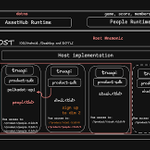
Three layers, one identity.
At the top, chains: People Chain runs the game, score and membership logic. Asset Hub runs the naming.
In the middle, your host (the app on your phone or desktop) holds the root key and derives one for each product it talks to.
At the bottom, Jollity turns plain protocol calls into an actual game. Play it, and it quietly raises your standing on-chain: Devicehood becomes Membership, one Score point at a time.

The shield color at the top of dot.li pages tells you how the page connected.
Green means a light client where you verify the data yourself without a middleman. Orange means it fell back to rpc-gateway, which is more reliable, but you're trusting a central node instead.
New tabs default to light client per-tab. If you keep landing on orange, check Settings for "Light Client Shared" or "Light Client Per-Tab."