

A Venture Capital firm led by a well-knit & diverse team, investing in disruptive technologies of the Digital Age.
ADGM, Abu Dhabi, UAE
Joined April 2023
- Tweets89
- Following14
- Followers127
- Likes261







Mental health is arguably the most underserved segment in MENA healthtech.
The ingredients are there:
→ Rising awareness
→ Chronic shortage of specialists
→ Growing employer demand
→ Limited Arabic-first solutions
The opportunity isn't just clinical.
It's one of the largest unmet needs in the region's digital economy.
Will mental health tech break through in MENA over the next 3 years?

Congratulations to the 14 @hub71ad startups recognized in the UAE Future 100.
Encouraging to see so many founders building globally relevant companies from Abu Dhabi and contributing to the UAE's innovation economy.
We were proud to participate in the celebration and look forward to supporting the next generation of entrepreneurs.

Congratulations to the 14 Hub71 startups recognized in the UAE's Future 100 initiative, celebrating ventures that are shaping the future of the nation's economy through innovation and impact.
A special congratulations to Circa BioTech, Electrogenos, Healthstay, FortyGuard, Housecall, HyveGeo, InvoiceMate, Metric, New Path Bio, NodeShift, Ovasave, P1 Energy, Toothpick, and Energent.ai on this well-deserved achievement.
We're proud to see Hub71 founders driving innovation across industries and contributing to the UAE's future-focused economy.
#Future100 #Hub71 #TechEcosystem #InAbuDhabi #UAE


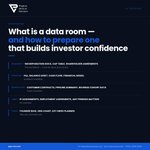
Your data room speaks before you do.
A clean, complete and well-organised data room doesn’t just make due diligence easier. It signals operational maturity and builds investor confidence.
Fundraising preparation matters.

Lebanese founders keep building through conditions most wouldn't attempt.
We want to meet them.
Phoenix Venture Partners is co-organising the LIFE Beirut Pitch Event on 22 December 2026. Up to 10 tech and tech-enabled startups will pitch to investors, advisors and the LIFE network.
Applications close 16 October 2026 at 5:00 PM Beirut time.
Apply: forms.gle/yXF81nYqSTyPivHB9
Details: lifelebanon.com/events/1b6b8…
Alongside LIFE, Anara Impact Capital, Globivest, LAIN, Middle East Venture Partners and Razor Capital.
Please pass this on to a founder who should be in the room.

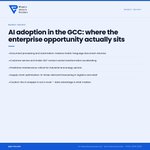
AI is not a sector. It’s an enabling layer.
In the GCC, the enterprise adoption curve is only beginning.
We see significant opportunity where AI solves real operational problems, particularly in Arabic-language workflows, industrial applications, supply chains and healthcare.
But we remain cautious about the label itself.
An AI wrapper is not a moat. Proprietary data, deep workflow integration and genuine domain advantage are.
Where do you see the most credible enterprise AI opportunity in MENA today?

Capital is becoming increasingly interconnected, across regions.
At Baku ID 2026, PVP joined investors and founders from across the GCC, Caucasus, Central Asia and Türkiye, with our Senior Associate Zahi Hilal serving as a Pitch Competition judge.
Our takeaway: the next regional champions won’t be built in one market.
They’ll scale across borders, following capital, talent and technology across an increasingly connected region.
That’s the kind of outlier we’re looking to back.


Phoenix Venture Partners is heading to the Dubai Private Capital Summit.
Our Founder & CEO, Steve Khayat, joins the panel "Venture Capital in the Middle East: Scaling Innovation Across a Rapidly Evolving Region" on 15 September 2026 at The Lana, Dubai.
He'll be in conversation with fellow regional investors from Global Ventures, STV, Aditum and Shorooq Partners, moderated by DLA Piper, part of a summit convening 400+ delegates and 50+ of the world's leading private-capital firms.
The Middle East has moved from frontier to focal point for global capital. We're proud to represent operator-led venture in that conversation, from the ADGM to the wider Gulf.
If you'll be in Dubai on 15 September, we'd welcome the chance to connect.
🔗 pvp-me.com


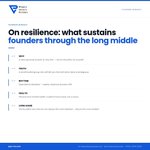
As investors, we've learned that startups rarely fail in a single moment.
Most are tested in the long middle: the years between early excitement and meaningful scale.
Resilience comes from:
→ Purpose beyond fundraising
→ Trusted truth-tellers
→ Consistent execution rhythms
→ Strong physical & mental health
→ Patience to compound over time
The market eventually rewards endurance.
The founders still standing when it does tend to win.

Most venture capital firms talk about capital.
We believe the real differentiator is judgment.
Not every startup should raise venture funding.
Not every founder should pursue hypergrowth.
And not every problem is worth spending a decade solving.
The best founders are not those who can raise the most money.
They are the ones who can make the best decisions when the stakes are highest.
Our capital is important, yet our judgment is indispensable.
We challenge assumptions, open doors, share hard truths, and help exceptional founders build enduring companies.
That's why we invest in outliers.
When founders raise institutional capital, they are not just taking money.
They are also agreeing to a governance structure.
Board seats, observer rights, information rights, protective provisions, and voting thresholds can shape how major decisions are made long after a financing round closes.
Governance is not bureaucracy.
It's the framework within which a company makes decisions.

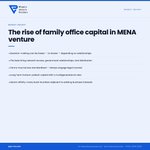
Family offices are becoming a meaningful source of venture capital in MENA, and founders should understand how they differ from institutional investors.
While many family offices have traditionally participated in venture as allocators to fund managers, an increasing number are also investing directly into startups, often alongside or following the lead of established VC firms.
As the ecosystem matures, more capital types are becoming available at more stages than ever before.
Understanding the motivations behind each capital source helps founders raise from the right investors, not just any investors.

VC term sheet lesson:
Liquidation preferences determine who gets paid first when a company exits.
Founders often obsess over valuation while paying far less attention to liquidation preferences.
That's a mistake, not because a particular structure is right or wrong. Liquidation preferences are a legitimate risk-return protection mechanism for investors. Rather, it's because too many founders sign term sheets without fully modeling the implications.
Exit outcomes can vary significantly depending on the liquidation preference agreed today.
Always model the exit before signing the deal.
The economics of the exit are often determined the day the term sheet is signed.

The GCC is simultaneously one of the world's largest hydrocarbon producers and one of the most ambitious investors in renewable energy.
That paradox is creating some of the region's most compelling investment opportunities.
The energy transition will take decades.
The companies being built today will help define it.
What Enertech opportunity do you think is most underinvested in MENA?
Building in Enertech? [email protected]

Before product-market fit, there is founder-founder fit.
More startups are damaged by co-founder conflict than by product or market challenges.
A strong co-founding team tells investors you've already built something hard: a functional partnership under pressure.

GCC sovereign wealth isn't just participating in venture. It's helping shape the global ecosystem.
Mubadala, PIF, ADQ, and QIA are doing more than allocating capital:
→ Anchoring regional VC funds
→ Accelerating ecosystem development
→ Creating pathways to commercial partnerships at scale
→ Increasing the global credibility of GCC-based fund managers
The result is a powerful flywheel connecting capital, innovation, and economic transformation.
The GCC's influence on venture is no longer regional. It's global.
