

Neither noise nor guessworks - only insights. Illuminating your investing journey with facts, data, charts, and more. #MarketInsights
Joined June 2025
- Tweets4.1K
- Following76
- Followers4.8K
- Likes2.3K





Pinned Tweet
"2x Volume in next 2 years"
~ CEO, Welspun Corp
Welspun Corp Management Takeaways on Recent $1.8 Bn Order Win
The $1.8 billion order, combined with Welspun’s ongoing US capacity expansion, provides strong volume visibility through FY29.
“From current volumes of 350,000 tons, we are looking at close to 700,000 tons, which is almost 2 times the current volume over the next 2 years.”— Vipul Mathur, MD & CEO
The order is tied to growing US gas production and the need for additional pipeline infrastructure to evacuate gas from the Permian basin.
The $1.8 billion order may not be a one-off. Welspun sees additional large projects developing, although they remain some distance from finalisation.
Debottlenecking, augmentation and the new greenfield facility should leave spare capacity even after accommodating the mega order.
Strong demand and higher capacity utilisation give Welspun the ability to prioritise customers, partners and projects rather than chasing volumes.
Fixed-price contracts are backed by raw-material arrangements, while US orders and raw materials are dollar-linked, protecting profitability from commodity and currency swings.
The US opportunity effectively needs to be served through Welspun’s local manufacturing footprint because tariffs make exports from India unattractive.
Management clarified that the win reflects a long bidding and engagement process rather than a sudden spike in US pipeline spending.
India's Next Capex Supercycle ~ Trillions Of Rupees In Investment Across 12 Emerging Sectors
India is preparing for a major investment cycle, supported by government incentives, private-sector capex and rising demand for advanced technologies.
Key Investment Opportunities:
Semiconductors: ~₹5.27 lakh crore in targeted public and private investment through 2032, including major semiconductor fabrication projects.
Artificial Intelligence: Over $71 billion in indicated investments, led by global technology companies and India's AI Mission.
Data Centres: Potential investment opportunity of up to $200 billion by 2035, driven by AI computing, cloud adoption and digital infrastructure.
Defence Manufacturing: ~₹5.07 lakh crore of combined contract and investment figures, reflecting rising domestic manufacturing opportunities.
Green Hydrogen: ~₹2.04 lakh crore in planned support and investment, with opportunities across electrolysers, renewable power and industrial decarbonisation.
Renewable Energy: ~₹97,065 crore of budgeted and private investment figures for the FY27 cycle, supporting India's 500 GW non-fossil capacity ambition by 2030.
EV & Battery Storage: ~₹80,300 crore in public support and private investment, with battery manufacturing and localisation emerging as major themes.
Biotechnology: ~₹2.31 lakh crore in government support, state targets and announced investments, supporting biopharma manufacturing and innovation.
Critical Minerals & Rare Earths: ~₹42,580 crore in India-specific commitments to strengthen mineral security and domestic processing.
Space, Drones & GCCs: Growing opportunities across private space technology, unmanned systems and demand-led expansion of global capability centres.
The Bigger Picture: India's next investment cycle could be increasingly driven by technology, energy security, defence indigenisation and advanced manufacturing, rather than conventional infrastructure alone.
The Investment Angle: The biggest beneficiaries may not necessarily be the companies announcing the largest capex, but the suppliers of equipment, components, engineering services and critical technologies supporting these investments.


Magellanic Cloud Limited’s wholly owned subsidiary, Provigil Surveillance Limited, secured a ₹3.16 Cr LOA from DFCCIL Jaipur for CCTV surveillance, centralized monitoring and video analytics across the Western Dedicated Freight Corridor, with installation within 90 days and five years of O&M.
#MagellanicCloud #Railways #Surveillance

#ForcasStudioLimited
#H1FY27 Key Results Highlights
* Total Income of ₹1,310.17 Mn, up 56%
* EBITDA of ₹153.06 Mn, up 73%
* EBITDA Margin of 11.74%, up 115 BPS
* PAT of ₹99.91 Mn, up 72%
* PAT Margin of 7.63%, up 69 BPS
* EPS of ₹5.68, up 72%
#FinancialResults

Sterlite Technologies (STL) ~ ₹18,618 Cr Record Order Book, $1.11 Billion AI Data Centre Deal And Net Debt-Free Balance Sheet
Sterlite Technologies is witnessing a significant business transformation, driven by rising AI infrastructure demand, hyperscaler orders and improving profitability.
Key Highlights:
1. Record Q1 FY27 Financial Performance
Revenue: ₹1,910 Cr, up 87% YoY.
EBITDA: ₹397 Cr, up 184% YoY.
PAT: ₹197 Cr.
EBITDA margin reached 20.8%, its highest level in nearly 20 quarters.
2. Order Book Reaches An All-Time High
Outstanding order book: ₹18,618 Cr.
Order intake increased from ₹7,687 Cr in FY26 to ₹13,100 Cr in Q1 FY27, a 1.7x increase.
The expanding pipeline provides multi-year revenue visibility, subject to order execution.
3. Landmark $1.11 Billion AI Data Centre Award
Secured a $1.11 billion (₹10,000+ Cr) product award letter from a global hyperscaler.
Optical connectivity products will support next-generation AI data centres during FY27–FY29.
This could establish AI infrastructure as a major growth driver for STL.
4. Additional Hyperscaler Orders
Secured $100 million+ in orders for its Neuralis integrated data centre connectivity portfolio.
Also won a strategic order for long-haul, dark-fibre high-density micro-cables.
5. Significant Balance Sheet Improvement
Raised ₹1,500 Cr through QIP.
Achieved net debt-free status.
ICRA upgraded its credit rating to AA (Stable), while CRISIL revised its outlook to Stable.
6. Higher-Margin Business Mix
The increasing contribution from AI data centres and specialised optical connectivity products is supporting operating leverage and profitability.
The Bigger Picture: STL is transitioning from a traditional optical fibre manufacturer towards a broader AI-ready digital infrastructure and connectivity solutions provider.
The combination of a record order book, improving margins and a stronger balance sheet creates significant growth potential.


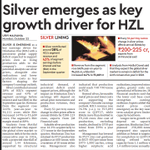
Hindustan Zinc ~ Silver Emerges As A Major Earnings Driver, With Every $1 Price Increase Adding ₹200–225 Crore To EBITDA
Hindustan Zinc (HZL) is increasingly benefiting from rising silver prices, strong production growth and improving zinc cost economics.
Key Takeaways:
1. Silver Becomes A Key Profit Contributor
Silver contributed 28% of segment revenue in Q2 FY27.
Accounted for 43% of segment EBIT, highlighting its disproportionate profitability contribution.
Silver segment revenue surged 141% YoY to ₹4,111 Cr.
Segment EBIT increased 147% YoY to ₹3,609 Cr, with an impressive 88% EBIT margin.
2. Significant Earnings Sensitivity To Silver Prices
According to JM Financial, every $1 per troy ounce increase in silver prices could add approximately ₹200–225 Cr to annual EBITDA, assuming other factors remain unchanged.
This creates substantial earnings leverage to higher silver realisations.
3. Structural Silver Supply Deficit
Motilal Oswal expects the global silver market to remain in deficit for the sixth consecutive year in 2026.
Projected shortfall: ~144 million ounces.
Industrial demand and constrained supply could support silver prices.
4. Silver Production Guidance Maintained
Q2 silver production increased 16.1% QoQ to 173 tonnes.
FY27 production guidance remains 680 tonnes.
Management indicated potential production of 730–750 tonnes by FY28.
5. Zinc Business Also Strengthening
Q2 FY27 revenue increased 76.5% YoY to ₹15,093 Cr.
EBITDA more than doubled to ₹9,248 Cr.
Zinc production cost, excluding royalty, declined from $994/tonne to $703/tonne.
FY27 zinc cost guidance reduced to $825–850/tonne, from $975–1,000 earlier.
6. Long-Term Capacity Expansion
HZL's planned 250,000-tonne integrated zinc capacity addition at Debari is targeted for completion in Q2 FY29.
Refined metal capacity could increase from 1.1 million tonnes to 1.4 million tonnes annually.
The Bigger Picture: Hindustan Zinc is developing a powerful combination of silver price leverage, rising silver volumes, lower zinc production costs and long-term capacity expansion.
Silver is becoming an increasingly important earnings driver, while operational efficiencies in zinc provide an additional profitability lever.
Key Monitorables: Silver prices, FY27 production guidance, zinc cost sustainability and execution of the Debari expansion.
Source: Supplied newspaper report, 22 October 2026, citing JM Financial, Motilal Oswal and company management commentary. Price sensitivity is an estimate, not guaranteed earnings.

India's Pharma CDMO Industry ~ Shifting From Low-Cost Manufacturing To Complex, High-Value Products
India's pharmaceutical CDMO industry is entering a new growth phase, with biologics, peptides, GLP-1 drugs and sterile injectables emerging as key opportunities.
Key Takeaways:
1. A Large Global Opportunity
Global CDMO market exceeded $140 billion in 2024.
India currently accounts for just 2–3% of the market.
McKinsey estimates India could capture 8–10% of the global CDMO market by 2033.
2. Shift Towards Complex Products
The next growth cycle is expected to be driven by:
Biologics and biosimilars
Peptides, including GLP-1 therapies
Sterile injectables
Drug-device combinations
These products require specialised manufacturing capabilities and regulatory expertise, potentially creating higher entry barriers.
3. OneSource Specialty Pharma ~ Scaling Complex Manufacturing
FY26 revenue: ₹1,421.6 Cr
EBITDA: ₹304.2 Cr, up 35%
Management expects FY28 organic revenue of approximately $400 million, with ~40% EBITDA margins.
Near-term performance remains affected by delayed semaglutide approvals and higher ramp-up costs.
4. Akums Drugs ~ Building Beyond Formulations
FY26 consolidated revenue grew 5.9% to ₹4,359 Cr.
EBITDA increased 13.3% to ₹522 Cr.
CDMO contributes approximately 80% of revenue.
Expanding into newer segments while strengthening its regulated-market presence.
5. Kilitch Drugs ~ Expanding Sterile Manufacturing
FY26 revenue increased to ₹235.47 Cr, from ₹198.32 Cr.
Focused on sterile injectables and expanding manufacturing capabilities.
6. Global Supply-Chain Diversification
Geopolitical developments, including the US Biosecure Act, could encourage pharmaceutical companies to diversify their manufacturing partners, creating opportunities for Indian CDMOs.
The Bigger Picture: India's CDMO opportunity is evolving from manufacturing scale and cost competitiveness towards complexity, regulatory compliance and specialised capabilities.
Companies that successfully commercialise higher-value products could benefit from stronger customer relationships and better margins.
Key Monitorables: Regulatory approvals, commercialisation timelines, capacity utilisation, customer additions and returns on specialised manufacturing investments.
Source: Business Standard, 22 October 2026, citing BCG, McKinsey and company management commentary. Forecasts are estimates.

ITC ~ Acquisitions Emerging As A Key Growth Driver, With FMCG Scale-Up And Margin Expansion In Focus
ITC is increasingly using acquisitions to accelerate its FMCG expansion, strengthen its brand portfolio and enter new consumption categories.
Key Takeaways From CMD Sanjiv Puri's Interview:
1. Acquisitions Becoming A Major Growth Lever
ITC's FMCG business now spans 30+ brands, addressing an estimated ₹8 trillion market opportunity by 2035.
Recent acquisitions include Yoga Bar, Mother Sparsh and Prasuma.
Strategy focuses on acquiring promising brands and scaling them through ITC's distribution and operational capabilities.
2. Aashirvaad Crosses ₹10,000 Crore
Aashirvaad has emerged as a ₹10,000+ crore consumer-spend brand.
Sunfeast has crossed ₹7,000 crore.
Bingo! has surpassed ₹4,600 crore.
These brands demonstrate ITC's ability to build and scale large consumer franchises.
3. FMCG Profitability Improving
Non-cigarette FMCG revenue increased from ₹10,000 crore in FY17 to ₹24,000 crore in FY26.
EBITDA margins expanded by approximately 740 basis points during this period.
Management aims to improve margins by another 180–200 basis points on an annualised basis over the next few years.
4. Value-Added Agriculture Gains Importance
Agri-business expanded from ₹8,000 crore to ₹20,000 crore despite global disruptions.
Value-added agriculture has grown 33% annually over the last five years.
Focus areas include spices, coffee and biological extracts.
5. Hotels And Paperboards Offer Additional Opportunities
ITC plans to expand its asset-light hotel portfolio from around 100 properties in 2017 to over 150.
Paperboards and IT businesses are also being positioned for growth.
6. Organisational Restructuring To Support Scale
ITC is developing 25 business heads across categories to improve accountability and execution.
Management remains open to further acquisitions where strategic fit and valuations are attractive.
The Bigger Picture: ITC is working towards reducing dependence on traditional businesses by building a larger, more profitable FMCG platform.
The key investment opportunity lies in scaling acquired brands, expanding FMCG margins and increasing the contribution of value-added businesses.
Key Monitorables: FMCG organic growth, acquisition returns, margin expansion, capital allocation and profitability of new categories.
Source: Supplied newspaper interview with ITC CMD Sanjiv Puri.

Ather Energy ~ Production Capacity Emerges As A Key Growth Constraint Amid Rising EV Competition
Ather Energy is facing an interesting challenge: Demand is growing, but manufacturing capacity could limit its ability to capture market share.
Key Takeaways:
1. Market Share Declines
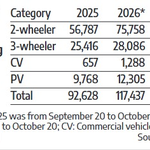
Ather's electric two-wheeler market share fell from 18.2% in January to 14.8% in September 2026.
Industry EV penetration increased to 11.6%, indicating a growing addressable market.
2. Production Near Full Capacity
June production: 31,000 units
Monthly manufacturing capacity: ~35,000 units
Capacity utilisation: ~89%
Management indicated that another 13,000–15,000 scooters could have been sold during the quarter with sufficient production capacity.
3. Dealer Inventory Falls Sharply
Dealer inventory declined from 14 days to just 3 days, suggesting limited stock availability.
Customers in some markets have faced waiting periods of up to two months.
4. Major Capacity Expansion Underway
New Chhatrapati Sambhajinagar facility expected to add ~920,000 units of annual capacity.
Facility scheduled to become operational towards the end of 2026.
Timely commissioning will be critical for meeting demand.
5. Competitors Are Scaling Aggressively
TVS plans to increase production from ~40,000 to over 50,000 units monthly.
Bajaj Auto has reached ~50,000 units and is working towards 60,000.
Hero MotoCorp has expanded capacity to nearly 30,000 units monthly, targeting 45,000 by FY27-end.
The Bigger Picture: Ather's near-term challenge appears to be manufacturing capacity rather than a complete absence of demand.
However, falling market share during a period of strong industry growth highlights the risk of competitors capturing customers while Ather expands production.
Key Monitorables: New plant commissioning, monthly production, delivery waiting periods, dealer inventory and market-share recovery.
Source: Supplied newspaper report, 22 October 2026. Capacity plans and management estimates are forward-looking.

Pooja Precision ~ Nearly Doubling Manufacturing Capacity, With New Opportunities In Aerospace And Defence
We aim to translate this capacity expansion into sustainable growth, targeting ~50% revenue growth in FY27, and achieving ~Rs 1,000 Cr in annual turnover by FY30.
Poojaa Precision Engineers is preparing for its next growth phase through capacity expansion, product diversification and higher-value precision engineering.
Key Growth Triggers:
1. Major Capacity Expansion
New Unit III at Chakan, Pune.
Melting capacity to increase to 28,800 MTPA.
Casting capacity to increase to 12,600 MTPA.
Expansion adds 15,000 MTPA melting and 6,600 MTPA casting capacity, nearly doubling existing capacities.
2. Entry Into Aerospace
Recently entered the aerospace segment.
Secured vendor approval from a customer for product supply.
Commercial contribution remains an important upcoming milestone.
3. Diversification Beyond Automotive
Developing products for EVs, energy, agriculture, defence and healthcare, reducing dependence on traditional automotive applications over time.
4. Higher-Value Precision Engineering
Strengthening in-house design, simulation, CNC automation and X-ray inspection capabilities, supported by IATF 16949 and ISO quality standards.
5. Deeper OEM Relationships
Focusing on increasing business with existing OEMs and Tier-1 suppliers through product development, engineering support and delivery performance.
6. Operating Efficiency
Improved production planning, yield optimisation and capacity utilisation could support better manufacturing economics as volumes scale.
The Bigger Picture: Poojaa Precision is positioning itself to evolve from a conventional precision components manufacturer into a larger, diversified engineering supplier.
The combination of nearly 2x capacity, aerospace entry and non-automotive diversification could create a new growth opportunity.
Key Monitorables: Unit III commissioning, capacity utilisation, aerospace order conversion, customer additions and return on expansion capex.
Source: Company investor presentation. Expansion plans and growth opportunities are forward-looking.


Core4 Engineers Limited Anchor Concluded Today
Anchor Allocation Details
Amount Raised: ₹14.36 crore
Shares Issued: 15,44,400 Equity Shares
Price Per Share: ₹93
No. Of Investors: 05
IPO Dates: October 23, 2026 – October 27, 2026
#Anchorallocation #SMEIPO #Core4EngineersLimited

Balkrishna Industries (BKT) ~ Strategic Partnership With Pirelli Marks Entry Into Premium Passenger Car Tyres
BKT has signed a strategic agreement with global tyre manufacturer Pirelli, marking an important diversification beyond its traditional off-highway tyre business.
Key Highlights:
1. Production Target Of 8 Lakh Tyres
BKT will manufacture up to 8,00,000 Pirelli-branded premium passenger car tyres by 2030.
Production will take place at one of BKT's newly constructed plants under an off-take arrangement.
Manufacturing will follow Pirelli's technology and quality standards.
2. Potential 50:50 Joint Venture
The agreement envisages a second phase involving a 50:50 JV between Pirelli and BKT.
The proposed JV would establish a dedicated manufacturing facility for high-value passenger car tyres.
Products could serve India and international markets.
3. Entry Into A New Market Segment
BKT has historically focused on off-highway tyres used in agriculture, construction and industrial applications.
The partnership provides a route into the premium passenger car tyre segment, supported by Pirelli's technology and brand positioning.
4. Strong Industry Tailwinds
India's passenger car registrations are estimated to grow 5–7% annually between 2025 and 2030.
The premium passenger car tyre market is expected to grow almost twice as fast, according to the release.
5. Complementary Strengths
Pirelli brings premium tyre technology, product expertise and brand recognition, while BKT contributes Indian manufacturing capabilities, industrial infrastructure and execution experience.
The Bigger Picture: BKT is taking its first major step towards diversifying from off-highway tyres into premium passenger car tyres.
The initial manufacturing agreement provides an entry point, while the proposed JV could create a larger long-term opportunity.
Key Monitorables: Production ramp-up, capex requirements, commercial economics, contribution to revenue and finalisation of the proposed 50:50 JV.
Source: Pirelli–BKT joint press release, 22 October 2026. The JV remains subject to conditions, and the 8 lakh tyre figure is a target for 2030.


A Listed Company Manufacturing Beer for Kingfisher, Carlsberg, Tuborg & Other Major Brands! 🍺
What makes this business interesting isn't just its manufacturing capacity, but the competitive MOAT it has built in India's highly regulated beer industry.
Meet Asgard Alcobev Ltd (BSE: 512025).
Through CMJ Breweries, it operates one of Northeast India's largest brewing platforms, with established relationships across leading beer brands.
Here's a closer look at its business model, competitive moat and expansion opportunity. 🧵👇

The Bigger Ambition: 48 Million Cases
Management has outlined a much larger expansion vision.
Current manufacturing footprint:
• 1 plant
• 8.4 million cases annual capacity
Long-term ambition:
• 4 plants
• 48 million cases annual capacity
That represents approximately 5.7x the current capacity.
Potential expansion markets include Karnataka, Maharashtra, Rajasthan and Uttar Pradesh.
These are strategic ambitions, not commissioned capacity or assured orders.


Profit Pulse Insight: The Real Opportunity Lies in Operating Leverage
The interesting part of Asgard is not simply that it manufactures beer.
It is the combination of:
✓ Established manufacturing relationships
✓ A licensed regional production platform
✓ Automated infrastructure
✓ Contract manufacturing revenue
✓ Seven owned brands
✓ Capacity expansion opportunities
If utilisation improves, the company could spread fixed manufacturing costs across higher production volumes.
At the same time, a growing owned-brand portfolio could improve the revenue mix.
The real investment question: Can Asgard transform an established regional brewery into a much larger, profitable contract manufacturing platform?
Execution, capacity utilisation, cash generation and returns on expansion capital will determine the outcome.