

LLM Training Infra/Inference/RL/RSI, PhD @RiceUniversity. @Google, @GoogleDeepMind ex:{@AWS, @Apple, @LinkedIn @PKU1898}, TSC @DeepSpeedAI @liger_kernel
California, USA
Joined April 2018
- Tweets3.9K
- Following1.9K
- Followers1.7K
- Likes6.2K



Zhipeng Wang 🇺🇦 retweeted

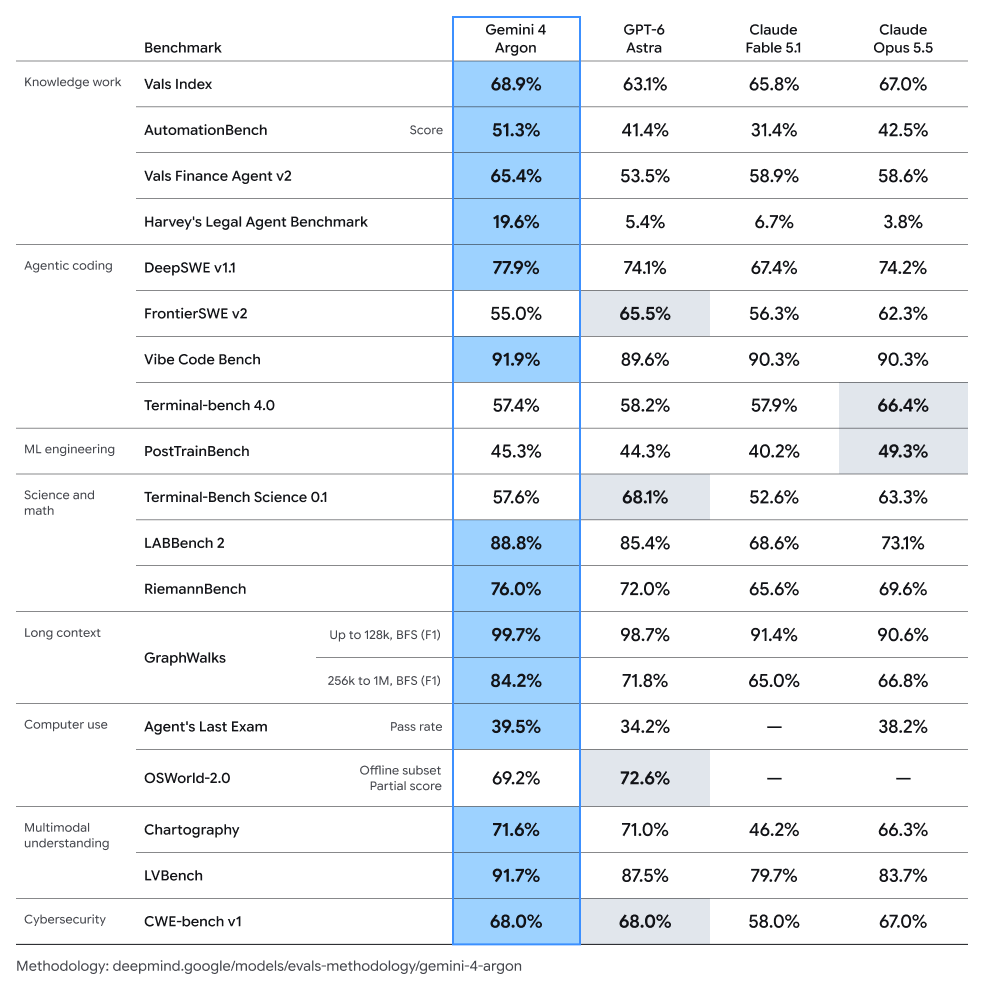
Very excited to announce Gemini 4 Argon, our new Frontier AI model, and a huge step forward across key capabilities. We’re focused on rolling it out responsibly starting with government and trusted cyber defenders through our Fairwind Program today, before wider availability soon

Happy to contributed a small way into the model development, learned a lot from the Gemini pre-training Infra team, now into RSI and also the fleet reliability journey. It was tough but fun. I got the chance to push myself into uncomfortable zone and grind hard. I know it’s still a long journey going forward but really excited about the path to AGI!!!

Lots of discussion out there about our next model(!), so I wanted to give an early look as soon as possible. Introducing Gemini 4 Argon!
It shows frontier performance in complex workflows, cyber defense and software engineering. Teams are using it extensively at Google, from coding to quantum computing, great feedback.
Here’s a look at the benchmarks:


Learning Jev from @CompleteSkeptic 's presentation is super inspiring, which triggered me to re-visit some of my past research on training prefill-only LLMs. The biggest challenge for training prefill only LLMs can be summarized as "how can we capture the long-context information and "squeeze" it into a classifier"? Can long-context training actually helps model performance? The empirical findings indicate that long-context does not always lead to better performance for prefill only LLMs. We need to find the right context window, effectively combine on-policy distillation + SFT, and leverage prefill optimization + multi-item scoring kernels (kudos to the awesome work from @yundaiiiii and @qingquan_song )
aclanthology.org/2025.emnlp-… (EMNLP 2025 Oral). Back in 2025, we've explored the model training techniques and serving optimization enabling high-performance prefill only LLM in Recommender Systems. Inference Optimization techniques such as multi-item scoring kernel, model pruning etc. were also explored.
proceedings.mlsys.org/paper_… (MLSys 2026 Oral). We've trained, productionized and optimized the inference stack for prefill only LLMs, and deployed it for Semantic Search.
aclanthology.org/2026.findin… (ACL 2026). You only need one single token to refine LLM safety alignment, similar idea from Jev or prefill only LLM, with much more efficient alignment algorithm.
It was a wonderful experience of exploring this particular domain, both from the ML Systems and the modeling perspective. I also remember the thought-provoking discussions with @gu_jindong_ @yundaiiiii and @qingquan_song . Science progresses periodically and the path to AGI is not straightforward. I do hope we can have multiple perspectives to think about what AGI really means, and what are the pros and cons for each path.
Also thanks @zhzHNN for the always insightful comments. Exchanging ideas with @zhzHNN is really enjoyable and full of wisdom.
Of course, thanks @CompleteSkeptic and the team for the exciting work.
Thrilled to share the news that our paper "Bayesian Preference Learning for Test-Time Steerable Reward Models" has been accepted by #NeurIPS2026 as the main conference paper. I personally really like this work and we've been working on this cool idea for over a year now. I still believe publishing in top conferences (not flooding) is important for promoting the AI field. Thanks for my awesome collaborators Shao and Jiwoo. My research covers both ML Systems and LLM modeling (especially RL and post-training), and I feel the biggest value is to conduct co-design between Infra and modeling.

Genuine question: where does the 60k+ submission come from? How many research institutions worldwide which write papers for ICLR?
I am honored to give the keynote speak at PyTorch Conference. I will be talking about the exciting updates from DeepSpeed project, and how to scale frontier AI models. Come and chat with me during the conference.

🎤 Meet keynote speaker Zhipeng Wang (@PKUWZP), Senior Staff Software Engineer at @Google and DeepSpeed maintainer. bit.ly/4iVl3mo
At #PyTorchCon North America, he’ll share advances helping DeepSpeed train large models efficiently across diverse hardware.
October 20-21 | San Jose
Register:
bit.ly/4sh3DSw

Thrilled to announce that our paper on LLM-powered Semantic Search (arxiv.org/pdf/2602.07309) has been accepted by @acmcikm 2026 (#CIKM2026). If you want to have a comprehensive picture on how we re-architected LinkedIn's semantic search stack using LLM, this is the must-read paper.
Two papers accepted by @emnlpmeeting as Findings, the work was done from the AI research team that I was leading back in LinkedIn. They are all centered around on-policy distillation and RL. Kudos to @WenhuiZhu8 @XiwenChen37 Yuanda Xu, Hejian Sang and other collaborators, hope you to see you in Budapest! #EMNLP2026 #LLM

To the best of my respect (I like Keller's Muon Optimizer work a lot), I do not think it's the best action for a person who barely published papers in top venues to trash AI top conferences. In fact, the community should do everything to make those AI conferences better. It's our last hope to get a place to share and open-source AI advancements. Otherwise, we will be living in the dark dominated by close-sourced AI Labs.

AI conference peer-reviews are completely broken. For NeurIPS 2026, my batch has very low reviewers responses rate (probably less than 5%), given that I have sent reminders twice. Maybe folks are all busy with their own rebuttals; Also for the @emnlpmeeting ARR submissions, the meta reviewer made factual mistakes and asking tons of ablation studies, however our submission is purely a dataset and benchmark paper, and we made it explicitly clear in all places.
If people don't really want to spend time even understand the paper you are reviewing, then it's probably good to just cancel the conference. What's the point of going through the review processes for months with people not even care what the paper is about? The field is completely broken. I have seen it consistently across multiple conferences.
I will be at #OSDI2026 next Mon to Wed at Seattle. I know everyone is very busy these days pushing new models, but learning new systems research is important. Happy to meet folks and discuss new ideas.
We presented our paper at #ICML2026 main conference on Tuesday July 7th 2PM (Hall A #410). When people are talking about LLM post-training, the SoTA methods are self-play RL and preference optimizations (e.g. SPPO), our aim is to make SPPO great again by calibrating the overconfident preferences over semantically similar responses. It paves the way for many follow-up research in LLM post-training. Feel free to DM me and ask questions.

To all “frontier AI labs” recruiters or HMs, one suggestion I have is to really look at objective qualifications, e.g. publications in top ML venues, PhD training, research expertise, and OSS contributions etc. AI research should not be like hedge funds, some random guys whose name is among a few hundreds names on some tech reports should not rank higher than solid researchers who publish top ML conference papers. Unless it’s for the senior leadership positions (which is reasonable to rely on connections), let’s filter out nepotism, connections or secret recipes etc. This field needs to focus on science and innovation, and reduce the false positives of hiring. Let’s make sure the real talents are given the opportunity to do their best work.
Can someone explain what does this mean? How did they do 1M long context pre-training? Did not find any details in the technical report... Also what does it mean by "super long-context pre-training decreased teh reliance on super-long-context post-training.... ", I don't understand what message it tries to convey...

One of the key insights from our SubQ 1.1 Small technical report (subq.ai/docs/subq-1-1-small-… ) was that super long-context pre-training decreased the reliance on super-long-context post-training to enable super-long-context modeling capabilities. Million-token-plus pre-training enabled the model the extrapolate post-trained capabilities to larger-than-trained lengths. For example, we pre-trained a model with one-million-token inputs and then did post-training at or below one million tokens, and it was able to perform NIAH with high accuracy at multi-million-token lengths. Read more in our technical report!

For all folks working on frontier AI research, self-play preference optimization (SPPO) is getting popular these days (e.g. you might be hearing terms like recursive learning, continuous learning, self-improving agent etc. if not more). But have you ever wondered why your SPPO training is not stable or not even working? If so, you should check out our paper accepted in #ICML2026, which we will present in 2 weeks. We proposed S-SPPO, the Semantic-Calibrated Self-Play Preference Optimization.
In this work, we identified a previously overlooked failure mode in SPPO: preference models often assign highly confident win/loss labels to responses that are actually semantically almost identical, causing the policy to overfit noise and eventually degrade during self-play training. In order to mitigate the failure mode, we proposed a dual-space semantic calibration framework called S-SPPO:
Supervision Calibration: It measures semantic similarity between the preferred and rejected responses and progressively weakens the preference target when the two responses are nearly equivalent, preventing the model from learning arbitrary distinctions.
Representation Calibration: It adds a latent-space repulsion objective that encourages chosen and rejected responses to remain geometrically distinguishable, preventing representation collapse during self-play.
Theoretically, the paper shows that these calibrations preserve SPPO’s underlying constant-sum game formulation and its convergence properties toward a Nash equilibrium.
Empirically, S-SPPO substantially improves self-play alignment performance, reaching 52.19% AlpacaEval 2.0 win rate and 47.46% length-controlled win rate on Llama-3-8B without using additional human preference annotations or stronger teacher models such as GPT-4. The results can be well-generalized to much bigger base models (e.g. > 70b), and we welcome people to test it out and let us know.
Check out the paper from here: lnkd.in/gdJeC_mB.
Kudos to @XiwenChen37 @WenhuiZhu8 for the intellectual discussions.

In next week's #ACL2026, we will present 3 papers at main conference which cover our recent work on LLM post-training, RLHF/Preference Alignment and Efficient on-policy distillation training for Reasoning LLMs. What makes those work especially valuable is that all of the algorithms have been validated across a variety of production-grade LLM post-training workloads, and can be applied off-the-shelf across frontier AI Labs and Enterprises use cases:
1. You Only Need One Single Token to Refine Safety Alignment (aclanthology.org/2026.findin…). In this work, we proposed the Single Token Alignment (STA), a highly parameter-efficient safety alignment method that refines an LLM’s safety-helpfulness tradeoff by optimizing only a single learnable prefix token (about 4K parameters) while keeping the entire base model frozen! STA combines hard sample filtering and focal-style weighting to better separate harmful from benign queries, significantly reducing over-refusal and improving alignment across LLMs, multimodal LLMs, and reasoning models without expensive retraining.
2. AHA: Aligning Large Audio-Language Models for Reasoning Hallucinations via Counterfactual Hard Negatives (aclanthology.org/2026.findin…). In this work, we introduced AHA (Audio Hallucination Alignment), a framework for reducing hallucinations in Large Audio-Language Models (LALMs) by constructing counterfactual hard-negative preference data that teaches models to distinguish genuine acoustic evidence from linguistically plausible but incorrect inferences. The authors also propose AHA-Eval, a diagnostic benchmark targeting four types of audio reasoning hallucinations (event omission, false event identity, temporal relation errors, and quantitative temporal errors), and demonstrate substantial gains in grounding and reasoning performance on aligned models. Now frontier Labs has the recipe for Audio LLM / voice agents preference alignments and post-training data curation.
3. Distilling the Essence: Efficient Reasoning Distillation via Sequence Truncation (aclanthology.org/2026.findin…). In this work, we empirically validated that using only a truncation of sequences should be sufficient for distilling reasoning LLMs with good performance, thus paving the way for computationally-efficient Reasoning LLM Distillation training. This is especially valuable for use cases such as Robotics and RecSys where distillation is critical and saving GPU resources is the key to accelerate model iterations.
Happy to discuss more ideas and potential collaborations. Kudos to my collaborators @WenhuiZhu8 @XiwenChen37 @kvignesh1420 Shao Tang @WeiRuiChen01 @gu_jindong_ and many others.