

Public Impact Analytics Science Lab at @Harvard 📈 Advancing and applying analytics for solving societal problems with public impact | Director @Soroush_Saghaf
Harvard University
Joined April 2022
- Tweets495
- Following230
- Followers317
- Likes579


PIAS Lab retweeted

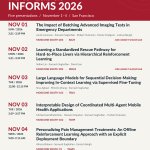
📣📣📣 Join us for my group’s talks at #INFORMS2026 annual meeting. Two super star PhD students are on the job market and will present in the Job Market Showcase.

We are ready for #INFORMS2026
Five talks spanning ED imaging, liver transplantation, LLMs, mobile health, and personalized pain management.
Find us Nov 1–4 in San Francisco

PIAS Lab retweeted

🚨I am on the 26-27 academic job market🚨
I will be presenting my JMP at #INFORMS2026 on Sunday as part of the Job Market Showcase session on “AI and Queueing Analytics in Healthcare”
If you are going to be @INFORMS I would love to connect!
papers.ssrn.com/sol3/papers.…

We are ready for #INFORMS2026
Five talks spanning ED imaging, liver transplantation, LLMs, mobile health, and personalized pain management.
Find us Nov 1–4 in San Francisco
PIAS Lab retweeted
📚 What is 𝐚𝐧𝐚𝐥𝐲𝐭𝐢𝐜𝐬 𝐬𝐜𝐢𝐞𝐧𝐜𝐞, and can it lead to better solutions for society's hardest problems?
I'm excited to join @INFORMS for a FREE virtual Book Talk on my book, "𝐈𝐧𝐬𝐢𝐠𝐡𝐭-𝐃𝐫𝐢𝐯𝐞𝐧 𝐏𝐫𝐨𝐛𝐥𝐞𝐦 𝐒𝐨𝐥𝐯𝐢𝐧𝐠: 𝐀𝐧𝐚𝐥𝐲𝐭𝐢𝐜𝐬 𝐒𝐜𝐢𝐞𝐧𝐜𝐞 𝐭𝐨 𝐈𝐦𝐩𝐫𝐨𝐯𝐞 𝐭𝐡𝐞 𝐖𝐨𝐫𝐥𝐝." 🎉
Data is everywhere, but insight is rare. Too often, AI and analytics produce impressive models or solutions that never change a decision. In this talk, I'll share how an 𝐢𝐧𝐬𝐢𝐠𝐡𝐭-𝐝𝐫𝐢𝐯𝐞𝐧 𝐚𝐩𝐩𝐫𝐨𝐚𝐜𝐡 can bridge that gap and help us tackle today's challenges and tomorrow's opportunities, from healthcare to public policy and beyond. 🌍
💡 What we'll discuss:
🔹 Why insight, not just data, drives real impact
🔹 How AI and analytics can address pressing societal problems
🔹 Where AI and analytics meet real-world decision-making
🔹 Your questions, in an open, live conversation
🗓️ Wednesday, October 7, 2026
⏰ 12:00–1:00 p.m. ET
💻 Virtual (Zoom)
🎟️ Free and open to all
Whether you're a researcher, student, practitioner, or policymaker, or just curious about using analytics to make the world better, I'd love to see you there. 🙌
👉 Register here: connect.informs.org/discussi…
♻️ Please share with colleagues and students who might find it valuable!
#INFORMS #Analytics #OperationsResearch #DataScience #DecisionMaking #PublicPolicy #ProblemSolving #BookTalk #AI
PIAS Lab retweeted
🎉 After 11 incredible years @Harvard I'm starting a new chapter.
I've sat with this post for a few months, wanting to get it right—because it marks the end of something wonderful and the start of something I'm 𝐠𝐞𝐧𝐮𝐢𝐧𝐞𝐥𝐲 𝐞𝐱𝐜𝐢𝐭𝐞𝐝 about.
After 11 wonderful years at @Harvard I've joined @SmithSchool and the Artificial Intelligence Interdisciplinary Institute at Maryland (AIM) at @UofMaryland. These two appointments will let me pursue the intersections that matter most to me and expand the reach and impact of the work I care about.
To my incredible colleagues, students, senior fellows, and postdocs at my lab—the @PIASLab @HarvardBizGov—thank you! I learned as much from you as I hope you learned from me, and these 11 years shaped me in ways I'm still discovering. 🙏
I won't pretend this was a simple decision. The political environment at @Harvard over the past few years affected many scholars, and it is never easy to get over unjust decisions. But I'm grateful to have found a new intellectual home, and I'm looking forward to learning from remarkable colleagues at Smith, AIM, and across the University of Maryland campus.
Onward to what's next. 🚀
PIAS Lab retweeted
⏱️ 11 𝐦𝐢𝐧𝐮𝐭𝐞𝐬 (4.2%) reduction---> Real-world impact of analytics science with zero capacity investment.
That's how much shorter the average ER visit became at @MayoClinic Clinic— with no new beds, no new hires, no new software, and no new IT integration. Just a better decision about where each patient should be seen, suggested by analytics science and proved via a 𝐩𝐫𝐨𝐬𝐩𝐞𝐜𝐭𝐢𝐯𝐞 𝐛𝐞𝐟𝐨𝐫𝐞-𝐚𝐧𝐝-𝐚𝐟𝐭𝐞𝐫 𝐟𝐢𝐞𝐥𝐝 𝐭𝐫𝐢𝐚𝐥.
🎉 I'm thrilled to share that our study, "Vertical Patient Streaming in Emergency Departments," is now published in 𝐌𝐚𝐧𝐚𝐠𝐞𝐦𝐞𝐧𝐭 𝐒𝐜𝐢𝐞𝐧𝐜𝐞.
Here's why I think it matters. 👇
🏥 Most EDs already have a "vertical" area — a seated treatment space for patients who don't need to occupy a bed. But the decision about who goes there is usually made ad hoc, in the middle of a busy shift, with no consistent logic behind it. That variability quietly costs hospitals enormous capacity.
So we asked a simple question: can we make that one decision better?
🤖 Our team analyzed nearly 50,000 ED visits to build a machine learning model that predicts — using only what's already captured at triage — whether a patient will ultimately need a bed. We fed those risk scores into a stochastic patient-flow model to derive the optimal routing policy. Then we did the hardest part: we compressed all of it into a decision tree a clinician can actually use at 2 a.m.
📊 Then we tested it in the real world — a 13-week prospective before-and-after field trial with 11,015 patients in Mayo Clinic Arizona's new emergency department:
✅ 11-minute (4.2%) reduction in total ED length of stay ✅ 8-minute (4.5%) reduction in time from arrival to disposition ✅ No increase in 72-hour return visits — safety fully maintained
Scaled to a medium-sized ED seeing ~40,000 patients a year, that's roughly 6,800 bed-hours recovered annually — capacity for about 2,000 additional patients and an estimated $3M in additional reimbursement. Without a single new bed. 🛏️❌
🙏 None of this happens alone. My deepest thanks to my brilliant co-authors from the @PIASLab and @MayoClinic: Arshya Feizi, Agni Orfanoudaki, Wayne Martini, and @nhodgsonem— to @INFORMS for highlighting our work and to the physicians, nurses, and triage staff who didn't just let us study their ED, but helped us redesign it. A model doesn't save a minute of anyone's time until a clinician trusts it enough to use it.
📄 Read the full paper in Management Science: pubsonline.informs.org/doi/1…
#Analytics #MachineLearning #HealthcareAnalytics #OperationsResearch #EmergencyMedicine #PatientFlow #HealthcareInnovation #INFORMS #ManagementScience #PIASLab

Press Release: Simple Triage Protocol Cuts ER Wait Times Without Adding Beds or Staff, New Study Finds [INFORMS journal Management Science] 🔗 hubs.ly/Q04rpwJ30
PIAS Lab retweeted

Press Release: Simple Triage Protocol Cuts ER Wait Times Without Adding Beds or Staff, New Study Finds [INFORMS journal Management Science] 🔗 hubs.ly/Q04rpwJ30
PIAS Lab retweeted
I will be at @INFORMS #healthcare2026 presenting my joint work with @PIASLab and @DanaFarber. In this paper we introduce a counterfactual decision making framework for evaluating treatment-guiding biomarkers in oncology.
ALSO... im on the academic job market!

PIAS Lab retweeted
Thank you @ICS_Informs for highlighting this paper (published by Management Science) as part of the @INFORMS Harvey J. Greenberg Research Award research highlights. Grateful to be included among the top three papers that were selected for the award.
Full paper: pubsonline.informs.org/doi/a…
#ReinforcementLearning #AI #CausalInference #CausalAI #MedicalAI

PIAS Lab retweeted
Can an LLM learn to make good sequential decisions?
That's the question behind my latest #PIAS #blog post, "𝐏𝐫𝐞𝐩𝐚𝐫𝐢𝐧𝐠 𝐀𝐈 𝐟𝐨𝐫 𝐒𝐞𝐪𝐮𝐞𝐧𝐭𝐢𝐚𝐥 𝐃𝐞𝐜𝐢𝐬𝐢𝐨𝐧-𝐌𝐚𝐤𝐢𝐧𝐠 — 𝐚𝐧𝐝 𝐖𝐡𝐲 𝐈𝐭 𝐌𝐚𝐭𝐭𝐞𝐫𝐬."
Most of the excitement around LLMs has focused on one-shot tasks: classification, translation, a clever answer to a single prompt. But the decisions that matter most in the real world don't work that way.
In our recent work, we asked a simple question: can we equip a pretrained LLM to make good sequential decisions from offline data — and can we understand why it works?
A few takeaways:
🔹 Instead of building a specialized model from scratch, we fine-tune an open-source pretrained LLM so it can read a handful of demonstrations and act in a new, unseen task — no further updates needed at test time.
🔹 We don't stop at intuition. For linear MDPs, we look inside the attention layer and show it behaves like an implicit estimator of the optimal value function, with a clean theoretical bound on how far the learned policy can fall short of optimal.
🔹 We tackle the hard, realistic cases — not just fully observable settings, but partial observability and genuine model ambiguity, which are the norm in medicine, not edge cases.
🔹 The gains are largest exactly where they're hardest to get. On a sparse-reward task with hidden goals, the approach reaches ~95% of oracle performance on held-out goals.
If you care about where AI is heading — beyond chatbots and toward robust, data-efficient decision support in high-stakes domains like healthcare — I think you'll find this one worth a read. It sits right at the intersection of LLMs, reinforcement learning, and real clinical problems.
📖 Read the full post here: soroushsaghafian.com/prepari…
I'd love to hear your thoughts — especially from those working on decision-making under uncertainty.
#AI #MachineLearning #LLMs #Healthcare #ReinforcementLearning #DecisionMaking #ArtificialIntelligence

PIAS Lab retweeted
🚨 New research: Can LLMs be used for 𝐬𝐞𝐪𝐮𝐞𝐧𝐭𝐢𝐚𝐥 𝐝𝐞𝐜𝐢𝐬𝐢𝐨𝐧-𝐦𝐚𝐤𝐢𝐧𝐠 in complex, ambiguous environments?
Our new paper — Large Language Models for Sequential Decision-Making: Improving In-Context Learning via Supervised Fine-Tuning — shows the answer is yes, and the gains are substantial.
Most AI decision-making research assumes the world is fully observable and unambiguous. Real-world problems — especially in domains such as healthcare — are neither. Our framework fine-tunes a pretrained LLM (Llama-2-7B) on offline, oracle-labeled trajectories so it can tackle MDPs, POMDPs, and Ambiguous POMDPS (APOMDPs): settings with partial observability and model ambiguity.
💡 Key findings:
→ SFT slashes the optimality gap from 43% → 15% vs. random baselines in long-horizon MDPs
→ In partially observed and ambiguous environments, fine-tuned LLMs outperform ICL-only baselines and DPT by up to 15 percentage points
→ On the Darkroom navigation task, our model achieves ~95% of oracle performance
→ Robust to out-of-distribution conditions — strong generalization without retraining
📐 On the theory side, we interpret the fine-tuned attention mechanism as implicitly estimating optimal Q-functions, and derive an end-to-end suboptimality bound that cleanly separates in-context estimation error from training-length bias.
This matters deeply for use in areas such as healthcare, where experimentation is costly or unethical and offline observational data are abundant. Our goal: give clinicians AI systems that reason under genuine uncertainty — not just clean textbook settings.
Huge congratulations to my current and former lab members Minmin Zhang and @aghaei_sina on this work!
📄 Read the paper: arxiv.org/abs/2605.09009
#ArtificialIntelligence #MachineLearning #LLM #ReinforcementLearning #Healthcare #DecisionMaking #Research #Sequential

PIAS Lab retweeted
How can we make #AI impactful in #healthcare? Looking forward to this event hosted by @UICmedicine where I will be sharing some thoughts and answers.
Join @PIASLab director, @Soroush_Saghaf, for the May Virtual Seminar hosted by @UICmedicine AI.Health4All
Making Al Impactful in Healthcare
📅 May 20, 2026
🕒 3–4 PM ET
medicine.uic.edu/events/ai-h…

PIAS Lab retweeted
“Let’s talk about data”📊
#Analytics #Sience (including #AI as one of its many branches) can help you improve the world and solve real-world problems. If you are interested, check out this short video and the book (Amazon: a.co/d/01AGVvdZ).
📺📺: youtube.com/shorts/MU9MS-WSO…

PIAS Lab retweeted
I’m very proud of my fantastic PhD student @JacobCJameson! Congratulations!
Congratulations to lab member @JacobCJameson for winning the People's Choice Award🏅for poster presentation at the IOE-ISyE-MS&E Rising Stars Workshop! 👏
@umichioe @GeorgiaTechISyE @StanfordEng

PIAS Lab retweeted
I’m grateful for this exciting collaboration with @awscloud and @DanaFarber.
@HarvardBizGov @harvard_data
🎥 New from @PIASLab & @harvard_data
Designing a Multi-Modal LLM for Personalized Patient Care (@Soroush_Saghaf)
This work explores how AI can move beyond prediction to support causal reasoning in clinical decision-making
youtu.be/yutzdT6WtTQ?si=nryp…
PIAS Lab retweeted

Coming up on Friday, get ready for the student-led AI Symposium at Harvard Kennedy School. Leaders from government, industry, and academia will gather to explore the future of #AI policy, governance, and innovation. Discover more here - hks-ai-symposium.com/#home

PIAS Lab retweeted

Did you know that @Arnold_Ventures has a standing RFP for causal research proposals related to crime and the criminal justice system? Send us your ideas! We aim to get you an answer fast (within 3 months).
All we need from you is a 3-page LOI that describes the intervention you're testing and the research design you're using.
(Link below.)
PIAS Lab retweeted
My thoughts on enhancing the impact of #healthcare #AI 👇

@HarvardBizGov affiliate @Soroush_Saghaf (@PIASLab) is a part of this recent SAN article that explores how #AI is revolutionizing health care in the U.S., but also asks can regulations keep pace to ensure better patient outcomes?
Read more here - san.com/cc/move-fast-and-hea…

PIAS Lab retweeted
Glad to see our research being used in a U.S. Supreme Court filing in U.S. Food and Drug Administration v. Alliance for Hippocratic Medicine. 👇
@HarvardBizGov
Research from the @PIASLab is cited in @USSupremeCourt brief in @US_FDA v. Alliance for Hippocratic Medicine.
The filing references work by @Soroush_Saghaf et al. (2022) on hospital closures and health system capacity.
reproductiverights.org/wp-co…
Paper:
link.springer.com/article/10…
PIAS Lab retweeted
@HarvardBizGov affiliate @Soroush_Saghaf (@PIASLab) is a part of this recent SAN article that explores how #AI is revolutionizing health care in the U.S., but also asks can regulations keep pace to ensure better patient outcomes?
Read more here - san.com/cc/move-fast-and-hea…
PIAS Lab retweeted
New research from @alexgazmararian, @NateMJensen & @HarvardBizGov Affiliate @DustinTingley shows that while people near new clean energy projects notice the investments, they tend to credit state governors over the White House.
Learn more about how political messaging shapes public perception of federal #climate actions: pubmed.ncbi.nlm.nih.gov/4174…
