

💬Host of Debatology Trains & Talks about ❤️Behavioral skills 🤔 Critical thinking 🧑🤝🧑 Ethics Likes to have constructive conversations 🇫🇷🇬🇧🇪🇺
Paris, France
Joined April 2011
- Tweets1.8K
- Following941
- Followers409
- Likes5.2K





Peter Barrett retweeted

Très content de voir ma tribune, cosignée avec Tom Bry-Chevalier, publiée aujourd'hui dans Les Échos.
On y revient sur l'histoire et les idées de l'altruisme efficace (AE), un mouvement que le gouvernement des États-Unis a identifié comme un nouvel ennemi de l’intérieur. 🧵
Peter Barrett retweeted

Online toxicity silences the majority and fuels power users
In online political discussions, a small fraction of highly active users typically generates the vast majority of content while most people silently observe. This vocal minority dominates the conversation, creating a distorted picture of public opinion that looks far more polarized than it actually is.
In the modern attention economy of social media, extreme or hostile content often gains the most visibility. This creates a spiral of silence among most users
A new experiment reveals that polite and constructive environments encourage silent readers to post their first comment, but the most active users are driven to post more when discussions become toxic.
So being polite and constructive is the way to create a better environment.
psypost.org/how-online-toxic…,

Peter Barrett retweeted

𝐋𝐞𝐬 𝐋𝐋𝐌𝐬 𝐜𝐨𝐦𝐦𝐞 𝐚𝐭𝐨𝐮𝐭𝐬 𝐜𝐨𝐧𝐭𝐫𝐞 𝐥𝐚 𝐩𝐨𝐥𝐚𝐫𝐢𝐬𝐚𝐭𝐢𝐨𝐧 𝐞𝐭 𝐥𝐚 𝐦𝐞́𝐬𝐢𝐧𝐟𝐨𝐫𝐦𝐚𝐭𝐢𝐨𝐧
Vous avez toutes et tous en tête les inquiétudes légitimes sur les risques que posent les LLMs.

Peter Barrett retweeted
Listening is associated with and a likely cause of better job performance, leadership, quality of relationships, trust, job knowledge, job attitudes, and well-being.
Listening is a dyadic phenomenon that benefits both the listener and the speaker, including supervisor-subordinate and salesperson-customer dyads.
A new review of the research finds that this process yields clarity, facilitates the generation of novel plans, increases well-being, and strengthens attachment to the conversation partner.
annualreviews.org/content/jo…

Peter Barrett retweeted
Relationship advice on Reddit is increasingly focused on telling people to break up or divorce and ignoring the need to compromise and communicate.
Is it just me or does this seem like a recipe for lonliness.

Peter Barrett retweeted

🚨 PNAS paper: "Indirect reciprocity undermines indirect reciprocity destabilizing large-scale cooperation" w/ @eric_schnell
How do we achieve global cooperation on climate or conflict reduction? The problem isn't selfishness as much as it is cooperation itself - at a smaller scale. 1/

Peter Barrett retweeted

Nouvel épisode (En résumé #189) en ligne sur le site ebbh, pour les curieux.
Peter Barrett retweeted

The internet doesn't bring out the worst in people. It makes the worst people more visible.
Across all 30 countries studied, those who are nasty in online political discussions are nasty in real life, too. They seek status through hostility.
Don't feed the hand that bites you.


Peter Barrett retweeted
𝐅𝐚𝐮𝐭-𝐢𝐥 𝐬𝐞 𝐦é𝐟𝐢𝐞𝐫 𝐝𝐞𝐬 𝐡𝐨𝐦𝐦𝐞𝐬 𝐬𝐞 𝐝𝐢𝐬𝐚𝐧𝐭 𝐟é𝐦𝐢𝐧𝐢𝐬𝐭𝐞𝐬 ? /
𝐒𝐡𝐨𝐮𝐥𝐝 𝐖𝐞 𝐁𝐞 𝐖𝐚𝐫𝐲 𝐨𝐟 𝐌𝐞𝐧 𝐖𝐡𝐨 𝐂𝐚𝐥𝐥 𝐓𝐡𝐞𝐦𝐬𝐞𝐥𝐯𝐞𝐬 "𝐅𝐞𝐦𝐢𝐧𝐢𝐬𝐭𝐬"?

Peter Barrett retweeted

I want to make sure AI doesn't incite human conflict. It's sometimes hard to explain what I do, but that's the core of it -- it won't happen automatically. And we're making progress! Both theoretically, and in field experiments that test how AI alters human relationships.
Peter Barrett retweeted
There’s more to the youth mental health crisis than social media. A key culprit is perfectionism.
307 studies, 35 years, 83k students: Young adults feel growing pressure to be flawless.
It's a risk factor for depression and anxiety—and it began a generation before smartphones.


Peter Barrett retweeted
A fantastic new paper in Nature finds that engagement-based algorithms on social media amplifies intergroup, moralized and emotional (IME) information + toxic content relative to reverse-chronological feeds, with the largest increases in moral outrage and political content.
Much of this hostile content is driven by extreme users who relentlessly post. When the researched created a ‘diversified’ algorithm to reduce the influence of extreme users it improved the accuracy of social norm perceptions and reduce perceptions of partisan animosity. Extreme users are ruining these platforms for everyone else.
The authors (led by @william__brady ) concluded that "reducing the influence of extreme users can curb algorithmic distortions without diminishing user experience."
nature.com/articles/s41586-0…
This is more evidence for the column I wrote for the Guardian last year arguing that a few extreme people were ruining the internet for the rest of us: theguardian.com/books/2025/j…

Peter Barrett retweeted

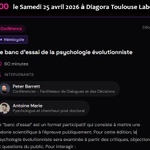
Attention coup de ❤️ (perso) des @RECtlse
@PHSBarrett a animé un format un peu particulier : un banc d'essai !
Le principe ?
Un champ de recherche + un chercheur qui répond aux objections sérieuses (si si !) le concernant...
(le champ de recherche hein pas le chercheur !)
1/3

Peter Barrett retweeted
Vous pensez qu'être « pro-rationalité » protège contre le partage de fake news politiques ? Nos données disent le contraire.
Peter Barrett retweeted

One of my favorites paper got published 🥳 It covers a lot of ground and it’s the best summary of my views on misinformation and what to do about it. Give it a read :)

Peter Barrett retweeted

The takeaway: when democracies in a polarizing environment ban platforms, compliance is likely to follow partisan dynamics. Partisan identity shapes who stays and who goes, and effects outlast the ban itself. Platform governance can deepen fragmentation in the digital space 11/
Peter Barrett retweeted
Political violence is often treated as something extreme or exceptional.
But much of the underlying psychology is not. It emerges from familiar processes: When people strongly identify with a group, threats to that group can feel deeply personal—sometimes leading to escalation rather than dialogue.
I discussed these issues in a BBC radio special on political violence that aired today. I also explained how leaders and regular citizens can defuse violence and intergroup conflict. Understanding these dynamics is essential for anyone working in leadership, media, policy, and conflict resolution.
You can listen to the full interview here with @aligoldsworthy :
open.spotify.com/episode/7uW…

Peter Barrett retweeted

Nous avons dépassé plus de la moitié de la campagne sur Ulule pour le #RECTLSE26 , merci de votre soutien !
Voici donc la deuxième "surprise" pensée pour vous remercier (il y en aura d'autres tout le long de la campagne). #TDAH #Barkley
👉fr.ulule.com/rec-2026/news/l…

Peter Barrett retweeted

While social media is polarising, evidence suggests AI may nudge people towards the centre.
This holds true of all studied models. Grok is more right-leaning than other models, but also has depolarising effects.
By @jburnmurdoch.

