


volta retweeted

Warren Buffett sold $134 billion in stocks in one year. The S&P 500 was at all-time highs.
In 2024, Berkshire Hathaway sold $143 billion in equities and bought $9 billion. Net: $134 billion out the door.
That was not one quarter. Between late 2022 and early 2025, Berkshire was a net seller for 10 consecutive quarters. Total: $174 billion.
No press conferences. No warnings. Just SEC filings, quarter after quarter.
The cash pile as of March 2026: $397.4 billion. The largest cash reserve any company has ever held.
Buffett created his own market indicator decades ago. Total U.S. stock market capitalization divided by GDP. His exact words: "If the ratio approaches 200%, as it did in 1999 and a part of 2000, you are playing with fire."
The ratio is now above 200%.
In 2007, he raised cash. In September 2008, Wall Street collapsed. Buffett called Goldman Sachs and wrote a $5 billion check. One phone call.
In 2008, his entire cash position was a fraction of what he holds today.
$134 billion sold. $397.4 billion in cash. The man who said 200% is playing with fire. The market crossed it.
volta retweeted
Warren Buffett lost $20 billion on a shoe company. He said it deserved a spot in the Guinness Book of World Records.
In 1993, he bought Dexter Shoe. A factory in Dexter, Maine. He called it a "business jewel."
He paid $433 million. But not in cash. He handed over 25,203 shares of Berkshire Hathaway.
Within a few years, cheap imports flooded the market. By 1999, 93% of shoes sold in America came from abroad. Dexter couldn't compete. The factory closed. 1,600 workers in a small Maine town lost their jobs.
The company went to zero.
Those 25,203 Berkshire shares are now worth over $20 billion.
In his 2000 letter to shareholders: "I clearly made a mistake in paying what I did for Dexter. I compounded that mistake in a huge way by using Berkshire shares in payment."
In his 2007 letter: "I gave away 1.6% of a wonderful business to buy a worthless business."
In his 2014 letter: "As a financial disaster, this one deserves a spot in the Guinness Book of World Records."
He wrote about the same mistake in 2000. In 2007. In 2014. In 2015. In his 2017 letter he added: "Today, I would rather prep for a colonoscopy than issue Berkshire shares."
Then at 94, after 60 years of shareholder letters, he wrote one line:
"Mistakes fade away. Winners can forever blossom."
$149 billion. $20 billion for a shoe factory in Maine. The mistake kept growing. So did Berkshire.
volta retweeted
Warren Buffett is worth $149 billion. He just called the stock market "a church with a casino attached."
The man is 95. He has been investing since 1962. The dot-com crash. The 2008 financial crisis. COVID. 60 years of watching markets panic, recover, and panic again.
On May 2, 2026, he sat down with Becky Quick at the Berkshire Hathaway annual meeting in Omaha.
"We've never had people in a more gambling mood than now."
He pointed at one-day options. Prediction markets. A U.S. Army soldier used advance knowledge of a military raid in Venezuela to bet on a prediction market. The Justice Department charged him with insider trading.
Buffett's words: "That's not investing. It's not speculating. It's gambling, just totally."
Then: "Prices for an awful lot of things will look very silly."
Berkshire Hathaway's cash as of March 31, 2026: $397.4 billion. The largest cash reserve any company has ever reported.
He did this before.
In 2007, he raised cash. In September 2008, the market collapsed. Buffett called Goldman Sachs and wrote a $5 billion check. One phone call.
His most famous line: "Be greedy when others are fearful."
At the end of 2025, he stepped down as CEO. Greg Abel took over January 1, 2026. Buffett stayed on as chairman. Kept every share of Berkshire he ever owned.
$397.4 billion in cash. Not buying.
$149 billion. The man who told you the market is a casino. And showed you his hand.
volta retweeted
Michael Bloomberg is worth $106 billion. He sat next to Warren Buffett and the CEO of Goldman Sachs and told them exactly who he'd hire.
Not someone from Harvard. Not Yale. Not Princeton.
The kid whose father never existed. Whose mother is a convicted drug dealer. Who worked three shifts at McDonald's to take care of his siblings.
"That's the kind of kid I want. With an ethic of taking care of his family. Because then he'll take care of others."
Bloomberg himself went to Harvard Business School. Class of '66.
He got hired at Salomon Brothers. $9,000 a year. Worked there 15 years. Made partner. Then got fired.
They handed him $10 million for his equity. He showed up to work the next morning. Different building. His own company.
He had two rules for building it.
Don't hire your relative. Don't hire your friend. Unless you absolutely have to.
And one rule for the office: rip down the walls.
No private offices. Not for executives. Not for managers. Not for him.
His desk is the same size as everyone else's.
"I'm not the smartest guy in the room. But nobody's going to outwork me."
Bloomberg LP. 20,000 employees. $15 billion in revenue. Zero private offices.
$106 billion. The man who told Goldman Sachs to stop hiring from the Ivy League.
volta retweeted
Howard Schultz is worth $3.5 billion. He once cried on camera telling a story about his father.
His father was a diaper delivery man in Brooklyn. Before the invention of Pampers. The family lived in the Bayview Projects. A two-bedroom apartment on the 7th floor. 150 families sharing one elevator.
In 1960, his father slipped on a sheet of ice. Broke his hip and his ankle.
No workmen's compensation. No health insurance. No severance. In 1960, if you were a blue-collar worker and you got hurt on the job, you were dismissed.
Schultz was 7. He came home and found his father on the couch with a cast from his waist to his ankle. He watched his father's self-esteem collapse. A World War II veteran who never finished high school. Held two, three jobs at a time just to buy food. Now lying on a couch with nothing.
Schultz started working at 12. Paper routes. A luncheonette. At 16, he worked in Manhattan's garment district, earning 5 cents per animal skin.
In 1987, he bought Starbucks. A handful of coffee shops in Seattle. He paid $3.8 million.
Then he did something no one understood. He gave every single employee health insurance. Including part-time workers. The first company in America to do it.
Then he added stock options. Also part-timers.
Starbucks was still a private company. Still losing money.
36,000 stores. 361,000 employees. All of them covered.
$3.5 billion. The kid from the Brooklyn projects who never forgot his father on that couch.
volta retweeted
Warren Buffett is worth $145 billion. In 1985, he told an interviewer he might not invest for two years.
“Isn’t that boring?”
He stole the idea from Ted Williams, the greatest hitter in baseball history. 521 home runs. A career hit rate of 34.4%.
Williams divided the strike zone into 77 cells. The best cell gave him a 40% hit rate. The worst gave him 23%. Same player, same bat. The only difference was which pitch he chose to swing at.
Buffett took that and explained his whole strategy in 55 seconds. Using baseball.
In baseball, the pitcher throws. You swing or you get a strike. Three strikes and you’re out.
Buffett said: “In the securities business, there are no called strikes. The pitcher just stands there and throws balls at you.”
US Steel at 25. General Motors at 68. Thousands of stocks flying past. All day. Every day.
“You don’t have to swing at any of them. You can sit there and watch thousands of pitches and finally get one right where you want. Something you understand. And then you swing.”
The problem? Money managers can’t sit still. If they sit out one inning, their clients start yelling: “Swing, you bum!”
So they swing. At everything. Because doing nothing looks like laziness.
Buffett didn’t swing. He waited.
Then he swung at Coca-Cola. American Express. Apple.
$145 billion. The man who kept the bat on his shoulder.
volta retweeted
Warren Buffett bought a shoe company for $433 million. That mistake is now worth over $18 billion.
1993. Dexter Shoe. A factory in a small town in Maine. Buffett called it a "business jewel." Said it "needs no fixing."
He paid with 25,203 shares of Berkshire Hathaway. Not cash. Stock.
By 1999, 93% of shoes bought in America were imported. Cheap labor overseas. Dexter couldn't compete. Profits dropped from $85 million to $17 million in five years.
By 2001, the shoe business lost $46 million. The company folded. 1,600 workers in a small Maine town lost their jobs. Many were too far into their careers to start over.
Buffett lost his entire investment. But the real loss wasn't $433 million.
Those 25,203 shares he traded for shoes? Worth over $18 billion today. He gave away 1.6% of Berkshire Hathaway for something worth zero.
He called it his "most gruesome mistake." Said it "deserves a spot in the Guinness Book of World Records."
In his shareholder letter, he wrote: "I clearly made a mistake in paying what I did for Dexter. By using Berkshire stock, I compounded this error hugely."
He didn't lose a shoe company. He gave away $18 billion in Berkshire stock for a factory that no longer exists.
$433 million for shoes. $18 billion in smoke.
volta retweeted
Warren Buffett's pregnant daughter asked him for a $41,000 loan. He told her to go to the bank like everyone else.
Growing up, his kids got 75 cents a week. If they wanted more, they did chores. Same Omaha house he bought for $31,500.
When a school form asked what their father did, his daughter wrote "security analyst." His son Peter took it literally. He thought his dad checked alarm systems for a living.
Susie didn't find out her father was rich until she read about him in the Wall Street Journal. She was 22.
Years later, she was pregnant. The kitchen was too small for a high chair. She asked her father for $41,000. Not a gift. A loan.
He said no.
"Oh, come on. Can't you do this?" She joked she'd end up on the cover of People as homeless while her father became "super rich."
"I was not asking him to give me the money." Just a loan. From a man worth tens of billions.
He sent her to a bank.
Warren Buffett has given over $60 billion to charity. Hospitals. Universities. Foundations. His pregnant daughter got a mortgage.
She said he made his fortune "sort of by accident." Just did what he loved. It turned into $145 billion.
$145 billion. His daughter got a mortgage.
volta retweeted
Warren Buffett is worth $145 billion. His granddaughter couldn't afford health insurance.
Nicole Buffett was adopted at 4. Her stepfather was Peter Buffett, Warren's son. She grew up visiting the family home in Omaha. Vacations at Laguna Beach. Birthday cards signed "Grandpa."
Warren paid her tuition at a top art school. Six figures. But when she asked for help buying a futon, his secretary called back: "You know the rules. School expenses only."
In 2006, she appeared in a documentary called "The One Percent." Jamie Johnson, heir to Johnson & Johnson, made it. Nicole talked about growing up in the Buffett family.
Warren sent her a letter. "I have not emotionally or legally adopted you as a grandchild." Signed "Warren." Not "Grandpa." He cut off Nicole and her twin sister.
By 2008, she was living on $40,000 a year. Selling paintings. Working at a boutique. No cable TV. No health insurance.
Warren Buffett eats McDonald's for breakfast. He announces the price while shaving. $3.17. He drives a 2014 Cadillac. He has given over $60 billion to charity.
In 2020, 14 years after the letter, Warren contacted Nicole himself. He had seen her NFT art. They reconciled.
The man who disowned his granddaughter over a documentary came back because of a jpeg.
$145 billion. A futon was too much.
volta retweeted
Warren Buffett paid $3.25 a share for Coca-Cola. Today that same share pays him $2.12 a year. Not the stock price. The dividend.
1988. He started buying. Spent $1.3 billion total. 400 million shares after stock splits. He has never sold one.
In 2025, those 400 million shares paid Berkshire Hathaway $816 million in dividends. $93,150 every hour. $25 every second. For doing nothing.
That is a 65% annual return on what he paid. Not on what the stock is worth today. On what he paid 37 years ago.
He held through the crash of 1990. Through the dot-com bust in 2000. Through the financial crisis in 2008. Through COVID in 2020. The stock dropped every time. The dividend arrived every quarter.
Coca-Cola has raised its dividend for 64 consecutive years. So next year, it goes up again.
People watch the stock price because it moves every second. The thing that actually compounded moves once a year.
He paid $3.25 a share. The dividend is $2.12. It hasn't stopped growing in 64 years.
volta retweeted
In 1962, Warren Buffett was 31, ran a fund from his bedroom, and started buying a failing textile stock at $8 a share. Today that stock costs $759,900.
June 1962. KMTV, Omaha. His first TV appearance. Local news.
The stock market had just dropped 27%. Wall Street was panicking.
Six years earlier, seven investors had given him $105,000. He put in $100. By 1962, that fund was worth $7.2 million.
He managed it all from a study next to his bedroom. No office. No secretary. No research team.
He told the reporter the market had been overvalued. Nobody outside Nebraska was listening.
While everyone else was selling, he started buying shares of a dying textile mill in New Bedford, Massachusetts. Berkshire Hathaway. $8 a share.
He never sold.
Berkshire Hathaway hit $1 trillion in market value. One share: $759,900. The most expensive stock in history.
He gave away over $60 billion. Still worth $145 billion. Still lives in the same Omaha house he bought for $31,500.
The man nobody was listening to in 1962 still lives in that $31,500 house.
volta retweeted
In 2008, Tim Ferriss stood in front of 31,000 people and asked Warren Buffett how to invest his first million. Buffett told him to buy an index fund and go back to work.
May 3, 2008. Berkshire Hathaway annual meeting. Qwest Convention Center, Omaha. Over 10,000 shareholders had slept on the sidewalks overnight.
Ferriss had a #1 New York Times bestseller. Didn't matter. His voice was shaking.
He walked to one of 13 microphones.
"Hi, my name is Timothy Ferriss. I'm a guest lecturer at Princeton University."
He asked: if you were 30, had your first million, and couldn't invest full-time, what would you do?
Buffett was worth $62 billion. He laughed.
"I'd put it all in a low-cost index fund that tracks the S&P 500 and get back to work."
Munger added: "Vanguard index fund."
Ferriss had waited hours. He got two sentences.
He started angel investing. Put $25,000 into Uber at a $3.7 million valuation. Backed Shopify as its first advisor. Invested in Facebook, Twitter, and Duolingo.
Uber went public at $75 billion.
His podcast hit 1 billion downloads. The 4-Hour Workweek became a #1 bestseller in 40 languages.
He later said Buffett was right for 99.99% of people. He put $25,000 on being the exception.
volta retweeted
Warren Buffett explained the 2008 financial crisis in three words: innovators, imitators, idiots. Then he made $10 billion from it.
October 2008. Charlie Rose. Lehman Brothers had collapsed two weeks earlier. Largest bankruptcy in American history. $639 billion in assets. Gone.
Rose asked what caused it.
"You cannot stand to see your neighbor getting rich. You know you are smarter than he is, and he is doing these things and getting rich."
"Your spouse is unhappy with you because you aren't doing it. And pretty soon, you start doing it."
"And so you get the three I's: the innovators, the imitators, and the idiots."
Housing fell 27%. The S&P 500 dropped 57%. Bear Stearns sold for $2 a share. $13 trillion in household wealth vanished. 9 million people lost their jobs.
Buffett picked up the phone and put $5 billion into Goldman Sachs. Made $10 billion on deals he struck while everyone else was running.
The man who explained every bubble in three words put $5 billion on the table while it was still crashing.
volta retweeted
Warren Buffett is worth $53 billion. He went on CNN and said five words about his late wife: "She put me together."
He married Susan Thompson in 1952. He had $20,000.
"Two turning points in my life," he said. "One when I came out of the womb and one when I met Susie."
By 1977 he was worth $67 million. She left him. Moved to San Francisco. He said it was "95 to 99 percent" his fault. "I just wasn't attuned enough to her. She'd always been perfectly attuned to me."
They never divorced.
Before she left, she introduced him to a waitress named Astrid Menks. Told Astrid to take care of him. Astrid moved in. Every Christmas for 27 years, they sent cards signed "Warren, Susie and Astrid."
Susan died on July 29, 2004. She was 72. Warren was worth $42.9 billion. She left $3 billion in Berkshire shares to charity.
He married Astrid two years later.
In 2013 he sat on CNN with his son and grandson. The chyron read: "She put me together."
"What happened with me would not have happened without her."
He turned $20,000 into $53 billion. He says it was 99% his fault he lost her.
Peter Lynch averaged 29% a year for 13 years. He turned Fidelity Magellan from $18 million into $14 billion. The best mutual fund track record in history. His two biggest mistakes weren't losses.
He sold Toys "R" Us too early. The stock went up twentyfold after he got out. He calls it the worst decision of his career.
"Same thing at Home Depot."
He bought both. He was right on both. He left the money on the table on both.
Press play. This is Lynch in a TV interview. White hair. Glasses. Dark suit, grey tie. Bookshelf behind him. He's explaining why selling winners is the most expensive mistake in investing.
"On a stock, all you can lose is 100%. I've done that." But a winning stock can go up three, five, tenfold. "Selling a good company and it doubles, then it triples, and it quadruples." That's not a hypothetical. That's his actual career.
"In this stock, I have a 10-year story, a 20-year story." He held positions for years. The ones he regrets are the ones he didn't hold long enough.
He retired at 46. Walked away from the best record in the business. Said it cost him too much time with his family.
"It's impossible to go bankrupt if you don't have any debt." That was his rule for picking stocks. Simple enough that anyone could follow it. Almost no one did.
"You don't have to be right even five times out of ten." One or two big winners carry everything else.
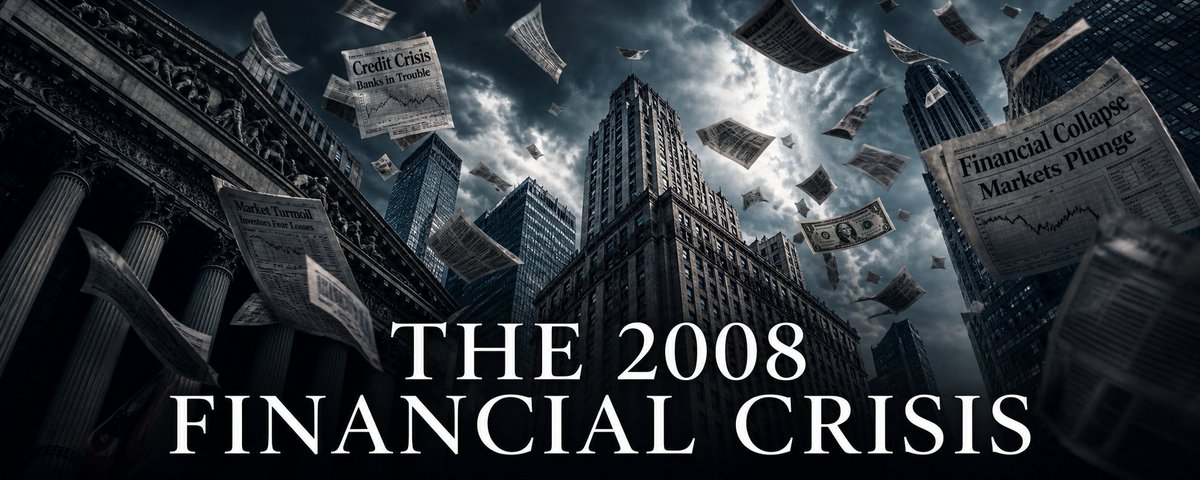
Save this tweet, then open the article below: how one man made nearly $4 billion in the 2008 crash and never found a second trade.

volta retweeted
In 1988, Donald Trump sat on Oprah's couch and described his entire 2016 presidential platform. He said he'd probably never run.
He was 41. He'd just bought the Plaza Hotel for $407 million. He had two casinos in Atlantic City, an 86-meter yacht he'd bought from a Saudi arms dealer, and a helicopter with his name on it. Forbes put him at $1 billion.
Oprah asked about politics. He didn't hesitate.
He said America was being "ripped off." That Kuwait "lives like kings" while paying nothing for U.S. protection. That Japan "knocks the hell out of our companies." That he'd make allies "pay their fair share."
She asked him straight: would you ever run?
"Probably not. But I do get tired of seeing the country get ripped off."
Then he said something the audience remembered for three decades:
"I wouldn't go in to lose. I've never gone in to lose in my life."
He went back to building towers. Two years later he owed $3.4 billion. The Plaza filed for bankruptcy. The yacht was sold. The airline shut down. The banks put him on a personal budget.
In June 2015, he came down a golden escalator and said the same things he'd said on that couch. Same words. Same grievances. Same confidence.
He won. Twice.
That interview was filmed before George H.W. Bush was even elected. Every line sounds like a 2016 rally.
volta retweeted
In 1980, Rona Barrett asked Donald Trump what he'd do if he lost his fortune. He said, "Maybe I'd run for president." He was joking. Both things happened.
He's 34. He just opened the Grand Hyatt a $100 million renovation of the old Commodore Hotel near Grand Central Terminal. It's his first major deal. His father co-signed the $70 million construction loan. Trump Tower is still three years away.
Barrett asks if he'd ever want to be president. He says no. "It's a very mean life." He says the most capable people in the country aren't running for office. Then he says: "One man could turn this country around. The one proper president."
He turns to Iran. The hostages have been held for nearly a year. "That this country sits back and allows a country such as Iran to hold our hostages is a horror." He says the U.S. should have used military force. "I don't think they'd do it with other countries."
Two years later, Forbes put him on the first-ever 400 list splitting a $200 million fortune with his father. By 1989, they valued him at $1.7 billion.
By 1990, he owed $3.4 billion. The casinos went bankrupt. The airline folded. The banks put him on a $450,000-a-month allowance.
By 2016, he was the 45th President of the United States.
A 34-year-old with one hotel, joking about bankruptcy and the presidency in the same sentence. The punchline took 36 years.
volta retweeted
In 1990, Donald Trump owed $3.4 billion and went on NBC acting like nothing was happening.
He's 44. Sitting in Trump Tower. The Taj Mahal just opened for $1 billion, funded almost entirely by junk bonds at 14% interest. Revenue projections are already falling short. Contractors aren't getting paid. He owes money to over 70 banks. $800 million of it he'd personally guaranteed.
He doesn't flinch.
A year earlier he was on the cover of every magazine in New York. He owned a yacht, an airline, three casinos, the Plaza Hotel. Forbes pegged his net worth at $1.7 billion.
By summer 1990, regulators warned of "the possibility of a complete financial collapse of the Trump Organization."
The Taj Mahal filed for bankruptcy in 1991. Trump Castle and Trump Plaza followed in 1992. The Plaza Hotel filed the same year. His yacht was sold. The airline shut down. The banks put him on a personal budget. The New York Post ran the headline "UH-OWE!"
His father sent a lawyer to one of his casinos to buy $3.5 million in chips. Not to gamble. To inject emergency cash. The Casino Control Commission fined them $30,000 for the illegal loan.
The banks could have buried him. They didn't. They calculated that the name on the building was worth more than the debt behind it. So they restructured. He gave up equity, sold assets, and clawed back deal by deal.
In 1995 he declared a $916 million loss on a single tax return.
By 2004 he was hosting the most watched show on television. By 2016 he was President of the United States.
The man on this tape is $3.4 billion underwater and talking like he owns the room. That's either delusion or the reason he survived.
volta retweeted
In 1978, Oprah Winfrey was earning $22,000 a year in Baltimore and her boss was trying to change her name to Suzie.
She was 22. Co-anchoring the six o'clock news on WJZ. She'd already been the youngest anchor in Nashville and the first Black woman to do it. Baltimore brought her in to be their new face.
It lasted eight months.
Her co-anchor hated her. Belittled her between commercial breaks. Management wanted a different look. They gave her a perm. Her hair fell out. They told her she was too emotional for news.
They pulled her off the air. But firing her meant paying out her contract. So they stuck her on a daytime talk show nobody was watching.
In 1984 she took over a last-place morning show in Chicago. Within months she overtook Phil Donahue. By 1986 the show went national. 25 seasons. 4,561 episodes. 48 million viewers a week. Advertisers paid $1 million for 30 seconds. By the final season she was making $300 million a year.
She grew up in rural Mississippi. Born 1954. No running water. Dresses made from potato sacks.
In 2008 she stood at Stanford's podium and told the graduates what it felt like the first time she sat down on that Baltimore talk show.
"Breathing," she said. "It felt like breathing."
The show they gave her to avoid paying severance made her worth $3.4 billion. The name stayed Oprah.
In 1976, two cousins left Bear Stearns and started an investment firm with $120,000 in combined savings. Today that firm manages $758 billion.
Their names are Henry Kravis and George Roberts. The firm is KKR. This is them on stage at the Milken Institute.
In 1988, they bought RJR Nabisco for $25 billion. It was the largest corporate takeover in American history. It inspired the book "Barbarians at the Gate." Congress held hearings. The press called them corporate raiders.
They kept going.
Kravis has been through 21% interest rates. 11% unemployment. The 1987 crash. The 2008 financial crisis. He says all of them were scarier than what's happening right now.
In this conversation, he and Roberts explain what they do when markets panic. Since the beginning of 2025, KKR has deployed over $30 billion. Not despite the uncertainty. Because of it.
Roberts says most investors overanalyze. They count the blue trucks in every company. They build spreadsheets instead of building conviction. He says the ones who succeed are curious. The ones who fail have tunnel vision.
Kravis lays out their allocation in three numbers. 70% in strong companies you want to own for years. Average in over six months. 20% in cash. 10% in higher-risk bets. He has followed this formula for 50 years.
Two cousins. $120,000. One rule: when everyone else freezes, lean in.