Practical notes on AI-assisted work, agents, judgment, review, and handoff. AI makes output cheap. The real edge is trusted work.

Joined April 2026
I write practical notes on how to stay useful in the AI era. Not prompt hacks. Not tool hype. I focus on: - judgment - review - handoff - AI-assisted work - clearer thinking - better workflows AI makes output cheap. The real edge is trusted work. Follow for practical notes on turning AI output into trusted work.
1
58
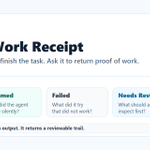
Useful agents need more than a chat box. The agent workbench has 5 parts: 1. Tools Can it take real actions? 2. Runtime Can it execute safely? 3. Tests Can it prove what changed? 4. Permissions Can you limit the blast radius? 5. Review Can a human inspect and decide? The product is the whole loop, not the model call.
21
The key phrase is: “more than moving a local agent to a server.” Cloud agents need a workbench: persistent runtime, real dev environment, tests, permissions, review surface, handoff back to the human. The product is not the model call. It is the loop around it.
A great cloud agent experience involves a lot more than moving a local agent to a server. We've learned that it requires a durable execution platform, a powerful harness, and the tools and infra to give agents realistic development environments. cursor.com/blog/cloud-agent-…
19
Most teams are still evaluating AI agents like chatbots. That misses the point. A useful agent needs a workbench: - tools to take real actions - a runtime to execute safely - tests to prove what changed - permissions to limit damage - review surfaces for humans The model is only one layer. The real product is the loop around it: context → action → evidence → review → handoff.
12
The useful unit of AI adoption is not the job. It is the task boundary. Before asking whether AI changes a role, ask: 1. What can be drafted faster? 2. What can be searched cheaper? 3. What can be reviewed earlier? 4. What still requires judgment? 5. Who remains accountable? AI changes tasks before it changes job titles.
3
“AI exposure by job” is a tempting frame, but it is too large to be useful. A job is a bundle of tasks, handoffs, reviews, decisions, and accountability. AI changes the bundle unevenly. The useful question is smaller: Which task boundary moved? That is where the real work change starts.
.@benedictevans: "People try to predict a profession is X or Y% exposed to AI—this is just the most ridiculous bunch of deluded horsesh*t."
10
“AI will replace X% of jobs” is the wrong question. A job is not one task. It is a bundle of: - inputs - decisions - reviews - handoffs - tools - accountability AI changes that bundle unevenly. Some tasks get cheaper. Some reviews become more important. Some decisions still need human judgment. Some handoffs disappear. The better question is not: “Will this job vanish?” It is: “Which task boundary just moved?”
6
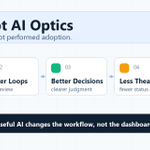
Real AI adoption should be visible in the workflow, not just the dashboard. The question is not: “Did people use AI?” The better question is: “What got easier, shorter, or unnecessary?” A practical test: 1. Removed work 2. Shorter loops 3. Better decisions 4. Less theater 5. Faster recovery Useful AI changes how work moves.
5
This is the AI adoption trap: companies start measuring the appearance of AI use instead of the disappearance of unnecessary work. A better question is not: “Who used AI this week?” It is: What handoff disappeared? What review loop got shorter? What decision became clearer? What status ritual went away? Real AI adoption should reduce optics work, not create a new category of it.
I wrote this thread before ChatGPT launched, but it is even more relevant in the AI age. Particularly, CEOs’ push for “more AI” is leading to a new kind of Optics work within companies: creating the perception of using AI, tokenmaxxing, etc. without much regard to UX or impact.
8
A weak AI adoption metric: “How many people used AI this week?” A better one: “What work disappeared because AI was added?” The useful signs are simple: - fewer handoffs - shorter review loops - clearer decisions - less status reporting - faster recovery from mistakes If AI creates more tracking, more meetings, and more internal theater, it is not improving the workflow. It is just adding a new layer of optics.
5
Agent-Ready Context Before an AI agent writes code, reviews a document, or updates a workflow, it needs context that is usable. Not more words. Better structure. 1. Goal: what outcome should exist 2. Boundaries: what not to touch 3. Sources: where truth comes from 4. Checks: how done gets verified 5. Owner: who decides when unsure Bad context creates more work. Clear context creates delegation.
7
The interesting part is not “PMs can skip engineers.” It is that the input format of work is changing. A PRD only becomes useful to agents when it contains: clear scope, system constraints, acceptance checks, source of truth, and review rules. AI does not remove work design. It makes unclear work more expensive.
A product requirements document just became source code. At OpenAI, a PM wrote a PRD in markdown on Monday. The coding agent read it, wrote the implementation, and passed it through review agents that checked architectural guidelines, front-end patterns, and design system compliance. By Friday a working feature shipped as a merged pull request. No engineer translated the document. No engineer wrote a line of code. Ryan Lopopolo, the engineering lead who built this workflow, calls it "PRD as code input, app as compiled output." The PM needs to understand users. The harness handles translation. The constraint that made this possible: the codebase is so modular that every piece of business logic exports a high-fidelity fake for testing. When the PM's agent-generated code connects to dependent services, it exercises real logic without touching production. The tests the PM vibed into existence actually exercise the full system. And the build fails if the code violates any of the hundreds of quality rules the engineering team encoded over months. Think about what this collapses. PM writes a doc. Engineer interprets it. Implementation takes a sprint. Testing takes another. PM validates. Each of those handoffs is a lossy translation. Each one costs a week of calendar time. Remove them and you get Monday to Friday with one person. The PM job didn't get easier. The translation tax disappeared. PMs who write precise documents now have the shortest path from insight to shipped product in the history of software.
1
Most agent failures start before the prompt. They start with unclear work. Before asking an AI agent to do anything useful, define: - the outcome - the boundaries - the source of truth - the acceptance checks - the human owner A better prompt helps. A clearer work surface helps more.
6
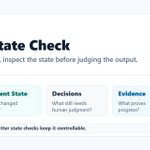
The Agent Visibility Layer Background agents need a visible operating surface. A useful agent should show: 1. Identity: which agent did the work 2. State: what changed right now 3. Evidence: why it made the change 4. Next step: what decision is pending 5. Owner: who is still accountable 6. Exit: how to stop or roll back Autonomy becomes usable when the system stays inspectable.
4
This looks small, but it points at a real product problem for background agents: identity. Once multiple agents appear across tabs, logs, mentions, and threads, users need to know: which agent did the work, what it touched, what state it is in, and what decision is still waiting. Agent UX is becoming work visibility UX.
2 quality-of-life improvements for developers working with Codex today: Codex background agents now have stable pixel identicons. When the same agent shows up across tabs, mentions, transcripts, and the thread panel, it’s easier to recognize at a glance.
2
31
The next AI work problem is not “can the agent act?” It is “can the human still see what is happening?” When an agent works in the background, users need visibility into: - identity - current state - changed files - evidence - pending decision - rollback path Invisible autonomy feels magical in a demo. It feels risky in real work.
1
12
The AI Decision Budget Every AI workflow needs a clear rule for human attention: 1. Auto-run low-risk, reversible tasks 2. Ask for evidence when confidence matters 3. Require approval for external or hard-to-undo actions 4. Escalate when goal, context, or owner is unclear Good AI work is not fully manual or fully autonomous. It is clear about where judgment matters.
5
A model upgrade only becomes useful when the workflow around it is clear. For coding agents, the next question is not “can it write more code?” It is: what can it change automatically, what evidence must it show, what requires approval, and who owns the final judgment?
🆕 @AnthropicAI's Claude Opus 4.8 is now generally available and rolling out in GitHub Copilot. Early testing shows: • It demonstrates a clear step forward in code understanding and generation across a range of real-world coding tasks. • It handles complex problem-solving and large-codebase navigation with notable improvement to previous versions. Try it out in @code or Copilot CLI. github.blog/changelog/2026-0…
4
Most teams make one of two mistakes with AI agents: They review every step, so the workflow becomes slower than doing it manually. Or they review nothing, so the system quietly does risky work. The useful question is not “human in the loop?” It is: which decisions deserve human attention?
3
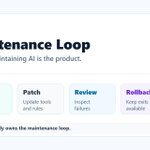
The AI Maintenance Loop Once an AI workflow is in production, the job is no longer “make it work once.” The loop becomes: 1. Monitor behavior 2. Re-run evals 3. Patch prompts, tools, and rules 4. Review failures 5. Keep rollback paths 6. Assign ownership Shipping AI is a release. Maintaining AI is the product.
1
28
Agent-assisted upgrades are a good example of where AI can be genuinely useful. Not because the task is glamorous. Because maintenance work is full of small, high-context fixes: version changes, broken assumptions, migration details, and tests that need to keep passing. AI work gets valuable when it reduces maintenance drag.
🔥 MSVC 14.51 is GA! Faster codegen, new language features, smoother retargeting, + preview Intel APX via /feature:APX. Copilot’s @Modernize agent helps fix upgrade issues fast ⚡ 👉 Read the blog: buff.ly/f3ipX8G
8