

AI, semiconductors & global markets | Tracking primary sources, industry shifts and key data | Filtering noise, sharing what truly matters
Hong Kong
Joined April 2017
- Tweets2.8K
- Following998
- Followers2.5K
- Likes16



Microsoft ($MSFT) faces elevated expectations heading into its first-quarter fiscal 2027 print, as sell-side models project Azure constant-currency revenue growth between 45.6% and 47%, exceeding management guidance of 44% to 45%. Consensus among supplied research houses indicates that Azure will clear its quarterly hurdle while Microsoft 365 Commercial Cloud accelerates to 17% constant-currency guidance. Forecasts establish a defined range across report dates: House J estimates 45.6% reported growth as of 19 October 2026, House D models 46% constant-currency growth while evaluating a 47% investor bogey as of 14 October 2026, and House A projects an upside case of 46% to 47% as of 15 October 2026. Each house anchors its projection on distinct infrastructure and monetization mechanics. House J attributes growth to 1 GW quarterly capacity additions and enterprise contract stability, with compute shared with expanding Copilot adoption. House A bases its upside view on capacity expanding to ~5 GW in fiscal 2027 from ~4 GW in fiscal 2026, alongside Maia silicon efficiencies. House D highlights hosted GPU price inflation and surging pass-through as OpenAI annual recurring revenue reached ~$50bn in September. To distinguish these views, investors should monitor sequential dollar additions, where Microsoft needs ~$2.9bn to achieve 45% growth versus $3.5bn for a 47% print, alongside second-quarter Azure guidance and first-quarter capex guided over $50bn. #Microsoft #AI

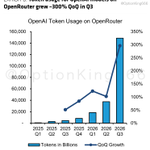
Datadog ($DDOG) absorbed a 300% QoQ surge in third-quarter 2026 token consumption across OpenAI models, lifting its AI customer cohort back into rapid sequential growth despite a major contract downsize. Following the mid-July release of Codex 5.6 and token price cuts of up to 80% in August, quarterly token volume on OpenRouter expanded from roughly 38 billion to nearly 150 billion tokens. This rebound reversed a summer lull where weekly growth slowed to the low teens. Although Datadog absorbed an ARR downsizing exceeding $100mn from OpenAI early in the quarter, gross AI customer consumption grew roughly 50% QoQ. Net of the downsize headwind, analyst models estimate Datadog's AI cohort expanded ~25% QoQ in the third quarter and project a matching ~25% QoQ increase in the fourth quarter. The volume surge highlights how enterprise token demand outpaces headline lab monetization, as OpenAI enterprise revenue grew 107% QoQ while total sales rose 77%. Analysts project Datadog revenue will reach $4,698mn in 2026 and $6,450mn in 2027, representing a 37.2% revenue CAGR as sell-side models raise near-term growth rates by roughly 7 percentage points. Non-GAAP operating income is projected to expand from $768mn in 2025 to $1,148mn in 2026 and $1,730mn in 2027. The primary downside risk centers on infrastructure unbundling at extreme customer scale, where high-volume labs face incentives to shift observability in-house or substitute point solutions such as ClickHouse for logs and Chronosphere for business metrics as contract commitments renew. #Datadog #OpenAI #AI

AppLovin ($APP) is projected by analysts to generate 52% of its topline revenue growth from eCommerce by 2028, outpacing mobile gaming as advertising expansion outside its core category accelerates. Sell-side models forecast that eCommerce revenue will expand by 74% year over year to reach $2,830 million in 2028, up from $976 million estimated in 2026 and $1,625 million in 2027. Over the same span, annual gaming ad revenue growth is projected to decelerate from 42% in 2026 to 17% in 2027 and 13% in 2028, reaching $9,516 million as mobile gaming ad inventory penetration reaches maturity. This shifts eCommerce from 8% of total revenue in 2025 to 12% in 2026, 16% in 2027, and 23% in 2028. Total revenue is projected to reach $12,346 million in 2028, representing a 23% annual increase. Consensus estimates take a more skeptical view, projecting eCommerce will drive only 31% of growth in 2028 with $2,265 million in revenue, keeping gaming at 69% of growth. Management targets an overall 30% compound annual growth rate over five years, expecting eCommerce to supply half of incremental gains. Sell-side analysts note that valuation multiples have compressed as investors question whether web commerce can offset gaming deceleration. Reflecting higher interest rates and execution uncertainty, analysts lowered their valuation multiple from 29x to 25x 2027 estimated free cash flow of $6,571 million, reducing their target price from $600 to $500. The primary operational test remains whether advertising returns on ad spend sustain customer adoption or deteriorate under platform competition. #AppLovin #AdTech

Tokyo Electron is projected by House A analysts to expand semiconductor equipment sales by +33% from FY25 to FY28E as AI infrastructure demand accelerates. Across the supplied research, House A and House D agree that equipment demand driven by AI infrastructure is accelerating, with sector sales projected to expand at a +27% annualized rate led by Lasertec at +37%. Upstream validation appears in record quarterly orders at component suppliers Rorze and Marumae, while toolmakers note wafer fab equipment demand is expanding two years ahead of expectations. House A models a 13.4 percentage point operating margin expansion at Tokyo Electron. Meanwhile, House D models lithography intensity driving the equipment market to c.$300bn in 2028E, lifting 2028E Low-NA EUV shipments to 117 units from 105. However, a direct common forecast range is explicitly withheld because House A models Japanese toolmaker sales while House D models global equipment totals and lithography backlog. Divergence emerges around operational bottlenecks. While House D anticipates steady volume expansion into 2028E, House A emphasizes severe capacity ceilings that cap laggards at +7% sales growth. Tokyo Seimitsu faces orders at 1.5x capacity with prober lead times stretching to 6 months from 3 months and no capacity upside until CY27-end, while Ulvac is at full capacity with lead times extending to 8-9 months from 6 months. To verify whether equipment demand converts smoothly into billings or stalls, watch upcoming earnings results for capacity expansions and lead-time normalization across Japanese toolmakers, alongside ASML backlog disclosure next quarter. #Semiconductors #AI


Amazon AWS instituted a 15% price increase for reserved GPU capacity on October 7, marking its fourth consecutive quarterly hike and lifting cumulative reserved compute pricing by 40% to 75% year to date. This pricing power reflects persistent infrastructure shortages across high-performance clusters, where demand backlogs from AI labs continue to outstrip server installations. Sell-side analysts model AWS revenue growth accelerating into the low 40% range year over year in the third quarter of 2026, before sustaining roughly 40% annual growth through 2027. Rather than discounting older capacity, cloud providers are capturing expanding unit margins on existing hardware because enterprise training queues remain deeply extended. Longer-term infrastructure commitments underpin this trajectory, with Amazon planning to deploy an incremental ~2 million GPUs across its data center network over 2027 and 2028. Expanding partnerships with leading model developers, including OpenAI, provide multi-year revenue visibility that analysts project will support a $365 price target by December 2027, representing an estimated 46% upside. In the near term, derivatives markets imply a 6.4% earnings-day move, closely tracking the 6.3% average realized move over the past three years. The critical observable to watch is whether gross margins expand in step with compute rate cards, or if speculative concerns over agentic AI disintermediating high-margin retail media advertising re-emerge to cap valuation multiples. #AI #MarketStrategy
Nichicon is expanding its AI and data-center aluminum electrolytic capacitor revenue by 5.8x from ¥5.2bn in FY26 to an estimated ¥30.0bn in FY29 as server power supplies transition to high-voltage architectures. Demand is shifting rapidly toward 400V and higher power supplies, where large long-L-type electrolytic capacitors provide essential intermediate bus voltage conversion. In low-voltage domains around compute trays, MLCCs dominate, but high-voltage server racks require high-capacitance electrolytic alternatives. Taiwanese power supply makers are accelerating component procurement, driving Nichicon's first-quarter book-to-bill ratio to 1.3x. Analysts project Nichicon will expand its AI market share from roughly 20% in FY25 to 30%, raising AI sales to 25.0% of total aluminum capacitor revenue by FY29. Operating profit reflects this operational acceleration, with sell-side models projecting ¥12.2bn in FY27, an 89% YoY surge that exceeds company guidance of ¥8.7bn by 40% and consensus by 5%. Forward operating profit is estimated to climb further to ¥15.1bn in FY28 and ¥17.7bn in FY29 as large capacitor shipments ramp from ¥2.2bn in FY26 to ¥23.5bn in FY29. Product mix improvements and raw material pass-throughs provide margin upside, offsetting a ¥4.3bn cost headwind assumed in official guidance. The primary downside risk centers on electricity and raw aluminum cost inflation, alongside execution delays at Taiwanese power assembly partners. Investors should monitor quarterly book-to-bill persistence and gross margin preservation at the upcoming interim earnings release. #Murata #TDK #Ibiden #Semiconductors
ASML ($ASML) order backlog surged an estimated 44% to a record €56bn in Q3 2026, up from €38.8bn disclosed in Q4 2025, according to sell-side balance-sheet models tracking customer prepayments. Because tool booking disclosures ceased after 2025, analysts track contract liabilities, which reached a record €24.6bn in Q3 2026 compared to €19.4bn at FY25. More importantly, non-current contract liabilities jumped to €9.0bn from €3.6bn in Q2 2026, signaling prepayments for tools shipping beyond twelve months. Historical regression indicates an R² above 96% and an implied 2.2x backlog-to-liability ratio, showing buyers pay 35% to 40% upfront. This translates to ~€35bn in backlog due within one year and ~€21bn extending beyond one year. This backlog structure implies ASML has covered 100% of planned 2027 EUV capacity (~€24bn sales) and roughly 60% of 2028 EUV revenue (~€35bn sales), while 2027 DUV capacity is ~60% booked (~€19bn sales), leaving headroom for pricing upside. In parallel, related industry studies project Low-NA EUV shipments expanding to roughly 65 units in 2026 from 44 units in 2025 after a 75% surge in memory tool sales, while value-based pricing discussions provide initial margin expansion in 2027. Sell-side models project fiscal 2028 diluted EPS reaching an estimated €84.18, roughly 18% above consensus, alongside 2026 estimated EPS of €43.23. The primary metric to track is whether non-current contract liabilities stay above €9.0bn, as any pullback would signal deferred tool installations. #ASML #SemiEquipment
CoreWeave ($CRWV) is projected by analysts to expand annual revenue from $5,131.1mn in 2025 to $47,535.0mn in 2028E, raised from a prior estimate of $44,185.2mn as high-density AI clusters scale. Analyst models project revenue growth of 152.6% to $12,960.1mn in 2026E and 112.4% to $27,529.3mn in 2027E, alongside EBITDA expanding from $3,094.6mn in 2025 to $7,693.2mn in 2026E, $18,180.8mn in 2027E, and $32,673.6mn in 2028E. Sell-side estimates for 2028E revenue stand 11% above consensus Street projections, underpinned by higher monetization per megawatt. Blended monetization currently sits at approximately $10mn/MW based on active power, but analysts assume new long-term contracts will price at $13mn/MW, supported by recent price hikes of 25% in July and 10% in October alongside short-term contracts signed at $40mn/MW. Higher-margin software offerings such as Forge, Omni, and managed inference are projected to lift revenue density without requiring proportional infrastructure capital expenditures. Operating profit is estimated by analysts to reach $10,176.6mn in 2028E, 24% above consensus Street projections as capacity additions decline relative to the installed base. CoreWeave finances infrastructure primarily through asset-backed delayed draw term loans tied to dedicated customer contracts rather than unsecured debt, which trades at 13.5% to 15.0% yields. Analysts estimate new borrowing costs between 750bp and 1050bp, keeping weighted average cost of capital at 11.8% against post-tax unlevered project returns of 15% to 21%. Supporting this expansion, sell-side models set a 12-month price target of $106.00 on an 18x forward EBIT multiple, applying a 50% discount to hyperscalers to reflect debt levels. The key risk to monitor is whether GPU residual values hold above capital costs after initial four-to-five-year agreements end, while data center leases of seven to 16 years remain active. #CoreWeave #DataCenters

However, 256Gb wafer prices recovered in early October, demonstrating resilient demand across targeted industrial and enterprise storage channels. The essential risk to track is whether spot price pauses in consumer electronics spill over into enterprise solid-state drive procurement. #Samsung #Memory

Major memory makers precipitated this spike by rapidly curtailing 8Gb production lines in favor of higher-density architectures. Manufacturers had slashed legacy output to convert fab space for AI memory. The crucial downside risk to watch is an abrupt demand drop if legacy equipment makers redesign systems to bypass DDR4 components. #Samsung #Memory
Consumables manufacturing at Disco will transition to the upcoming Gohara plant by 2028. The operational reallocation aims to optimize the flagship Kuwabata site, where high ceilings were specifically designed for precision dicers and grinders rather than blades. Freeing floor space allows Disco to expand assembly lines for advanced packaging equipment. Production efficiency at Kuwabata also benefits from internally developed automated guided vehicles and insourced sheet metal processing. The report notes this operational streamlining raises enterprise value over time. However, any slowdown in final electronic device demand or delays in customer factory expansions could dampen utilization of this newly segregated capacity. #DISCO #SemiEquipment
ASML ($ASML) and European semicaps showed a regional divide across 70 investor meetings, as European buyers cited visibility into 2028 while Asian funds questioned whether 2027/28 equipment growth is priced in. Asian accounts probed for incremental upside sources, asking whether wafer fab equipment spending can deliver further earnings revisions. The report contends that multi-year growth is not fully priced in, as trading multiples sit well below historical averages due to skepticism over post-2027 durability. Re-rating depends on manufacturers expanding shipment capacity and realizing gains from value-based pricing. Unfavorable trade restrictions or delayed customer technology transitions represent the primary downside risks. #SemiEquipment #ASML
Sumitomo Bakelite is projected to generate FY26 business profit of ¥54.0bn, outperforming company guidance of ¥38.0bn by 42%, according to Nomura. Surging demand for semiconductor encapsulants in AI data center power semiconductors drives this major forecast divergence. Nomura models full-year operating profit growth at 56.6%, supported by strong back-end packaging materials demand. Earnings momentum will accelerate in the second half of FY26 following price revisions for encapsulants and the acquisition of Kyocera's chemicals business. With a target price of ¥10,000 versus its ¥9,317 share price, valuation reflects growing AI exposure. The observable to monitor is whether management deploys its strong balance sheet to boost share repurchases and lift capital efficiency. #Chemicals #Materials Report date: 2026-10-14 · Nomura

Sumitomo Electric Industries is on track to secure NVIDIA ($NVDA) accreditation for ultra-high-power CPO lasers in fiscal 27/3 before scaling in 28/3 H2, according to Nomura. The Japanese supplier provides silicon photonics to NVIDIA and anchors laser production through an exclusive seven-year Indium Phosphide substrate procurement agreement with Lumentum Holdings ($LITE). NVIDIA selected the company as a silicon photonics vendor for co-packaged optics in March 2025, while Lumentum confirmed its Japanese substrate supply is locked under multi-year contract. Small-scale manufacturing issues limited past output. The key observable is whether fixing these fabrication problems accelerates commercial laser delivery by late 2027. #Lumentum #SumitomoElectric #NVIDIA #OpticalNetworking Report date: 2026-10-13 · Nomura

Semiconductor distributor price breadth contracted sharply in September 2026, with only 26% of microcontroller products recording price increases compared with 45% in August. According to Barclays, analog products seeing price hikes narrowed to 35% from 48%, while power semiconductors dropped to 29% from 49%. Flat pricing absorbed 41% of MCUs and 52% of power chips. Average pricing stayed positive at 0.4% for MCUs and 0.6% for power semiconductors, while analog softened by 0.7%. Across tracked listings, products falling over 20% in price expanded from 3% to 7% of the total basket. Pricing resilience could falter if distributor inventory rebuilding prompts renewed discounting across commoditized analog catalog lines. #Semiconductors #Tech Report date: 2026-10-13 · Barclays

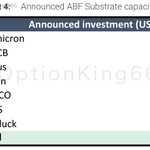
Global ABF substrate makers have committed US$14.3bn in capex year to date, yet this still falls short of implied market demand, according to Morgan Stanley. Because each US$1 of investment supports only US$0.50 to US$0.60 in annual revenue at full ramp, the pipeline yields US$7.2bn to US$8.6bn in incremental sales, trailing the US$11.4bn needed as the market reaches US$20.9bn by 2030. Project commitments are led by SEMCO at US$5.0bn, Ibiden at US$3.2bn, AT&S at US$2.0bn, Unimicron at US$1.7bn, and NYPCB at US$1.5bn. However, most facilities will not ramp until late 2028 to 2030, including SEMCO's Sejong site in September 2028 and NYPCB's southern facility in 2H29. Downside risks center on fab construction delays or prolonged lead times for substrate equipment. #PCB #Unimicron #NanYaPCB #AMD Report date: 2026-10-14 · MS

ABF substrate demand will exceed available capacity by 9.3% in CY27 and 13.7% in CY28, according to Morgan Stanley. This widens the modeled supply deficit by 3.1 and 4.3 percentage points versus prior estimates, locking in structural shortages. Although below buy-side expectations of roughly 50%, the bank projects substrate contract prices will accelerate by 25%+ in CY27. Supply-demand ratios reach 113.7% in CY28 and 125.9% by 2030 as larger package sizes, layer counts, and manufacturing complexity constrain usable yields. While suppliers plan new lines, most facilities will not ramp until 2028-30. Key risks that could ease tightness include weaker server end-demand, T-glass shortages crimping lines, or early adoption of CoWoP packaging. #PCB #Unimicron #NanYaPCB #AMD Report date: 2026-10-14 · MS
