

We collect your business history. We turn it into memory. We run your growth on it.
Joined September 2026
- Tweets64
- Following2
- Followers12
- Likes87






Marketing: “Traffic is up.”
Sales: “Pipeline isn’t.”
A new client is coming onboard with OpenWay AI, and the owner needs one answer: what exactly is broken?
Peak season is in full swing. No time to bring in outside consultants. No extra budget for them either.
The cost of a consulting team and an OpenWay AI subscription are two very different numbers. So why not test it?
We’re just getting started and will share what we learn. In the meantime, we wrote about where AI can actually help in B2B marketing:
openway.ai/blog/ai-marketing…
🤖 Made with AI

openway.ai retweeted

If your next campaign brief doesn't mention what your last one taught you, youre about to pay for the same lesson twice.
I've watched this happen in B2B teams of every size.
A test runs -> sales hears on calls that buyers are worried about implementation, not price -> a few reps adjust their pitch.
The results get a slide in the monthly review. Then the next hypothesis comes up, and the person writing it opens the old brief. That brief still says price is the objection.
Nobody did anything wrong. The learning sat in call notes, a CRM field, and the memory of two salespeople. Pulling it out again would take days, and the launch date was already set.
In 350+ customer development interviews before we wrote any code for @OpenWay_AI , this was the pattern I kept coming back to.
Teams were spending real money to learn what works. Then they started each experiment almost from zero. That's what we built OpenWay AI around. It keeps what the business has already learned (calls, campaigns, CRM history, decisions) as working memory, so the next test starts from there. Anything that gets sent or published still waits for a person to approve it.
When I talk to Heads of Growth now, I ask one question first: how long does it take your team to find out what the last experiment actually taught you?
We turn your business memory into growth, starting with one real task → openway.ai

openway.ai retweeted
Most growth teams I've interviewed run an experiment, learn something real, and then start the next one from a blank brief.
The last test showed which objection mattered. The call notes said why a deal finally moved. Then a new hypothesis comes in, and someone rebuilds all of it from Slack threads, an old deck, and whoever still remembers.
After 350+ customer interviews and 300+ beta users running live growth experiments on @OpenWay_AI, this is the time I'd look at first if you want to launch faster: the days spent rediscovering what the company already learned.
Which decisions from the last test still stand?
What did sales hear that marketing never saw?
What would you skip if the brief already knew it?
openway.ai/business-memory

openway.ai retweeted
Three different things we call “AI visibility”
Your page was crawled.
Your page was cited.
Someone clicked through.
Three different events. Each answers a different question.
The first tells you a system accessed the page. The second tells you it used the page in an answer. The third tells you someone arrived.
I want these separated when we evaluate content at @OpenWay_AI. Otherwise, it’s too easy to celebrate activity without understanding what happened.
The same applies to Google rankings. They tell us something useful about Google. They don’t settle the question of visibility across AI search.
Before adding another article to the calendar, check whether the existing ones can be found, read, and used.
anna2084.substack.com/p/5-no…
openway.ai retweeted
Before you publish another hundred articles
AI made publishing faster. It didn’t make every new page useful.
You can change a competitor’s name, rearrange a few paragraphs, and publish another article. A different URL doesn’t give it a different purpose.
This is one of the rules we’ve been building into the content workflow at @OpenWay_AI: every page needs its own reason to exist.
What question does it answer?
What evidence does it add?
Why would someone need it if they’ve already read the other one?
If the answers are almost identical, I’d fix the brief before generating more copy.
A hundred articles is an output number. I want to know how many useful questions we’ve actually answered.
anna2084.substack.com/p/5-no…
openway.ai retweeted
Ask AI what your company does
One positioning exercise I’d recommend to any founder: ask a few AI systems to explain your company.
Then read the answers without mentally correcting them.
Which category do they put you in? Who do they compare you with? Which part of your product disappears?
At @OpenWay_AI , we have to keep business memory connected to growth. Otherwise, the explanation can drift toward another tool for storing information.
That changes what people expect us to do.
anna2084.substack.com/p/5-no…
You ask AI a question, get a smart answer, close the tab… and next week you start from zero again.
For a business, that can mean losing the context behind decisions, actions, and results.
openway.ai/blog/claude-for-b…

openway.ai retweeted
When someone leaves a team, we ask them to hand over their work.
I’d also want to know what they stopped doing and why. The next person could spend months reaching the same conclusions.
That thinking should stay with the company.
openway.ai/business-memory
openway.ai retweeted
We spend so much learning what works in our business. Yet somehow, the next campaign starts from scratch.
I think that’s a bigger problem than we realize.
I wrote about business memory and why we’re building @OpenWay_AI around it:
openway.ai/business-memory
It’s Saturday morning. You’re off, but OpenWay AI is still connecting the dots in your business data and looking for what could drive growth next.
Sometimes the best growth ideas are already hiding in what your business knows.
openway.ai/blog/b2b-growth-h…
🤖 Made with AI

openway.ai retweeted
An AI can read your company’s history and still need help deciding what to rely on.
Which decision still stands? Which source should take priority? What changed since that document was written?
A Transformer works with the information in its current context. On its own, it does not provide a reliable system for long-term business memory.
That requires a separate layer to determine what to retrieve, what is outdated, and what can support a specific action.
This is why retrieval and trust are central to the Business Memory architecture we’re building at @OpenWay_AI
(notes after today’s discussions about “post-LLM” at the @streamlinedvc Founder Summit today)

Meet @OpenWay_AI!
what happens when you put pioneers from Google, ex-McKinsey, 3 PhDs, Forbes U30 in one room for six months? a fight between technology and business thinking, and out of it a product built to tackle one reason enterprise AI struggles to deliver measurable value: business context and feedback don't reliably carry over into the next action. MIT calls it the learning gap, and it's why 95% of enterprise pilots show no P&L impact.
everyone is racing to give AI more memory. we came at it from a different angle: the bottleneck isn't how much AI can store, it's whether it keeps the right facts current and pulls up exactly the ones the next decision needs.
we did this by solving continual learning in the system, not in the model.
OpenWay AI turns a company's operating history into memory that can be trusted, then executes growth work on top of it. Campaigns, deals, traffic, calls, customer insights are no longer just records; they become actions that drive your revenue, and what each action produces goes back into that memory. I wish my previous companies had it!
data volume is no longer a limit. OpenWay AI collects your data in real time and keeps it current. for every task, it decides which data to trust and which to throw away.
how do we know it works? 300+ beta users are already running live growth experiments on it. a general-purpose model can know almost anything and still not know your business. so instead of giving you the average answer for the market, openway ai acts on what is true for yours.
full write-up, use cases, and all our story: openway.ai

openway.ai retweeted
Last week, I spoke with a prospective customer who’s looking for ways to bring AI into their company’s everyday processes beyond coding. It was a familiar conversation. I’d encountered the same situation in more than 50 companies during customer discovery interviews.
You’ll probably recognize your own team here.
Read here and share your thoughts. Happy to discuss
anna2084.substack.com/p/your…

openway.ai retweeted
The best part of @Techweek_ ? People.
Even better? When you meet completely by chance at NY TechWeek because you both got turned away at the door of an event that was already full, and you’re like, “You look great, stranger. Let’s go get coffee?” 👀
And 3.5 months later, you’re actually making plans to meet for coffee at SF TechWeek because you’re no longer strangers and have so much to talk about!
The moral of the story: don’t think meeting amazing people at @Techweek_ by @a16z will go according to plan. You’ll meet them completely at random, when you least expect it. And those will be your best connections.

openway.ai retweeted
In my customer discovery interviews for @OpenWay_AI, I’ve often asked what people expect AI to do for their business.
One question I keep coming back to: are we using AI to help knowledge move through a company, or adding more places for it to get lost?
We’d expect AI to help. Yet every summary and handoff creates another point where someone, or something, decides which details survive.
Imagine a buyer finally says yes after sales explains the rollout. AI records “implementation discussed.” Marketing uses another AI tool to draft the next campaign from an existing brief, which still assumes price is the main objection..
We already had to manage what gets lost between people. Now we also have to manage what gets lost when AI compresses a conversation, decides what matters, or works from an incomplete brief.
When you evaluate AI at work, do you check what gets lost between the outputs?

In @Forbes , our founder @AIBelova shares 10 lessons from 10 years of building and scaling a tech company, including what she would do differently today with AI in the picture.
Many of those lessons shape how we’re building OpenWay AI.
forbes.com/councils/forbesbu…

openway.ai retweeted
10 lessons from 10 years of scaling tech companies.
One I’d apply much earlier: build distribution while word of mouth is still working.
Your first customers recommending you doesn’t tell you how to reach the next thousand. Personal networks have limits. What brings your first customers may not work in the next segment or country.
I wrote about this and nine other lessons in my new @ForbesBizCncl article.
Read here forbes.com/councils/forbesbu…
openway.ai retweeted
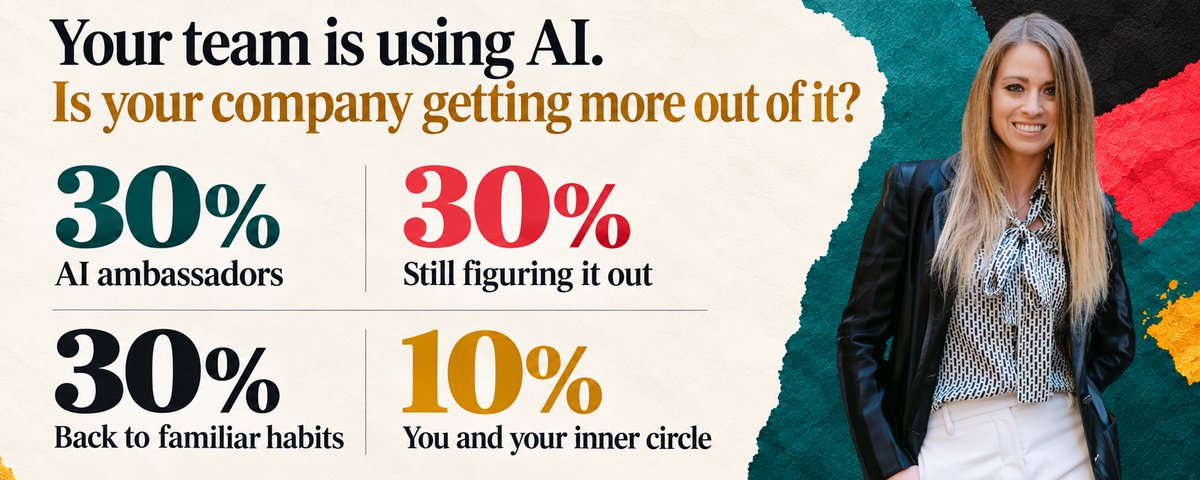
“Astra, maxed out.” That’s how an ordinary day starts for a nontechnical employee now. After cusdev interviews with 50+ companies, I keep coming back to this: personal productivity doesn’t always translate into company productivity. Read here
openway.ai retweeted
Your AI ambassadors say their personal productivity has reached Mars. Meanwhile, you’re trying to understand what changed for the company.
After customer discovery interviews with 350 companies, I keep coming back to that gap. As a founder, I want to know what the rest of the team can build on and what got better for the customer.
That’s the result I’m interested in. And you?