

Open-source AI for healthcare. 2,000+ Apache-2.0 clinical models. 600+ MLX and 700+ ONNX variants. Built for local and on-device AI. Free, forever.
Joined August 2025
- Tweets2.4K
- Following12
- Followers8.1K
- Likes4.6K




Pinned Tweet
OpenMed 3.0 is out: Patient Journey.
One synthetic patient, five systems: a clinic note, hospital FHIR, an outside clinic's HL7, a lab CSV, a retina DICOM report. They disagree.
3.0 links every fact to its exact source, keeps the conflict open and amends without erasing.

The access check in code: one boundary, two views.
A researcher asking for the identified view gets role_denied. The de-identified view answers without a subject id. Withdraw consent and the same clinician request comes back consent_withdrawn.

Docs: github.com/maziyarpanahi/ope…
Runs offline, no hosted policy service. Synthetic data.


Separated projections in openmed 3.0.0:
github.com/maziyarpanahi/ope…
Synthetic journey. The demo script wrote the de-identified view; the SDK keeps both apart, gates each read and writes a content-free audit row. Apache 2.0.
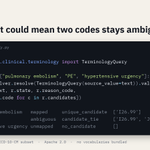
Three mentions, three honest outcomes: mapped, ambiguous, unmapped.
"hypertensive urgency" stays unmapped even though I10 (hypertension) is in the vocabulary. Close is not the same as correct.

Docs: github.com/maziyarpanahi/ope…
The mention text is stored as a keyed hash, not as text. Synthetic demo subset.


Terminology resolution in openmed 3.0.0:
github.com/maziyarpanahi/ope…
Synthetic 3-concept ICD-10-CM subset. OpenMed bundles no vocabularies; you bring your own. Apache 2.0.
Hugging Face's science team counts OpenMed among the most active AI-for-science contributors, with Ai2 and NVIDIA.
2,277 open models and 26 open datasets for medicine:
huggingface.co/OpenMed
Open weights and open data are how medical AI earns trust.


Hugging Face is becoming more and more the home of AI x Science projects. Open source accelerates scientific discovery when models, datasets, and tools are shared openly, all researchers can reproduce them and build on top of them.
A big thanks to @allen_ai, @OpenMed_AI, and @NVIDIAAI for being the most active contributors of AI for Science artifacts on @huggingface these days!
🤗 Hugging science heatmap: huggingface.co/spaces/huggin…


Docs: github.com/maziyarpanahi/ope…
Local and offline: no terminology server, no hosted validator.
A patient journey to FHIR R4 and back: 6 facts out as 8 entries, 6 identical facts back.
Now flip one Condition from inactive to active in transit. OpenMed 3.0 refuses the import as a custody conflict instead of merging it.
Every trip also reports what it could not carry.

FHIR Journey round trips in openmed 3.0.0:
github.com/maziyarpanahi/ope…
Synthetic record, 5 sources. The added resources and the edit were made by our test script. Apache 2.0.
The spot that grew: 8.70, 8.98, 9.40, 9.99 mm. +1.29 mm vs ±0.20 mm measurement error, so it's flagged. L02 moved −0.05 mm, inside the error, and it got that right.
LFM never sees the images. OpenDerm measures, LFM pulls the history via tool calls and writes the cited review.

It also left L07 open. It has no verified match in earlier visits, so there's no trend to report, and it didn't invent one.
Open weights on @huggingface:
huggingface.co/LiquidAI/LFM2…
Synthetic images, hosted run, model wait sped up 3x in the video. A review aid, not a diagnosis.


Guarded clinical briefs:
github.com/maziyarpanahi/ope…
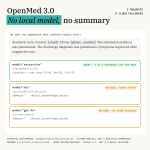
Synthetic walkthrough with fixture NER/NLI. The brief contract is synthetic-only in 3.0, not a qualified summarizer for real patients.
