

Closing the gap between information that can be produced and information that can be acted on.
Decentralized
Joined December 2023
- Tweets705
- Following25
- Followers790
- Likes405



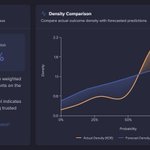


We've built a SOTA system for human judgement.
The next port of call is to distil it.
This quoted post is unavailable.
Excited to see Olena featured on World ID site!
We were one of the first teams to get access to Selfie Check, and now use it to help keep Olena human - reducing bots and Sybil attacks without adding friction for users.
Try Olena on the World Mini App 👇
world.org/ecosystem/app_b8f6…


Olena retweeted

Code (and math) are where AI is making the biggest steps towards total automation.
Because it can check if its outputs work on its own.
Most other things aren't so easily checked. That's where it needs external judgement, often human judgement.
And that's where @OlenaProtocol comes in.

"If the accusations against Michael Jackson were true, many more accusers would have come forward by now"
Agree or disagree?
predict.olena.xyz/claims/if-…

Olena Asks: how likely is this claim to be true?
If Balogun's exact red card had been shown to a Bosnia player in that same match, the ban would not have been suspended.
predict.olena.xyz/questions/…

Olena retweeted
We often run reality-benchmarked claims like "France will win the World Cup" to compare the system against prediction markets. And we're doing really well so far on that score!
But questions like this are where Peer Prediction really stands out.
Everyone knows Sinners won by $165M. Nobody knows how much of that was the film and how much was the marketing.
Studios can't decompose it with internal data.
Box office prices success in a single bundle: film × push × release date. It can't offer any more specific insights.
And no prediction market can either. A counterfactual has no ground truth settlement. Nothing ever resolves.
But unbundling that package unearths information that is worth billions. Sinners became Hollywood's referendum on whether original films still work, and studios are setting next year's slates based on how they read it. If the film won, you greenlight originals. If the marketing won, you don't.
Peer prediction doesn't need ground truth yet still involves incentives that reward honest best estimates. So we can produce a similar type of discipline that makes markets such a powerful crowd wisdom tool, and unearth the information buried in that bundle, because it's also located in people's minds.
Everyone who watched those movies knows what they saw whether it was marketing that got them in the door or not.

Olena Asks: how likely is this claim to be true?
With equal marketing support and equally favourable release dates, Sinners still outgrosses One Battle After Another.
predict.olena.xyz/questions/…
Olena Asks: how likely is this claim to be true?
With equal marketing support and equally favourable release dates, Sinners still outgrosses One Battle After Another.
predict.olena.xyz/questions/…
Olena Asks: How likely is this claim to be true?
Germany's new sick-note rules will actually get people back to work: real absence from illness will fall in their first full year.
predict.olena.xyz/questions/…
Olena retweeted

Think you’re good at predicting what happens next?
⚽ Will France win the World Cup?
🤖 Are today’s AI guardrails doing more harm than good?
🌍 Is the WLD token a net positive for World ID’s mission?
Make your predictions and build your forecasting track record on Olena: predict.olena.xyz/

Olena Asks: how likely is this claim?
The Reunited Oasis Are Better Live Than 1990s Oasis Were
predict.olena.xyz/questions/…
Olena Asks: how likely is this claim?
Fable's Re-release Will Show AI Guardrails Are Net Harmful
predict.olena.xyz/questions/…

Olena retweeted
We've had quite a few new sign ups. Here's a quick lowdown on how the scoring works.
Your response to a given claim asks you two questions, and you’re scored on both answers.
1. Your probability: your genuine best estimate.
2. Your prediction of the crowd: where you think everyone else’s answers will lie on the distribution.
Two answers, two scores.
Your own probability is scored on being surprisingly popular. You score well when answers near yours show up more often than people expected.
So if most people predict that almost nobody will answer around 70%, but then a meaningful number of people do answer around 70%, that area was surprisingly popular. The people who gave those answers are rewarded, because they contributed information the crowd had underestimated.
Your crowd prediction is scored separately. Here the goal is simpler: how accurately did you predict what everyone else would say? If you expected high confidence in the accuracy of the claim, and most people were in the 80-100% region, you score well. If you expected uncertainty either by clustering in the centre, or by a wide spread of views, and these turned out to be true in each case, you also score well. If the line you draw doesn’t look anything like the crowd’s distribution, you’ll score badly.
Why two scores? Because the crowd prediction creates the baseline for the surprisingly-popular score. The system can only tell what was surprising by comparing what actually happened with what people expected to happen.
Together, the two scores make honesty your best strategy. Your crowd prediction should be honest because it is scored on accuracy. And your own probability should be honest because your private information is your best clue about where other informed people may also land. You don’t exist in a vacuum, if you’ve seen information that caused you to hold a certain view, other people will have seen it too.
That is the clever mechanism at the heart of Olena’s Peer Prediction Protocol. Prediction markets create strong incentives to tell the truth when a question will soon be resolved by a ground truth. Peer Prediction brings a similar logic to a much wider range of questions, because it doesn’t require a ground truth to produce truth-telling incentives.
In doing so it expands the wisdom of crowds into almost any domain where people hold useful private information.

Olena Asks: How likely is this claim?
Putin Invaded Ukraine Mainly to Protect His Power at Home
predict.olena.xyz/questions/…
Olena Asks: How likely is this claim?
France will win the World Cup
predict.olena.xyz/questions/…
Olena retweeted
The 2nd Peer Prediction Competition starts tomorrow! 🚀
A quick note on how to participate:
• Joined our last competition or already have an Olena account? Participate through the website:
predict.olena.xyz/
• New to Olena? Register through either the website or the World Mini App:
world.org/ecosystem/app_b8f6…
See you on the leaderboard!
Excited to announce the protocol upgrades are complete & the 2nd peer prediction competition starts Wednesday.
Many improvements. The app should be easier to navigate & scores easier to understand.
We're also launching a @worldnetwork mini app.
Try it: world.org/ecosystem/app_b8f6…
Excited to announce the protocol upgrades are complete & the 2nd peer prediction competition starts Wednesday.
Many improvements. The app should be easier to navigate & scores easier to understand.
We're also launching a @worldnetwork mini app.
Try it: world.org/ecosystem/app_b8f6…