


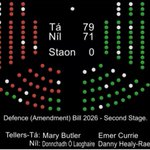



A welcome result, with Sinn Féin’s Triple Lock referendum motion defeated 84–77 in the Dáil.
Reasoning is straightforward: the Triple Lock is legislation, not a constitutional requirement. Reforming it does not abolish neutrality or remove Government and Dáil oversight.
Irish overseas deployments should not be subject to the veto of a UN Security Council permanent member. That is a matter of sovereignty, not abandoning neutrality.

The Government has defeated a Sinn Féin motion by 84 votes to 77 which called for planned changes to the Triple Lock to be put to the people in a referendum
rte.ie/news/2026/1118/159968…


A very interesting look at some of the equipment being used by the Defence Forces during Operation Fianna, the joint security operation supporting Ireland’s EU Presidency. More than 700 personnel from the Army, Air Corps and Naval Service are involved, bringing together conventional troops, Special Operations Forces, air defence, counter-drone systems, ISR and maritime security under one Joint Task Force (JTF).
Probably the most interesting piece of equipment pictured is the large rifle-shaped system carried by a soldier near a Ukrainian aircraft at Casement Aerodrome. It appears to be an MC2 Technologies NEROD RF, a portable Counter-UAS jammer. Rather than physically destroying a drone, NEROD disrupts the control link between the aircraft and its operator as well as satellite navigation signals. Depending on the drone, this can force it to hover, land or return to its launch point. It forms part of the wider CUAS capability now being fielded by the Defence Forces alongside the MBDA Sky Warden system.
The rooftop photograph shows another layer of the operation. Army Ranger Wing precision fire and counter sniper personnel overlooking Casement. The kneeling operator appears to be using a suppressed H&K HK417-family 7.62mm precision rifle with a high magnification optic and additional night/thermal sighting equipment. Alongside him, another operator is using a dedicated observation system to scan the approaches. Both are equipped with modern SOF helmets and helmet-mounted night-vision equipment, giving the team the ability to operate effectively in darkness as well as daylight. The Defence Forces specifically described these as heli-borne precision fire and counter-sniper teams.
Also visible is the new Thales SquadNet radio being used operationally, alongside a ruggedised tablet. The tablet is likely providing a digital tactical picture, potentially including Blue Force Tracking and a Battlefield Management System such as SitaWare. Putting radios, position data and a shared operational picture into the hands of troops on the ground is a major improvement in situational awareness, particularly during a complex operation where multiple units and agencies are operating in the same area.
The wider air-defence element is significant too. Artillery Corps Air Defence Batteries deployed C-UAS teams and RBS 70 short-range surface-to-air missile systems to secure the airspace. Air Corps fixed and rotary-wing assets provided intelligence, surveillance and reconnaissance, Engineer Specialist Search Teams searched the VIP terminal and surrounding areas, Mechanised Infantry and Cavalry established inner and outer security cordons, and the Naval Service monitored the maritime approaches in the Irish Sea.
But a lot of the work behind an operation like this will never appear in the photographs. The Joint Task Force HQ, operations and planning staffs, intelligence personnel, communications specialists, logisticians, liaison officers, transport crews, maintainers and the many others working behind the scenes are what allow all of these individual capabilities to function as one operation. Coordinating hundreds of personnel across land, air and sea while working alongside An Garda Síochána and protecting visiting delegations is a significant command & control task in itself.
Operation Fianna is probably one of the clearest public examples yet of how the Defence Forces are changing. Conventional perimeter security remains important, but alongside it are SOF precision teams, modern night vision, software defined radios, counter drone jammers, air defence systems, airborne ISR and maritime surveillance, all coordinated through a joint headquarters.
A very impressive operation and a job well done by everyone involved, both those visible in the photographs and the many personnel working behind the scenes to make it happen. 🇮🇪 🇮🇪


“They believe they are dealing in some ways similar to what we saw with respect to CrowdStrike where there is an update that has gone awry”
independent.ie/world-news/mi…

2
330
Hundreds of Irish schools have received sent bomb threats via email this morning.
independent.ie/irish-news/hu…

230
Royal Navy becoming hybrid as 1st Autonomous Squadron is welcomed into its ranks
forcesnews.com/services/navy…

103
Royal Navy unveils unmanned boat squadron in response to 'changing face of modern warfare'
itv.com/news/meridian/2026-1…

Rúaidhrí O’Connor: Andy Farrell’s Fiji dilemma as injuries and tight schedule force selection hand independent.ie/sport/rugby/r…

68
Simon Harris told party delegates that “everyone who can work should be expected to make a contribution”. “The dole is a safety net, not a way of life,” Mr Harris said this evening. “At a time of full employment it is simply not acceptable for any person to remain on the live register year after year after year,” he said.
independent.ie/irish-news/si…

1
1
310
RTE studios bomb threat. Other media organisations in Ireland and the UK have also been sent identical threats this morning.
independent.ie/irish-news/st…

Leinster appoint UBB head coach McNamara, takes the helm from Cullen.
rte.ie/sport/rugby/2026/1103…

100
The final chapter in Irelands UNIFIL mission:
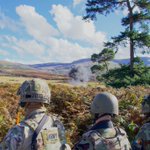
The 69th Infantry Group has been completing its Mission Readiness Exercise (MRE) in the Glen of Imaal, ahead of its deployment to Lebanon this November. For the 294 personnel preparing to deploy, this represents the final Irish troop rotation under UNIFIL's current operational mandate.
These exercises are far more than simply another training requirement. Simulated ambushes, hostile encounters, explosive incidents, casualty evacuations and live-fire scenarios are designed to replicate the challenges personnel may face overseas. The objective is to test soldiers and commanders under pressure, identify weaknesses and ensure that every member of the contingent understands their role when situations deteriorate.
For first-time deployers, this training is invaluable. It provides an opportunity to experience realistic operational scenarios alongside experienced personnel before facing the uncertainties of an overseas mission. The importance of developing confidence, teamwork and effective leadership cannot be overstated.
Another interesting aspect of recent Irish overseas deployments has been the integration of Army Ranger Wing (ARW) personnel alongside conventional soldiers, as highlighted in the first photo (noted by different uniform, body armour, helmet and designators). This practice provides specialist personnel with experience of sustained overseas operations and conventional military command structures, including valuable leadership experience, while bringing additional expertise to the wider contingent.
This deployment also marks a significant moment in Irish peacekeeping history.
In September 2023, the 68th Infantry Group deployed to the Golan Heights, becoming Ireland's final large-scale contingent under UNDOF before returning home in April 2024.
Now, the 69th Infantry Group faces a similarly historic responsibility in Lebanon.
After almost five decades of Irish service with UNIFIL, the mission's operational mandate is scheduled to conclude on 31 December 2026. The 69th Infantry Group will therefore not only fulfil its peacekeeping responsibilities but also contribute to the safe and orderly withdrawal of personnel and equipment throughout 2027.
But this does not necessarily mean the end of Ireland's involvement in Lebanon.
On 12 October, the EU formally established EUSM Lebanon, a new support mission intended to strengthen the Lebanese Armed Forces and Internal Security Forces through training, advice and assistance. Ireland has expressed interest in contributing, although its future participation has yet to be decided.
Rather than the traditional peacekeeping role undertaken by Irish infantry units, future involvement could focus on developing the capabilities of Lebanon's own security forces.
Since 1978, generations of Irish soldiers have served in Lebanon, often in exceptionally difficult circumstances. Forty-eight Irish Defence Forces personnel have lost their lives in the pursuit of peace.
As this chapter approaches its conclusion, the importance of preparing those heading overseas remains as critical as ever.
A historic deployment for the 69th Infantry Group and another significant milestone in the proud peacekeeping tradition of Óglaigh na hÉireann.
🇮🇪🇺🇳🇱🇧
(images sourced from official DF Flikr account)


Would be very well welcomed

Government considering bid for portion of €21bn EU ‘defence’ loans
Previous attempt to draw on European Union facility for Defence Forces vetoed by Paschal Donohoe
irishtimes.com/ireland/2026/…

A GENERATIONAL LEAP IN DEFENCE FORCES COMMUNICATIONS 🇮🇪
Óglaigh na hÉireann is rolling out over 6,000 Thales Software Defined Radios (SDRs) across the Army, Naval Service and Air Corps. The €76m programme replaces ageing SINCGARS equipment and introduces secure voice, tactical data and modern networked communications.
SYNAPS-H | Handheld Tactical Radio
A multiband VHF/UHF SDR for dismounted commanders. Frequency rage of 30–512 MHz coverage, 5 W transmission power, integrated GPS and a weight of approximately 1.2 kg including battery. Beyond voice, it supports tactical data, position reporting and the transmission of imagery.
SYNAPS-V | Vehicle and Naval Radio
A dual-channel SDR featuring two independent radio channels with 50 W amplification per channel. It supports simultaneous voice and data communications across tactical networks, with mesh networking allowing information to be relayed between connected radios.
SQUADNET | Personal Soldier Radio
Weighing approximately 250 g, SquadNet provides individual soldiers with short-range communications, GPS position sharing and tactical networking. The radio has approximately 24-hour battery life and ranges of up to 6 km through network relaying under suitable conditions.
INVISIO | Communications and Hearing Protection
A separate investment of almost €20m introduces integrated tactical headsets and active hearing protection, enabling personnel to maintain clear communications in high-noise environments while retaining awareness of surrounding sounds.
WHY DOES THIS MATTER?
The real advancement isn’t simply radio range or transmission power. It’s the ability to share battlefield information rapidly and securely.
During Defence Forces trials, Cavalry units operating in Wicklow transmitted drone imagery through SYNAPS-H, allowing higher command in the DFTC to view the information within minutes.
Modern software-defined waveforms, including GEOMUX and ESSOR capabilities, also provide a foundation for future upgrades and improved interoperability with European military partners.
Modern military effectiveness depends on secure communications, shared situational awareness and the ability to coordinate forces across land, sea and air.
This investment represents one of the most significant technological advances in the Defence Forces in decades, and a major undertaking for the CIS Corps personnel responsible for implementing and sustaining these systems.
A long-awaited step towards a modern, digitally connected and operationally capable Óglaigh na hÉireann 🇮🇪 🤝 🇫🇷
(Technical specifications and capabilities referenced are drawn from publicly available manufacturer documentation and official publications.)

Ireland’s sovereignty, neutrality and the future of the Triple Lock. 🇮🇪
Tonight, the Dáil voted 79–71 to advance legislation that would remove the requirement for UN authorisation before Ireland can deploy its Defence Forces on certain overseas missions. The Bill has further stages to complete, but this is a significant moment in the debate over Irish sovereignty and military independence.
Ireland spent centuries fighting for the right to govern itself and determine its own future. Yet under our current legislation, decisions to deploy our own soldiers on international peace-support operations can depend on authorisation from the United Nations. Five permanent members of the UN Security Council: Britain, France, the United States, Russia and China - possess veto powers that can obstruct missions Ireland itself wishes to support.
Think about that for a moment. A sovereign nation, with a democratically elected parliament, can find its ability to deploy its own Defence Forces constrained by the political interests of foreign powers. Whatever one’s position on the legislation, that raises a fundamental question about national independence.
And contrary to some of the claims circulating, removing the UN authorisation requirement does not automatically mean abandoning neutrality, joining NATO or surrendering control of our military. The proposed legislation retains Government approval, requires Dáil approval for deployments exceeding 50 personnel, and requires qualifying missions to comply with the principles of the UN Charter and international law.
There have also been widespread calls for a referendum. People are entitled to seek one, but the Triple Lock is a statutory mechanism, not a constitutional provision requiring a referendum to amend it. We elect representatives to scrutinise and legislate on precisely these matters. The legitimate debate about safeguards should not be confused with the suggestion that reform automatically ends Irish neutrality.
There is also a broader Defence Forces issue here. Ireland needs a military capable of operating effectively alongside international partners, developing its personnel through overseas operational experience, strengthening interoperability and contributing meaningfully to peacekeeping and international security. We should be investing in modern equipment, realistic training, operational readiness and the retention of experienced personnel. Greater flexibility in overseas deployments can complement that ambition, although legislation alone cannot deliver it.
Our Defence Forces have an internationally respected peacekeeping tradition stretching back to 1958. Maintaining that contribution in a changing world requires both appropriate democratic safeguards and the freedom to make decisions in Ireland’s national interest.
Irish neutrality should mean independence of decision-making, not dependence on the political permission of major powers.
Ultimately, the principle is simple: decisions concerning Irish troops, their missions and the risks they undertake should rest with Ireland’s democratically accountable institutions, operating under Irish and international law.
That is a conversation about sovereignty worth having.

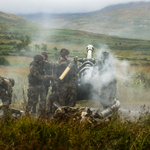
The DF can’t even fire these arty pieces to their full spec. We have no dedicated training area large enough to practice fall of shot observers / FOOs.
Firing into GoI waterfall, maybe 2km away line of sight…
Can’t fault the professionalism of our arty men and women tho. Making use of what they have 💥 💥

I know this was an exercise, but the glory days of naked towed artillery are long since past. Soldiers can only operate what equipment they are given. Our defence forces deserve better. 🇮🇪
13
1,068
Military group claims 'lack of respect' in refusal to pay allowances to armed anti-drone pilots (via @thejournal_ie) jrnl.ie/7198943

6
505
Completely predictable, understandable, and preventable.
The Defence Forces said it is not expecting an exodus from the force once the peacekeeping mission in Southern Lebanon comes to an end later this year
rte.ie/news/ireland/2026/102…

A very significant small-arms upgrade appears to be on the way for the Irish Defence Forces: the Heckler & Koch G28E in 7.62×51mm NATO.
H&K recently won the Defence Forces contract for up to 374 new Designated Marksman Rifle / Sniper Support Rifle systems and telescopic sights. The G28E has now also appeared prominently in an official Defence Forces video welcoming the latest Cadet Class, in the familiar RAL800 configuration with what appears to be a Schmidt & Bender 3–20×50 optic and a piggyback red-dot sight. Deliveries under the contract are expected from 2027.
The really interesting part is how the DF intends to use them. The original requirement specifically called for the new rifle to replace the modified FN FAL currently used for sniper support, while also introducing a proper DMR capability to Infantry and Cavalry units down to section level. In the sniper role it can accompany the Accuracy International .308 AW and .338 sniper systems, giving the spotter a highly capable semi-automatic 7.62 rifle for observation, target indication, rapid follow-up shots and protection of the sniper pair. At section level it fills the gap between the 5.56mm Steyr AUG and the dedicated sniper rifle, allowing a trained marksman to engage targets at considerably greater distance with greater precision and effect.
That would be a massive step forward from the current FN. The Irish spotter rifle was created by taking older FALs already held in Defence Forces stocks and fitting them with modern optics, rails, bipods and adjustable features. It was a sensible way of creating a capability at the time, and the DF itself rated it for accurate fire out to around 800m, but ultimately it remains a legacy battle rifle heavily adapted for a precision role rather than a weapon designed from the outset as a modern DMR. Its reputation among users has also been somewhat mixed over the years.
The G28 is purpose-built for exactly this job. It is a gas-operated, semi-automatic 7.62×51mm rifle using 10 or 20-round magazines. H&K gives it a maximum effective range of up to 800m, with a 3–20× optic in its standard precision configuration and a red dot mounted above for rapid close-range engagements. That combination allows one weapon to transition from precision shooting at several hundred metres to a much quicker engagement at close range without changing weapon systems.
For the infantry section this could finally give the DF a genuine modern designated marksman capability rather than relying almost entirely on the AUG until a sniper asset is attached. For sniper teams it replaces an ageing and heavily modified FN with a current-production rifle designed specifically around precision semi-automatic fire.
It is one of those acquisitions that may not attract the attention of a new armoured vehicle or helicopter, but at ground level it could make a very meaningful difference. A modern 7.62 DMR at section level and a common sniper-support rifle across the force is a capability the Defence Forces has been looking to establish for a long time.
🇮🇪 🤝 🇩🇪

