

Goo - a .NET declarative desktop UI framework: https://xitter.cf/t.co/gCNIM647xo SharpTUI - a lean .NET TUI Framework: https://xitter.cf/t.co/aPXnMhEFWh
Joined July 2024
- Tweets5.5K
- Following420
- Followers258
- Likes6.5K








awesome the first #blocknet block mined on the longhorn pool happened last night!
Not many people on the pool yet, so it all went to one miner.
If you have an AMD CPU/GPU, get in on the pool:
longhornpool.net/

LONGHORN is LIVE.
longhornpool.net
A #BNT #blocknet miner built for AMD, plus a zero-fee pool.
Pool 0% fee
Miner 2% fee
The lowest total fees for AMD miners.


Elation retweeted

The first two gratis donations have been contributed to @_gnoland, an interpreted and fully-deterministic implementation of the Go programming language.
See them here:
github.com/gnolang/gno/pull/…
github.com/gnolang/gno/pull/…
🤖 Made with AI

local models take a long time to test...might as well make something to keep you mesmerized as it works.
Elation retweeted

GPT + Opus (via Copilot CLI) helped me uncover 180 JIT bugs, each with a minimal C# repro using only safe code 😶 - most had been hiding from us for many releases github.com/dotnet/runtime/is…


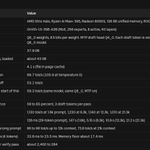
Bus use: stock llama.cpp reached ~145GB/s on Ornith. These engine tweaks reach ~171GB/s over a whole pass and 234GB/s in its best kernel.
The memory floor for a pass is ~17.4ms, this implementation reaches 23.5ms so still some headroom left at the same quant.
Caveats:
custom ggml + libllama under stock llama-server
Speed moves ~2.5% run to run and more by prompt.
Pooled routing changes the model, a preliminary and partial SWE-bench run showed about 11/19 resolved rate with my pi harness, 10m per task.
Draft head: only the 65,536 most common tokens of 248k, stored at Q4_0. Used for drafts only, every token is still verified by the full Q8_0 model so the output does not change. It only moves draft acceptance rate.
Next lever is MTP and Ornith ships its own draft block. It drafts 3 tokens, then one main pass verifies 4 positions.
The trunk is read once per pass, not once per token. So, a thin trunk makes verification cheap. ~2.7 tokens kept per pass.
There is a problem, though. 4 positions each pick 8 of 256 experts, so up to 32 expert sets per pass.
The fix is pooled routing. The 4 positions share a pool of 12 experts and each takes its top 8 from the pool. ~60% less expert traffic. Routers tuned for the Strix.
Since you can't make the bus faster, you need to cut bytes/token.
Ornith at Q8_0 reads a 2.17GB trunk once per pass + 1.10GB of experts per token.
Stock llama.cpp running Ornith-1.5-35B-A3B: 45 t/s
