







YOru retweeted

Want to know what the SpaceX IPO is actually about?
Just ask D0: "Write me a SpaceX IPO report."
It reads the full 287-page roadshow deck for you, pulls from the S-1, CNBC, Reuters and Bloomberg, and gives you the answer in seconds: the valuation, the seven business segments, the catalysts, and everything before the June 12 listing.
No more reading hundreds of pages yourself. Just ask D0.
Everything on $SPCX before it lists, in one ask.

Lately, while juggling investment research and on-chain trading, the biggest source of fatigue for me has been the "fragmented environment." Even after reading through hundreds of pages of whitepapers or corporate financial reports to find meaningful metrics, constantly switching between DEXs, wallets, and chart analysis tools often caused me to miss crucial timing.
Recently, however, I came across a solution that completely shifted the paradigm of my workflow. It’s a project that goes beyond simply "viewing" the internet, seamlessly connecting research and immediate execution into a single, cohesive flow.
What impressed me the most was how it handles massive amounts of financial data. By simply uploading complex investment prospectuses or market analysis reports, its AI extracts hidden risks and core metrics in just a matter of minutes. The information discovery process—which would have previously kept me wrestling in front of a monitor all day—has become incredibly streamlined. It feels like the noise is cleared away, leaving only the insights that truly matter.
What’s even more surprising is the experience of taking action based on these insights. I could execute transactions instantly within the environment itself, without the hassle of copying addresses, switching apps, or signing multiple transactions across different platforms. From interpreting real-time market data to interacting with smart contracts, the user's intent translates directly into action without any friction.
Sitting quietly in front of my monitor analyzing the market after work, I can really feel how complex ideas in my head materialize into tangible results.
Ultimately, in a market exploding with data like today's, a true edge comes down to who can understand and act on information faster than anyone else. It seems we are entering an era where the web browsing experience itself becomes a powerful weapon. If you are seriously diving into the Web3 ecosystem and investing, you should definitely keep an eye on the new opportunities this technological evolution will create.
@DonutAI @GigiWillliams
🤖 Made with AI

4
59
Lately, as I’ve been diving deep into the intersection of blockchain and AI, I realized I’ve been looking in the completely wrong place.
We tend to obsess over the flashy things in the spotlight. We celebrate surface-level metrics like "how much did TPS increase?", "which chain is the fastest?", or "how smart is this new AI model?" But the true deciding factor of a system's success always lies in the invisible infrastructure behind the scenes.
Particularly in an onchain environment, Latency is not just about perceived speed. It is strictly a matter of power and capital. It’s a battle over who gets the data 0.001 seconds faster, who reacts first, and who ultimately captures the market edge. As autonomous AI agents fully enter the market, this competition will only intensify. For AIs that think and act at machine speed, today’s heavily bottlenecked networks are nothing but a frustrating shackle.
Ultimately, the key to enabling AI agents isn't just the intelligence of the models themselves. It's the Memory and Data Fluidity that allow that intelligence to sense its environment in real-time and execute actions instantly.
This is exactly why I've found myself completely captivated by @get_optimum recently.
Instead of forcibly overloading the main network to squeeze out a bit more speed, they are fundamentally altering the architecture of data transmission. Through RLNC technology—which shards messages and instantly recombines them—they can seamlessly recover and deliver information without even needing the complete data to arrive first.
Optimum doesn't try to be the flashy main character. Instead, they quietly take on the role of a "Memory Guardian," ensuring that massive decentralized systems don't collapse and that the arteries of information never clog.
True innovation is often invisible. The era of onchain AI can only truly begin once this robust, high-performance memory layer is established. Optimum is building the foundation for that future—quietly, but with absolute certainty.
@CryptoSundayz
@cryptooflashh
@aqccapital
@sajidazouarhi
🤖 Made with AI
2
5
85
Honestly, isn't crypto trading exhausting these days? Checking charts, refreshing your Twitter (X) feed, digging through research platforms... With dozens of browser tabs open, bouncing back and forth, you usually end up missing the actual entry setups. The friction and fatigue from this fragmented Web3 environment is real.
I recently found a tool that finally stopped this endless "tab switching," and it's @DonutAI (D0).
Usually, I'm pretty hesitant about AI trading bots because they feel like a sketchy "black box" where you have no idea what's going on under the hood, but this one is different. You just use plain language, and it automatically connects you to over 200 tools.
It's so reassuring because even while I'm asleep, its "Agentic Loop" ( Alert - Analyze - Execute - Contro ) is running 24/7. From grasping market trends to executing 150x leverage, I can do it all in one place while staying entirely in charge.
Plus, right now, they're running a promo where you get double the monthly credits on D0 and D0 Pro plans for the exact same price. Thanks to that, I don't have to ration my credits and can really dive deep into market intelligence.
If you hate complicated setups and just want to get your trading done cleanly in one place, I highly recommend giving it a shot right now. It definitely gives you so much more clarity in the market.
@GigiWillliams
🤖 Made with AI

5
101
YOru retweeted

X 시작 80일 차, 팔로워 곧 15,000명 달성.
엑스가 돈이 된다는 말을 듣고 3월 23일 시작했습니다.
3개월도 채 되지 않아 팔로워 15,000명을 달성했고, 지금까지 발생한 수익은 약 740만 원 정도 되네요. 이 수익은 제 빚 8천만 원을 갚는 데 사용했습니다ㅠ
항상 제 글을 읽어주시고 공감해 주시는 분들 덕분입니다.앞으로도 더 많이 소통하겠습니다.
진심으로 감사드립니다
그리고 가끔 제 글을 보고 “실행할 용기를 얻었다”, “동기부여가 된다”는 이야기를 들을 때가 있는데, 그럴 때마다 정말 기분이 좋네요.
앞으로도 함께 성장해 나갔으면 좋겠습니다.

Let's be honest. If you're in the crypto market, you've probably experienced hitting the buy button at the perfect time, only to watch your profits vanish before your eyes due to network delays.
We always expect instant and seamless transactions, but in reality, blockchains bottleneck the moment traffic spikes. While nodes take forever to verify blocks, fees skyrocket and user frustration peaks. Aren't we all a bit tired of the "scalability limitations" excuse?
Ultimately, the root of all these problems comes down to how quickly and efficiently data propagates across the global network. This is exactly why I've been diving deep into a project called @get_optimum recently.
How Optimum is Changing the DNA of Blockchain
Optimum isn't just offering a flashy, superficial fix. They are fundamentally rewiring the deepest layers of the network.
- Building a Data Highway: They reduce unnecessary bandwidth waste and push data transmission speeds between nodes to the absolute limit.
- Zero-Lag Consensus: With reduced latency and faster block delivery, frustratingly slow transaction confirmation times are a thing of the past. It enables the network to seamlessly handle massive numbers of users and transactions without flinching, even during heavy traffic.
But what truly impresses me isn't just the product itself—it's the engineering team tackling this incredibly daunting challenge.
The People Building the Foundation Behind the Scenes
It's easy to get caught up in the flashy exterior of a project, but the true competitive edge of infrastructure lies in the technical prowess of its team. Efficiently moving massive amounts of data on a global scale isn't just about being good at coding. It requires a deep, masterful understanding of distributed systems, networking, and data architecture.
The sheer dedication of the Optimum team—quietly grinding away at backend optimizations that most users will never even notice—deserves immense respect.
A New Paradigm for Block Space
The consistent, low-latency data delivery environment Optimum is building is far more than a simple "performance upgrade." If they succeed at scale, block space—which has long been a symbol of volatility and delays—will finally evolve into a predictable, stable, and tradable asset.
This is a massive endeavor that could fundamentally restructure the entire blockchain market, extending far beyond a single ecosystem. I am incredibly excited to see their next steps.
@sajidazouarhi
1
4
82
Where is the Real Bottleneck in Blockchain? ePBS and Optimum
We shouldn’t get blinded by flashy metrics like TPS or the launch of shiny new chains. As liquidity and users flood onchain, the real question we must ask is: "Can the underlying infrastructure actually handle this weight?" At its core, every transaction is just data moving. If data can't travel efficiently, even the most brilliant architecture becomes useless.
ePBS: A True Solution or Just a Band-Aid?
The headliner for Ethereum’s next major upgrade (Glamsterdam) is ePBS (Enshrined Proposer-Builder Separation). It aims to scale the network by bumping gas limits and blob sizes by restructuring slot deadlines.
- The Current Issue: A block must be selected, proposed, propagated, and attested within a tight 4-second window, causing massive bandwidth bottlenecks as block sizes grow.
- The ePBS Fix: It decouples the block. Validators only need to receive the consensus block (a cryptographic commitment) within 4 seconds. The heavy execution payload and blob data are then propagated separately, utilizing the remainder of the 12-second slot.
While it's a clever design, let’s be realistic: this isn't a cure for the bandwidth bottleneck. It’s just buying time—a strategic sidestep. To unlock serious throughput and shorten slot times, we need to fundamentally change how fast data moves across the network.
When block propagation lags, validators end up building on outdated information. This leads to competing blocks, frequent reorgs, and delayed consensus. This is exactly why I'm watching projects like Optimum (@get_optimum). Instead of taking the easy route of launching yet another L2/L3 chain, they are fixing the foundational network layer.
Optimum’s Random Linear Network Coding approach propagates Ethereum blocks with ultra-low latency. Crucially, it doesn't slow down as block sizes increase or as the network grows more decentralized.
The Outcome: Better synchronization > Fewer reorgs > Stronger consistency > Maximum L1 scalability.
Most users will never think about how nodes communicate, but this invisible infrastructure is what makes mass adoption possible.
True progress isn't always about creating something brand new; sometimes, it’s about making the existing foundation unbreakable. The ultimate path to L1 scaling begins with the fastest flow of information.
🤖 Made with AI

𝐞𝐏𝐁𝐒, 𝐬𝐥𝐨𝐭 𝐭𝐢𝐦𝐢𝐧𝐠𝐬, 𝐚𝐧𝐝 𝐬𝐜𝐚𝐥𝐢𝐧𝐠 𝐚𝐩𝐩𝐫𝐨𝐚𝐜𝐡𝐞𝐬
Ethereum is targeting Q3 for the next major upgrade, Glamsterdam. ePBS is the headliner, restructuring the deadlines within a slot to allow for larger blocks (higher gas limit & more blobs).
In the current slot structure a block has to be selected, proposed, propagated and attested to by the network in under 4 seconds. Increasing block size means more data has to reach nodes in the same short amount of time, and you run into bandwidth constraints.
ePBS buys more time for data propagation by separating blocks into the consensus block, execution payload, and blobs, and changing the deadlines for when those different parts of the block need to arrive.
Instead of the entire block needing to reach validators before the 4 second mark, they only need to receive the consensus block- a cryptographic commitment to a certain block & set of blobs. They make their attestation without receiving the execution payload, then have the remainder of the slot to receive that payload and verify it. Blob data is propagated separately giving nodes the full 12 seconds to receive it.
This scheme makes it easier to increase the gas and blob limits, which is good for some additional scaling. However, it's more of a sidestep than a true solution to the bandwidth bottleneck.
If you want to unlock serious throughput gains you need to improve how fast and efficiently data can move across the network. That's the key to increasing block size while ALSO shortening slot times.
Removing the bandwidth bottleneck means fundamentally upgrading the way data moves across Ethereum. Optimum's Random Linear Network Coding approach propagates Ethereum blocks with lower latency AND in a way that won't slow down as the size of blocks increase, OR as the network becomes larger and even more decentralized.
Scale the L1.

3
93
Watching the AI market lately, it feels like everyone is obsessively focused on who can build the most massive model. But if we just keep scraping and training on the same recycled internet data, will we ever create an AI that truly understands our lives?
What really hit me like a wake-up call recently at Consensus 2026 (Solana Accelerate AI) in Miami wasn't some lofty, hype-filled vision—it was the quiet, grounded path @getoro_xyz is taking.
While everyone else is fighting over the same scraps of public data, ORO is looking somewhere entirely different: real people's everyday lives, voices, and raw health data straight from wearables. The fact that they already have over 600,000 contributors voluntarily delivering more than 11 million structured health data points every single month is honestly mind-blowing. This isn't just a statistic; it's the absolute perfect foundation for AI to genuinely understand human behavior and health patterns.
What really draws me to ORO amidst this massive technological shift is how it makes you tangibly feel that "the control over my data belongs to me."
Up until now, we've essentially been handing over our daily lives to Big Tech for free. The ORO ecosystem flips that script. Your actions and data are transparently protected, and you are tangibly rewarded for your contributions, complete with staking incentives. You don't just remain a passive user; you actually get to help shape the project's direction through governance voting, and you hold early access rights to experience new Web3 AI tools and services before anyone else.
I am convinced that the future of AI supremacy won't be decided by the sheer size of a model, but by who can secure the most ethical, overwhelmingly high-quality human data.
Stepping out of the spectator's seat, watching your everyday data become the raw material for real innovation, and actually getting that value returned directly to you - that’s exactly why I can't take my eyes off ORO's next moves.

Every click, search, and interaction we make is training Big Tech's AI. But why aren't we getting rewarded for it?
Who is your data actually working for?
Legacy digital platforms collected user data in centralized servers and used it for free to improve their products. ORO flips this outdated structure, proposing a new AI economic ecosystem where 'your data works for you.'
1. Complete Control & Fair Rewards
Instead of your info being collected without transparency, ORO lets you dictate 'what data to share and who gets access.' More importantly, when your data contributes to AI development and creates value, you directly receive a fair economic reward.
2. zkTLS & TEE: Ultimate Privacy, Zero Raw Data Exposure
Worried about your sensitive info getting leaked in exchange for rewards? ORO sends your data straight into 'Secure Vaults.'
zkTLS: Verifies the authenticity of information without revealing a single drop of the underlying raw data.
TEE (Trusted Execution Environments): Processes computation only in perfectly isolated, tamper-proof environments.
As a result, no human, platform, or node operator can ever see your 'raw data.' Only verified computations happen safely inside the vault.
3. Greater Protection = Higher Data Value
ORO's strict privacy protection prevents your data from being replicated without permission. By preserving its 'scarcity' and 'integrity,' your data retains a much higher economic value in the market.
Until now, we've basically been free volunteers training AI for mega-corporations. But the infrastructure ORO is building is completely redefining 'digital ownership' based on participation, consent, and privacy.
Far more than just a platform, we need to keep a close eye on how @getoro_xyz will rewrite the rules of the future AI data economy!

1
59
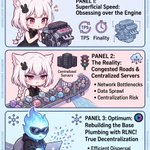
While everyone is obsessing over "supercar engines," some people are rebuilding the "highways."
Looking at the crypto scene lately, everyone seems fixated on "inner-network" mechanics like consensus algorithms, execution speeds, and Data Availability (DA). But there's a real bottleneck we are constantly overlooking: the physical time it takes for data to fly across the globe.
Take Solana, for example. Its speed is truly phenomenal. A single slot is a mere 400ms. But this incredible speed actually trips it up. Just the "propagation" process—where a leader produces a block and broadcasts it to the network—eats up over 100ms of that tight window.
As a result, delays happen. Nodes start receiving blocks late, and some miss them entirely. So, what do validators do to shave off even 0.1 seconds of delay? They end up flocking to the exact same data centers, getting as physically close to the leader as possible. Paradoxically, a system built for decentralization regresses into a perfectly centralized server room just to keep up with its own speed.
No matter how powerful the engine (the blockchain) is, it is useless if the roads the information travels on (communication infrastructure) are congested.
This is exactly why I've been keeping a close eye on @get_optimum lately. Instead of launching yet another shiny new chain, they are completely overhauling the base plumbing that every network shares: data propagation itself.
Their approach is incredibly smart. They aren't just clumsily tossing around heavy, full-block copies like before. By leveraging RLNC (Random Linear Network Coding) technology, they propagate coded fragments of data. This means nodes can gather useful data much faster, regardless of where they are physically located on Earth. Without the need to cluster in specific, expensive data centers, true decentralization becomes possible again.
The greatest infrastructure is often invisible. Users probably won't even realize this tech is running under the hood. They'll just notice the result: "Wow, the network is so much faster and more stable."
When everyone is distracted by flashy features and top-speed competitions, it's this kind of invisible, foundational work that truly pushes the entire ecosystem forward. That is real innovation.
🤖 Made with AI

The Evolution of Blockchain
Building a 'Perfect Road Network' Rather Than a 'Faster Car'
In the quest to boost blockchain performance, we have thus far obsessed over building 'faster cars' (hardware). However, as massive networks like Solana and Ethereum expand, the true bottleneck emerges elsewhere. The challenge has shifted from how fast blocks are produced to 'how quickly and reliably that information is propagated' to countless nodes.
Instead of forcing validators into exorbitantly expensive server upgrades, @get_optimum presents an entirely different solution: laying an invisible, 'ultra-fast fiber optic pipeline' directly beneath the existing blockchain highway.
At the heart of this innovation lies mump2p and RLNC (Random Linear Network Coding) technology. It abandons the traditional, fixed transmission model that passively waits for complete data delivery. Instead, it empowers network nodes to flexibly fragment, recode, and forward data, allowing the network itself to carve out optimal routing paths. As a result, latency seemingly evaporates, and the network boasts unwavering resilience even in the face of packet loss.
The shifts brought about by this sub-surface innovation are clear:
Validators: No longer need to pour massive capital into unreasonable hardware upgrades, dramatically reducing the risk of node failure.
Users: Experience a seamless, lag-free dApp environment, instantly ready to accommodate the influx of millions of new users.
Having already proven its overwhelming efficiency on the Ethereum testnet, @get_optimum's vision is more than a mere technical upgrade. It serves as a crucial milestone, demonstrating that the future of high-performance blockchains lies not just in 'production speed,' but in achieving the 'most flawless flow of data.'

1
2
111
Finding Your Perfect Calm in a Crazy Market
The world moves fast, and the markets fluctuate day and night. But your daily life doesn't need to get swept up in all that chaos!
Instead of staring at screens with tired eyes, we believe in the magic of a warm cup of coffee and good company. After all, the best ideas and true innovations don't spark over glowing red and green charts—they happen in real conversations and genuine connections.
So, go ahead and quietly leave the fast-paced market tracking to D0 @DonutAI .
Whether you're laughing and sharing ideas with friends, or catching some well-deserved sleep while the rest of the world is quiet, your trusty AI partner is on it. D0 stays perfectly synced with the market, quietly and flawlessly catching every opportunity for you.
No more stressing over endless charts.
Just smart, hassle-free decisions.
Let the AI crunch the cold, complex data. You just focus on connecting with the community and dreaming up a better tomorrow.
Don't trade harder. Live your life a little more beautifully.
@GigiWillliams
🤖 Made with AI
3
53
The Evolution of Blockchain
Building a 'Perfect Road Network' Rather Than a 'Faster Car'
In the quest to boost blockchain performance, we have thus far obsessed over building 'faster cars' (hardware). However, as massive networks like Solana and Ethereum expand, the true bottleneck emerges elsewhere. The challenge has shifted from how fast blocks are produced to 'how quickly and reliably that information is propagated' to countless nodes.
Instead of forcing validators into exorbitantly expensive server upgrades, @get_optimum presents an entirely different solution: laying an invisible, 'ultra-fast fiber optic pipeline' directly beneath the existing blockchain highway.
At the heart of this innovation lies mump2p and RLNC (Random Linear Network Coding) technology. It abandons the traditional, fixed transmission model that passively waits for complete data delivery. Instead, it empowers network nodes to flexibly fragment, recode, and forward data, allowing the network itself to carve out optimal routing paths. As a result, latency seemingly evaporates, and the network boasts unwavering resilience even in the face of packet loss.
The shifts brought about by this sub-surface innovation are clear:
Validators: No longer need to pour massive capital into unreasonable hardware upgrades, dramatically reducing the risk of node failure.
Users: Experience a seamless, lag-free dApp environment, instantly ready to accommodate the influx of millions of new users.
Having already proven its overwhelming efficiency on the Ethereum testnet, @get_optimum's vision is more than a mere technical upgrade. It serves as a crucial milestone, demonstrating that the future of high-performance blockchains lies not just in 'production speed,' but in achieving the 'most flawless flow of data.'
🤖 Made with AI
Look, the real bottleneck of Blockchain? It’s the damn "Data Delay," and @get_optimum is fixing it!
You know why people lose money in the market? Simple. Information lag.
You think your liquidation bot is fast? You set up everything in milliseconds, but guess what? While your data is crawling to the validators, some other guy's bot already snatched it.
Listen, kid. The problem isn't your strategy. It’s the damn data propagation speed!
The bigger the network gets, the more those nodes chatter, causing major traffic jams. That means slow consensus, delayed blocks, and you? Missing out on good money. Back in my day... well, anyway!
So, what does this OPTIMUM actually do?
These smart folks aren’t focusing on running the transactions. No, sir. They focus on how fast the information travels. They use some fancy high-tech encoding and smooth transmission tricks to clear up the network highway.
For Traders: No more lagging behind. You actually get a fair shot at the prize!
For Validators: No more wasting bandwidth. They get the critical data, boom, just like that.
For the Network: It can grow as big as it wants without slowing down like an old computer.
Here’s the bottom line: Data is exploding every single day. If the pipes are clogged, the network dies. @get_optimum is building the ultimate fast-lane infrastructure so everyone stays perfectly in sync.
🤖 Made with AI
4
79
Drowning in info? Let Donut (D0) gather all those scattered insights for you!
Jumping between Telegram, Discord, X, and charts all day long... Phew, it gets super overwhelming sometimes, right? These days, the problem isn't a lack of information—it's that there's way too much of it!
In those quiet moments with a cozy cup of coffee , Donut (D0) is here to neatly organize all that mess into just one simple chat window! No more hopping from app to app. You can easily catch the market vibes, fund flows, technical breakdowns, and shiny new opportunities all at a glance.
Here’s how our smart little @DonutAI understands the market and grows!
Live Scanning & Clever Analysis - It constantly watches live data like prices, whale splashes , and even social moods (both on-chain and off-chain)!
Smart Strategies & Safe Checks - It learns market patterns to suggest the best trade setups and carefully double-checks the risks before making any moves!
Growing With You! (Feedback Loop) - Whenever you approve, reject, or adjust its ideas, Donut learns from your choices and gets even smarter for next time!
We don't use Donut because we expect it to be 100% perfect all the time. It’s just so nice to have everything tucked into one comfy spot before we start digging deeper.
No more drowning in all that noisy chatter! Let’s make our own smart choices and build a brighter future together with Donut.
Think deeper. Build stronger. Grow together.
@GigiWillliams
🤖 Made with AI

1
2
61
The blockchain industry is still obsessed with "execution." Faster transactions, higher throughput, cheaper compute... But all of that is just a fight happening near the finish line.
The real battle is won before execution ever starts.
A brilliant bid is worthless if it arrives late; a perfect block is irrelevant if it misses the cutoff. Value isn’t created by execution alone—it’s created by who gets the right information to the right place at the right time.
We have reached the point where we must conquer the unknown frontier of information "delivery."
Why "Data Delivery" Beats "Computation"
Traditional blockchains are still stuck in the primitive cycle of "receive, verify, and forward the exact same copy." As networks grow, this approach inevitably hits the massive walls of bottlenecking and latency.
The game changer here is Network Coding.
The Old Way:
Sending exact, redundant copies of data. (Inefficient, vulnerable to loss)
Network Coding:
Mathematically encoding and fragmenting information. (Parallel processing, self-recovering)
RLNC (Random Linear Network Coding) is the peak of this evolution. It doesn't just move data; it generates random linear combinations of packets and floods them across the network.
The End of Retransmission:
If a packet is lost, you don't need to resend the original. The receiving node simply reconstructs the data from the coded fragments.
Traffic Jam Clearance:
Data flows through multiple paths simultaneously, keeping the information moving even during peak congestion.
Native Resilience:
The network remains robust even when individual nodes lag or fail.
Optimizing Flow, Not Just Execution
We are moving from an era of squeezing performance out of individual nodes to an era of optimizing the flow of information across the entire network.
Infrastructure like @get_optimum understands this shift. In a complex, decentralized web, the winners won't be those who compute the fastest—they will be the ones who circulate information the smartest.
🤖 Made with AI

1
2
41
Watching the explosive sprint of AI, many people are asking, "Is the era of blockchain finally coming to an end?" After all, massive capital and public attention are rapidly shifting toward Big Tech.
However, Muriel Médard, an MIT professor and world-renowned authority in information theory, sees it completely differently. She argues that the rise of the AI era is precisely why the value of blockchain has never been more critical.
AI's Fatal Flaw, and Why Blockchain is the Cure
Currently, AI is advancing at a breakneck pace—especially ‘Agentic AI,’ which makes autonomous decisions and processes financial transactions without human intervention. However, it suffers from fatal flaws: the "black box" problem where the decision-making process remains opaque, and the constant threat of data contamination.
"In a world without human intervention, how can we trust the decisions and transactions made by an AI agent?"
The only infrastructure capable of answering this question is blockchain's core essence: immutable proofs and decentralized ledger technology. Blockchain acts as the ultimate verification brake to ensure this high-performance AI engine doesn't run out of control.
The Real Bottleneck: Blockchain is Too Sluggish
But there is a pragmatic hurdle. Current blockchains are simply too slow to support AI services, where users won't tolerate even a few seconds of delay.
When people think about blockchain scaling, they usually only focus on achieving a higher TPS (Transactions Per Second). But the deeper I look, the more I realize that moving data across the network efficiently is just as important. No matter how fast a chain can process transactions, it is useless if data transmission hits a bottleneck.
Enter 'Optimum (@get_optimum)'
To solve this bottleneck, Professor Médard co-founded a project called Optimum. Instead of building yet another blockchain from scratch, Optimum focuses on a infrastructure layer called 'Universal Data Acceleration' to help existing blockchains communicate better.
- Data Optimization via RLNC: By utilizing Random Linear Network Coding (RLNC) technology, it dramatically improves how data moves between network nodes, reducing unnecessary overhead and boosting performance.
- Supporting Decentralized Learning (Federated Learning & RAG): It allows AI to securely and rapidly acquire and verify information in real-time, even in decentralized environments where data is scattered across multiple locations.
- Plug-and-Play Compatibility: It doesn't ask existing chains to start over or migrate. It works alongside the current ecosystem, making the underlying network stronger.
True Innovation Happens at the Infrastructure Layer
Decades ago, we passively consumed information pushed to us (Push). Today, we actively search for the information we want (Pull). Now, we are entering an era where AI instantly translates information into 'intended actions' (Action).
Sometimes, the biggest upgrades in this industry aren't flashy new layer-1 chains.
They are the fundamental infrastructure improvements—like what Optimum is building—that help every existing chain perform better. This evolution is what will ultimately complete the true 'Web3 tech stack,' allowing decentralized AI agents to trust, communicate, and transact with one another.
🤖 Made with AI
1
98
Every click, search, and interaction we make is training Big Tech's AI. But why aren't we getting rewarded for it?
Who is your data actually working for?
Legacy digital platforms collected user data in centralized servers and used it for free to improve their products. ORO flips this outdated structure, proposing a new AI economic ecosystem where 'your data works for you.'
1. Complete Control & Fair Rewards
Instead of your info being collected without transparency, ORO lets you dictate 'what data to share and who gets access.' More importantly, when your data contributes to AI development and creates value, you directly receive a fair economic reward.
2. zkTLS & TEE: Ultimate Privacy, Zero Raw Data Exposure
Worried about your sensitive info getting leaked in exchange for rewards? ORO sends your data straight into 'Secure Vaults.'
zkTLS: Verifies the authenticity of information without revealing a single drop of the underlying raw data.
TEE (Trusted Execution Environments): Processes computation only in perfectly isolated, tamper-proof environments.
As a result, no human, platform, or node operator can ever see your 'raw data.' Only verified computations happen safely inside the vault.
3. Greater Protection = Higher Data Value
ORO's strict privacy protection prevents your data from being replicated without permission. By preserving its 'scarcity' and 'integrity,' your data retains a much higher economic value in the market.
Until now, we've basically been free volunteers training AI for mega-corporations. But the infrastructure ORO is building is completely redefining 'digital ownership' based on participation, consent, and privacy.
Far more than just a platform, we need to keep a close eye on how @getoro_xyz will rewrite the rules of the future AI data economy!
🤖 Made with AI
Here is the English version, perfectly tailored to match the engaging, fast-paced style of your Crypto/Web3 Twitter or blog post!
When talking about blockchain scalability, everyone only brings up TPS or Sharding. But the real bottleneck is 'data propagation'.
Adding more lanes doesn't help if the trucks are old (The TPS Trap)
Let’s say we introduce sharding and achieve millions of TPS, far surpassing Visa. But how does all that transaction data physically travel between nodes?
Most networks still rely on the same old gossip protocol. You can add as many lanes to the highway (sharding) as you want, but the trucks moving the cargo are still running on outdated diesel engines.
Of course, chains like Solana (Turbine) or Monad (RaptorCast) have tried to improve this by introducing a tree topology—splitting data and delivering it hierarchically. However, as the number of hops increases, accumulating packet loss and latency becomes incredibly hard to avoid.
How OptimumP2P is Rebuilding the Network Layer
To solve this bottleneck, Optimum replaces the outdated gossip protocols and legacy tree structures with an RLNC (Random Linear Network Coding)-based data propagation approach. The core idea isn't just about faster 'computation'—it's about redesigning the 'way' data itself moves across the network.
Overwhelming Speed & Efficiency:
Instead of blindly broadcasting massive chunks of data, every node gets a unique piece. This minimizes redundancy, enabling propagation in just 150ms—6x faster than existing solutions.
Resilience Against Packet Loss:
It is built to recover naturally even when packet loss happens, making it highly resilient against network bottlenecks.
Chain-Agnostic:
It works seamlessly on any L1 infrastructure aiming to scale, including Ethereum, Solana, and NEAR.
True Scaling Requires 'Smart Data Movement'
If Web3 is going to function like a true World Computer, it can't just be a network that computes well.
While chains like NEAR are solving 'vertical scaling' (more capacity) through sharding, Optimum is completing 'horizontal efficiency' (smarter data movement) underneath it all. One without the other is just incomplete.
Every L1 is currently racing in the scalability war, but the ultimate winner won't just be the chain with the 'largest capacity'—it will be the chain with 'the fastest, smartest data movement.' This is exactly why we need to keep a close eye on what @get_optimum is building!
🤖 Made with AI
The Privacy EVM Backed by a16z: Seismic Core Breakdown
Public chain transparency can actually be a dealbreaker for the traditional finance sector. Securing $17M from a16zcrypto, Seismic (@SeismicSys) is breaking these limits. Here’s a quick, easy-to-read rundown of this privacy-specialized blockchain.
1. Private by DefaultIt’s the ultimate infrastructure for enterprises and financial institutions to run Web3 services while keeping sensitive customer data completely secure and hidden.
2. Just add an 's' to the variable? (The SRC20 Innovation)If Ethereum has ERC20, Seismic introduces SRC20. Developers can simply prepend an 's' to a variable type (e.g., suint256), and transaction amounts and actual balances are completely blinded to external observers, masked as 0x00...0.
3. 0.4s! Hyper-Fast Global Financial Infra
-Ultra-Fast Settlement:
Near-instant, low-cost transfers to 150+ countries in just 400ms (0.4s).
-Global Virtual Accounts:
Instantly spin up local bank accounts in 30+ countries, including USD and EUR.
-Smart Compliance:
Equipped with a one-click shared KYC network and automated monitoring for high-value/suspicious transactions.
4. Use Your Familiar Dev Tools (Perfect Compatibility)No need to learn a new programming language. Builders can seamlessly plug in with existing Ethereum tools like Solidity, Foundry, and Viem. This makes it incredibly easy to build Shielded Tokens, Confidential DeFi, and Private On-Chain Voting.
A project catching the two hardest rabbits in crypto: 'Privacy' and 'Compliance.' Keep a close eye on this one—it is definitely going to change the game for on-chain finance!
🤝 Paid partnership

2
75
ORO AI — Privacy and AI Progress Can Finally Coexist
One of the biggest problems in AI is this:
AI needs better data,
but users don’t want to surrender their private lives.
That’s the tension.
If AI is going to become more useful in healthcare, finance, education, robotics, and personal assistants, it needs real human context.
But that data is sensitive.
Medical records.
Financial behavior.
Daily routines.
Location patterns.
Personal preferences.
This is where ORO AI becomes interesting.
ORO is exploring a model where AI can learn from valuable human data without exposing the raw information itself.
The key idea is:
Your data stays protected.
The intelligence improves.
You get rewarded.
That is a much better model than the old Web2 system.
ORO’s approach focuses on privacy-preserving infrastructure like:
→ Trusted Execution Environments
→ zkTLS
→ secure computation
→ cryptographic verification
→ decentralized data contribution
This means data can be verified and used safely, while users keep control over what they share.
That opens the door to much bigger use cases:
→ patient-approved medical datasets
→ smart city mobility data with consent
→ AI assistants trained on private behavior
→ creators licensing personal datasets
→ traders contributing market sentiment data
The future AI economy may not only be about who builds the biggest model.
It may be about who controls the most valuable data.
And more importantly:
Who gets rewarded for creating it?
ORO AI is pushing a simple but powerful idea.
Users should not be invisible fuel for AI.
They should be owners, contributors, and beneficiaries.
In a world where AI runs on data,
ownership may become just as important as innovation.
@getoro_xyz

4
37
ORO AI - Data Ownership Is Becoming the Next Big Narrative
For years, big tech has been building empires from our data.
Every click.
Every search.
Every purchase.
Every conversation.
Every online habit.
All of it becomes fuel for smarter AI models.
But the problem is simple:
Users create the value,
companies capture the profit.
That old model is starting to look broken.
This is why I’m paying attention to ORO AI.
ORO is not just another AI x crypto project.
It is trying to build a new data economy where users can actually own, control, and benefit from the data they generate.
The Web2 model was:
→ collect user data
→ train models
→ monetize insights
→ keep the rewards centralized
ORO flips this structure.
Instead of treating people as free data sources, ORO wants contributors to become active participants in the AI economy.
That means:
→ user-owned data
→ privacy protection
→ transparent contribution
→ direct rewards
→ community-driven value creation
This matters because AI is entering a new phase.
Models will keep improving.
Compute will become cheaper.
Architecture will be easier to copy.
But high-quality real-world data?
That becomes the real moat.
Navigation data.
Health signals.
Trading behavior.
Gaming patterns.
Social preferences.
Human decisions.
These are not just random data points.
They are the raw material for the next generation of AI.
And if humans produce that value, humans should not be left out of the reward loop.
That’s the bigger idea behind ORO AI.
Not just decentralized AI.
Not just data infrastructure.
A shift from corporate data extraction
to user-powered intelligence economy.
@getoro_xyz
🤖 Made with AI

1
4
42