

NULLA is the quantum-resistant Layer-1 for encrypted computation, private AI, and confidential finance. Join our community: https://xitter.cf/t.co/jy6f5vqwKV
Joined October 2025
- Tweets292
- Following0
- Followers2.1K
- Likes64





Pinned Tweet
The new wallet release for the Authgate parachain is going live on GitHub right now!
After bridging tokens to the NULLA network, you can now use a private note on both lanes to purchase an auth key for privacy-preserving Web2 logins.
As a team, we registered the first app on the platform for just 1 planck (approximately 0 NULLA).
The video shows how to purchase an auth key using a private note.
github.com/NullaZK/NULLA-and…
github.com/NullaZK/NULLA-des…
NULLA Bridge Update
The bridge is now open on the official website.
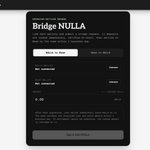
You can start requesting migrations using the form shown in the screenshot, which you can find in the navigation bar under Participate.
This version of the bridge is monitored and manually triggered by the NULLA team to ensure the security of all transactions.
To request a bridge transaction, you only need to:
Connect your Base and NULLA wallets.
Register the wallet pair.
Specify the amount you want to bridge.
We are already working on making the bridge permissionless in the future, allowing migrations to be processed without manual intervention from the team.

We have finished the full pipeline testing of the AuthGate SDK.
It allows providers to add Nulla's privacy-enforced authentication to their Web2 applications.
Tomorrow we will publish the SDK on GitHub and launch the following:
- the use-case app built by the team
- several video tutorials
- a registration form, so providers can request an app ID on the network, granted by the team
- the updated wallets (desktop, Android and CLI) that implement AuthGate functionality

Nulla Network is adding full EVM compatibility.
We are integrating pallet-revive — the next-generation Ethereum compatibility layer developed by Parity and already powering Polkadot's Asset Hub smart contract platform — directly into the Nulla ecosystem.
What this means in practice:
Deploy unmodified Ethereum contracts.
Solidity contracts compile and deploy as-is: the integration supports direct EVM bytecode upload, so existing audited contracts can migrate without recompilation.
Use the Ethereum tools you already know.
The integration ships with a complete Ethereum JSON-RPC server (eth_call, eth_sendRawTransaction, eth_getLogs, tracing and more), meaning MetaMask, Hardhat, Foundry, ethers.js and viem all work out of the box against a Nulla endpoint.
Native interoperability with our privacy stack.
Because the EVM layer lives inside the same runtime family as ProofHub, ScanProof and AuthGate, EVM contracts will be able to interact with our privacy lanes through XCM — opening the door to Solidity dApps that settle payments through shielded NULLA notes.
One token, one network. EVM transactions pay gas in NULLA (12 decimals), with address mapping between Ethereum-style 0x addresses and Substrate accounts handled natively by the pallet.
Rollout plan: the EVM layer will launch on our dev first, exposed through a team dedicated RPC endpoint, before being promoted to mainnet after the same end-to-end validation process we used for AuthGate.
More details, endpoints and developer docs coming soon.
— The Nulla Network Team
Hey everyone!
We’re looking to turn AuthGate live this week, and once AuthGate is live, our next step will be exploring the following:
EVM Compatibility
We’re actively working on bringing EVM-compatible parachains into the Nulla Network ecosystem.
The goal is straightforward: let Solidity developers and existing Ethereum tooling, MetaMask, Hardhat, standard dApp stacks, and more, deploy directly into our privacy-preserving architecture without having to learn Substrate/ink! from scratch.
This matters because it lowers the barrier for builders who already know EVM tooling to bring their projects into a network with real on-chain privacy, including quantum-resistant and homomorphic encryption capabilities.
Exploring an ICO Launchpad Parachain
We’re also investigating what it would take to integrate a dedicated parachain acting as an ICO launchpad, a place where new projects in the Nulla ecosystem could raise funds transparently, with the same privacy and security guarantees the rest of the network provides.
To be clear: this is still at the exploration stage.
We’re evaluating the mechanics, compliance considerations, and how it would interact with the rest of the parachain stack, ProofHub, ScanProof, AuthGate, and the upcoming EVM lane, before committing to a design.
As always, real progress will be shared with real proof, working code, live testnets, and verifiable transactions, the same way we’ve approached everything so far.
More updates as these take shape.
— The Nulla Network Team
hey everyone,
Following up on our last AuthGate post — we've taken the demo a step further, and we want to be upfront about what this actually is.
## What you'll find there
This isn't just a proof-of-concept to test the AuthGate workflow. **It's becoming the official AuthGate app tracker** — the one place to see:
- **Live network stats, pulled directly on-chain**: how many apps are registered on AuthGate, how many access keys have been issued, how many have been redeemed. No fake numbers, no backend database — every stat on that page is a live read straight from AuthGate's storage, right from your browser.
- **A real, working integration guide** for developers: the exact code to register an app, let users pay anonymously, and grant a session — copy-pasteable, because it's the same code powering the demo itself.
- **Real-world use cases**, not hypotheticals: paywalled content, private API access, token-gated communities, anonymous voting — concrete examples of what AuthGate actually enables today.
## Why this matters
We wanted a page that answers the question every builder asks first: *"okay, but how do I actually use this, and why would I?"* — instead of just proving it works, it will shows **who's already using it and how**, live, as the ecosystem grows.
As more apps register on AuthGate, this same page will keep tracking them — it's not a snapshot, it's a living index of the AuthGate app ecosystem.
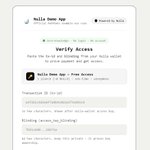
Try it yourself: log in anonymously with the same zero-cost demo key from our last post, and land straight in the Hub.
More apps, more use cases, more stats — this page grows as the ecosystem does.
The Nulla Network Team


AuthGate Is Ready: Real Privacy for Web2 Login:
Today we want to explain, in a precise and verifiable way, how AuthGate works, the new module from Nulla Network that allows users to access Web2 applications completely anonymously, paying with shielded NULLA.
What is AuthGate?
AuthGate is a dedicated parachain (para 2003) that acts as a bridge between Nulla's on-chain privacy and the login systems of traditional Web2 applications. It requires no wallet connection, no email, and no KYC.
How it actually works, step by step
A service provider registers their application on AuthGate, specifying an access price in NULLA.
The user already owns shielded NULLA (private notes on ProofHub or Pedersen coins on ScanProof) in their wallet.
The user purchases an access key by spending the private note. This operation generates a local secret (blinding) and a public cryptographic commitment, calculated as follows:
commitment
=
BLAKE3
(
"nulla_access_key_v1"
∥
app_id
∥
blinding
)
The privacy parachain sends a cross-chain XCM message to AuthGate, which records this commitment in its storage — without ever learning the identity of the person who made the payment.
The user presents the secret (tx-id + blinding) to the application's website. The application's backend verifies that the hash matches, then marks the key as "used" on-chain.
The application grants access. No wallet address, no IP address, and no identity is ever linked to the account that made the original payment.
Each key is single-use: once consumed, it cannot be reused by anyone else, not even by the person who originally purchased it.
The first real-world use case
We have already prepared the first demonstration website using AuthGate in production: a real Web2 application with a login page integrated directly with our official SDK ("nulla-authgate-sdk"), not a simulation.
Over the next few days:
- we will officially register this application on AuthGate;
- we will launch the dApp together with the SDK, so that anyone can see the complete flow working in real time on our network.
Try it without spending anything
To allow the entire community to test how it works without any financial risk, this first demonstration application will have an access key with a zero cost (0 NULLA).
This means you will be able to:
- generate a private note and complete the entire real cryptographic flow;
- gain access to the demonstration application;
- verify for yourself that the system works exactly as described;
- without spending a single real NULLA.
Why it matters
This is not simply a discount or coupon system: it is the first public demonstration that a traditional Web2 application can authenticate its users without ever knowing who they are, leveraging Nulla Network's cryptographic privacy end-to-end, from payment all the way to login.
We will keep you updated as soon as the demonstration application is registered and live.
Stay tuned.
We just updated the GitHub repository with the Authgate Parachain:
github.com/NullaZK/nulla-rel…
This GitHub update covers only the runtime and pallet of the parachain.
Tomorrow, we will update the SDK that providers can use to add privacy-preserving authentication to their websites, leveraging NULLA.
Alongside the SDK, we’ll also release the first website created by the NULLA team to properly showcase the functionality.
Parachain AuthGate is being registered right now.
This step requires waiting for at least one session and assigning validator cores to the parachain ID.
Once we ensure the chain is healthy and remains stable for at least one day, we will publish the code on GitHub along with a detailed explanation of the workflow that powers this parachain and enables user privacy.
NULLA Bridge
The NULLA Bridge allows users to transfer value between NULLA Mainnet and Base by connecting and verifying both wallets.
NULLA to Base: NULLA tokens are locked on-chain through the official nullaBridge pallet. Once the transaction is finalized, the system verifies the wallet, recipient, and amount. The team then mints the equivalent amount of wNULLA on Base.
Base to NULLA: the user submits a request signed by both wallets. The team reviews the request, completes the wNULLA burn on Base, and then unlocks the corresponding NULLA tokens to the specified wallet.
Every request:
requires valid signatures from both wallets;
verifies the available balance on the source chain;
cannot exceed the available balance;
prevents either wallet from submitting another request while one is pending;
can be tracked directly through the dapp.
The bridge is manually operated by the team to provide an additional verification layer for every transfer. Wallet signatures bind the addresses, direction, and amount, but cannot move funds on their own. Minting and unlocking are performed only after the corresponding on-chain transaction has been verified.
On the L1 Mainnet, we have a total supply of 1.25 billion tokens, therefore on Base, we minted the equivalent amount required to distribute the tokens to all users and provide liquidity for the liquidity pool.
At the moment, the bridge holds exactly the same amount of tokens that was minted on Base.
The remaining supply is allocated as follows: 5 million tokens to each validator required to run the chain, with the remainder held in the sudo address.
Regarding staking and rewards, these parameters remain the same as in the first launch:
20% of each era’s emissions go to the treasury.
The remaining 80% is distributed among validators and potential nominators of each node based on their actual era points.
80% of transaction fees go to the treasury, while the remaining 20% goes to the block author.
Inflation is set at 8%.
These values can be queried directly from the chain storage using the Nullascan explorer by navigating to Chain State → nullaParams.
DAY 2 update:
We've published updates for both the Android and Desktop wallet, now pointing to the new mainnet endpoints.
Android: github.com/NullaZK/NULLA-and…
Download and install the new APK over your existing installation (same package, should update in place and preserve your wallet). As always with any update, back up your recovery phrase first just in case — if Android ever asks you to uninstall before installing, that would wipe local data.
Desktop: github.com/NullaZK/NULLA-des…
extract the new zip anywhere you like, your wallet data lives in your user profile folder, not inside the app folder, so it's preserved regardless of extraction path. If you have a desktop shortcut pointing to the old folder, just recreate it after extracting. As always, back up your recovery phrase before updating.

New chain L1 is now live again, with validators run by the team.
Chain blocks can be observed here:
nullascan.com/?rpc=wss%3A%2F…
We have already locked the bridge pallet and the equivalent amount minted on Base.
We will now perform the calls to register the parachains and set the validator cores for them.
Nulla is live again !