

@NowrojeeOSF
Account based inUnited States
About this account
- Account based in
- United States
- Connected via
- United Kingdom App Store
Account-level information from X, not a live location or the device used for a specific post.
President of @OpenSociety. Pursuing philanthropy grounded in critical thinking, local knowledge, and risk-taking, to advance human rights, equity, and justice.
Washington, DC
Joined March 2024
- Tweets383
- Following548
- Followers3.5K
- Likes450






Pinned Tweet
The ICC is a court of last resort, delivering justice and accountability for victims of war crimes, crimes against humanity, and genocide.
The Trump admin’s actions are a direct attack on Ukrainians, Palestinians, the Rohingya, Darfurians, and Afghan women and girls’ right to pursue accountability.

The Open Society Foundations today condemned the Trump administration’s announcement of new sanctions on the International Criminal Court (ICC) as an institution, an unprecedented escalation of its campaign against the independent court dedicated to ensuring accountability for the gravest crimes.
“Since its establishment, the International Criminal Court has served as a court of last resort, delivering justice and accountability for victims of war crimes, crimes against humanity, and genocide when they have nowhere else to turn. The Trump administration’s actions are a direct attack on the victims’ right to pursue accountability for crimes against Ukrainians, Palestinians, the Rohingya, Darfurians, and women and girls in Afghanistan,” said Binaifer Nowrojee @NowrojeeOSF, president of the Open Society Foundations.
“The attack on the ICC punishes the people seeking justice instead of the perpetrators. These actions threaten to create a new era of impunity, where grave crimes go unpunished, and the perpetrators are free to repeat them. No one should be beyond the reach of the law, no matter how powerful. Open Society is committed to a world where human rights are protected, power is constrained by law, and justice is available to all.”
Open Society supported the campaign to establish the ICC following the genocides in Rwanda and the former Yugoslavia in the 1990s to prevent those responsible from evading justice. As a court of last resort for victims who have nowhere else to turn, the ICC investigates and prosecutes individuals responsible for war crimes, crimes against humanity, genocide, and the crime of aggression when national authorities are unwilling or unable to do so. Nearly two-thirds of UN member states have joined the court. Its work spans the globe; it has initiated 18 investigations in countries including the Philippines, Sudan, Venezuela, and Ukraine.
Open Society has long supported the ICC’s engagement with civil society and has consistently opposed efforts to undermine the court’s independence. In August, the Open Society Institute, a part of the Open Society Foundations, joined three human rights groups in a lawsuit challenging the Trump administration’s previous sanctions targeting individuals and organizations affiliated with or assisting the work of the ICC.
In 2025, the Open Society Justice Initiative joined more than 70 civil society and faith-based organizations in warning against the potential use of sanctions to attack the court. The group argued that the ICC performs a vital role in international affairs by investigating crimes that shock the conscience of humanity and that “it does so in a manner that protects the due process rights of the accused, the sovereignty of states, including the United States, and the rights of victims.”
Open Society is committed to the independent and impartial pursuit of international justice wherever crimes that violate international law have been perpetrated.
Many congratulations to Navi Pillay on being awarded the Nobel Peace Prize, a fitting recognition of a lifetime devoted to human rights and justice around the world.
It comes on the same day the Trump Administration has imposed sanctions on the International Criminal Court. Navi’s life’s work shows why international justice matters, above all to the victims and survivors of the gravest crimes, who so often have nowhere else to turn.
I have known and admired Navi for decades, as a lawyer, a judge and the UN’s human rights chief. As a judge at the International Criminal Tribunal for Rwanda, she sat on the case that made history as the first-ever conviction for sexual violence as an act of genocide under international law. At the International Court of Justice, she sat as a judge in the case brought by The Gambia against Myanmar over the genocide of the Rohingya.
Her most recent work has continued that pursuit of justice for victims of genocide. In 2025, as chair of the UN Commission of Inquiry on the Occupied Palestinian Territory and Israel, she found that Israel had committed genocidal acts against Palestinians in Gaza.
No one is more deserving of this prize, and no moment could make clearer why the work Navi has led is so important and so necessary.

BREAKING NEWS
The Norwegian Nobel Committee has decided to award the 2026 #NobelPeacePrize to Navanethem “Navi” Pillay for her efforts to promote peace and international law.
#NobelPrize

As the first woman to lead @OpenSociety, it is incredible to me that over 80 years, not a single woman has served as UN secretary-general.
The world needs one who is visionary, bold, and ready to take this organization into the future.


Attacks on hard-fought and hard-won gender rights gains are painful.
But remember: Nobody organizes against a movement that isn't a threat to the old order.
Namibia’s first woman president, Netumbo Nandi-Ndaitwah @SWAPOPresident, is a trailblazer for Namibia and for women across Africa. Under her leadership, women make up 57 percent of Namibia’s Cabinet—a significant reflection of her commitment to women’s participation and leadership in decision-making.
Women’s leadership matters because it changes whose voices are heard, whose priorities are considered, and who gets to shape the decisions that affect our societies and our future. It also matters for the women and girls who see themselves in positions of leadership and know that these spaces are open to them, too.

ALT Binaifer Nowrojee shakes hands with President Netumbo Nandi-Ndaitwah.
I’m grateful to the governments of Norway and Kenya for convening a timely and important discussion on the Horn of Africa and the Red Sea.
One of the things that strikes me about the current moment is how difficult it has become to separate crises that were once discussed independently.
From the genocide in Gaza, to the U.S.-Israeli attack on Iran and Iran’s subsequent attacks on all its Gulf neighbors, to the conflict in Sudan and tensions in the Red Sea—broader questions of regional security are increasingly part of a single, interconnected political landscape.
Lasting stability cannot be imported. It must be built by the states, institutions, and societies that have the greatest stake in the region’s future. In other words, sustainable security cannot be built for the region without being built by the region. That requires investing in diplomacy alongside security, cooperation alongside deterrence, and political solutions alongside military ones.

ALT Binaifer Nowrojee delivers remarks at an event at OSF at UNGA 81

ALT Binaifer Nowrojee shakes hands with event attendees

ALT Binaifer Nowrojee speaks to event attendees
Multilateralism among states is under enormous strain. But beneath the surface, something else is happening: cooperation is now moving faster between cities than between countries.
When a city in Kenya learns from a city in Colombia, and a city in Europe learns from both, we build a network of trust that no single government can create, and that no single government can take away.

ALT Binaifer Nowrojee delivers remarks at Open Society at UNGA 81.
This week, @OpenSociety hosted a conversation centered around the importance of local collaboration in building peace and safety—the kind of peace you measure by whether the market opens on a Tuesday morning, whether a mother can feel safe letting her children walk to school, whether a young person sees a police officer as a protector or a threat.
This kind of peace is built in neighborhoods, in town halls, and in county offices by people who don’t get to leave when the cameras get switched off.
To Governor Timamy, Diana Eggleston, Father Jorge Atilano González Candia, Juan Pablo Fonseca, and Felip Roca, thank you for your pioneering work. Continue to borrow boldly, share generously, and do not let anybody tell you that local is small.
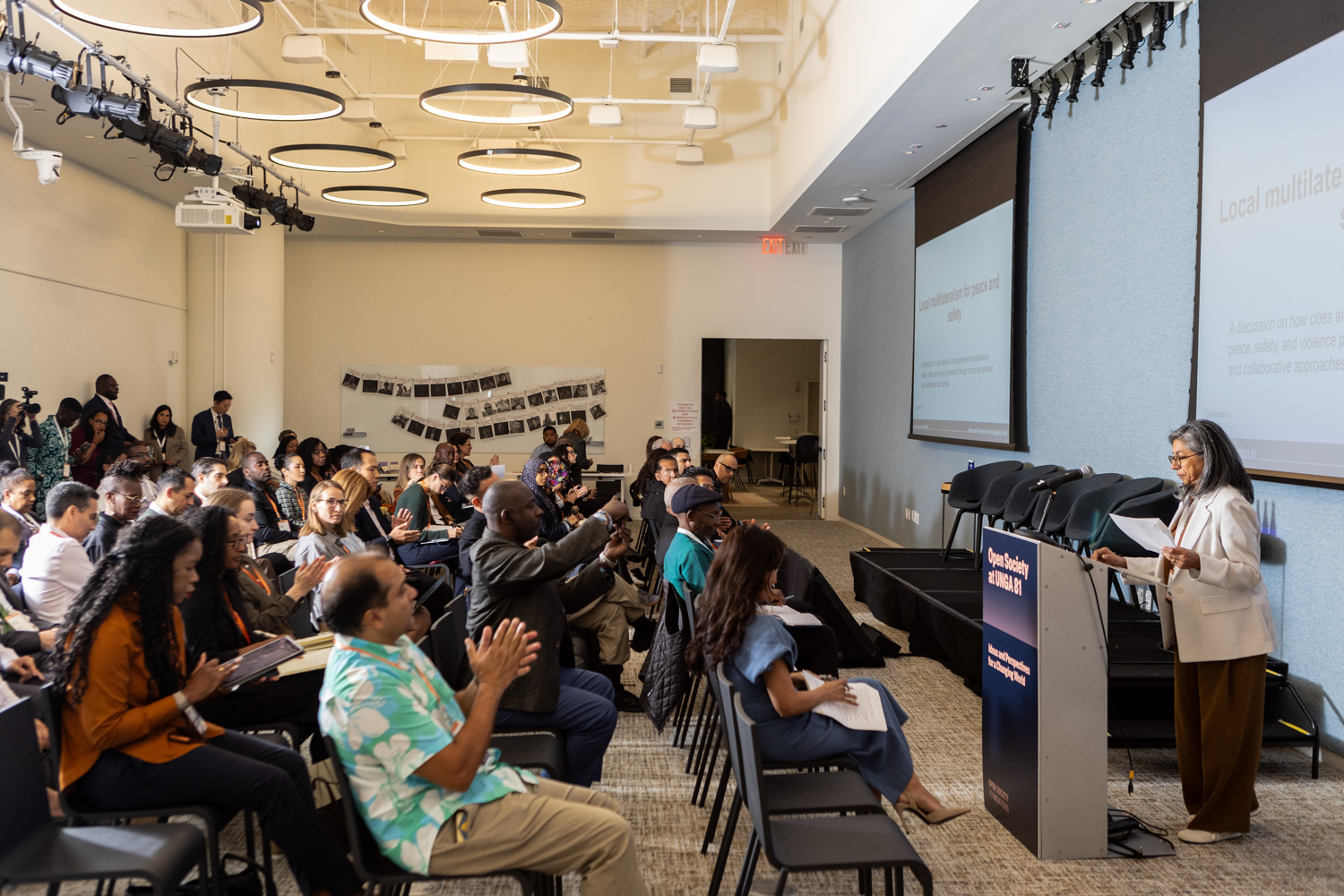
ALT Binaifer Nowrojee addresses a group at Open Society at UNGA 81.
At @NRGInstitute’s 20th anniversary in New York, I spoke about the choices we are all making right now about critical minerals and the energy transition.
No community should be left behind. No country should be forced into an unfair bargain. And no child should pay for their development with their future.
Open Society is proud to have been there at the beginning, and we remain committed to that vision.
I gathered with local leaders and peace builders from Kenya, the Netherlands, Mexico, Colombia, and Spain to talk about local multilateralism for peace and safety.
At Open Society, we hold a simple conviction: security that is not built on human rights is not security at all. Lasting peace cannot be designed from above and delivered to people. It has to be built with them.
Twenty years ago in the @OpenSociety offices, a small group of people began asking a question that many in power found uncomfortable: If a country’s oil, gas, and minerals belong to its people, why were so many of those people living in poverty right beside it?
It was a privilege to join @NRGInstitute in New York this week to honor the organization that’s never stopped asking that question.
Laws can be rolled back. Institutions can be weakened. But a person who has learned to ask, “Whose wealth is this?” doesn't unlearn that lesson. We need those people now more than ever.

ALT OSF President Binaifer Nowrojee delivers remarks at a NRGI event.
Binaifer Nowrojee retweeted

We mourn the passing of Emma Bonino, a former Open Society board member. She was a tireless advocate for human rights. May her fearlessness continue to inspire those fighting for open societies everywhere. osf.to/4xQ5EIV

In this special issue of @TheIdeasLetter, five thoughtful pieces reckon with South Africa’s predicament today.
As my colleague @TamukaKagoro77 writes, the ANC’s once inspiring liberation narrative is facing exhaustion, alternatives have not emerged, and mass politics have dismayingly organized around the expulsion of migrants and not the emancipation of all.
The end of apartheid’s laws did not lead to the end of its structures, or the injustices they perpetuate. And what’s at risk is the vision of a “democratic and open society” that South Africa’s landmark constitution promised.
Thirty years on, South Africa’s hope immediately after apartheid has been dashed as inequality, unemployment, and xenophobia remain high. Wealth remains in few hands, nearly half of working age people are unemployed, and immigrants have become scapegoats for these issues and others.
In the latest edition of @TheIdeasLetter, William Shoki of @africasacountry, @TamukaKagoro77, @PanasheChig, and @NicDawes discuss the origins of this, the lingering legacy of apartheid, and the possible (and impossible) ways out of this.
What changes in governments around the world when women hold political power?
The policies they pursue—on development, on participation, on human rights protections.
When women lead, everyone’s outcomes improve.
International justice is all that the women and girls of Afghanistan have left. There is nowhere else for them to turn to. The same is true of the victims in Ukraine, Gaza, Darfur, and Myanmar’s Rakhine State.
If international justice is lost, it would be a betrayal of the victims of the most serious crimes, and impunity for the perpetrators. scienzainrete.it/articolo/af…

Powerful states are flouting international legal norms. Both the Russian invasion of Ukraine and the images from Gaza that we’re seeing today are horrific, with the devastation of the Palestinian people being streamed to us live. I think this is a moment of global shame that will stay with us.
But it's too simplistic to say that rights have disappeared or that human dignity doesn't matter. If you only look at who’s leaving the stage, you won't see who’s stepping onto it. Countries across continents are making their voices heard, advancing human rights, equality, and justice: Spain mobilizing countries, Pacific and Caribbean island nations leading on climate, The Gambia taking Myanmar to the International Court of Justice, Barbados leading on debt relief.
The global landscape is shifting.
My conversation with @demorgen: demorgen.be/nieuws/het-publi…

Binaifer Nowrojee retweeted
States, countries, and cities across the U.S. secured $58 billion via a settlement from companies that fueled the overdose crisis. Yet many jurisdictions are shutting out community members from deciding how this money should be spent to combat the overdose crisis—including on expanding treatment, housing, and harm reduction, writes our @OSFKasia. commondreams.org/opinion/opi…

Binaifer Nowrojee retweeted

“This moment calls us not only to defend past gains, but to reimagine rights for generations to come. It demands...intentional action on this continent in the pan-African spirit of Agenda 2063 and the African shared values on human rights, democracy, and governance.” @NowrojeeOSF
