

Ex-@Freshfields (Paris), #Notaire à Maurice, spécialisé en #patrimoine, #DIP et #fiscalité internationale. Auteur, conférencier #tax #Blockchain #LegalTech
République de Maurice
Joined March 2019
- Tweets284
- Following942
- Followers264
- Likes2.9K



Pinned Tweet
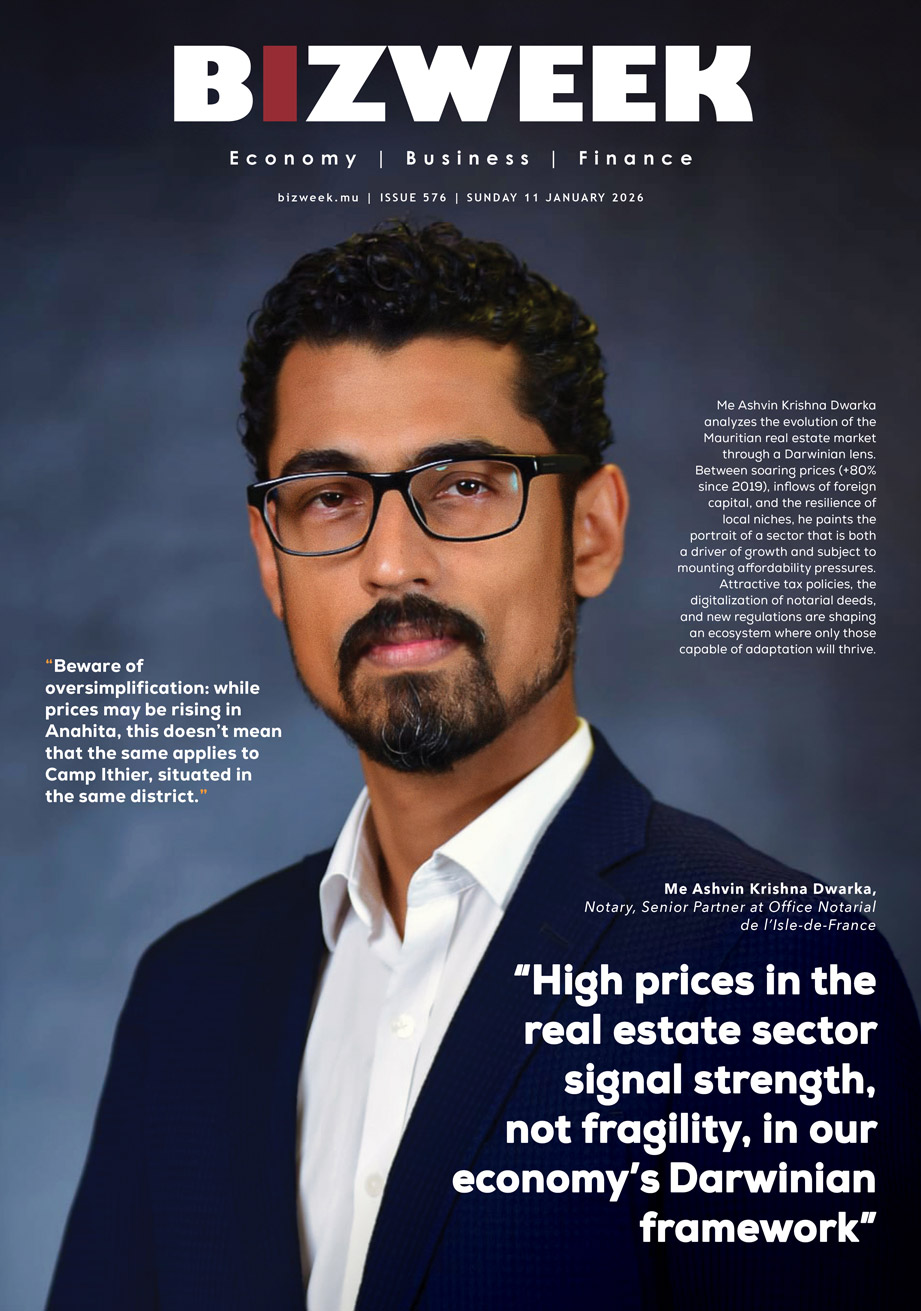
L’immobilier à Maurice : un écosystème Darwinien où seule l’adaptation permet de prospérer. Ravi de partager mon analyse sur l’évolution du marché en ce début 2026 dans le dernier numéro de @Bizweek_mu . 🧶 Décryptage en quelques points...
🔽🔽🔽

High prices in the real estate sector signal strength, not fragility, in our economy’s Darwinian framework - Me Ashvin Krishna Dwarka, Notary, Senior Partner at Office Notarial de l’Isle-de-France. @NotaireDwarka
📖Full article: bizweek.mu
#BIZweek #Mauritius
1
117
Maître Ashvin Krishna Dwarka - Notaire retweeted

How many times can an agreement be reconsidered before diplomacy becomes a means of postponing its implementation?
British Prime Minister Andy Burnham wants to reshape the Chagos agreement to address Washington’s concerns about Diego Garcia. His suggestion that the Greenland arrangement might offer a model opens another chapter in an already protracted process.
From Mauritius, the central point remains unchanged: the Chagos Archipelago belongs to Mauritius. London’s hesitation cannot indefinitely postpone the completion of our decolonisation.
This position has a substantial legal foundation. In its 2019 advisory opinion, the International Court of Justice concluded that Mauritius’s decolonisation had not been lawfully completed in 1968. It found that Britain was obliged to end its administration of the archipelago as rapidly as possible. Although an advisory opinion is not a binding judgment between states, the Court’s conclusions carry significant legal authority.
The diplomatic challenge is to implement a settlement consistent with that legal framework while providing credible security arrangements.
Diego Garcia’s strategic importance does not give London an unlimited licence to delay.
The agreement negotiated under Keir Starmer already sought to reconcile Mauritian sovereignty with the continued operation of the joint UK-US base. Burnham now wants arrangements that better satisfy American concerns. Those concerns should be identified precisely, rather than used to justify an open-ended reconsideration of the entire settlement.
What additional safeguards does Washington require? Which provisions are considered inadequate? Can those issues be resolved without weakening the sovereignty commitments already negotiated?
Mauritius deserves clear answers. It should not have to negotiate against a moving target whenever political priorities shift in London or Washington.
The Greenland comparison offers no shortcut around those questions.
Burnham has pointed to an arrangement accommodating an expanded American military role while retaining Danish sovereignty. Any useful comparison must therefore explain how military access can coexist with the sovereignty of the country concerned.
If that is the principle London wishes to explore, it should state plainly how its proposal would uphold Mauritian sovereignty over the whole archipelago.
A new diplomatic formula cannot become a respectable name for retreating from an existing commitment.
The imbalance is already apparent. Britain’s Ministry of Defence confirmed on 6 November that no payments had been made under the agreement signed in May 2025, and that implementation required the full support of Mauritius and the United States.
Washington’s support matters for the operation of a joint military facility. It should not become an indefinite political veto over the completion of Mauritian decolonisation.
December must bring measurable progress.
Navin Ramgoolam’s demand for a clear roadmap, with a first milestone in December 2026, is justified. That milestone should identify the remaining disagreements, the proposed solutions and a credible timetable for implementation. Another declaration of goodwill would fall short.
Chagossian communities must also have a meaningful voice in decisions affecting their rights and future. A settlement’s legitimacy depends on how it treats the people most directly affected.
Mauritius can negotiate practical guarantees for Diego Garcia. It can engage seriously with British and American security requirements. But flexibility must be reciprocal, and negotiations must lead somewhere.
London may delay implementation. It cannot reasonably expect Mauritius to accept permanent uncertainty.
The Chagos belong to Mauritius. The task is to give effect to that reality, with a timetable and commitments that survive changes of government.
Maître Ashvin Krishna Dwarka - Notaire retweeted

J'ai vu une Tesla décoller. Et j'ai entendu beaucoup de bêtises.
« Ça ne sert à rien. » « Gadget de milliardaire. » « Qui a besoin d'une voiture qui vole ? »
Personne. Et c'est exactement pour ça que c'est important.
En 1978, Brabham a aligné en Formule 1 une voiture équipée d'un ventilateur géant à l'arrière. Il aspirait l'air sous le châssis et plaquait la voiture au sol. Elle a gagné sa première course avec une avance insolente. Elle a été interdite immédiatement.
Quarante-huit ans plus tard, on y revient. Un système de succion qui colle la voiture à la route et lui permet de passer sous la seconde au 0 à 100.
Personne n'a « besoin » de faire le 0 à 100 en moins d'une seconde. Comme personne n'a besoin d'une Formule 1. Et pourtant : les freins carbone de votre berline, l'hybridation de votre moteur, l'aérodynamique de votre SUV, les palettes au volant — tout ça vient de voitures de course que personne n'utilisera jamais pour aller au travail.
La Formule 1 ne sert à rien. Pourtant elle sert à tout.
En 1973, quand la France a lancé Ariane, l'Europe sortait de onze échecs consécutifs du programme Europa. La presse parlait d'argent jeté dans l'espace. Vingt ans plus tard, Ariane détenait la moitié du marché mondial des lancements commerciaux, et chaque satellite de télévision, de météo ou de GPS que vous utilisez a bénéficié de cette obstination.
Le progrès a toujours la même tête au début : un truc inutile, cher, ridicule, construit par des gens qu'on prend pour des fous.
Ce que j'ai vu à Dallas, ce n'est pas une voiture volante. C'est un châssis, une gestion de l'énergie et une maîtrise des flux d'air que l'industrie automobile mettra dix ans à digérer.
Les applications viendront : sécurité, freinage, stabilité, consommation. Elles finiront dans des voitures ordinaires conduites par des gens qui expliqueront, en 2036, que tout ça était évident.
La question n'est jamais « à quoi ça sert ».
La question est : qui ose encore construire des choses qui ne servent à rien ?
Il y a cinquante ans, c'était nous. La fusée, le TGV, le Concorde, le Minitel.
L'Europe construisait des choses absurdes et magnifiques.
Aujourd'hui, on commente depuis le siège arrière car nous sommes hors course.
Merci @elonmusk de nous faire rêver

Maître Ashvin Krishna Dwarka - Notaire retweeted

Kids making fun of influencers just restored my faith in humanity. Nature is healing🤣
Maître Ashvin Krishna Dwarka - Notaire retweeted

Lee Kuan Yew proved that a nation's destiny is engineered, not inherited.
In 1965, when Singapore was unceremoniously booted out of Malaysia, the international consensus predicted absolute state failure.
He inherited a swampy, impoverished island with a population of just two million people living in squalor.
It had zero natural resources, no agricultural land, no military defense, and lacked even enough basic drinking water to sustain human life.
If Lee Kuan Yew had operated on the standard of modern populist politics, he would have spent the next thirty years weeping on international stages, blamed historical external factors, and begged neighboring countries for permanent welfare handouts. He didn't. He went to work.
While post-colonial leaders across Africa and Asia turned inward to launch economically illiterate isolationist experiments, Lee championed hyper-globalization.
He realized that if you have no domestic market, your only asset is human capital. He cleared the malarial swamps of Jurong, instituted strict pro-market property rights, lowered taxes, and laid down red carpets for Western multinationals like Texas Instruments and Hewlett Packard before the supporting infrastructure even existed.
His domestic masterclass was built on structural logic, not ideological fantasies.
He gave his anti-corruption units actual teeth, starting with his own cabinet. If a politician stole public funds, they didn't get a promotion or a diplomatic posting, they went straight to prison. Zero tolerance meant global investors knew their capital was safer in Singapore than in London or New York.
He transformed subjects into stakeholders through the Central Provident Fund and the Housing Development Board. By aggressively shifting 75% of the population out of slums into state-of-the-art public housing, he gave ordinary citizens a physical, equity-based ownership stake in the country's survival.
He instituted mandatory bilingualism and made English the main national language to plug his workforce directly into the global grid.
He hired elite technocrats based on raw competence, completely ignoring ethnic divisions.
Teachers were paid corporate-level salaries because he understood that a first-world economy cannot be built by an uneducated majority.
In a single compressed generation, GDP per capita skyrocketed from under $500 to overtaking the United States and the United Kingdom.
The structural lesson of Singapore is a devastating indictment of Africa's current leadership.
It proves that poverty is not a permanent geographical curse; it is a choice made by incompetent elites who prefer primitive capital accumulation over national engineering.

Maître Ashvin Krishna Dwarka - Notaire retweeted

The official verdict is absolute Crap!
I'm a Commercial pilot (Complex piston singles) and I have followed this story from the beginning. The official story is pathetic. This will go down in history as one best examples of aviation bravery.
For this story to have the happy ending that it did, 3 things had to happen perfectly:
First, Cpt. Smit who while on the floor (being attacked with an axe!!!) thought "these are my last moments, but I cant let these people die" and somehow opened the cockpit door. Without his bravery and determination, Everybody dies no question.
Second the passengers Yaniv and Yitzhack rushed the cockpit the minute they heard screams. Dont minimize this. Most people in a situation like this would freeze in their seats. Not to mention getting the the front of the plane in a zero G nose over. I'm assuming IDF training (mandatory for all Israelis) but even then excellent reactions under pressure. By rushing to the front immediately, they were on the other side of the door the second that Cpt Smit opened it. The IDF training also probably had a hand in their ability to rapidly neutralize the co-pilot.
Yaniv taking the stick and pulling out of the dive is critical simply because there was no time otherwise. At the rate of decent by that point there is maybe 30s to impact if they keep diving (and they were already past Vne)
However, contrary to popular male ego, a non pilot successfully recovering the plane has odds near zero. Commercial aircraft are huge and have massive momentum. Even in a small plane, if you are too heavy on the controls nothing happens for ten seconds, then next thing you know you are upside down. The most likely outcome after a non-pilot pulling out of a dive would be overcontrolling and triggering a stall. Fortunately (according to Yaniv's interview) the relief pilot took over just as he leveled the plane.
The relief pilots being on board was fortunate, the relief pilot managing to take over the controls before Yaniv could trigger a stall was perfect timing. The pilots were not just random pilots or random airline pilots, they were the relief crew which meant they had hundreds if not thousands of hours in that exact model. Why is this important? Because the co-pilot had smashed the instruments (once again from Yaniv's interview) and the rudder was damaged from exceeding Vne. The relief pilots could handle this as a routine emergency, for a pilot unfamiliar with that airplane and instruments smashed it would be a insurmountable challenge.
Finally the Pilot who thought he was going to die was in luck because on board was a dentist. A dental surgeon no less. Not quite the same an ER doc, but enough to stop major arterial bleeding from multiple wounds.
If somebody doesnt make a great movie out of this it would be a crime. This is aviation history being made.
Maître Ashvin Krishna Dwarka - Notaire retweeted

On this day in 1986, Palestinian terrorists hijacked Pan Am Flight 73 in Karachi, Pakistan. They brutally murdered 21 people and wounded more than 100.
Flight attendant Neerja Bhanot hid American passports and helped passengers escape. She was killed two days before turning 23.
Remember her courage.

Maître Ashvin Krishna Dwarka - Notaire retweeted

The engineer who designed that house's column structure deserves a national medal.

Maître Ashvin Krishna Dwarka - Notaire retweeted

I was a bricklayer.
It was how I paid the bills when I first moved to America. Even the biggest title in bodybuilding, Mr. Olympia, only paid a thousand dollars back then.
It makes me proud that in March, the winner of our Arnold Classic and our Arnold Classic UK took home more than a million dollars. He can focus on bodybuilding.
But in our day, that wasn’t an option. Some guys were teachers. Some sold insurance. Franco and I laid bricks.
We put an ad in the paper and sold ourselves as European craftsmen. We figured if people heard the accents, they would picture old-world masonry instead of two bodybuilders with a wheelbarrow.
It worked.
The phone rang. And then we had to go out and actually do the job, which was the part nobody could fake. Luckily, Franco knew what he was doing.
The work was simple. Mix the mortar. Set the brick. Tap it level. Scrape the edge. Then do it again. And again. Nobody claps for you. There is no crowd, no music, no trophy. There is just the next brick sitting there waiting for you.
You can still find some of the walls we built in Venice.
That’s where my lesson today comes from.
One brick doesn’t look like anything. Ten bricks don’t look like anything. A hundred bricks, you’re starting to see something, but it doesn’t impress anyone.
You just keep laying bricks until the job is done.
And you know what happens after four or five hours on a wall?
You are so damn tired, or you feel so great that you stop measuring.
You are not standing back every ten minutes asking how far from finished it is. You are covered in mortar, your hands are raw, you’re schvitzing, and you are happy. The work took the question away from you.
That is the part nobody tells you about hard work: It doesn’t just build the wall. It terminates the voice that keeps asking when the wall will be done.
Maître Ashvin Krishna Dwarka - Notaire retweeted

The Count of Monte Cristo has been voted the most American hero in French literature.
(In a poll I conducted:)
1. Edmond Dantès is destroyed by the establishment not because he did anything wrong – but because he was about to succeed. Three mediocre men find it convenient that he disappears. This is not villainy. It is the European system operating as designed.
2. He does not petition for justice. He does not appeal to institutions. He builds himself — from nothing, in a prison cell — into something the system has no category for. The Château d’If is his Stanford, his Wall Street, and his boot camp, all at once.
3. The fortune is not inherited. It is found, claimed, and deployed. He has no bloodline the establishment must respect. So he buys his way in, masters their codes faster than they learned them, and uses their own rules as weapons. This is the American founding myth in a French waistcoat.
4. The revenge is not hot. It is architectural. Years of patience, precision, and methodical excellence – each enemy given exactly enough rope. He does not rage against the system. He becomes the consequence.
5. Every other hero of French literature is tragic, compromised, or absorbed. Dantès alone wins completely, on his own terms, without surrendering who he is. The European novel teaches you why the system always wins. Monte Cristo is the exception – which is why it feels American.
6. “Wait and hope” — his closing words — are not passive. They are the most aggressive possible stance: the decision to outlast, outthink, and outlive the corrupt establishment that thought it had finished you.
7. America was built by people who had been finished by someone else’s establishment and who decided to build anew from scratch. They recognized the Count immediately. The French invented him. The Americans understood him.


Now The Fountainhead – arguably the better book:
1. There are two ways to exist: create from your own vision, or live by reflecting and pleasing others – Rand calls them the first-handers and the second-handers.
2. Howard Roark is an architect who will only build what he actually believes in. He starves rather than compromise the design. The world resists him constantly.
3. Peter Keating is the opposite – talented enough, but builds his entire career on flattering clients, copying styles, and climbing socially. He succeeds, but remains hollow.
4. The villain, Ellsworth Toohey, is the system made conscious: he deliberately promotes mediocrity, knowing that a world of second-handers needs a critic to tell them what to think – and that gives him total power.
5. Roark’s crime, in the eyes of that world, isn’t failure – it’s that he doesn’t need their approval. That independence is experienced as an affront.
6. The novel’s argument: civilization’s actual source is the rare individual who originates rather than imitates. Everyone else — including people who despise him — lives downstream of what he creates.
7. The Fountainhead is Roark himself. Not a fountain – a fountainhead: the original source, where the water actually comes from. Before the river, before the tributaries, before anyone else draws from it. The title says: find that person, and you’ve found where everything real begins.

Maître Ashvin Krishna Dwarka - Notaire retweeted

Sublime texte "Le train de ma vie" de Jean d'Ormesson
"A la naissance, on monte dans le train et on rencontre nos parents.
Et on croit qu’ils voyageront toujours avec nous.
Pourtant, à une station, nos parents descendront du train, nous laissant seuls continuer le voyage…
Au fur et à mesure que le temps passe,
d’autres personnes montent dans le train.
Et ils seront importants : notre fratrie, amis, enfants, même l’amour de notre vie.
Beaucoup démissionneront (même l’amour de notre vie) et laisseront un vide plus ou moins grand.
D’autres seront si discrets qu’on ne réalisera pas qu’ils ont quitté leurs sièges.
Ce voyage en train sera plein de joies, de peines, d’attentes, de bonjours, d’au-revoir et d’adieux.
Le succès est d’avoir de bonnes relations avec tous les passagers pourvu qu’on donne le meilleur de nous-mêmes.
On ne sait pas à quelle station nous descendrons.
Donc vivons heureux, aimons et pardonnons !
Il est important de le faire, car lorsque nous descendrons du train, nous devrions ne laisser que des beaux souvenirs a ceux qui continuent leur voyage…
Soyons heureux avec ce que nous avons et remercions le ciel de ce voyage fantastique.
Aussi, merci d’être un des passagers de mon train.
Et si je dois descendre à la prochaine station,
je suis content d’avoir fait un bout de chemin avec vous !
Je veux dire à chaque personne qui lira ce texte que je vous remercie d’être dans ma vie et de voyager dans mon train."
Jean D’Ormesson

Maître Ashvin Krishna Dwarka - Notaire retweeted

The first trillionaire in human history
- Elon Musk
- Born in South Africa
- Bullied relentlessly as a kid
- Immigrated to North America
- Arrived with a backpack and a dream
- Built Zip2 with his brother
- Sold it 4 years later for $300 million
- Co-founded PayPal with the profits
- Revolutionised digital payments
- Sold PayPal to eBay for $1.5 billion
- Bet everything on Tesla and SpaceX
- Got mocked for electric cars
- Got laughed at for reusable rockets
- Nearly went bankrupt in 2008
- Kept building anyway
- Turned Tesla into the world’s most valuable automaker
- Made EVs mainstream and transformed the automotive industry
- Made reusable rockets a reality
- Reduced the cost of reaching space by 95%
- Sparked the modern commercial space race
- Built Starlink and connected millions around the world to high-speed internet
- Turned SpaceX into the most valuable private company in history
- Bought Twitter for $44 billion
- The world said he overpaid
- He was called reckless, stupid & crazy
- Advertisers fled, media declared it dead
- Critics called it the worst acquisition in tech history
- Renamed it 𝕏
- Rebuilt the platform anyway
- Turned it into one of the most influential platforms on Earth
- Launched xAI and accelerated the global AI race
- Sent astronauts to space
- Is trying to get humans to mars
- Created millions of jobs
- Generated hundreds of billions in value
- Inspired an entire generation of builders
Before:
- Failed repeatedly
- Worked insane hours
- Slept in factories and offices
- Got bullied, laughed at and mocked
- Constantly told “it’s impossible”
- Kept building anyway
- Made it possible
Today:
- Richest person on Earth
- First trillionaire in human history
- Largest IPO in history $1.77 trillion
Most people quit when the world laughs at them.
Elon Musk built the future instead.
Love him or hate him…
Nobody has changed more industries in a single lifetime.
Payments. Cars. Energy. Space. Social Media. Communications. AI.
History won’t remember the people who said it couldn’t be done.
It will remember the people who did it anyway.
Congratulations Elon.
The first trillionaire. 🚀


Maître Ashvin Krishna Dwarka - Notaire retweeted

A British novelist whose father worked in a bank explained the entire 2008 financial crisis in a 272-page book that a 12-year-old can follow, and the part that should scare you is how simple the fraud was once he stripped the jargon off it.
His name is John Lanchester.
He is a novelist by trade. He writes for the London Review of Books and The New Yorker. He grew up in Hong Kong because his father worked at a bank there, which means he absorbed the language of finance the way most kids absorb the language of cartoons. By the time the 2008 crisis hit, he was one of the very few writers on earth who could speak both finance and English fluently.
He sat down and wrote a book called I.O.U.: Why Everyone Owes Everyone and No One Can Pay.
In the UK it was published under the title Whoops! It came out in 2010. 272 pages. The reviews from financial journalists were almost embarrassed in their praise, because Lanchester had done in plain English what most of them had failed to do in years of professional coverage. He had actually explained what happened.
Here is the version a middle schooler can understand.
Step one. A bank gives a home loan to a person who clearly cannot pay it back. No real job. No savings. No way to make the monthly payments. The industry had a nickname for these loans. They called them NINJA loans. No Income. No Job. No Assets. The bank knew the person could not pay. The bank did not care.
Why did the bank not care?
Because the bank was not going to keep the loan.
Step two. The bank takes thousands of these loans, puts them in one giant pile, and sells the entire pile to a Wall Street firm. The Wall Street firm now owns the right to collect all those monthly payments. The original bank has been paid. Whether the homeowners actually pay or not is now someone else's problem.
Step three. The Wall Street firm takes the giant pile of loans and chops it into slices. They call the slices tranches. The top slice is supposed to be the safest because it gets paid first. The bottom slice is supposed to be the riskiest because it gets paid last. They give each slice a credit rating. The top slice gets stamped AAA, which is the highest rating you can get on earth. It is the rating used for the bonds of the United States government.
A pile of loans to people with no income and no job has just produced an investment product rated as safe as the United States government.
Step four is where the trick gets worse.
The bottom slices, the ones full of the riskiest loans, are hard to sell. Nobody wants junk. So the Wall Street firm takes the bottom slices from a hundred different piles, mixes them together into a new pile, and chops that new pile into new slices. And the top slice of this new pile, made entirely from the junk of the old piles, also gets stamped AAA.
This new product has a name. It is called a Collateralized Debt Obligation, or CDO.
A 12-year-old can see what is wrong here. You cannot take a hundred bags of garbage, dump them into one big bag, and then declare that the top of the big bag is now gold. The garbage is still garbage. The math does not change it.
But the people who ran the ratings agencies were not 12-year-olds. They were adults with finance degrees. And they stamped this stuff AAA over and over again because the Wall Street firms were paying them to do the stamping. The ratings agencies had become a paid service. The people they were rating were also the people writing their checks.
Step five. The Wall Street firms sell these AAA-rated CDOs to pension funds, foreign governments, insurance companies, and retirement accounts all over the world. Everyone buys them because the rating says they are safe.
Step six is the final trick.
Someone invents a product called a Credit Default Swap. It is insurance against a CDO going bad. The clever part, the part that Lanchester explains so well, is that you do not have to actually own the CDO to buy insurance on it. You can buy insurance on a CDO that belongs to someone else. You can buy insurance on a CDO ten times over. A hundred times over. There is no limit.
This is the equivalent of taking out fire insurance on your neighbor's house. And then on a thousand strangers' houses. And then betting against the entire neighborhood.
The smart people in the industry realized the CDOs were garbage. So they started buying credit default swaps against them. Not to protect themselves. To bet on the collapse.
Step seven was the part nobody planned for.
Housing prices stopped going up. The NINJA borrowers, who had been refinancing every year by using the rising value of their houses as collateral, suddenly could not refinance. They started missing payments. The bottom tranches of the CDOs started failing. Then the middle. Then the AAA tranches that had been declared safer than government bonds turned out to be made of the same garbage as the rest.
Then the insurance bills came due.
The biggest insurer in the world, AIG, had written hundreds of billions of dollars in credit default swaps on these CDOs. They did not have the money to pay. If AIG collapsed, every major bank on earth that had bought insurance from them would also collapse, because their "safe" CDOs would suddenly have no insurance. The American taxpayer ended up writing AIG a check for 182 billion dollars to keep the entire global financial system from falling apart.
The total damage of the crisis, by every honest estimate, runs into the trillions of dollars. Millions of people lost their homes. Millions lost their jobs. Almost nobody on Wall Street went to jail.
Here is the part Lanchester drives home in the final chapters, and the part you should not forget.
The fraud was not hidden in the math. The fraud was hidden in the complexity. Each individual step looked legitimate. Each individual product had a name, a rating, a paper trail. The reason nobody stopped it was that no single regulator, no single executive, no single auditor was forced to look at the entire chain from end to end. The garbage at the start and the AAA stamp at the end were separated by so many layers of paperwork that everyone could honestly say their specific layer looked fine.
Lanchester's central argument is the one that should haunt every person reading this in 2026.
Complexity is the disguise. Anytime a financial product is so complicated that the person selling it cannot explain it in 60 seconds, the complexity itself is the warning sign. The complexity is not protecting the customer. The complexity is hiding the fact that the customer is the product.
The 2008 crisis was not a failure of intelligence. It was a failure of plain language.
Almost every product on the market today that is being sold to retail investors, from leveraged ETFs to certain crypto derivatives to private credit funds, has the same structural pattern. Layered. Hard to explain. Stamped with an authoritative rating. And the people selling it can never quite tell you what is inside.
Which brings me to the question.
The next 2008 is already being built somewhere in the financial system right now.
Which industry, or which product, do you think is hiding the same trick under the same kind of complexity right now in 2026, and what makes you suspicious of it?

Maître Ashvin Krishna Dwarka - Notaire retweeted

Je me souviens. Il y a pile 45 ans, je passais l'oral le plus court de ma vie.
Il a duré très exactement 15 secondes.
Et j'en ai tiré des leçons.
Le professeur s'appelait Georges Tapinos. Il était le prestigieux patron de l'Institut National des Etudes Démographiques (INED). Et il tenait à Sciences Po un séminaire intitulé "Evolution et permanence de la théorie économique"...
... Ce qui était assez flou pour qu'il puisse raconter ce qu'il voulait, dans l'ordre où il le voulait, et de la façon qu'il souhaitait.
Lors de son premier cours, nous étions 220 à l'écouter, dans le grand amphithéâtre Boutmy. Mais il s'est révélé si aride, si ardu et si abscons, notamment en matière mathématique et statistique, que plus d'un quart des élèves ne sont pas revenus, pour son second cours.
Lequel fut pire.
Et cela a continué ainsi pendant 3 mois. Jusqu'à ce qu'on se retrouve à 8, dans une petite salle, au deuxième étage.
Là, il a dit : "Bon, on va maintenant pouvoir être moins compliqué".
Il est quand même resté très difficile à suivre.
Dès lors, pour le comprendre, il fallait lire. Lire vraiment les œuvres des auteurs dont il parlait, lire leurs critiques, et réfléchir.
Cela ne se faisait pas trop, à Sciences Po, où l'on travaillait tellement que la plupart du temps, les élèves se contentaient d'apprendre sagement ce qu'on leur disait de croire, sur les œuvres inscrites au programme.
Mais, en dépit de mes lectures, j'avoue que souvent, G. Tapinos expliquait des choses que je ne comprenais pas bien.
Dans ce cas, je ne l'interrompais pas. J'allais le voir, après le cours. Et là, lui, le patron débordé de l'INED, prenait un temps infini pour expliquer, détailler. Au point qu'à plusieurs reprises, nous allions terminer la discussion au Basile, le bistrot à côté de Sciences Po.
J'en sortais intensément heureux.
Il n'a fait qu'un cours "simple". Sur "Le parapluie et les utopistes français". 🙂
Il avait fait venir un copain, dont j'ai hélas oublié le nom. Qui, partant du fait que Proudhon, Fourier, Cabet souhaitaient couvrir les trottoirs pour protéger les passants du soleil et de la pluie - alors que les libéraux préféraient le parapluie individuel - expliquait, sous cet angle, toute la philosophie économique du "socialisme" pré-marxiste, en France.
C'était brillant - et concret.
Mais, le reste du temps, Georges Tapinos flottait dans ses limbes, avec passion.
Surtout, il n'enseignait pas seulement ses certitudes. Il expliquait ses doutes.
C'était passionnant.
Ce fut même le professeur le plus passionnant que j'ai eu à Sciences Po.
Et, peut-être parce qu'il était né à Athènes, et qu'il était d'origine grecque, j'ai toujours pensé qu'il enseignait comme Platon ou Aristote enseignaient.
En sélectionnant les plus coriaces, les plus avides de connaissances. Et petit à petit, en les poussant à lire, à réfléchir. A s'accoucher d'eux-mêmes.
Puis vint l'oral. Après avoir enseigné à 8 élèves pendant des mois, après avoir discuté avec chacun, il nous connaissait bien.
Mais il fallait un oral, pour que le séminaire soit "validé".
Il était assis dans une petite salle, derrière un bureau. Je me suis approché, l'ai salué, me suis assis en face de lui.
J'ai, comme on nous l'apprenait, posé ma montre à plat sur le bureau, afin de bien calculer le temps, et de rester dans les 10 minutes que devait durer un oral.
Et là, il m'a demandé :
- "Que pensez vous de Keynes ?"
J'ai eu un vertige. Une panique. En économie, John Maynard Keynes est un monument. Un auteur immense.
J'avais presque tout lu de lui; lu les néo-keynésiens, les critiques de Keynes. Mais comment faire une synthèse ?
Alors, le temps que je mobilise mes neurones pour tenter de trouver un plan englobant tout ce que je savais, j'ai dit, très sincèrement, la première chose qui m'est venue - à laquelle je crois toujours :
- "Keynes... ? C'est bien écrit".
Il m'a regardé, a hoché discrètement la tête, en signe d'approbation. Puis il a répondu :
- "Je vous remercie. Bonne journée."
Et du geste, il m'a m'invité à me retirer.
J'ai repris ma montre. Le tout avait duré 15 secondes.
Et je suis sorti, un peu éberlué.
Il m'a mis 16/20. Ce qui, à l'époque, à Sciences Po, était considéré comme une très bonne note.
Je ne sais pas si Platon ou Aristote faisaient passer des oraux. Je ne pense pas.
En tout cas, j'en ai gardé l'idée qu'un grand enseignant n'est pas là, d'abord, pour évaluer / noter / juger. Mais pour passionner tellement ses élèves, qu'il n'a même plus besoin de les noter.
J'y pense encore, aujourd'hui...
... Et si le Paradis existe, j'avoue : j'aime à m'imaginer que Georges Tapinos y discute des heures, avec Pareto, Galbraith, Keynes, Schumpeter ou Solow. Autour d'un verre de résiné bien frais.🙂

Maître Ashvin Krishna Dwarka - Notaire retweeted
"Le jour où je vais disparaître, j'aurai été poli avec la vie car je l'aurai bien aimée et beaucoup respectée. Je n'ai jamais considéré comme chose négligeable l'odeur des lilas, le bruit du vent dans les feuilles, le bruit du ressac sur le sable lorsque la mer est calme, le clapotis. Tous ces moments que nous donne la nature, je les ai aimés, chéris, choyés. Je suis poli, voilà. Ils font partie de mes promenades et de mes étonnements heureux sans cesse renouvelés. Le passé c'est bien, mais l'exaltation du présent, c'est une façon de se tenir, un devoir. Dans notre civilisation, on maltraite le présent, on est sans cesse tendu vers ce que l'on voudrait avoir, on ne s'émerveille plus de ce que l'on a. On se plaint de ce que l'on voudrait avoir. Drôle de mentalité! Se contenter, ce n'est pas péjoratif. Revenir au bonheur de ce que l'on a, c'est un savoir vivre."
Olivier de Kersauson, Promenades en bord de mer et étonnements heureux

Maître Ashvin Krishna Dwarka - Notaire retweeted
"Lire, c'est partir, s'égarer, faire des rencontres, s'arrêter pour réfléchir ou rêver, repartir en jubilant, écouter battre son cœur, se désaltérer, voler des cerises ou des pommes, avoir peur, avoir envie, s'émerveiller, se plaindre, s'interroger , se souvenir, et ainsi poursuivre, voyageur infatigable, jusqu'au bout du livre."
Bernard Pivot

Maître Ashvin Krishna Dwarka - Notaire retweeted
"Nous sommes comme des livres. La plupart des gens ne voient que notre couverture, la minorité ne lit que l'introduction, beaucoup de gens croient les critiques. Peu connaîtront le contenu."
Émile Zola


