

|Dr. (OD)|| COC @Metisl2, @goatnetwork @lazainetwork|| Co-founder of @Quarilabs & @QuariAI|
Ghana
Joined April 2018
- Tweets699
- Following409
- Followers2K
- Likes3.1K







Norbert🌿 retweeted

Read the full release on our MOU with KOSDAQ-listed Square Tech over at @BitcoinMagazine.
It covers the first program in scope - a stablecoin payment service for foreign tourists in South Korea - and how GOAT agent payment technology fits into it.
bitcoinmagazine.com/press-re…

Norbert🌿 retweeted
BREAKING: GOAT Network and KOSDAQ-listed @Squaretech_HQ have signed an MOU to advance AI agent-powered stablecoin payments in South Korea 🇰🇷
The first focus is a stablecoin payment program for foreign tourists that Square Tech is developing with Lordsystem. It aims to let visitors verify their identity with a mobile passport and pay participating merchants in US dollar stablecoins, and the partners will explore bringing GOAT's AI agent payment technology into it.
Under the agreement, Square Tech will lead business development, merchant partnerships and regulatory engagement in Korea. GOAT Network will provide its AI agent payment technology and Bitcoin-secured network infrastructure, and DAC Labs, the core infrastructure developer behind GOAT Network, will support technical integration, security reviews and network operations.
Full announcement below.
goat.network/news/goat-netwo…

Come sit with me 😂 You won’t even blink with the chats we gon’ have.
Starting with: did Satoshi ever consider how future tech like AI could impact Bitcoin security?
👀


Norbert🌿 retweeted
GOAT Flow is live. Now it's time to bring businesses in.
From the 2nd to the 20th of September, find a business that should be selling to agents and put GOAT Flow in front of them.
Pick a real business: a merchant, startup, creator, store, platform, or API provider. Post original content on X introducing them to GOAT Flow. Explain what it enables and how it fits their business, highlight the features that matter for them (Checkout, QuickPay, API Payments, card and crypto payments, x402), tag the business and @GOATNetwork, and include a link to goat.network/flow.
Up to 3 entries per person, each targeting a different business in a different content style, with only that one business tagged. The 5 best entries win $20 each, judged on quality, originality, relevance, and how well GOAT Flow is presented.
If a business you introduced goes on to integrate GOAT Flow, a $200 bounty is yours once the GOAT team confirms the integration. To qualify, the business must be a real, active operation with a genuine use case and a working integration. The GOAT team makes the final call.
Find a business. Introduce GOAT Flow. Bring them into the agent economy.

Join us for the final day of our Summer Builder Bootcamp 2026.. Great projects and builders we’ve had this year.

OpenClaw Summer Builder Bootcamp 2026 Live Demo Day. xitter.cf/i/broadcasts/1yKAPwqoy…


Speaking at this years @ETH_Toronto during the @CanadaCryptoWk🇨🇦 Week was thrilling.
Not surprising, but it still gives me chills seeing that many institutional leaders participating in a blockchain conference, not as the audience but as speakers. After almost 10 years in this space, I can confidently say how much the industry has matured. The next couple of years will be even more exciting with clearer regulations, AI, agentic payments, stablecoin infrastructure, and privacy.
Glad I also had the chance to meet so many brilliant colleagues across the industry.


Norbert🌿 retweeted

Great to see @Norbeegh representing Metis as a speaker at @Futurist_conf and @ETH_Toronto during @CanadaCryptoWk.
The industry continues to mature with AI, agentic payments, stablecoin infrastructure, privacy, and clearer regulations driving the next wave of Web3 innovation.
Excited for what’s ahead.


Norbert🌿 retweeted

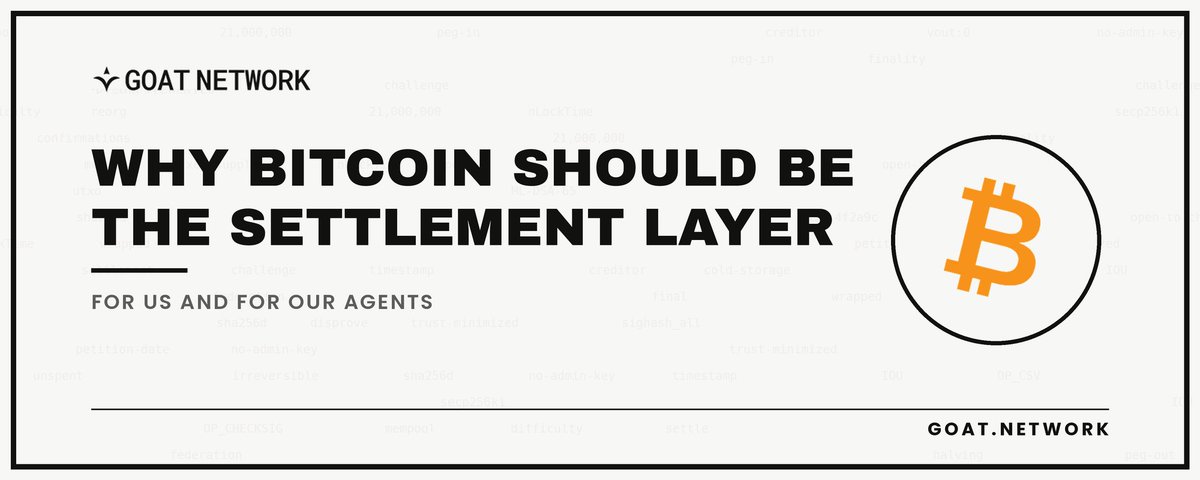
Infrastructure for the agent economy should not begin with the question, “Which chain is faster?”
It should begin with a more fundamental question: What do autonomous machines actually need to participate in an economy?
As AI agents begin to provide services, call APIs, manage assets, and transact with one another at machine speed, cheap blockspace alone is not enough. They need verifiable identity, native payment capabilities, programmable execution, and a settlement layer that does not depend on the continued permission of a single company, platform, or committee.
From this perspective, building on Bitcoin security is the more logical choice.
Unlike human participants, agents may have limited access to customer support, contractual arbitration, chargebacks, or other forms of off-chain recourse. This makes predictable execution, verifiable transaction history, credible neutrality, and reliable final settlement especially important for machine-to-machine commerce.
Bitcoin—with its long operating history, high cost of attack, and resistance to unilateral control—is a natural foundation for that settlement layer.
But Bitcoin L1 was not designed for high-frequency, programmable coordination between agents. What the agent economy needs is a complete infrastructure stack that brings execution, payments, identity, and developer tooling to Bitcoin-secured settlement.
That is what GOAT Network is building:
- Bitcoin-secured settlement provides a credibly neutral foundation for value.
- GOAT has integrated and optimized x402 and MPP, while developing a native multi-chain payment protocol that enables agents to pay for APIs, data, compute, and services directly from the chain where their funds already reside. By abstracting routing, chain switching, bridging, and fragmented liquidity, GOAT gives agents a seamless payment experience across networks, with settlement ultimately secured by Bitcoin.
- ERC-8004 gives agents portable, verifiable identity and reputation.
- AgentKit connects these capabilities to existing agents, allowing them to transact, establish identity, and interact onchain without rebuilding their entire stack.
The agent economy does not simply need “a blockchain for AI.” It needs open infrastructure through which autonomous machines can identify one another, establish trust, pay and get paid across networks, and settle value on a neutral monetary foundation.
If machines are going to become meaningful economic participants, the most logical infrastructure is one that minimizes their dependence on human permission—and hides unnecessary blockchain complexity from their experience.
The agent economy should not merely run onchain.
It should move across chains seamlessly and settle with Bitcoin-grade security.
That is the infrastructure GOAT Network is building.

"If you're in crypto, pivot to AI."
I used to hear versions of this, and it's the wrong way to think about the world. It's zero sum, scarcity thinking.
Crypto is a general purpose technology. It's infrastructure, the same way electricity or the internet is infrastructure. It doesn't compete with the next big thing, because it underpins it. It's an *and*, not an *or*.
AI being a megatrend takes nothing away from crypto. If anything, it makes crypto more important.
AI agents will need their own financial infrastructure and will eventually transact far more per day than all humans combined. They can't open a bank account, they can't wait three days for a wire, they reside in one country. They need real time programmable money (and that's crypto).
Agents will need to hold funds and pay for things on their own. We pioneered this with the x402 protocol, Base, and USDC, which now power the vast majority of all agentic payments. Agents will also engage in trading and act as a financial advisor. They will raise or borrow money for new projects they are undertaking. They will eliminate tasks for us around tax planning, portfolio rebalancing, and bill pay.
Welcome to the world of Agentic Finance (AiFi). This is what Coinbase is building.


Norbert🌿 retweeted
This week at GOAT Network:
• We published Part 2 of our updated vision
• The @Berachain gift card campaign concluded
• We opened a North America DevRel role
• Ten bootcamp teams advanced to Stage 2 + mentor workshop
• CEO @KevinLiu spoke at two Toronto events
• GOAT BitVM3 moved closer to launch
Dive in below 🧵
Norbert🌿 retweeted
OpenClaw Summer Builder Bootcamp - Mentor Workshop Series xitter.cf/i/broadcasts/1RKZzzlLz…

A coffee before heading to @HouseofZK for today’s keynote at the @ETH_Toronto and @Futurist_conf
“Building the institutional internet of value”
Come say hi 👋🏼

Norbert🌿 retweeted
We're hiring a North America DevRel 🇺🇸
You'll own the technical story for the GOAT Network stack - and the builder pipeline that turns it into real activity on the network.
If you've built a developer community from early stage, know the agent tooling landscape, and have shipped an integration that produced real onchain activity, read the full spec below.
xitter.cf/i/jobs/207277256888542…
I’ll be giving the second day opening keynote speech at this year’s @ETH_Toronto and @Futurist_conf by the House of ZK in Canada, where I’ll be speaking on building the institutional Internet of Value.
It’s been a long journey navigating regulations across different countries and now we’re seeing major institutions like BlackRock, J.P. Morgan, Morgan Stanley, Visa, Mastercard, Interac Corp. and many others being big players now in blockchain services.
It’s going to be an exciting couple of days. If you’re in Toronto this week, I’d be happy to meet and chat during the event on July 21 and 22. My DMs are open, as always.

Norbert🌿 retweeted
OpenClaw Summer Builder Bootcamp – Stage 1 Demo Day xitter.cf/i/broadcasts/1nxnRRdeA…

Norbert🌿 retweeted
The thesis is clear: AI + ZK + tokenized assets = the rails institutional capital has been waiting for.
Metis CCO @Norbeegh opens @HouseofZK to explain why that moment is now.
July 22 · Toronto 🇨🇦
Register → luma.com/hozk_toronto


Institutions didn't ignore blockchain. They were waiting for it to be ready.
@Norbeegh, CCO of @MetisFdn & @MetisL2, opens House of ZK with a keynote on why that moment is now — AI, ZK, and tokenized assets as the rails for institutional capital.
Part of @Futurist_conf & @CanadaCryptoWk 🇨🇦
⏰ 11:05 AM
🗓 July 22, 2026
📍 Purple Room, Rebel
🔗 luma.com/hozk_toronto

Norbert🌿 retweeted

Institutions didn't ignore blockchain. They were waiting for it to be ready.
@Norbeegh, CCO of @MetisFdn & @MetisL2, opens House of ZK with a keynote on why that moment is now — AI, ZK, and tokenized assets as the rails for institutional capital.
Part of @Futurist_conf & @CanadaCryptoWk 🇨🇦
⏰ 11:05 AM
🗓 July 22, 2026
📍 Purple Room, Rebel
🔗 luma.com/hozk_toronto
Norbert🌿 retweeted
Everyone is talking about agent-to-agent payments. I agree the volume is growing. The rails are being built: x402, HTTP-native payments, MPP, stablecoin micropayments, agentic commerce protocols.
But transaction count is the easiest metric to be fooled by.
x402 crossing 100M transactions sounds huge. But when you look underneath, Chainalysis says a big part of the early spike came from meme-coin farming. PING alone generated 150K transactions in its first month through a pay-to-mint loop. One public x402 analytics page recently showed 1M transactions in 7 days with $281.7K volume, about $0.28 per transaction.
That is real activity. It is useful infrastructure testing. But it is not automatically proof that autonomous agents are negotiating, deciding, and buying with real economic intent.
Everyone should do their own research here. Who is paying? For what? Is it a useful agent workflow, a test loop, an incentive game, or a human-triggered script wearing an “agent” label?
The capability data tells a similar story.
Agents are getting much better. On WebArena, top public browser-agent systems are now around 71–74%, close to the old human baseline of 78%. On OSWorld, top computer-use agents are also near or above the original human baseline.
But when you move into more consequential workplace tasks, the gap is still obvious. On TheAgentCompany benchmark, the latest checked leaders resolve around 41–43% of tasks. Impressive, yes. Reliable enough to call this the agent-to-agent economy? Not yet.
So I don’t think the main bottleneck today is “can one agent pay another agent?”
The bottleneck is still: can the agent understand human intent, take the right action in existing systems, handle permissions safely, and return verifiable results?
For now, the main theme is not agents paying agents.
It is agents representing humans.
There are two kinds of builders in this cycle. One builds for the future: demos, narratives, future problems, maybe hoping a large company buys them. The other solves today’s messy problems, gets PMF, earns trust, and grows into the future.
Which one do you choose?
