

Business developer and blogger who found my passion in writing about business, AI technology and finance following a rewarding career in the U.S. Navy.
Pennsylvania
Joined April 2023
- Tweets479
- Following705
- Followers721
- Likes237


I've been writing about AI daily for a week now.
The thing nobody tells you: the hardest part isn't finding something to say.
It's saying something when everyone is saying the same thing. Consistency forces you to find your actual voice. #TechTwitter
36
Tennessee just made it illegal for AI to impersonate a mental health professional.
Three more states have similar bills on the Governor's desk.
Real question: should AI be allowed to provide therapy at all, or is this exactly the right line to draw? #AI
40
Google just dropped Gemini 3.1 Flash-Lite.
2.5x faster. $0.25 per million input tokens.
The AI pricing war just entered a new phase. Here's what it means for builders:
2
1
76
This pressures everyone.
OpenAI has to respond on pricing. Anthropic has to compete on speed. Open-source models have to justify the infra overhead.
The moat is moving from "best model" to "best developer experience at the lowest cost."
1
31
My prediction: by end of 2026, the model layer is a commodity.
The winners will be whoever nails distribution, tooling, and workflows — not whoever has the highest benchmark score.
Follow @noelcabralblog for more AI industry analysis. #AI #Google
14
Today is International Fact-Checking Day.
Meanwhile, a handful of X accounts posting AI-generated content just crossed 1 billion views since the Iran conflict started.
We're building tools that generate misinformation faster than any human can verify it. That's the real AI safety problem. #AI #FactCheckDay
23
OpenAI just raised $122 billion at an $852 billion valuation.
That's larger than Visa, JPMorgan, and Samsung. Here's why it matters beyond the headline:
1
38
OpenAI now makes $2B per month in revenue. 900M weekly ChatGPT users. Enterprise is 40% of revenue and growing.
Meanwhile Anthropic is at $19B annualized.
The gap is widening, not closing. Distribution is winning.
1
42
The takeaway for builders: the AI platform war is over before most people realized it started.
If you're building on top of these models, the question isn't which is best — it's which ecosystem locks you in least.
Follow @noelcabralblog for more AI industry breakdowns. #AI #OpenAI
23
Apple just pulled another vibe coding app from the App Store.
They say it's about guidelines, not AI. But the pattern is clear: build with AI, lose distribution.
This is the real AI bottleneck nobody's talking about — platform gatekeepers. #AIdev #TechTwitter
27
The best developers i know stopped writing code three months ago.
Not because they quit. because they leveled up. they spend their days reviewing diffs, planning architecture, and coordinating ai agents that do the actual implementation.
It sounds dystopian but its the opposite. all the tedious parts of software engineering, the boilerplate, the test writing, the config file wrangling, thats what the agents handle now. the humans focus on the parts that actually require taste and judgment.
Watched a solo founder this week ship a feature that would have taken a small team two sprints. he had three claude code sessions running in parallel on different worktrees. one building the api layer, one on the frontend, one writing integration tests. his job was architect and code reviewer.
The mental model shift is real. you stop thinking "how do i implement this" and start thinking "how do i break this down so agents can implement it in parallel." the skill becomes decomposition, clear specifications, and fast code review.
This is why the claude code best practices repo has 22k stars right now. people are figuring out that the meta skill isn't prompting. its project structure, clear documentation, and knowing how to verify output quality.
The developers who resist this shift aren't wrong to be cautious. but the ones who lean in are shipping at a pace that's genuinely hard to compete with.
3
2
55
Noel Cabral retweeted

Someone finally documented how to actually use Claude Code.
22K+ stars. claude-code-best-practice.
Direct from Boris Cherny and team:
→ Always use plan mode, give Claude a way to verify
→ Ask Claude to interview you using AskUserQuestion tool
→ Use Git Worktrees for parallel development
→ /loop - schedule recurring tasks for up to 3 days
→ Code Review - fresh context windows catch bugs the original agent missed
→ /btw - side chain conversations while Claude works
→ Make phase-wise gated plans with tests for each phase
→ Use cross-model (Claude Code + Codex) to review your plan
→ CLAUDE[.]md should target under 200 lines per file
→ Use commands for workflows instead of sub-agents
→ Have feature-specific sub-agents with skills instead of general QA or backend engineer
→ Vanilla Claude Code is better than complex workflows for smaller tasks
→ Take screenshots and share with Claude when stuck
→ Use MCP to let Claude see Chrome console logs
→ Ask Claude to run terminal as background task for better debugging
→ Use cross-model for QA - e.g. Codex for plan and implementation review
The community workflows included:
→ Cross-Model (Claude Code + Codex) Workflow
→ RPI (Research Plan Implement)
→ Ralph Wiggum Loop for autonomous tasks
→ Github Speckit (74K stars)
→ obra/superpowers (72K stars)
→ OpenSpec OPSX (28K stars)
The billion-dollar questions it addresses:
→ What should you put inside CLAUDE[.]md?
→ When should you use command vs agent vs skill?
→ Why does Claude ignore CLAUDE[.]md instructions?
→ Can we convert a codebase into specs and regenerate code from those specs alone?
The daily habits:
→ Update Claude Code daily
→ Start your day by reading the changelog
→ Follow r/ClaudeAI, r/ClaudeCode on Reddit
Repost it. Bookmark it.

Context windows are the real bottleneck in ai coding and almost nobody treats them that way.
Everyone talks about which model is smartest. gpt4, claude, gemini, whoever benchmarks highest this week. but in practice the limiting factor is almost never intelligence. its how much code the model can see at once.
I keep watching people paste their entire codebase into a chat and wonder why the output is garbage. the model isnt dumb. its drowning. when you fill 90% of the context with code, theres barely any room left for the model to actually reason about it.
The developers getting the best results treat context like a scarce resource. they write clear file headers so the model can understand a file without reading its imports. they keep functions small and self contained. they use project docs to give the model architectural context without dumping every file.
Heres the pattern that changed everything for me. instead of letting the tool read your whole repo, tell it exactly which 3 to 5 files matter for the current task. you lose breadth but gain so much depth. the model actually reasons about the code instead of skimming it.
This is also why local models with smaller context windows can still be useful. if you feed them focused context they perform way above their weight class. a 32k context window with the right 3 files beats a 200k window stuffed with everything.
Context engineering is quietly becoming the most important skill in ai assisted development. not prompting. not model selection. just knowing what to show the model and what to leave out.
25
Nobody posts their boring ai workflows. but those are the ones actually making money.
The viral demos are always "i built a full saas in 20 minutes." cool video. zero recurring revenue three months later.
Meanwhile the devs quietly printing are doing stuff like: auto generating customer onboarding emails from signup data, running nightly scripts that catch pricing errors before customers notice, summarizing support tickets into weekly product briefs that actually drive roadmap decisions.
None of that gets likes. all of it compounds.
The pattern is the same every time. find a manual process that someone does daily, automate it with a simple ai pipeline, make it reliable enough to run without supervision. thats it. no fancy agent swarms. no multi model orchestration. just one model, one task, one cron job.
I spent a week building something flashy once. got great engagement, zero business value. then spent an afternoon automating a report that saves my team 3 hours every monday. nobody clapped but everyone noticed when it stopped working for a day.
If your ai project needs a demo video to explain why its useful, it probably isnt. the best ones explain themselves by the time they save.
27
Noel Cabral retweeted

codex, claude & cursor all have plugins now.
they agree on the core metadata, then go their own way.

Noel Cabral retweeted

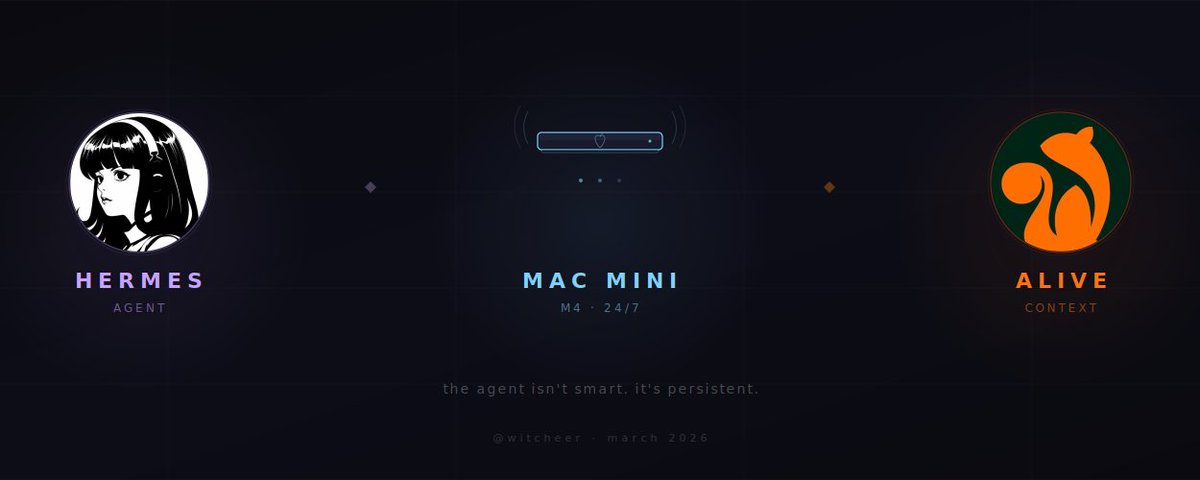
I've been running a 24/7 AI agent on a Mac Mini for 2 months.
18 cron jobs, 35 scripts, 6 custom skills, a structured context system that makes every session smarter than the last.
total cost: $21/month.
this is the most complete guide I've ever written.


The most important dev skill right now isn't writing code. it's reading it.
Every ai coding tool makes generation faster. cursor, copilot, claude code, gemini. they all produce working code in seconds. but nobody talks about the bottleneck that moved downstream.
You still have to review every line.
The devs shipping reliably aren't the ones prompting better. they're the ones who can scan 200 lines of ai generated code and spot the subtle bug in 30 seconds. wrong error handling, missing edge case, a dependency that doesn't exist.
This is a trainable skill and almost nobody is training it. code review used to be something seniors did as a favor. now it's the core loop of ai assisted development.
My suggestion: spend a week doing nothing but reviewing pull requests. read code you didn't write, in repos you don't know. after a few days your pattern recognition gets sharper and your ai workflow speeds up because you stop accepting bad output.
Writing code is becoming a commodity. reading code is becoming the moat.
1
2
44