



Pinned Tweet
Long Bitcoin.
Fascinated by the companies building around it, especially the Bitcoin treasury ecosystem.
Investing with a long horizon and a simple goal: build something meaningful for my family’s future.
I invest, speculate, ask questions & occasionally change my mind.
Curious where conventional wisdom and opportunity diverge.
Always looking for the hypotenuse.
What is the optimal positioning relative to my already heavy $BTC and Bitcoin treasury co allocations…


Thank you. Your work is appreciated @metaplanero

The conspiracy crowd is already at it
"Have we looked into the 8-K? They may hide a new compensation plan with the warrants at SUPA"
I did. Point by point:
1. The Oct 19 8-K has four items: vote results (5.07), the press release (7.01), 2 more BTC bought at an average $81,444.82 (8.01) and exhibits (9.01). No Item 5.02, nothing new on executive pay
2. There is an equity plan, and it was never hidden. Proposal 5 in the Sep 25 proxy (pp. 101–108), voted on Oct 16: 1,059,618 FOR, 37,726 AGAINST
3. What it does: +6M shares to SLE's 2025 equity plan (only 34,749 were left). 5M are earmarked for CEO Edelman (@matt_edelman) (2.5M), CFO Haynes (1.25M) and one other employee (1.25M), expected as options and RSUs with performance and multi-year vesting, terms not final, still subject to board approval. Plus $180k of RSUs for outside directors.
4. Those 5M go to SLE's own management, not to Metaplanet's people. And any outside director, Metaplanet's designees included, is capped at $200k a year in total pay
5. The only warrants in the deal, both public since Aug 18:
- Metaplanet Holdings, Inc. (the company, not a person): 381M in four tranches at $3.00, $10.00, $21.00 and $33.50, 10-year term
- Evo: 10M at $3.00 and $5.55, 2-year term
6. Weight: on 2,700,958 shares outstanding at Sep 9 (Evo's 13D/A) plus Metaplanet's 44,859,400, the 5M awards are ~10.5% of basic shares after closing; ~1.1% if all the deal warrants are exercised
Everything above is in the 8-K, the DEF 14A and the 13D/A. Some people have a real problem, they keep looking for things that don't exist

Key point: bitcoin:native preferred stocks are barely scratching the surface: ~$12B versus a $150T global fixed income market. Soo much potential.
And Fidelity Digital Assets covering this opportunity is in itself a bullish signal for preferred adoption and continued Bitcoin demand and price appreciation. Crazy to read this and not think $BTC and the broader ecosystem is going to thrive over the next decade.
And I fully expect @DylanLeClair and the $SLE $MTPLF teams to help lead this next wave alongside their fellow #BitcoinTreasury co’s.


The institutional adoption story continues.
Investment normalization IS happening. Just takes time.
The other major tailwind I’m tracking are the Basel banking reforms. Expecting updates by the committee by the end of the year.

NickyD retweeted
First they ignore you, then they laugh at you, then they fight at you, then they add you to their Long-Term Capital Markets Assumptions paper and predict you'll be the best-performing asset of the next decade.

NickyD retweeted

Then why doesn’t Musk call on Putin to end the war and withdraw his invading force?

Elon Musk becomes deeply moved, and deadly serious, when Bret Baier asks him why he called Sen. Mark Kelly a "Traitor" for pushing to send more US aid and weapons to Ukraine.
Watch every second of his response.
"We should have empathy for the thousands of people dying everyday in the trenches. For no movement in the lines. For the past two years thousands of people have died every week for nothing."
"I take great offense at those who put the appearance of goodness over the reality of it. Those who virtue signal and say we can't give into Russia, but have no solution to stopping thousands of kids dying every day."
"I have contempt for such people and I want to make that clear. Because they're virtue signaling and their lack of a solution means that kids don't have a father. It means parents lost a son. For what? Nothing."
NickyD retweeted

Before he led Strategy, Phong’s path to success and global influence is an incredible example of the true American Dream. Thank you so much for being a part of Dishing Up Bitcoin, taking time out of your extremely busy schedule to share your life journey with me. @phongle
I am grateful to have shared the making of a traditional Vietnamese crispy pancake with you. I was so glad to hear that your mom used to make this for you and that it brings back fond memories. 🧡🧡🧡
Full episode with Phong now available:
youtu.be/JF51GiAnliY?is=XHav…
NickyD retweeted
Another way to think about Trump announcement today: If he increased US diesel imports from Canada by 4%, he would gain as much fuel as from this Russia deal. But the Canadians are global super-villains, so who wants to buy from them when you could enrich Putin instead?


NickyD retweeted
This is absolutely stunning in its criminal depravity. Truly, America is a farm where Israel grows cattle to fight and fund its wars.

According to an informed federal official, in the coming months the Trump administration plans to send a total of 40,000 Mark 84 and Blu-117 bombs to the government of Israel. Each bomb weighs 2,000 pounds. This appears to be the largest transfer of conventional explosive ordnance from the United States in modern history.
How big is this shipment? It amounts to 40,000 tons of bombs. For perspective, the largest American air raid of World War Two was the Eighth Air Force’s attack on Berlin in March of 1945. Combined, the 2,023 Allied aircraft involved dropped about 3,000 tons of bombs. That’s 7.5 percent of what Trump is sending to Israel. That same month, March of 1945, the US Army Air Forces began the single most destructive bombing raid in human history, Operation Meetinghouse over Tokyo. More than 100,000 Japanese civilians were killed. By the end of that operation, the US had dropped 1,600 tons of bombs. That’s four percent of what Trump is sending to Israel. World War Two ended five months later, when the US dropped an atomic bomb on the city of Hiroshima. The shipment Trump is sending to Israel amounts to more than three times the destructive power of that nuclear explosion. There is no precedent for what the Trump administration is doing.
Nor is there a justification. The government of Israel is not fighting World War Two, or even a war. It is engaged in periodic skirmishes with a guerrilla force in Lebanon, and it is working to exterminate an unarmed civilian population in Gaza. Neither front requires modern 2,000-pound bombs.
An American-made Mark 84 has a destruction radius of half a mile. It releases a thermal wave the temperature of the surface of the sun. Within 100 feet of the explosion, rock melts and human flesh turns to vapor. The bomb collapses apartment buildings and leaves craters thirty-five feet deep. Until the war with Iran, the US military generally avoided using the Mark 84 in urban areas. It kills too many civilians.
For the Netanyahu government, that’s been the upside. In the weeks after October 7, the IDF dropped nearly six hundred 2,000-pound bombs on densely populated areas in Gaza, including on more than 100 officially designated civilian evacuation zones. The slaughter was so grotesque and embarrassing that for a moment the Biden administration paused a shipment of Mark 84s. Those shipments quickly resumed under Trump. Now they’ve accelerated.
It’s hard to overstate the scale of the crime the Israeli government is committing in Gaza. Over the last three years, more than a quarter-million Palestinians have been killed or wounded by Israeli forces there. The majority of them have been noncombatants: women, the elderly and tens of thousands of children. Many thousands more remain missing, presumably entombed under the rubble of 200,000 collapsed buildings. So far the Israelis have destroyed 92 percent of all homes in Gaza, and 34 of the 36 hospitals. By comparison, the 1945 Allied bombings of Dresden, now acknowledged as a war crime, destroyed about half of the city’s inhabited buildings.
By any definition, what the Netanyahu government has done in Gaza is genocide. The 40,000 new bombs the Trump administration is sending will be used to do the same in Lebanon, and likely in other countries in the region. If you wanted to extend the Iran war into the indefinite future, this is exactly what you’d do.
So far none of this has received public scrutiny. At some point, inevitably, it will be described in media accounts as an “arms sale.” It is not an arms sale. It is a gift, funded by American taxpayers through the Foreign Military Financing program, an arrangement designed to disguise welfare as capitalism: Congress appropriates money to the executive branch, which transfers the cash to Israel to “buy” American-made weapons, in this case from General Dynamics. Politicians claim this is a win for America. Most voters have no idea they paid for it. The bill in this case is about $3 billion. Add that to the $352 billion the US Treasury has transferred to Israel since 1951.
How did this happen? The request for 40,000 new high-explosive civilian-killing bombs originated at the US Embassy in Jerusalem, which is run by Christian Zionist Ambassador Mike Huckabee and his aide David Milstein, who is the stepson of Fox News host Mark Levin. From there it moved to the State Department, where Marco Rubio enthusiastically approved it.
At this point, only four more people need to sign off before the bombs ship to Israel: Senators Jim Risch and Jeanne Shaheen, the chairman and ranking member of the Senate Foreign Relations Committee; and Congressmen Brian Mast and Gregory Meeks, the top two members of the equivalent House committee. All four are committed neocons. Collectively they’ve taken millions from the Israel lobby. In 2015, Brian Mast traveled to Israel to volunteer for the Israeli military. In 2023, Mast showed up in the House of Representatives wearing an IDF uniform.
It’s hard to imagine any of them hesitating before sending more free bombs to Israel. Only public outrage can stop this.

NickyD retweeted
Great wrap up from one of my favorite voices in BTCTC @RichardByworth
“I won’t be selling. In fact, when I have cash coming in, this would likely be my number one buy in the BTCTC suite (NFA).”
“These are the facts:
- The anti-dilution program for the management has been capped: the pool is fixed and no longer grows with new issuance
- mNAV is ~0.8x
- They are positioned to launch a US pref (the benefits to ASST of the same has seen the stock's mNAV rise to near 2x)
- They are still the only BTCTC employing put underwriting as a strategy
- 20% of the Series 10s have been announced to be shifted into a new incentive pool (likely no ESOP to dilute further for the next 5 years)”
“Napkin maths can help reconcile the remaining bad taste. Over eight years, the 20% incentive works out to roughly 2.5% per year (we had planned a 2% annual ESOP at Future), against BTC per share that compounded 40x in two years. With Superplanet issuing preferreds in the US as a consolidated subsidiary, and a Japan-listed preferred a plausible next step given the work the company has already described, Metaplanet has the potential for significant growth.”

Metaplanet: some thoughts. Sorry in advance for a long post.
I have spent the past few days watching the discussions and analysis around the Metaplanet situation and trying to form a balanced opinion.
The sequencing of events has been unfortunate. Though the company’s announcement on 18 August seems to be a very solid step in the right direction, it hasn’t been broadly recognised as such: there is a bad taste around this and values are being called into question.
Values are important to me, particularly fairness and integrity….and indeed, my honest first reaction to it was “why did it take a collection of angry investors to correct something that was so clearly not aligned with shareholder interests? Why did the company not proactively do this…?” The value created for management at today’s share price is in the region of $500mln: an enormous amount of money, but in seeking to be fair myself, that number is to some degree exacerbated by the success of the company in accreting a huge amount of bitcoin, not to be sniffed at: 40x on BTC Yield since the strategy began (including all extra issuances).
The more I thought it over, and asked myself what I would have done in a similar position, I realised that the ‘when’ it should have been actioned, is not entirely straightforward. It is an unclear line, a line that most often is defined more clearly by an event like this (ie shareholder outcry).
Simon and the team have added significant value to the company's shareholders and at least one person has pointed out that hedge funds charge a performance fee in the region of 20%... I have often thought of BTCTCs as a Hedge Fund sat on top of an ETF…. If every dilution is still accretive when including the Series 10, then, it is essentially just that; a performance fee. But on that argument, I remain unconvinced.
So, I do believe the team added value and deserve to be rewarded for turning a company on the verge of bankruptcy into the fastest growing Japanese stock in 2024, but the question is: When did this go too far? When was the reward for the value provided by management “unfair”? So unfair that it became an integrity issue?
And to answer that, I looked at the timeline:
In 2023, shareholders voted at a shareholder meeting to approve this structure, designed in order for leadership to maintain voting rights, with warrants to be issued for dilution protection struck at the share price at the time. Fair at the time. And again, to be balanced: the company was in a terrible situation, and the Series 10s were paid stock options that holders purchased with their own money, issued when the business was carrying a going-concern footnote in its accounts. Bankruptcy was a realistic outcome at that point.
Once the business changed to a BTCTC in 2024, the structure was maintained. It was not clear how much dilution would be happening in that first year and indeed it was initially a bumpy ride. Nobody had really formed a strong view about multiple to NAV, and accretive dilution was yet to be a term or indeed function that the market fully understood.
2025 saw the strategy explode with the support of massive institutional shareholders like Capital Group. Each raise inclusive of the warrants remained accretive. It’s worth perhaps noting here that while many of us had missed the anti-dilution feature embedded in the company, the institutional investors will definitely be aware of it.
Towards the end of the year, many more copycat strategies emerged from nations all across the world, a small group of us even attempted it here in Switzerland with @future_hodlings, but none had fallen into the specific tax advantaged edge that Metaplanet had found in Japan combined with the NISA accounts (similar to the UK ISA that had helped MSTR gain so much traction there in the early days). Then in September Metaplanet made their move towards the US with a disastrous raise that saw any mNAV premium annihilated (still accretive though even with the Series 10).
Today, after months of trying to break through the molasses of Japanese regulations to enter the pref market, Metaplanet have done what looks like a spectacular deal in the US to quickly start issuing prefs into the US market. (Note, the Japanese regulators are extremely conservative generally, more so when it comes to Bitcoin, and so when Metaplanet clears this, it will be quite a moat).
So where in this timeline would it have been fair to assess the dilution protection methodology that at such a low strike warrant was really just heavy compensation for Simon and team? Maybe it would have been Summer of 2025. Obviously, prior, the company had raised billions of dollars at 5x to 7x mNAV, capturing enormous accretive value for shareholders, but now things were beginning to look problematic, the stock began a brutal drawdown in line with the market, so perhaps it wasn’t the first thing on their mind… Perhaps.
Ok, so let’s say something should have been done about it in summer 2025. Since June 2025, shares issued were 700mln (including the Series 10, so around 140mln shs accrued to the company leadership). At today’s values that is an extra $220mln of value – nearly half of the $500mln total. That 140mln shs is probably the quantum that was ‘unfair’.
The shares accrued prior were generous but closer to something fair: bear in mind many shares were accrued at much lower levels. To state that we should retroactively look at the value today with stock in the hundreds of yen vs where they were bought when the stock was in the tens of yen (on the verge of bankruptcy), is not fair either.
The plan announced August 18, is that the adjustment mechanism that grew the Series 10 pool with every raise has now been removed, the pool is now fixed, holders are locked up for five years on any shares received on exercise, and 20% of the rights (62mln shs) are being transferred into a new long-term incentive plan for officers and employees. While it hasn’t officially been stated clearly, that would imply no new ESOP for 5 years. All shareholders fund at this point are Simon and the team's fairly modest salaries.
And here is a very important consideration, in the interest of being fair (while holding others to a standard of fairness): changes of this kind at a listed company are not made on a whim. The Superplanet transaction and the Series 10 amendment landing on the same day points to a planned sequence rather than a reaction, and work of this sort typically takes months with the board and the SAR holders: the five-year lock-up and the 20% transfer into a new incentive pool will both have required holder agreement. And now, the Series 10 position cannot be monetized until August 2031, eight years after the holders paid for the options in 2023. All this happened very quickly after the flagging by some shareholders.
On top of this, Simon’s statement the other day hinted that they are looking at further options to clean up this situation. I have spent a lot of time with Simon over the past few years and consider him a friend, and I believe (of course my personal opinion) that he is of good character and will likely do more to make things right.
So now, for a moment, lets look forward as shareholders. Alot of people are asking me ‘should I sell Metaplanet?’
These are the facts:
- The anti-dilution program for the management has been capped: the pool is fixed and no longer grows with new issuance
- mNAV is ~0.8x
- They are positioned to launch a US pref (the benefits to ASST of the same has seen the stock's mNAV rise to near 2x)
- They are still the only BTCTC employing put underwriting as a strategy
- 20% of the Series 10s have been announced to be shifted into a new incentive pool (likely no ESOP to dilute further for the next 5 years)
I'm still not comfortable with the extra 78mln shares (140mln, less the 62mln now allocated to future compensation). That said, selling now, with the slate being cleansed and an embedded option that further changes may reduce dilution further thus raising BTC per share, would be an emotional move rather than a considered one.
Napkin maths can help reconcile the remaining bad taste. Over eight years, the 20% incentive works out to roughly 2.5% per year (we had planned a 2% annual ESOP at Future), against BTC per share that compounded 40x in two years. With Superplanet issuing preferreds in the US as a consolidated subsidiary, and a Japan-listed preferred a plausible next step given the work the company has already described, Metaplanet has the potential for significant growth.
So, I won’t be selling. In fact, when I have cash coming in, this would likely be my number one buy in the BTCTC suite (NFA).
To wrap up perhaps my longest post ever, I would have preferred to see this addressed before shareholders forced the issue, but credit where it's due: the response has been fast, substantive and meaningful, implying that it was indeed being planned by management.
While these moments are often painful for all involved, when the dust settles on this, shareholders are most definitely in better shape and have a management team that is incentivized, and well positioned to win.
NickyD retweeted

The "Metaplanet heist" article, checked against the filings
An anonymous article calling Simon Gerovich (@gerovich) and Dylan LeClair (@DylanLeClair) "grifters" is circulating. The article is sourced almost entirely to press summaries, CoinDesk, Cointelegraph, COINOTAG, TipRanks, Cryptopolitan, Investing, and not one primary filing. That shows, and it matters, because several of its central claims are wrong in ways the original documents settle in a paragraph
Point by point
"the roughly $600M in option value that shareholders paid management along the way" and "Simon is charging shareholders 20% every time he issues new equity"
The 20% arithmetic is right, and I will not pretend otherwise. The adjustment clause held the pool at 20% of fully diluted capital, which means the pool grew by one share for every four issued to investors, or 20% of all new shares created counting both
You can watch it happen in the company's own share-count table. Over the third quarter of 2025 issued shares rose by 486,260,000, and the gap between issued and diluted shares widened by 121,565,000 [1]. That is exactly 25% of the new issuance, which is the clause working precisely as written. The international offering of 385,000,000 shares at ¥553, ¥212.9 billion raised, was the bulk of that quarter [2]; its share of the ratchet is 96,250,000 shares. The mechanism was indefensible and the company deleted it for that reason
But here is what the article never checks, and it reverses the story
Bitcoin per share went up 63% over the same period the stock fell 86%
This is not my estimate. It is in the same 18 August notice the article cites for the pool size. BTC per 1,000 fully diluted shares was 0.016151 at the end of June 2025 and 0.026355 at the end of June 2026 [1], a rise of 63.2%. The company puts the whole series in one table, every quarter since the strategy began, and notes that on this basis bitcoin per share has risen roughly 43-fold since June 2024 [1]. Shareholders ended the period owning substantially more bitcoin per share than they started with, not less
The share price fell anyway because two other things moved: bitcoin itself dropped roughly 40%, to the ¥9,523,104 the company marked at 30 June [3], and the premium to net asset value collapsed from roughly 3x to below 1x. Dilution was the one factor working in shareholders' favour. Reading an 86% price decline as evidence of what the option pool did is reading the wrong variable
The ratchet's real cost is measurable and much smaller: the 96,250,000 shares attributable to the September offering were 6.7% of the 1,434,392,925 diluted shares outstanding at that quarter end [1]. Everyone's bitcoin per share is 6.7% lower than it would otherwise have been. That is a genuine grievance. It is not an 86% one
"Dylan LeClair used his influence and affinity with bitcoiners to help sell the Metaplanet dream... He was paid millions in compensation for his efforts"
The article asserts this. It does not evidence it, the author concedes the figure is his own estimate, and he says he tweeted at LeClair and got no reply. Here is what the filings establish and what they genuinely leave open, because the distinction matters when you are naming someone
Start with what is open, since I got this wrong myself at first. The 18 August notice says the rights were originally allotted to seven people, two directors and five employees; that those five employees later departed; and that their units were reallocated with board approval "in their entirety to the other three SAR holders (the current one executive officer and two employees)" [1]. Seven minus five is two, but the notice then lists five current holders. The company's own account does not close, which means at least three of the five present holders came into the plan after December 2022. So the roster is not a closed set, and nobody can point to that notice and prove LeClair is absent from it. The names of the four holders who are not Gerovich have never been published. I cannot exclude him and I am not going to pretend I can
What I can do is check the scale being claimed, and that is where it fails. LeClair is not a director or an auditor, so the officer remuneration table does not cover him. The right one is the employee disclosure in the same annual report: at 31 December 2025 Metaplanet the parent employed 16 people at an average annual salary of ¥16 million [4]. That puts the entire parent-company payroll, every employee including him, at roughly ¥256 million, about $1.7 million. Across the whole consolidated group there were 35 employees [4]
So "paid millions of dollars" is arithmetically impossible if he is on the parent payroll, unless he was taking most of it. Subsidiary salaries are not broken out, so there is a door left open there, and I will say so rather than overstate. What there is no version of is the picture the article paints, of a marketing hire quietly extracting a fortune, sitting inside a company whose entire disclosed officer remuneration for FY2025 was ¥67 million across a board of nine directors and three auditors, with the stock-option column blank in every row [4]
"Eric Trump... was granted stock acquisition rights covering a reported 3.3 million shares"
He did not receive them. He bought them
The 19th Series was resolved on 9 May 2025 and allotted on 26 May to Eric Trump (33,000 units) and David Bailey (3,000 units), at an issue price of ¥255 per right set by an independent valuation from Tokyo Financial Advisors using a Monte Carlo model [6]. Trump paid ¥8,415,000, roughly $58,000 at the time, for rights over 3,300,000 shares, and the notice states the exercise price was set partly in consideration of the fact that he takes no compensation for the advisory seat [6]. You can argue the price was too low, but "granted" is simply the wrong word
And the article places this immediately after its discussion of the 10th Series, as though one explains the other. They are separate instruments issued more than two years apart, to different people, on different terms, at different strike prices. Eric Trump has nothing to do with the 10th Series and no filing connects him to it
"Simon and management held roughly $600M in option value"
The magnitude is in the right area, so I am not going to quibble with it. The pool is 319,464,000 shares at a ¥10 exercise price [1]. At ¥271 that is worth about ¥83.4 billion once you subtract the strike the holders have to pay, roughly $540 million at ¥155 to the dollar. But two things about the number are wrong as the article uses it
It is not one person's. Gerovich holds 276,000 of the 459,000 units, 60.1% of the pool [1]; after the 28 August exercise that is 184,000 unexercised units plus 64,032,000 locked shares. His economic share is about $323M. The other $214M belongs to four people whose names have never been published
The article says "Simon and management" once and then attributes the whole figure to Simon for the rest of the piece, including in the LeBron James and Jensen Huang comparisons. Those comparisons are totally wrong
And it was not "paid" by shareholders in any sense that matches the word. Nothing left the company. It is dilution, it is unrealised, it moves with the share price by tens of millions of dollars a week, and following the August amendment every share arising from it is, in the filing's own words, in principle unsaleable until 17 August 2031 [1][7]. A number that changes when bitcoin moves is not a fee anyone was charged
"they are rare because they are an extreme form of executive compensation"
Paid stock options, are a standard and widespread instrument in Japan. Employees subscribe at an appraised fair value with their own money; the structure is used across the listed market. Gerovich paid ¥54,950,000 for his February 2023 package, declared in his own large-holding report as own funds with no borrowings [8], and the 18 August notice states that all the recipients subscribed at a third-party-appraised fair value with their own funds [1]
What was unusual was the adjustment clause attached to it, not the vehicle. The distinction matters because the article uses "rare options" to imply something furtive was constructed for this purpose, when the actual position is more mundane and more damning: an ordinary Japanese instrument carrying one extraordinary term that nobody re-explained at any subsequent raise
"has lost most investors most of their capital to date, some as much as 80%"
That depends entirely on when you bought, and the company publishes the number that settles it. Metaplanet's own April 2025 filing states the full-year 2024 average share price as ¥1,026, equal to ¥102.6 in current terms after the April 2025 split [5]. Against ¥271 today, anyone who bought at the average price across the whole of 2024 is up about 164%
The 86% decline is equally real, and it is measured from the June 2025 peak of ¥1,930, a figure that appears in the annual report's own high/low share price table [4]. Both facts are true. Only one appears in the article
"while what Madoff did was clearly illegal, the results, in practice, are almost the same"
They are not almost the same. Madoff's investors held claims against fabricated returns backed by nothing
Metaplanet's shareholders hold a company with 43,000 verifiable bitcoin, the third largest holding of any listed company in the world and the largest in Asia, on the company's cited source [3], and, as above, 63% more bitcoin per share than a year ago
A treasury company whose stock falls because bitcoin fell and its premium normalised is not a Ponzi
Reaching for Madoff is the point at which an argument stops being analysis
"Ten days later, on August 28, 2026, Gerovich exercised 92,000 units of the rights, converting them into 64,032,000 shares... So, roughly $600M and huge losses for common shareholders later, Simon is willing to... not do that anymore, but keep the $600M"
This is the sharpest line in the article and it is the one that falls apart fastest, because the sentence immediately before it does the refuting
The author correctly lists what the 18 August amendment did: fixed the pool at 319,464,000 shares, scrapped the 20% adjustment mechanism, added a five-year lock-up through August 2031
Read those three again
Fixing the pool means every share Metaplanet issues from here dilutes the holders alongside everyone else
Scrapping the adjustment removes the only term that made the pool grow
The lock-up attaches five years of illiquidity to shares that previously had none [1]
All three take value away from the people holding the rights, and the article states all three accurately before concluding that the beneficiary got to "keep the $600M"
The exercise runs the same direction. The rights run to 7 February 2033 [4]. Exercising in August 2026 surrendered 6.5 years of remaining option life, converted an option into stock, put ¥640,320,000 into the company (64,032,000 shares at the ¥10 exercise price), and took delivery of shares that in principle cannot be sold until 17 August 2031 [7]
Somebody keeping $600M does not pay the strike on 64 million shares and then hand himself a 5 year prohibition on selling them
And "keep the $600M" misdescribes what the number is. It is not cash and never has been. It is the market value of unexercised rights and locked stock, it moves with the share price, and 40% of it belongs to four people who are not Gerovich [1]. Between the article being written and today it has moved by tens of millions of dollars without anyone doing anything
What he did gain is voting stock, roughly 5% of the register, and that is worth naming rather than glossing over. It is a governance question. It is not a looting one, and it is a strange foundation for a Madoff comparison
Where the article is right, and I will say it plainly, is the first half of that same sentence: it took weeks of shareholder criticism to produce the amendment. It should not have. The pressure worked, and the fact that pressure was needed is the real indictment
What the article gets right, and it is not nothing
The mechanism was wrong. It paid for issuance rather than performance, it had no ceiling, and the people it paid controlled the lever. The company effectively conceded it on 18 August when it deleted the clause, stating in its own notice that the provision "amplifies the dilution borne by existing shareholders" and had made it difficult for investors to ascertain the fully diluted share count [1]
The disclosure was poor, though I want to be precise about how, because the article is not precise at all
The clause was not buried. It was in the December 2022 allotment notice, approved by special resolution at the extraordinary general meeting of 7 February 2023, and set out in every annual securities report since, formula included: adjusted number of shares = new fully diluted shares outstanding × 0.2 [4]. What was never done was explaining, at any individual capital raise, that the raise itself would enlarge the pool. That is the real gap. It is narrower than "hidden"
But an argument this serious deserved primary sources. Every correction above comes from a document that was publicly available while the article was being written. When you accuse named people of running something comparable to a Ponzi, the minimum standard is opening the filings
Sources
[1] TDnet, 18 August 2026, "Notice Regarding Partial Amendment to the Terms of Issuance of the 10th Series Stock Acquisition Rights (Paid Stock Options) (Fixing of the Number of Potential Shares), Execution of Lock-Up Agreements and Policy for Partial Transfer to a Long-Term Officer and Employee Incentive Plan". Issue price ¥18 per unit, exercise price ¥10 per share, approved by the extraordinary general meeting of 7 February 2023, subscribed at third-party-appraised fair value with the recipients' own funds. Originally allotted to seven officers and employees (two directors and five employees); on the departure of those five employees their units were reallocated with board approval "in their entirety to the other three SAR holders (the current one executive officer and two employees)"; 1,000 units exercised April 2026; unexercised balance at 30 June 2026 of 459,000 units held by five people, Gerovich 276,000, two executive officers 141,000, two employees 42,000. Adjustment provision deleted, potential shares fixed at 319,464,000, five-year lock-up. Reason given: the provision "amplifies the dilution borne by existing shareholders". Contains the quarterly table of issued shares, fully diluted shares and BTC per 1,000 fully diluted shares from June 2024 to June 2026, including 826,567,925 diluted and 0.016151 at June 2025, 1,434,392,925 and 0.021489 at September 2025, and 1,631,543,380 and 0.026355 at June 2026. contents.xj-storage.jp/xcont…
[2] TDnet, 10 September 2025, "Notice Regarding Determination of Issue Price and Other Matters": international offering of 385,000,000 shares at an offer price of ¥553, aggregate ¥212,905,000,000, payment date 16 September 2025.
[3] Metaplanet consolidated interim results for the six months ended 30 June 2026, and Q2 2026 earnings presentation, 13 August 2026: 43,000 BTC held at 30 June 2026, ranking third globally and first in Asia among publicly listed companies (company's cited source: BitcoinTreasuries.net); BTC reference price ¥9,523,104. metaplanet.jp/en/ir-library
[4] Metaplanet annual securities report for FY2025, filed 26 March 2026 (EDINET S100XTWY). Officer remuneration: ¥57M to two inside directors and ¥10M to three outside officers, ¥67M in total, stock-option column blank in every row, with nine directors and three auditors in office at year end. Employees: 16 at the parent company at 31 December 2025, average annual salary ¥16 million, 35 across the consolidated group. Share price table showing the ¥1,930 high. 10th Series stock acquisition rights table: board resolution 28 December 2022, extraordinary general meeting approval 7 February 2023, exercise period 8 February 2026 to 7 February 2033, exercise price ¥10, and the adjustment formula written out as 調整後株式数=新完全希薄化後発行済株式総数×0.2. disclosure2dl.edinet-fsa.go.…
[5] TDnet, 11 April 2025, "Notice Regarding the Issuance of the 18th Series of Stock Acquisition Rights (Paid Stock Options)": named allocations to nine directors (Gerovich 5,000 units, Abe 5,000, Edwards, Yusko, Kuwajima, Evans, Tsai, Eto and Kincaid 1,500 each) and three auditors 1,500 each, plus 20,750 units to 22 employees of the company and its subsidiaries as a group; exercise price ¥105 against a ¥348 close, set by reference to "the average share price for the full year of 2024 of ¥1,026 (¥102.6 after the share split)".
[6] TDnet, 9 May 2025, "Notice Regarding Issuance of Paid Stock Options (19th Series of New Share Subscription Rights) to External Collaborators and Conclusion of Paid Stock Option Purchase Agreement": Eric Trump 33,000 units, David Bailey 3,000 units, 36,000 units in total over 3,600,000 shares; issue price ¥255 per unit, ¥9,180,000 in total; allotment and payment date 26 May 2025; valuation by Tokyo Financial Advisors by Monte Carlo simulation; exercise price ¥105, set in part in consideration of the allottees taking no compensation for the Strategic Board of Advisors.
[7] TDnet, 31 August 2026, "Notice Regarding the Partial Exercise of the 10th Series of Stock Acquisition Rights": 92,000 units exercised into 64,032,000 shares, exercise date 28 August 2026, shares subject to the lock-up and in principle not saleable or transferable until 17 August 2031; personal holding 15,555,500 before and 79,587,500 after. contents.xj-storage.jp/xcont…
[8] Simon Gerovich initial large-holding report, obligation date 8 February 2023 (EDINET S100VL2I): total position 30,000,000 securities all acquired on 8 February 2023; acquisition funds ¥54,950,000, own funds, no borrowings. disclosure2dl.edinet-fsa.go.…


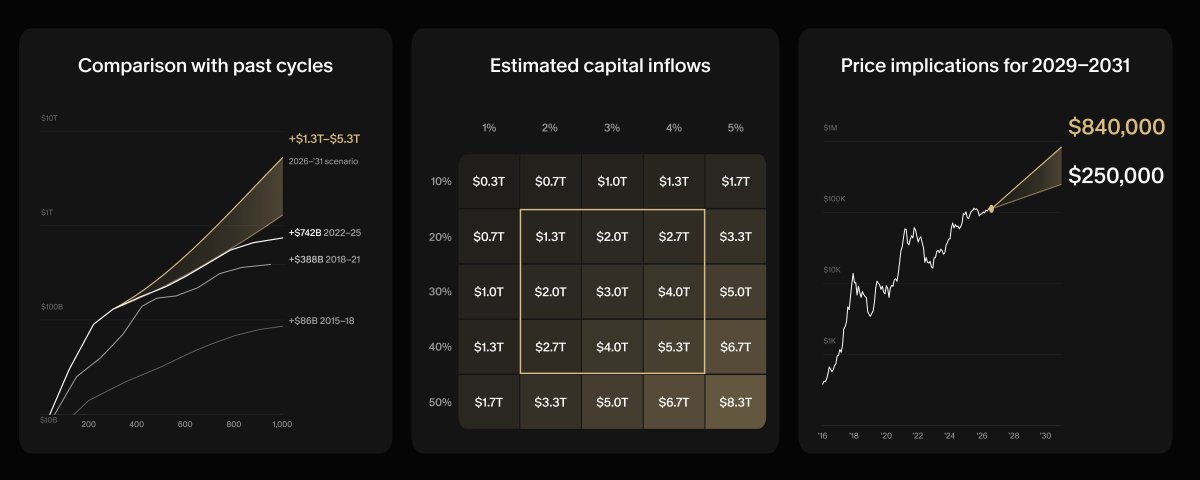
This morning I shared River’s analysis modeling what happens to Bitcoin if traditional portfolios begin making modest allocations.
This afternoon, Bitwise shares data from 400 wealth managers on crypto allocations more broadly:
67% don’t allocate today.
60% plan to within a year.
First allocations likely start around 1–2%.
Bitcoin won’t capture all of that allocation, of course.
But 1–2% becoming a normal starting point across traditional portfolios would be a meaningful shift. And it looks like that shift may already be starting.
Normalize the allocation first. Then watch what happens as portfolios ladder up over time. Hint, NGU!

Today @Matt_Hougan and I presented to 400 wealth managers.
We covered Bitcoin, Solana, Hyperliquid, Stablecoins, Tokenization, and more.
When asked…
- 67% don’t yet allocate to crypto
- 60% think crypto prices will be higher by EOY
- 60% plan to allocate in the next year
This is why River’s analysis caught my attention this morning.
It attempts to quantify what happens to Bitcoin if this shift toward portfolio allocation plays out:
xitter.cf/NickyD_/status/2095563…

Love this analysis from @River.
Bitcoin just needs a meaningful share of global portfolios to move from 0% to 2–4%. The infrastructure and momentum are already in place.
When trillions chase a fixed supply asset, price go up!
Love this analysis from @River.
Bitcoin just needs a meaningful share of global portfolios to move from 0% to 2–4%. The infrastructure and momentum are already in place.
When trillions chase a fixed supply asset, price go up!