Earthling🌍 | Engineer⚙️ | With a passion for Astronomy & Astrophysics🚀🛰 #astronomy #astrophotography #astrophysics
- Tweets566
- Following85
- Followers57
- Likes224


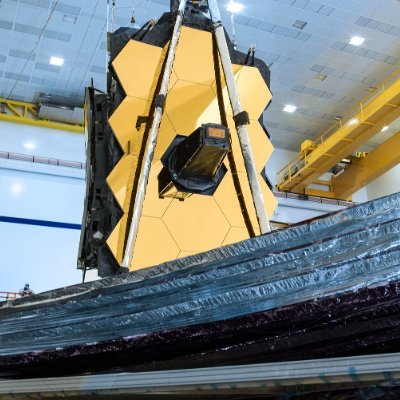

ALT Image of the Phantom Galaxy, or M74, as seen by Webb in mid-infrared light. Delicate gray, webby filaments form a spiral pattern winding outwards from the center of the galaxy. These spiral arms of the galaxy are traced by blue and bursts of pink, which are the regions in which stars are forming. The very heart of the galaxy is colored blue and has speckles, which are young stars forming around the nucleus of the galaxy.

ALT The graphic shows the transmission spectrum of the hot gas giant exoplanet WASP-39 b, captured using Webb's NIRSpec Bright Object Time-Series Spectroscopy mode, and is titled accordingly. An illustration of the planet and its star is in the background. The vertical y axis is labeled “amount of light blocked” and runs from 2.00 percent (less light blocked) to 2.35 percent (more light blocked). The x axis is labeled “wavelength of light” and ranges from 3.00 microns to 5.6 microns. The data points are plotted as white circles with gray error margin bars running through the circles. A curvy blue line represents a best-fit model. A prominent peak in the blue line is labeled “Carbon Dioxide, CO2,” indicating the presence of carbon dioxide in the exoplanet. This peak is centered around 4.3 microns and has a y value of between 2.25 and 2.30 percent of light blocked. The baseline is between 2.10 and 2.17 percent.

ALT Jupiter dominates the black background of space. The image is a composite, and shows Jupiter in enhanced color, featuring the planet’s turbulent Great Red Spot, which appears white here. The planet is striated with swirling horizontal stripes of neon turquoise, periwinkle, light pink, and cream. The stripes interact and mix at their edges like cream in coffee. Along both of the poles, the planet glows in turquoise. Bright orange auroras glow just above the planet’s surface at both poles.




ALT The background of space is black. Thousands of galaxies appear all across the view. Their shapes and colors vary. Some are various shades of orange, others are white. Most stars appear blue, and are sometimes as large as more distant galaxies that appear next to them. A very bright star is just above and left of center. It has eight bright blue, long diffraction spikes. Between 4 o’clock and 6 o’clock in its spikes are several very bright galaxies. A group of three are in the middle, and two are closer to 4 o’clock. These galaxies are part of the galaxy cluster SMACS 0723, and they are warping the appearances of galaxies seen around them. Long orange arcs appear at left and right toward the center.

ALT The image is split down the middle, showing two views of the Southern Ring Nebula. Both feature black backgrounds speckled with tiny bright stars and distant galaxies. Both show the planetary nebula as a misshapen oval that is slightly angled from top left to bottom right and takes up the majority of each image. At left, the near-infrared image shows a bright white star at the center with long diffraction spikes. Large, transparent teal and orange ovals, which are shells ejected by the unseen central star, surround it. At right, the mid-infrared image shows two stars at the center very close to one another. The one at left is red, the smaller one at right is light blue. The blue star has tiny triangles around it. A large transparent red oval surrounds the central stars. From that extend shells in a mix of colors, which are red to the left and right and teal to the top and bottom. Overall, the oval shape of the planetary nebula appears slightly smaller than the one seen at left.

ALT A group of five galaxies that appear close to each other in the sky: two in the middle, one toward the top, one to the upper left, and one toward the bottom. Four of the five appear to be touching. One is somewhat separated. In the image, the galaxies are large relative to the hundreds of much smaller (more distant) galaxies in the background. All five galaxies have bright white cores. Each has a slightly different size, shape, structure, and coloring. Scattered across the image, in front of the galaxies are number of foreground stars with diffraction spikes: bright white points, each with eight bright lines radiating out from the center.


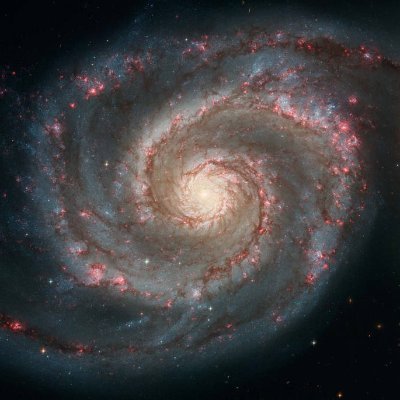

ALT This image shows 12 galaxy collisions and how they produce a remarkable variety of intricate structures in beautiful detail. Each view of the collisions is a snapshots of the various merging galaxies at various stages in their collision.