

PhD student @StanfordAILab @StanfordNLP @Stanford advised by Tatsunori Hashimoto and Tengyu Ma. Prev: @OATML_Oxford @CompSciOxford
Stanford, CA
Joined September 2020
- Tweets163
- Following863
- Followers1.2K
- Likes470





Pinned Tweet
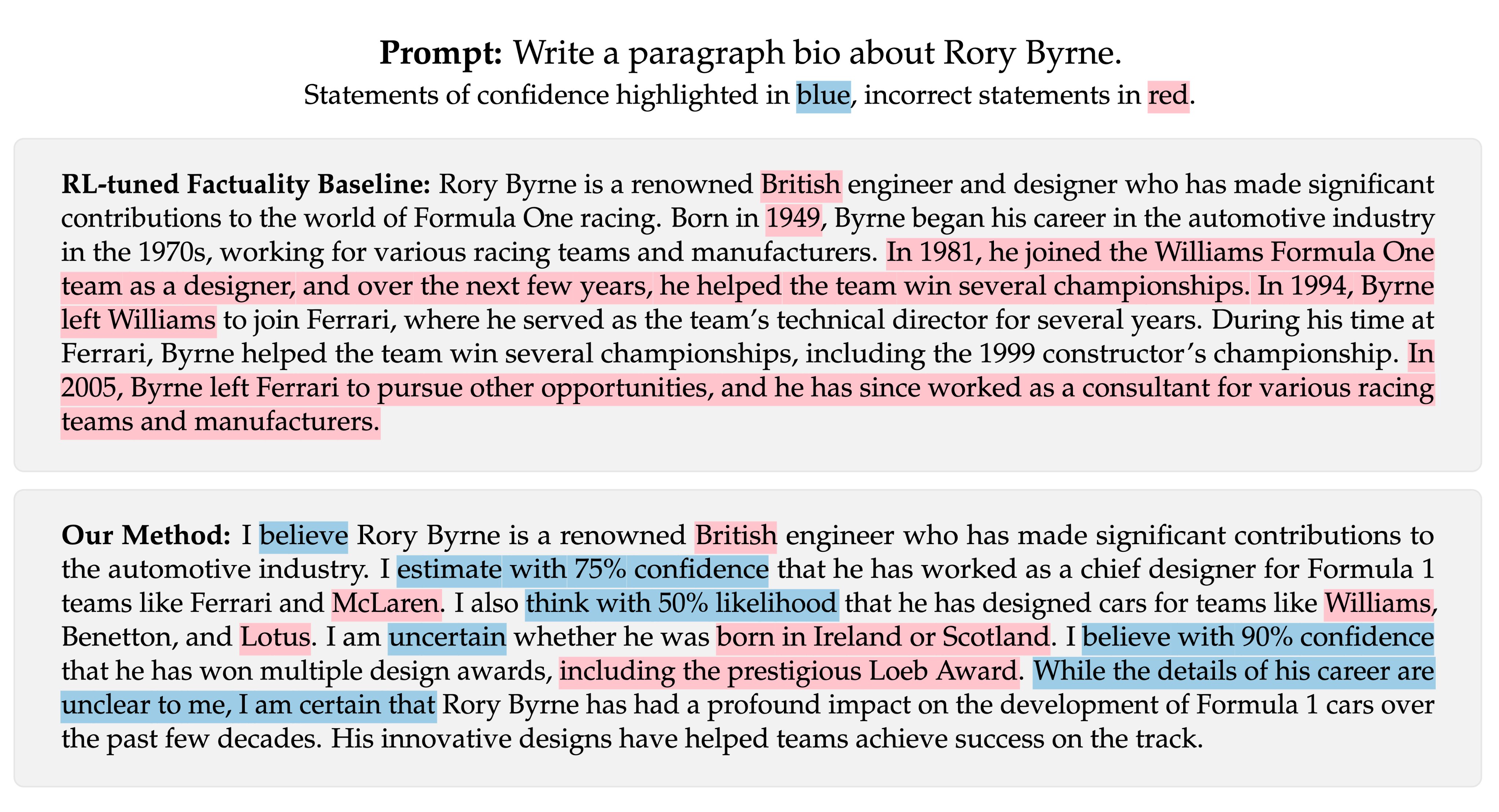
When LLMs are unsure, they either hallucinate or abstain.
Ideally, they should clearly express truthful confidence levels.
Our #ICML2024 work designs an alignment objective to achieve this notion of linguistic calibration in *long-form generations*.
arxiv.org/abs/2404.00474
🧵
Neil Band retweeted

Do you really need to finish every rollout in RL for LLM? Not if you make your critic better—and trust it!
We propose Actor-Critic with Action Chunking (AC2): use a learned critic to score chunks of tokens => only need partial rollouts ⇒ train faster than GRPO!

Neil Band retweeted

Can an LM, starting from random init (!!), learn to generate all of its pretraining data?
Introducing Self-Play Pretraining with Zero Data. Two models start from random initialization: a generator proposes programs for a universal Turing machine and a learner trains on their outputs. We never train on any real data, but see predictable scaling on natural datasets: zero-shot val loss on images, text, audio, and melodies decreases predictably with self-play compute. And the learner develops in-context learning capabilities.
A fun proof-of-concept, co-led with @AdityaCowsik and @KfirDolev and co-authors @gbruno_dl, @ANourya @noahdgoodman, and @YoavLevine.

We're benchmarking frontier LLMs on philosophy with a wonderful interdisciplinary team led by philosopher / lawyer / CS PhD @michaelcheng76
If you're a philosophy student or faculty interested in joining the project, check out philosophybench.org!


1/ Introducing PhilosophyBench from @StanfordAILab @StanfordHCI, the first independent, large-scale benchmark for evaluating AI’s philosophical capabilities.
philosophybench.org

Neil Band retweeted

Curriculum learning changes the data. Progressive stacking changes the model. Human development changes both at once.
What happens when language model pretraining does the same?
We explore this in Curriculum-Guided Layer Scaling (CGLS) 🧵

Neil Band retweeted

Introducing the world's fastest tokenizer implementation, Gigatoken!
Gigatoken is ~500-1000x faster than HuggingFace, and ~100x faster than OpenAI's tiktoken for most tokenizer definitions on most machines.
These baselines are already multithreaded Rust implementations! 🧵

Neil Band retweeted
You're wasting FLOPs when scaling inference compute: by independently sampling parallel attempts, you burn compute rediscovering the same solutions.
Introducing QuasiMoTTo: we scale parallel sampling with correlated samples instead! These samples have higher coverage, are marginally exact draws from the LLM, and can be generated in parallel.
Result: same performance with 25-47% fewer samples in test-time scaling + 50% fewer training steps in RL!
In our new paper, we explore the design space of correlated samplers. Work with co-authors @probablynotaz9 (co-lead), @gandhikanishk, @noahdgoodman, and Emily Fox!

Neil Band retweeted

We open-sourced the code for this project!
You can use it to make synthetic LLM training data for any downstream target.
The code also gives you a minimal example for computing data-weight metagradients through LLM training + evaluation.
Check it out: github.com/TristanThrush/dat…

Neil Band retweeted

What if diffusion models could think ahead instead of being greedy at every step?🤔 We introduce:
Learned Relay Representations for Forward-Thinking Discrete Diffusion Models

Neil Band retweeted
Can a language model learn, end-to-end, what to keep in its own KV cache and what to throw away? Can it learn to forget while it learns to reason?
Deep learning's central lesson: capability emerges from end-to-end optimization, not heuristics/strong inductive biases. But for efficiency, we rely heavily on hand-designed approaches.
🗑️ Introducing Neural Garbage Collection (NGC): we train a language model to jointly reason and manage its own KV cache, using reinforcement learning with outcome-based task reward alone. No SFT, no proxy objectives, no summarization in natural language.
New paper with @jubayer_hamid, Emily Fox, and @noahdgoodman!

Neil Band retweeted

A synthetic data generation method that, when a model is trained on the generated data, it maximizes a certain differentiable objective. e.g. it is possible to make data that engraves a QR code in the weights of an LM head. (Or, more conventional things like translating documents to improve target language loss.)

Neil Band retweeted
New paper!
Want to precisely optimize synthetic training data to do practical or even wacky things?
Dataset Policy Gradients get you there, letting you target any differentiable training or post-training metric. We embedded a QR code in GPT-2’s weights using only training data!

Neil Band retweeted

Our new paper, “End-to-End Test-Time Training for Long Context,” is a step towards continual learning in language models.
We introduce a new method that blurs the boundary between training and inference. At test-time, our model continues learning from given context using the same next-token prediction objective as training.
With this end-to-end objective, our model can efficiently compress substantial context into its weights and still use it effectively, unlocking extremely long context windows for complex reasoning and applications in agents and robotics.
Paper: test-time-training.github.io…
Code: github.com/test-time-trainin…

Tim's an amazing researcher and mentor, go work with him!

I'm so happy to share that I’ll be joining @UofT as an Assistant Professor of Statistical Sciences and Computer Science, with an appointment at the @VectorInst, in 2026!
I'm recruiting postdocs and PhD students: timrudner.com!
Please help me spread the word!
🧵(1/5)

Neil Band retweeted

Data centers dominate AI, but they're hitting physical limits. What if the future of AI isn't just bigger data centers, but local intelligence in our hands?
The viability of local AI depends on intelligence efficiency. To measure this, we propose intelligence per watt (IPW): intelligence delivered (capabilities) per unit of power consumed (efficiency).
Today’s Local LMs already handle 88.7% of single-turn chat and reasoning queries, with local IPW improving 5.3× in 2 years—driven by better models (3.2×) and better accelerators (1.7×).
As local IPW improves, a meaningful fraction of workloads can shift from centralized infrastructure to local compute, with IPW serving as the critical metric for tracking this transition.
(1/N)

Neil Band retweeted

Since compute grows faster than the web, we think the future of pre-training lies in the algorithms that will best leverage ♾ compute
We find simple recipes that improve the asymptote of compute scaling laws to be 5x data efficient, offering better perf w/ sufficient compute

Neil Band retweeted
(1/n) Check out our new paper: "Fantastic Pretraining Optimizers and Where to Find Them"! >4000 models to find the fastest optimizer! 2× speedups over AdamW? Unlikely. Beware under-tuned baseline or limited scale! E.g. Muon: ~40% speedups <0.5B & only 10% at 1.2B (8× Chinchilla)!

Neil Band retweeted

Can AI solve open problems in math, physics, coding, medical sciences & beyond?
We collected unsolved questions (UQ) & tested frontier LLMs. Some solutions passed expert validation…


Neil Band retweeted

Very cool thread about the CS336 Language Models from Scratch course at Stanford taught by @percyliang et al.
Makes me wish I was a student again!

Wrapped up Stanford CS336 (Language Models from Scratch), taught with an amazing team @tatsu_hashimoto @marcelroed @neilbband @rckpudi. Researchers are becoming detached from the technical details of how LMs work. In CS336, we try to fix that by having students build everything:
Neil Band retweeted
How can we close the generation-verification gap when LLMs produce correct answers but fail to select them?
🧵 Introducing Weaver: a framework that combines multiple weak verifiers (reward models + LM judges) to achieve o3-mini-level accuracy with much cheaper non-reasoning models like Llama 3.3 70B Instruct!
🧵(1 / N)
